You’ve decided you want an industrial piercing. Great choice — it’s one of the boldest, most architecturally striking ear piercings you can get. But now you’re staring at a range of prices online that goes from suspiciously cheap to eyebrow-raisingly expensive, and you’re not sure what’s normal.
Here’s the short answer: an industrial piercing typically costs between $50 and $120 all-in. But that number only tells part of the story. The real question is not just how much it costs — it’s what you are actually paying for, and whether cutting costs in the wrong places will cost you far more in the long run.
This guide breaks down every dollar involved in getting an industrial piercing done properly. By the time you finish reading, you’ll know exactly what to expect, what to look for, and where it is — and isn’t — worth saving money.
❝ The industrial is one of the more technically demanding ear piercings available. The price reflects that complexity — and skimping on quality here is genuinely risky.
What Is an Industrial Piercing?
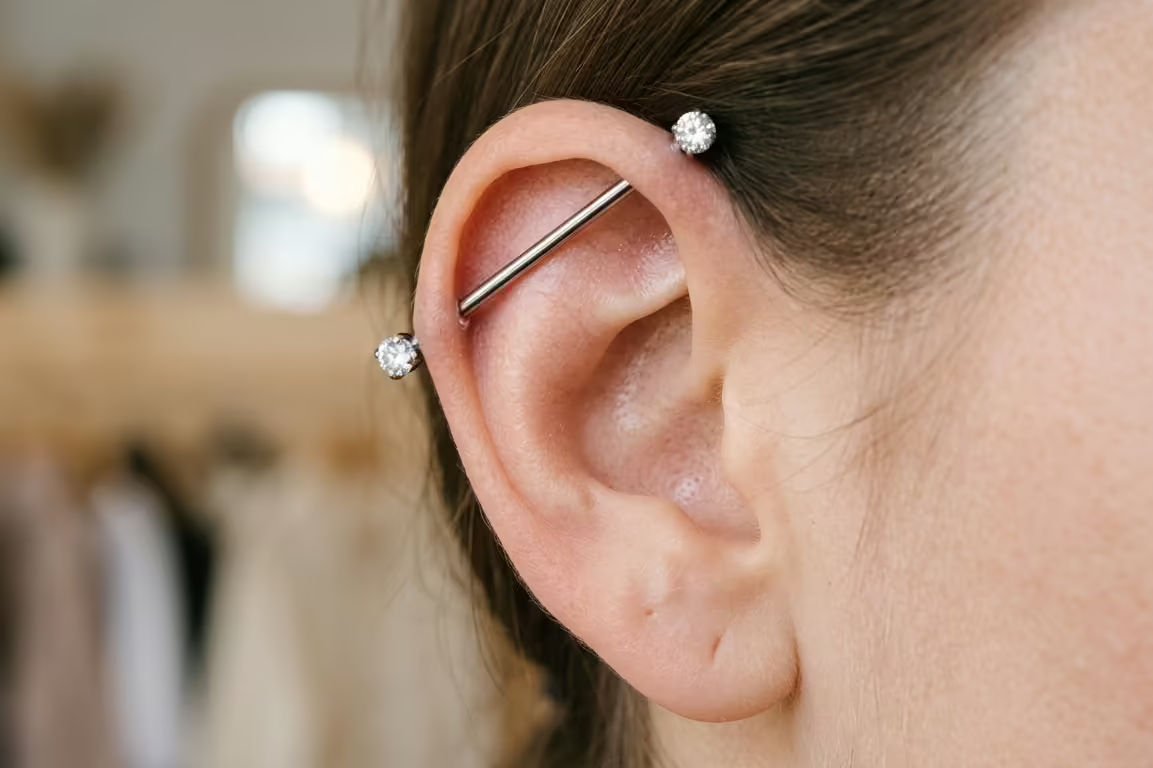
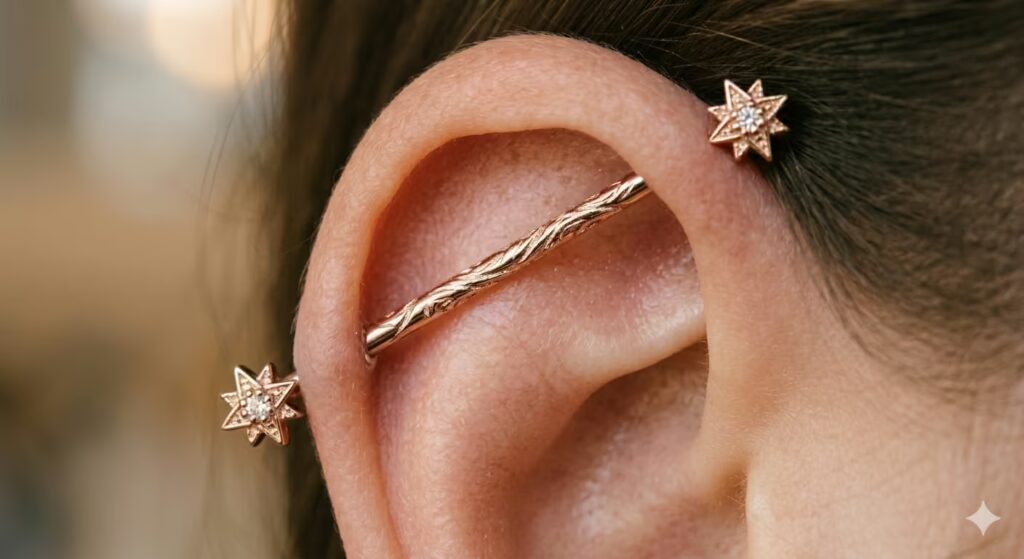
An industrial piercing — sometimes called a scaffold piercing or bar piercing — consists of two separate holes in the upper ear cartilage connected by a single straight barbell. The standard placement goes through the helix (the outer upper cartilage) and forward helix (the inner upper cartilage near the head), though variations exist depending on ear anatomy.
That connected barbell is what makes it visually distinctive. Instead of two independent piercings sitting side by side, you get one continuous piece of jewelry that spans the width of the upper ear. The effect is architectural and striking — like a bridge across your ear.
It is also what makes it more complex than most ear piercings. The piercer is not just placing one hole accurately — they are placing two holes that must align perfectly for the barbell to sit straight. If the angle is even slightly off, the jewelry will pull, and the piercing will have ongoing healing problems. This precision requirement is a major reason a good industrial piercing costs more than a simple lobe or helix.
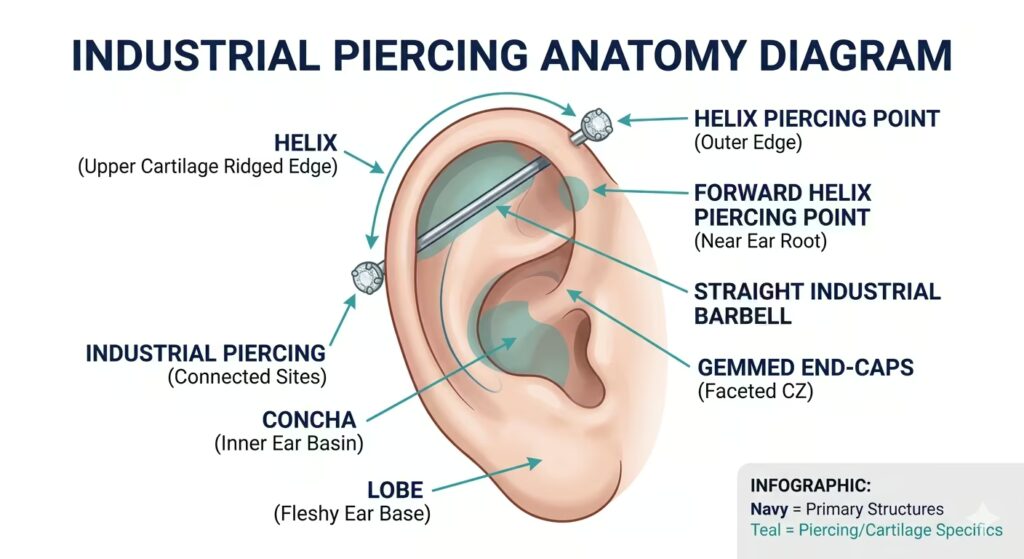
The standard industrial barbell is 14 gauge (1.6mm thickness) and ranges from 32mm to 38mm in length, depending on the anatomy of the ear. Getting the length right matters — too short and the bar puts pressure on the piercings, causing irritation bumps; too long and it catches on everything. A good piercer measures carefully before selecting the barbell.
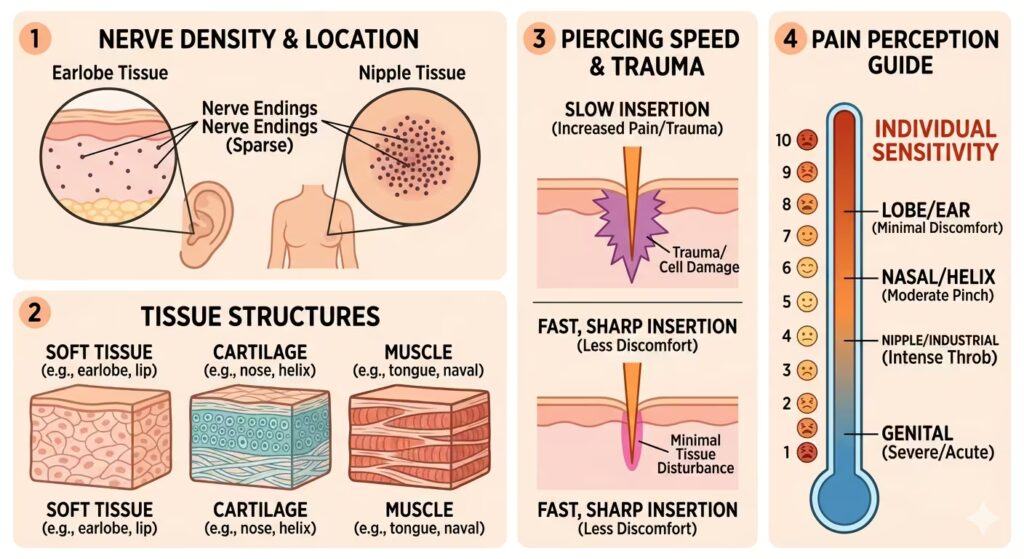
If you are curious about how the industry fits into the broader world of ear-piercing history and culture, our article on types of ear piercings and their pain levels is a great companion read.
How Much Does an Industrial Piercing Cost? The Full Breakdown
Let’s get into the actual numbers. An industrial piercing has several cost components, and understanding each one helps you read a studio’s pricing clearly.
The Piercing Service Fee
This is what you pay for the piercer’s time, skill, and the use of the studio’s equipment and sterilisation process. For an industrial piercing, expect to pay $40 to $80 at a reputable studio. Budget studios may charge less; high-end studios in major cities may charge more.
Some studios quote a single all-in price that includes basic jewelry. Others quote the service fee and jewelry separately. Always ask which one you are looking at before comparing prices between studios.
The Jewelry
This is where costs can vary most dramatically — and where the temptation to cut corners is strongest. Resist it.
Industrial barbells come in a wide range of materials, and the material matters enormously for healing. Here’s what you need to know about your options:
| Material | Price Range | Pros | Cons |
| Implant-grade Titanium | $25–$60 | Lightweight, hypoallergenic, anodised colours available | Higher upfront cost |
| Implant-grade Steel | $15–$35 | Affordable, widely available, good for most people | Contains nickel — not ideal for sensitive skin |
| Solid 14k–18k Gold | $60–$150+ | Premium look, fully hypoallergenic, very durable | Highest cost, heavier than titanium |
| Acrylic / Mystery Metal | $5–$15 | Very cheap | Not body-safe. Avoid entirely for new piercings. |
For a fresh industrial piercing, implant-grade titanium is the gold standard recommendation from most professional piercers. It is lightweight — which matters because the industrial barbell is longer than most jewelry — and it is completely hypoallergenic. It also comes in anodised colours, so you can have a black, blue, purple, or rose gold barbell without any coatings that could cause problems during healing.
❝ Never start a fresh cartilage piercing with mystery metal, acrylic, or cheap steel from a fashion accessory brand. Your body will tell you — loudly and painfully — that it disagrees with the choice.
Aftercare Products
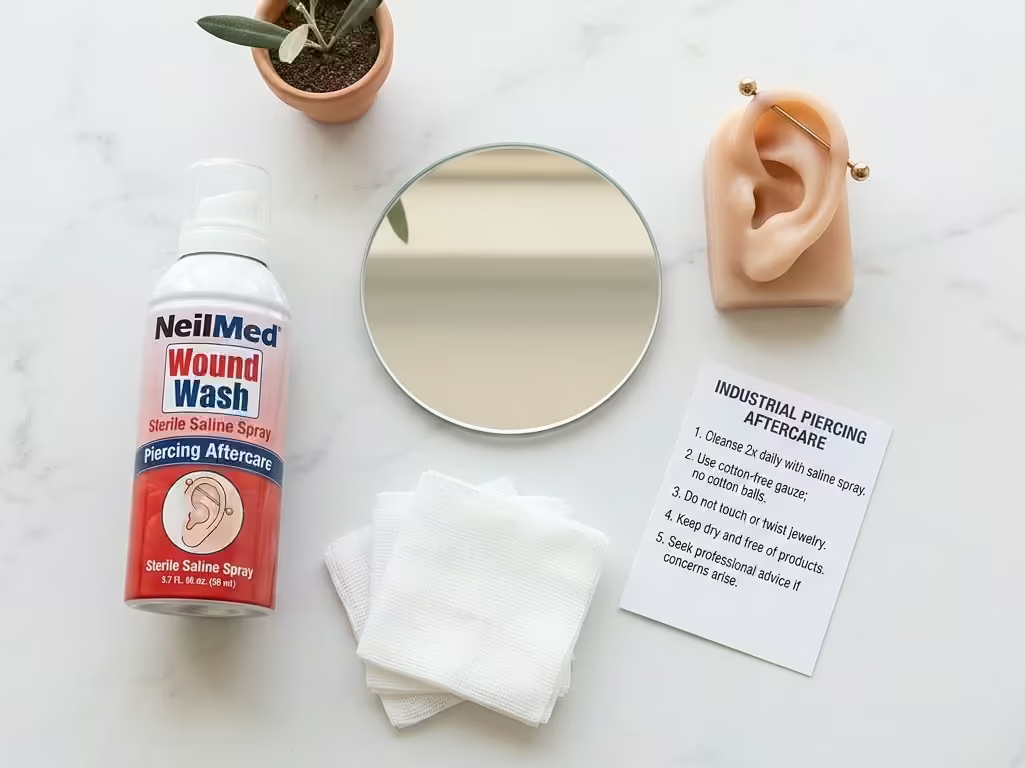
Most reputable studios will recommend — and often sell — a sterile saline wound wash spray for aftercare. Brands like NeilMed Wound Wash or similar sterile saline sprays are the current professional standard. Budget $8 to $15 for a can that will last you through the early healing period. You do not need expensive branded aftercare kits — plain sterile saline is genuinely all you need.
The Tip
Tipping your piercer is standard practice and genuinely appreciated. A good piercer for an industrial is doing skilled, precise work. A tip of $10 to $20 is appropriate and goes a long way in building a good relationship with a studio you plan to return to.
Total Cost Summary
| Cost Component | Typical Range |
| Piercing service fee | $40–$80 |
| Implant-grade titanium barbell | $25–$60 |
| Sterile saline aftercare spray | $8–$15 |
| Tip (recommended) | $10–$20 |
| Total (realistic all-in) | $83–$175 |
Industrial Piercing Prices by Country
Prices vary significantly depending on where you live. Here is a realistic snapshot of what you can expect to pay for a well-done industrial piercing across major markets.
| Country | Budget Studio | Reputable Studio |
| United States | $50–$70 | $80–$130 |
| Canada | CAD 55–75 | CAD 85–140 |
| United Kingdom | £35–£55 | £65–£100 |
| Australia | AUD 60–85 | AUD 100–160 |
| Kenya / East Africa | KES 1,500–3,000 | KES 3,500–7,000 |
Within any country, city-centre studios in major urban areas typically charge more than suburban or smaller-town studios. This reflects higher rent, higher operating costs, and often — though not always — higher demand for experienced piercers. That said, location alone is not a reliable indicator of quality. A highly skilled piercer working in a small town may do better work than an average piercer in a trendy city studio.
What Actually Drives the Price Up — and Down
Understanding what makes one studio charge $60 and another $130 for the same piercing helps you evaluate whether a price is fair or a red flag.
What justifies a higher price
A piercer’s training and experience are the single biggest factor in quality. Industrial piercings require precise angle calculation and perfect spatial alignment across two separate holes. An experienced piercer who has done hundreds of industrials has developed an eye and technique for this that a newer piercer simply does not have. You are paying for that accumulated skill.
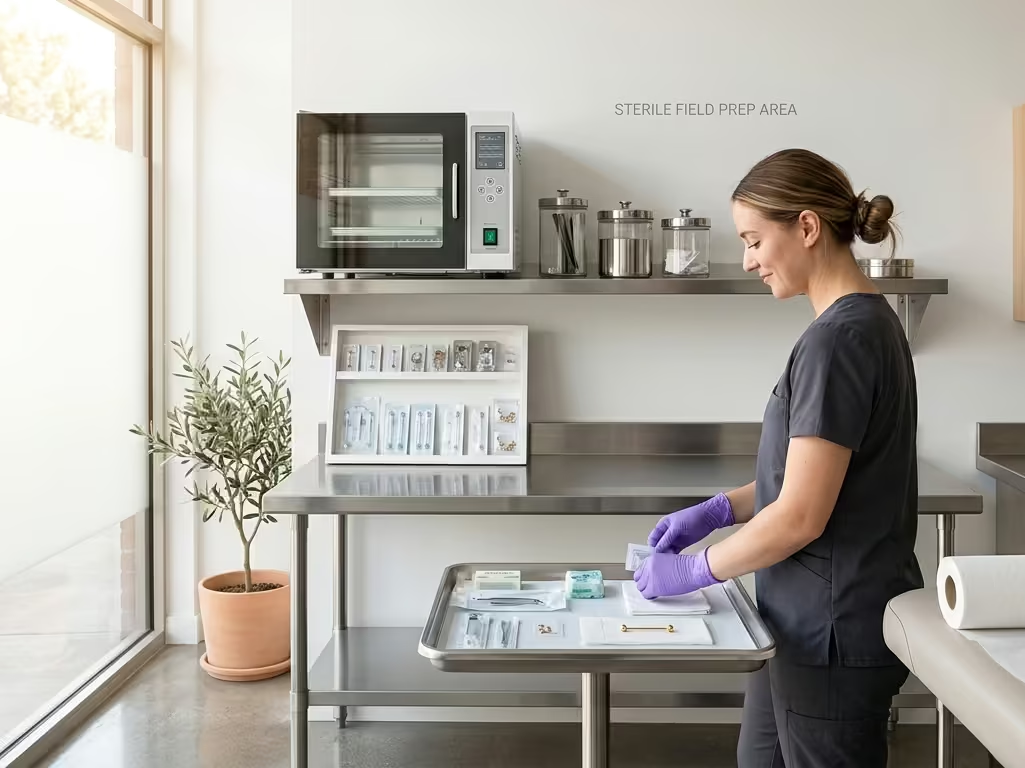
Studio overhead is real. A studio that maintains an autoclave, uses single-use sterile needles, operates in a properly ventilated space with medical-grade surfaces, and carries appropriate public health licensing has higher costs than one that cuts corners on any of these. Those costs show up in the price — and they should.
Jewelry quality, as covered above, makes a significant difference to both the healing process and the long-term look of your piercing. Studios that stock implant-grade titanium and solid gold from reputable suppliers are charging you for materials that are genuinely better for your body.
Red flags that explain a suspiciously low price
A price under $40 all-in for an industrial piercing is a warning sign. At that price point, something is almost certainly being compromised — whether it’s the quality of the jewelry, the sterilisation process, the piercer’s experience, or some combination of all three.
Using a piercing gun on cartilage is a particularly serious concern. Guns cannot be fully sterilised; they crush tissue rather than puncturing it cleanly, and they are widely banned for cartilage use by professional piercing bodies. Any studio offering cartilage piercings with a gun should be avoided entirely, regardless of price.
❝ If a studio is offering an industrial piercing for $25, including jewelry, the question is not “what a great deal” — it is “what are they cutting corners on?” The answer is rarely reassuring.
The Hidden Costs: Healing and Aftercare Over Time
The upfront cost of an industrial piercing is only part of the financial picture. The industrial is one of the slower-healing piercings available. The average healing timeline is 6 to 12 months, and some people are still completing the healing process at 18 months. That timeline has cost implications worth planning for.
Ongoing aftercare
Sterile saline spray is your main ongoing cost. A can typically last four to six weeks with twice-daily cleaning. Budget for two to three cans over the early healing period, then occasional use as needed. Total cost over the healing period: roughly $20 to $45.
Downsizing the jewelry
This one surprises many first-time industrial piercing owners. The barbell you are pierced with is intentionally slightly longer than your final jewelry will be, to accommodate swelling during the initial healing phase. At around six to eight weeks — once the initial swelling has settled — your piercer will replace it with a shorter bar that fits your healed anatomy correctly.
This downsizing appointment typically costs $15 to $30 for the service plus the cost of the new jewelry. It is not optional — leaving an oversized barbell in for too long can cause the bar to shift and catch, which can irritate and create healing problems. Budget for it from the start.
Irritation bumps and potential complications
Cartilage piercings — and industrials in particular — are more prone to irritation bumps than lobe piercings. These are not infections. They are usually the result of pressure on the piercing (sleeping on it, catching it on clothing or hair), low-quality jewelry, or an incorrectly sized barbell. Most resolve on their own with improved aftercare and downsizing of jewelry.
If you develop a genuine infection — which is less common but does happen — you may need to see a GP and take a course of antibiotics. This is another reason why choosing a clean, professional studio with sterile equipment reduces your total cost over time, not just your risk.
How to Choose the Right Studio for an Industrial Piercing
The industrial is not a piercing to shop around purely on price. Here is what to actually look for when choosing a studio.
Check their portfolio specifically for industrials
Most professional piercers maintain portfolios on Instagram or their website. Look for healed industrial piercings — not just freshly done ones — because healed results tell you how well the placement and alignment held up over time. A straight, well-healed industrial with no visible irritation is a much better indicator of skill than a beautifully photographed fresh piercing.
Ask about their jewelry suppliers
A reputable studio can tell you exactly who makes their jewelry and confirm that it is implant-grade. Brands like BVLA, Anatometal, Industrial Strength, and NeoMetal are widely respected in the professional piercing community. If a studio cannot tell you who supplies their jewelry, that is a concern.
Look for APP membership or equivalent
The Association of Professional Piercers (APP) maintains standards for jewelry quality, sterilization, and piercer training. APP-member studios have agreed to follow these standards. It is not the only indicator of quality, but membership is a useful baseline check when evaluating a studio you have not visited before.
Visit before you commit
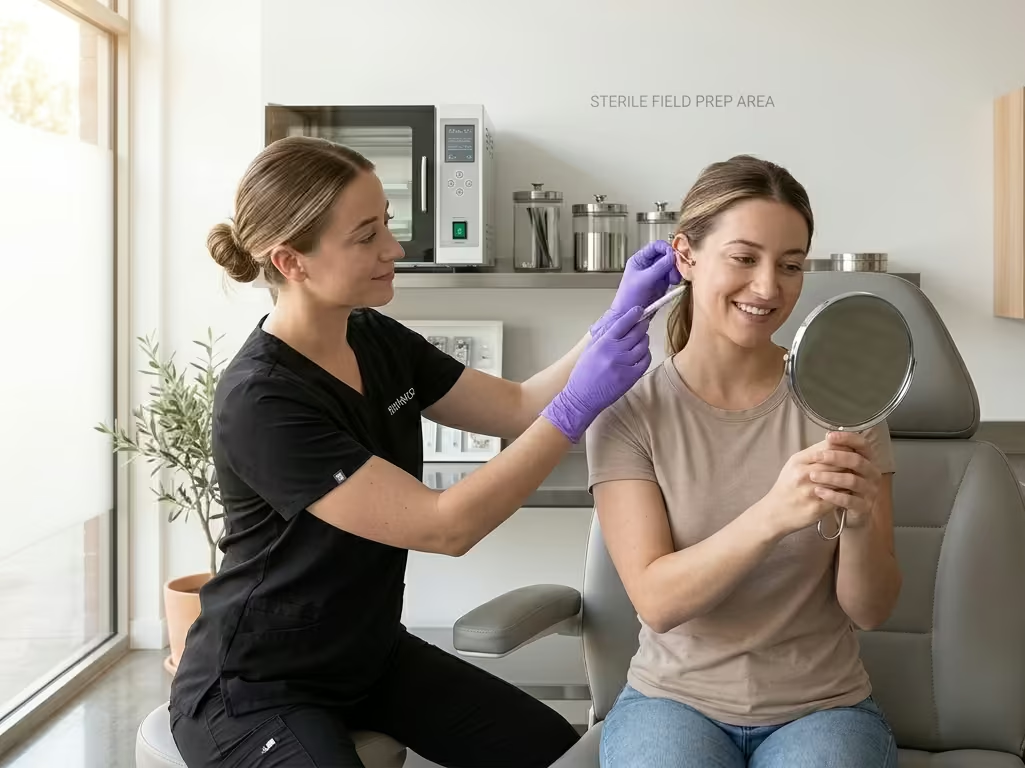
A good studio will welcome you coming in to look around, ask questions, and meet the piercer before booking. The space should be visibly clean. Needles should be single-use and individually packaged. The autoclave should be present and in use. If a studio makes you feel like you are being rushed into a decision or discourages questions, that tells you something important.
Is an Industrial Piercing Worth the Cost?
That depends on what you are looking for. If you want a bold, distinctive ear piercing that commands attention and looks genuinely architectural, the industrial delivers that in a way that few other piercings can. It is a statement piece in the truest sense.
The tradeoffs are real, though. It heals slowly. It requires consistent, patient aftercare for the better part of a year. It is sensitive to pressure and movement during healing, so adjust how you sleep and be careful with headphones, hats, and hair. And if the placement is off — even slightly — it will make its displeasure known throughout the entire healing process.
The investment in a properly done industrial piercing by an experienced piercer with quality jewelry is, in most cases, genuinely worth it. The investment in a cheap industrial done quickly at a low-cost studio, on the other hand, has a real chance of becoming a much more expensive problem.
❝ The industrial piercing rewards patience — patience in choosing the right piercer, patience in the healing process, and patience in waiting for the result you wanted when you decided to get it.
If you are researching ear piercing options, our article on the types of ear piercings and their pain levels covers the full spectrum of placements and what to expect from each. And if you want to understand the deeper history and culture behind ear piercing, our piece on the evolution of ear piercings from ancient Egypt to modern trends is a fascinating read.
Frequently Asked Questions
Can I negotiate the price at a piercing studio?
Not really, and it is not considered appropriate to try. Piercing studios set their prices based on real costs — jewelry, sterilisation, time, and skill. Asking for a discount signals that you are prioritising cost over quality, which is not a great way to start a relationship with someone who is about to put a needle through your ear. If a studio is outside your budget, find one that fits it rather than trying to haggle.
Why is my industrial piercing quote more expensive than a friend’s?
Several things could explain this. Your friend may have gone to a different type of studio, in a different location, at a different time. The jewelry selection may have been different. Prices have also increased across the piercing industry over the past few years, reflecting inflation in material and operating costs. A quote from two or three years ago is not a reliable comparison point for today’s pricing.
What happens if I get it done cheaply and it goes wrong?
The most common outcome of a poorly done industrial is a prolonged healing nightmare — months of irritation, bumps, soreness, and repeated setbacks that require multiple return visits and possibly new jewelry. In some cases, the piercing needs to be removed entirely and allowed to close before being redone correctly. When you add up the cost of all those follow-up visits plus the emotional toll of a frustrating healing experience, the “cheap” industrial often ends up costing more than a properly done one would have.
How much does it cost to change industrial piercing jewelry later?
Once your industrial is fully healed — which takes at least six months and often longer — changing the jewelry is relatively straightforward. A professional jewelry change at a studio typically costs $10 to $20 for the service, plus the cost of new jewelry if you are upgrading. Healed industrials accept a wider range of jewelry options, including custom decorative barbells, so this is something to look forward to once the hard work of healing is done.
Final Thoughts: Spend Smart, Not Cheap
Getting an industrial piercing is an exciting decision. It is a genuinely impressive piece of body art that, when done well, looks incredible for years. The key word there is “done well.”
The total realistic cost for a properly done industrial piercing — experienced piercer, quality implant-grade titanium, sterile aftercare supplies, appropriate tip, and a downsize appointment — sits between $100 and $175 in most markets. That is not an insignificant amount of money. But it is money spent on something that will be part of your body and your appearance for as long as you want it there.
Spend it on the right studio, with the right piercer, using the right materials. Your future self — the one with a beautifully healed, perfectly straight industrial piercing — will be very glad you did.