Types of Lip Piercings: A Complete Guide to Every Style, Placement, and Name
Lip piercings come in more varieties than almost any other category of body piercing. A stud placed at the corner of the upper lip means something entirely different, both visually and culturally, from two rings flanking the lower lip or a single centered piece below it.
Knowing the names matters because each style has its own placement, healing timeline, dental considerations, and aesthetic. Getting the wrong information about which is which before you book an appointment leads to mismatched expectations and sometimes the wrong piercing entirely.
This guide covers every common lip piercing type with honest detail: where each one sits, what it looks like, how painful it is, how long it takes to heal, and the dental risks. Whether you are choosing your first lip piercing or planning a combination, this is the reference you need.
❝ Lip piercings are some of the most varied and expressive facial piercings available. But every one of them involves proximity to teeth and gums, which means dental health is a consideration for all of them.
Understanding Lip Piercing Anatomy
Before looking at individual types, it helps to understand the anatomy of the lip area and why placement matters so much for lip piercings.
Most lip piercings do not actually go through the lip itself. They go through the skin around the lip, either above the upper lip or below the lower lip. The jewelry sits with one end visible on the outside and a flat disc or ball inside the mouth, resting against the inner tissue and teeth.
A few piercings, such as the vertical labret and the jestrum, go directly through the lip tissue. These have different healing considerations because the lip itself is mucous membrane tissue that is always moist and in constant motion.
All lip piercings share one consideration: the interior component of the jewelry sits in or near the mouth. Saliva, bacteria, food, and drink all come into contact with the healing piercing from the inside. This makes oral hygiene and internal aftercare just as important as external cleaning. For the full picture on oral piercing aftercare, our guide to cyber bites piercing: everything you need to know covers the dual internal and external cleaning routine in detail.
The Full Comparison Table
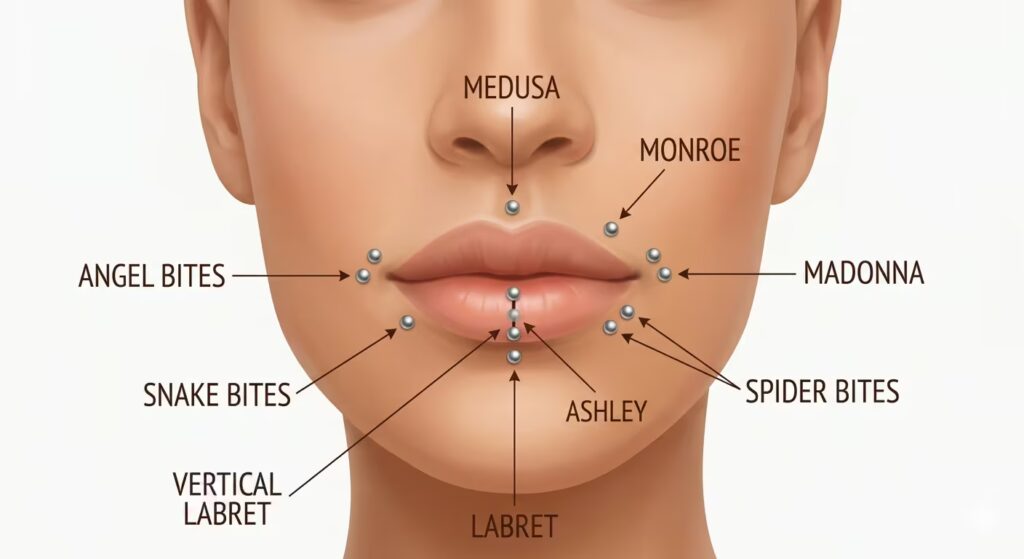
Here is every common lip piercing type at a glance, with the key facts for each one, before we go into individual detail.
| Name | Placement | Pain (1-10) | Heal Time | Key Consideration |
| Labret | Center below the lower lip | 4–5 | 3–6 months | Interior disc contacts lower front teeth and gums. |
| Medusa / Philtrum | Center above the upper lip | 4–6 | 3–6 months | Interior disc contacts the upper front teeth and gums. |
| Monroe | Off-center, upper left lip | 4–5 | 3–6 months | Named for Marilyn Monroe’s beauty mark. Subtle and elegant. |
| Madonna | Off-center, upper right lip | 4–5 | 3–6 months | Mirror image of Monroe. Named for Madonna’s beauty mark. |
| Vertical Labret | Through the lower lip center | 5–7 | 6–10 weeks | Both ends are visible. Does not contact teeth. Low dental risk. |
| Ashley | Through the lower lip center, a single stud | 5–7 | 8–12 weeks | Only front stud visible. Goes through the lip itself. |
| Jestrum | Through the upper lip center | 6–8 | 8–12 weeks | Curved barbell. Both ends are visible. Higher rejection risk. |
| Snake Bites | Both sides of the lower lip | 4–5 each | 3–6 months | Two separate piercings. Double the healing and dental management. |
| Spider Bites | Two piercings on one side, lower | 4–5 each | 3–6 months | Edgier asymmetric look. Double jewelry in a small area. |
| Angel Bites | Both sides of the upper lip | 4–5 each | 3–6 months | Monroe plus Madonna together. Symmetrical upper lip look. |
| Dahlia | Both corners of the mouth | 5–7 each | 8–12 weeks | Placed at the corners. Dramatic effect. Requires precise placement. |
| Cyber Bites | Medusa above and labret below | 4–6 each | 3–6 months | Vertical symmetry frames the whole mouth. Two piercings. |
| Canine Bites | Four piercings: two upper, two lower | 4–5 each | 3–6 months | Angel bites plus snake bites together. Bold full lip look. |
| Dolphin Bites | Two close together below the lower lip center | 4–5 each | 3–6 months | Similar to spider bites, but placed in the center rather than on one side. |
| Shark Bites | Four piercings on the lower lip (two on each side) | 4–5 each | 3–6 months | Snake bites doubled up. Intense and bold. High dental management. |
Individual Lip Piercing Guides
Labret piercing
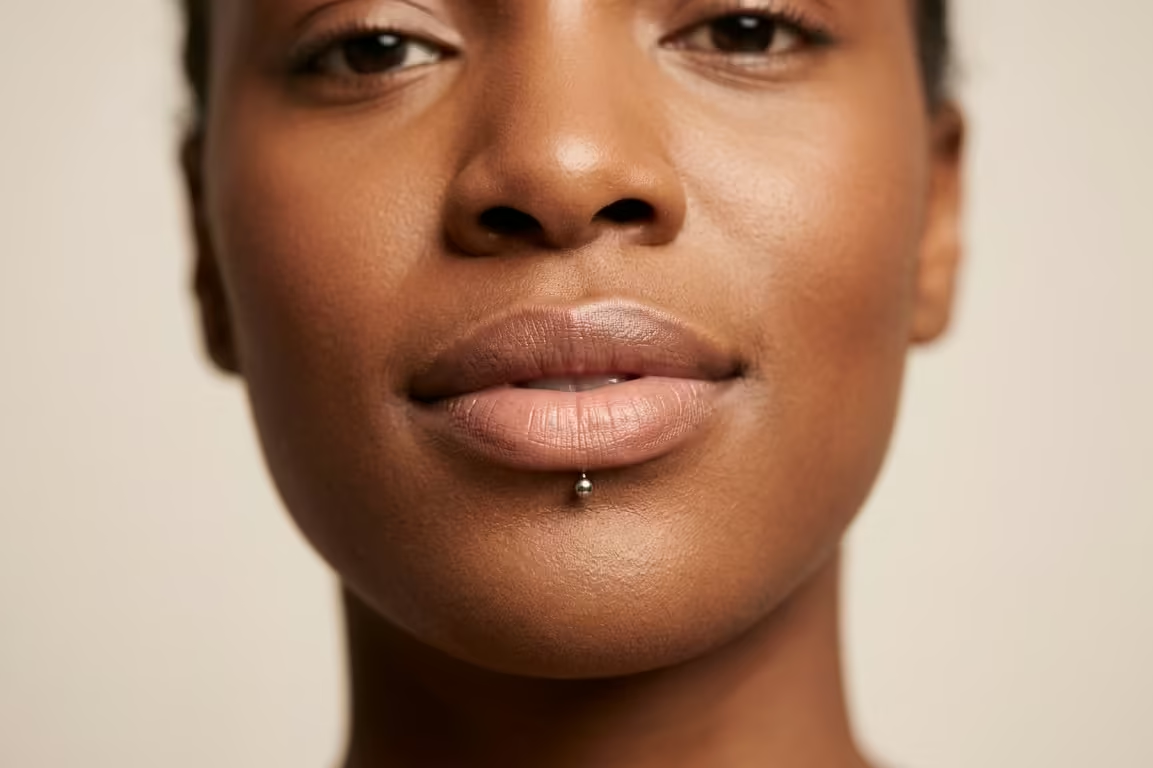
The labret is the most common lip piercing and one of the most versatile facial piercings available. It sits centered below the lower lip, directly above the chin. A flat-back labret stud is used with the flat disc inside the mouth and the decorative end visible on the outside.
The labret is the lower component of a cyber bites piercing, which adds a Medusa above the upper lip to create a vertically symmetrical look. It is also the starting point for snake bites and several other combination styles.
Dental consideration: the interior disc sits against the gum line at the back of the lower front teeth. Correct jewelry sizing after the downsizing appointment, and choosing a bioplast or smaller disc, significantly reduces enamel and gum contact.
Medusa / Philtrum piercing
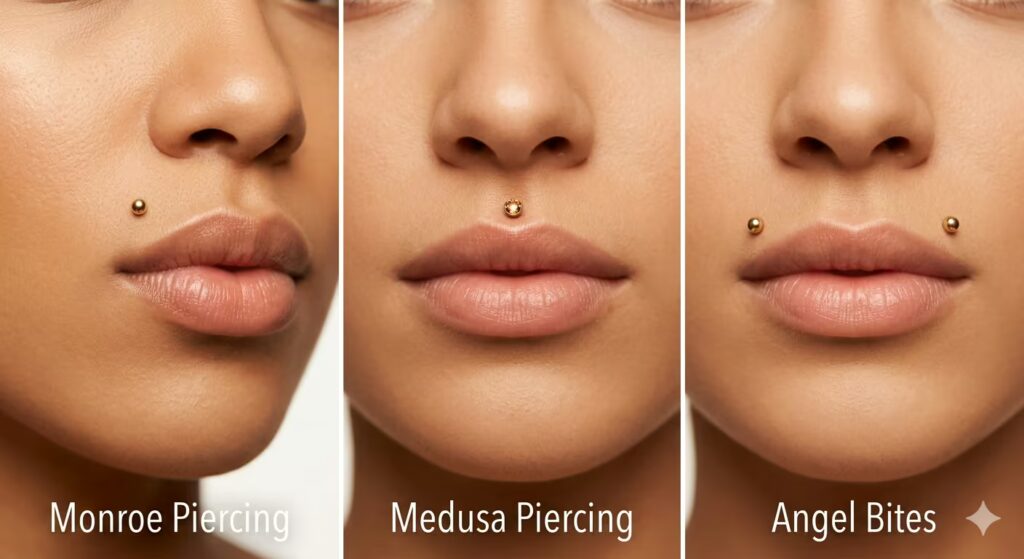
The Medusa sits centered above the upper lip in the philtrum groove. It is named after the Greek mythological figure, and both “Medusa” and “philtrum piercing” refer to the same placement.
It is one of the most striking single facial piercings available because of its position on the symmetry axis of the face. A full guide to the Medusa piercing, including the mythology behind the name, healing, costs, and dental considerations, is in our dedicated article on Medusa piercing: everything you need to know.
Monroe and Madonna piercings
The Monroe sits on the upper-left side of the lip, mimicking Marilyn Monroe’s famous beauty mark. The Madonna sits on the upper right side, inspired by the Madonna’s beauty mark. Both are placed at roughly the same height and distance from the center, just on opposite sides.
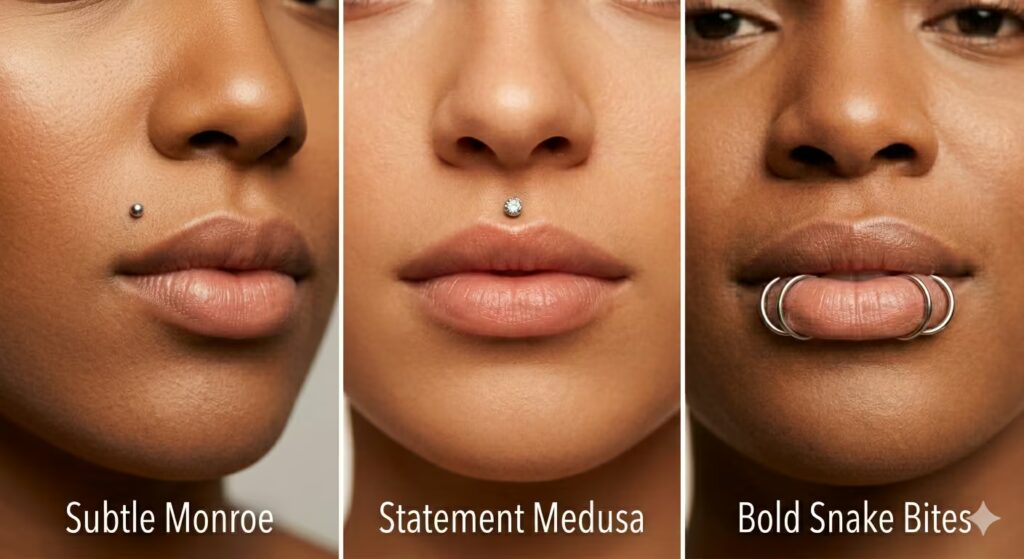
Both are subtle piercings when worn with a small stud. They add a hint of glamour and vintage beauty mark aesthetic without the boldness of a centered philtrum placement. Many people choose one or the other based on their preference, or get both as angel bites for a symmetrical look.
Vertical labret piercing
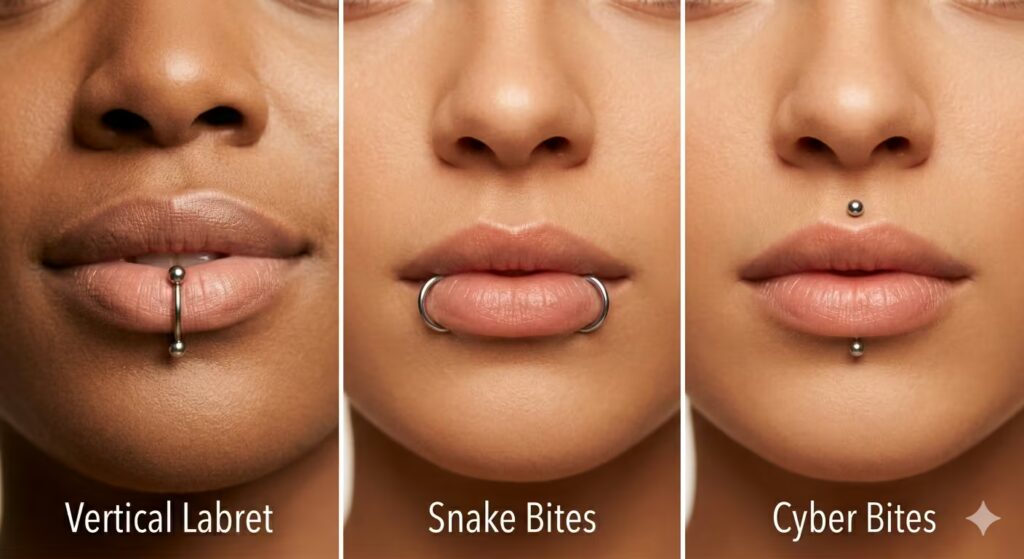
The vertical labret is a curved barbell that enters through the outside of the lower lip and exits through the top of the lip, so both ends of the jewelry are visible. Neither end enters the mouth, so it has essentially no dental contact and one of the lowest dental risk profiles among lip piercings.
It heals faster than most lip piercings because the curved barbell passes through the lip itself, which is well-vascularised tissue. However, it is through the lip directly, which means it is in constant contact with food, drink, and facial movement. Aftercare is particularly important for this one.
The vertical labret creates a distinctive double-stud look on the lower lip, making it visually unique. It does not pair with a standard labret directly below the lip but works well alongside other facial piercings.
Ashley piercing
The Ashley is a single piercing that goes directly through the center of the lower lip with only the front stud visible. The back of the jewelry sits inside the mouth against the inner lip tissue rather than the teeth.
It creates the cleanest, most minimal lip piercing look possible. One small stud right at the center of the lower lip, nothing else visible. The trade-off is that it heals through the mucous membrane of the lip itself, which is challenging because that tissue is always moist, always moving, and in regular contact with food and drink.
The Ashley has a higher migration risk than standard lip piercings because of how much the lip moves. An experienced piercer who has done many Ashley piercings specifically is strongly recommended for this one.
Jestrum piercing
The jestrum is a curved barbell version of the Medusa. It enters through the philtrum above the upper lip and exits through the upper lip itself, with both curved ends visible: one above and one through the lip.
The visual effect is distinctive — a double-ended piece that draws attention to the Cupid’s bow of the upper lip. It heals through lip tissue, which makes it faster to initially heal but more demanding to maintain. It also has a higher risk of rejection than the standard Medusa because of the movement of the lip tissue it passes through.
Snake bites piercing
Snake bites are two piercings placed symmetrically on either side of the lower lip, mimicking the placement of snake fangs. They are one of the most popular lip piercing combinations and can be worn with rings, studs, or a mix of both.
Because snake bites are two separate piercings, they involve twice the healing demands, twice the dental contact management, and twice the aftercare. Getting both done in the same session is common, but it means managing two simultaneous oral piercings throughout the healing period.
The aesthetic payoff is significant. When both piercings are well-healed and styled with matched jewelry, snake bites create a bold, symmetrical lower-lip frame that is one of the most recognisable lip-piercing looks.
Spider bites piercing
Spider bites are two piercings placed close together on one side of the lower lip. Rather than the symmetrical placement of snake bites, spider bites create an asymmetric look that many people find edgier and more distinctive.
The close placement of the two piercings means they need to be spaced precisely to avoid tissue crowding. Too close and the interior discs overlap, creating constant pressure. An experienced piercer is particularly important for spider bites to ensure the spacing is correct.
Angel bites piercing
Angel bites are the upper lip equivalent of snake bites: two piercings symmetrically placed on either side of the upper lip, combining a Monroe on the left with a Madonna on the right.
They create a soft, symmetrical upper lip frame that many people describe as more feminine in appearance than the bolder lower lip combinations. Worn with small studs, they are relatively subtle. Worn with rings, they become more prominent.
Dahlia piercing
Dahlia piercings are placed at the corners of the mouth, at the exact points where the upper and lower lips meet. This is a technically demanding placement that requires a piercer with specific experience in corner-of-mouth piercings.
The visual effect is dramatic — the two studs at the corners of the mouth create the illusion of an extended or widened smile. Healing is more challenging than most lip piercings because the corners of the mouth experience significant tension and movement during eating, speaking, and facial expressions.
Cyber bites piercing
Cyber bites combine a Medusa above the upper lip with a labret below the lower lip. The result is a vertical axis of two piercings that frames the entire mouth symmetrically.
Our dedicated guide to cyber bites piercing: everything you need to know covers the full details, including dental risk, the dual aftercare routine, whether to get both done at once or separately, and jewelry options at every stage.
Canine bites, dolphin bites, and shark bites
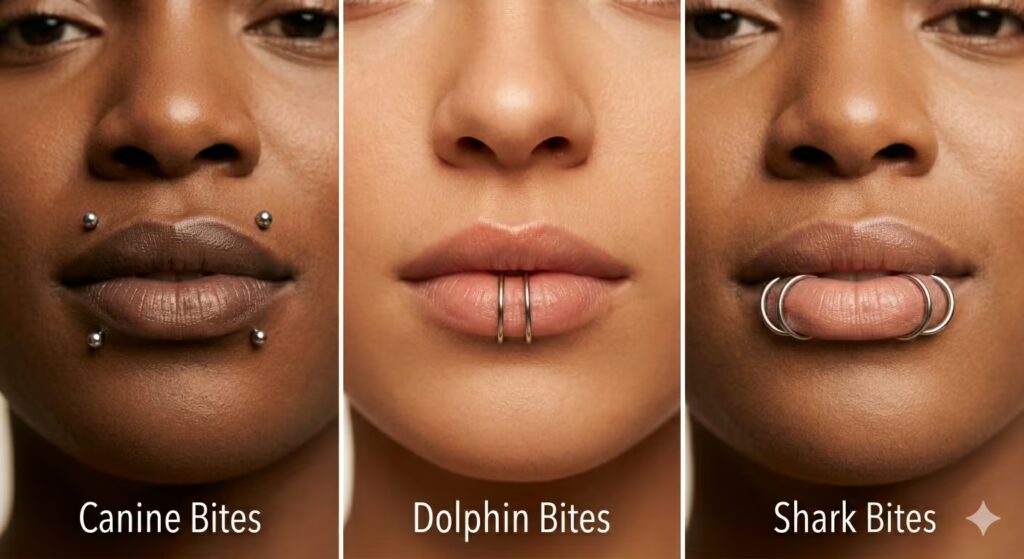
These three are the more complex multiple-piercing combinations. Canine bites combine angel bites and snake bites for four piercings in total across both lips. Dolphin bites place two piercings close together below the center of the lower lip. Shark bites double the snake bites with four piercings on the lower lip, two on each side.
All three involve significant management of dental contact across multiple interdental disc positions. They are best built over time rather than done all at once, allowing each individual piercing to heal properly before the next is added.
Dental Risk: The Consideration Every Lip Piercing Carries
Every lip piercing with a labret stud has an internal disc that sits against the teeth and gum line. The dental risk is real and worth understanding before choosing any lip piercing style.
Enamel wear happens when the hard metal disc repeatedly contacts the backs of the teeth. Accumulated over months and years, this causes gradual erosion that cannot be reversed. Gum recession can occur when the disc presses against the gum tissue, exposing tooth roots and causing sensitivity.
The piercings with the lowest dental risk
The vertical labret has essentially no dental contact because neither end enters the mouth. The Ashley and jestrum piercings, which go through the lip itself, contact the inner lip tissue rather than directly against teeth in the same way a labret disc does.
Managing dental risk for standard lip piercings
Jewelry sizing is the most important protective factor. Getting the stud downsized to the correct post length, six to eight weeks after the initial swelling settles, significantly reduces disc movement and contact pressure.
Bioplast or PTFE disc backs are softer than metal and reduce enamel abrasion upon contact. Many experienced piercers recommend these specifically for long-term wearers of lip piercings.
Tell your dentist about any lip piercings. Regular dental monitoring for signs of enamel wear and early gum recession is the most effective long-term protection strategy.
❝ The dental risk from lip piercings is real and manageable, not a reason to avoid them. The key is the right jewelry size, the right disc material, and regular dental check-ups throughout long-term wear.
Aftercare for Lip Piercings
All lip piercings require both external and internal cleaning because the jewelry sits in contact with both the outside of the face and the inside of the mouth.
External cleaning
Clean the exterior entry point twice daily with sterile saline wound wash. Spray onto the piercing, leave for thirty seconds, then rinse gently. Avoid cotton wool near lip piercings as fibres catch on the jewelry ends.
Internal cleaning
Rinse with alcohol-free mouthwash after every meal. This removes food particles from around the interior disc before they irritate healing tissue. Alcohol-based mouthwash is too harsh for healing oral tissue and delays healing.
Diet during healing
Soft foods in the first two weeks reduce trauma to healing lip tissue. Avoid spicy, acidic, and very hot foods during the early healing phase. Alcohol and smoking significantly increase healing time and infection risk.
The downsize appointment
At six to eight weeks, return to your piercer for a downsizing. The initial longer post is replaced with a shorter one that fits the healed anatomy. This reduces interior disc movement, protects dental health, and makes the stud sit more naturally. It is not optional for any labret-style lip piercing.
Choosing the Right Lip Piercing for You
With so many options, choosing the right lip piercing is partly about aesthetics and partly about practical lifestyle fit. Here are the most useful questions to ask yourself before booking.
How visible do you want it to be?
A single Medusa or labret reads as a deliberate, confident facial statement without being overwhelming. A Monroe or Madonna is noticeably subtler and reads more like a beauty mark. Snake bites, canine bites, and shark bites are significantly bolder and make an unmistakable statement.
How much healing complexity can you manage?
A single labret or Medusa is the lowest-complexity option: one piercing, one aftercare routine, one set of dental considerations. Combination piercings like cyber bites double the demands. Four-piercing combinations, such as canine or shark bites, are a serious commitment that is best built incrementally.
Does your professional or social environment allow it?
Lip piercings are on the face and visible in all normal interactions. Unlike a septum that can be flipped up, lip piercings cannot be easily hidden. Clear retainers reduce visibility but do not make them invisible.
If your workplace allows facial piercings, any style is viable from day one. If there are restrictions, a single subtle stud in a Monroe or Medusa position is the most manageable option, since the jewelry can be switched to a flesh-toned retainer during work hours once the piercing is fully healed.
Frequently Asked Questions
Which lip piercing is the least painful?
The Monroe, Madonna, and standard labret piercings are generally the least painful. They pass through the skin around the lip rather than through the lip tissue itself, which has less nerve density than the lip itself.
The jestrum, Ashley, and Dahlia piercings pass through the lip itself or the corners of the mouth, where tissue is denser and more sensitive, putting them higher on the pain scale for lip piercings.
Which lip piercing heals the fastest?
The vertical labret and Ashley piercings, which pass through the lip tissue, often have faster initial surface healing because the lip has better blood supply than the skin around it. However, the mucous membrane of the lip is more difficult to keep clean.
For standard labret-style piercings, the Medusa, Monroe, Madonna, and labret all have similar healing timelines of three to six months. Good aftercare is the biggest variable in healing speed for all of them.
Can I eat normally after getting a lip piercing?
You can eat from day one, but your diet should adapt for the first two weeks. Soft foods that do not require significant chewing and are not spicy, acidic, or very hot significantly reduce trauma to healing tissue.
Most people are eating close to normally by the end of week two. The main ongoing consideration is rinsing with alcohol-free mouthwash after every meal throughout the healing period.
Which lip piercing does not affect teeth?
The vertical labret has the lowest dental impact because neither end enters the mouth. The Ashley and jestrum contact the inner lip tissue rather than the teeth directly. For labret-style piercings, proper sizing and bioplastic disc backs are the most effective measures for protecting teeth.
What is the most popular lip piercing?
The labret and Medusa are consistently the most popular single lip piercings. Snake bites are the most popular multiple lip piercing combination. Popularity varies by region, fashion trends, and the influence of social media aesthetics at any given time.
Can I get multiple lip piercings at once?
Technically, yes, but most experienced piercers advise getting them one or two at a time. Multiple simultaneous oral piercings mean multiple healing timelines to manage, multiple dietary restrictions, and multiple sources of potential irritation during the most sensitive healing phase.
Getting combination piercings, like cyber bites, at once is a popular choice. Getting all four canine bites at once is significantly more demanding. The better approach for complex combinations is to build them incrementally over time.
Ready to Choose Your Lip Piercing?
Lip piercings offer one of the widest ranges of looks available in facial piercing. From the minimal elegance of a single Monroe stud to the bold statement of shark bites, there is a style for every aesthetic preference and every comfort level with visibility and commitment.
The key decisions are placement, combination, and the dental management plan. Once you have a clear picture of which style suits your face and your life, the next step is to find an experienced piercer with a strong portfolio of healed lip piercings.
Use implant-grade titanium from the start. Get the downsizing done in six to eight weeks. Clean inside and outside consistently. Tell your dentist. Do all of that, and a lip piercing can be one of the most characterful additions to your appearance you will ever make.
For more on individual lip piercing styles, our detailed guides to cyber bites piercing and Medusa piercing: everything you need to know go deep on the two most popular choices. And for a broader view of all body piercing types, our guide to body piercing types with pictures covers the full spectrum.