Every Body Piercings Placement Explained With Pain Levels, Healing Times, and What to Expect
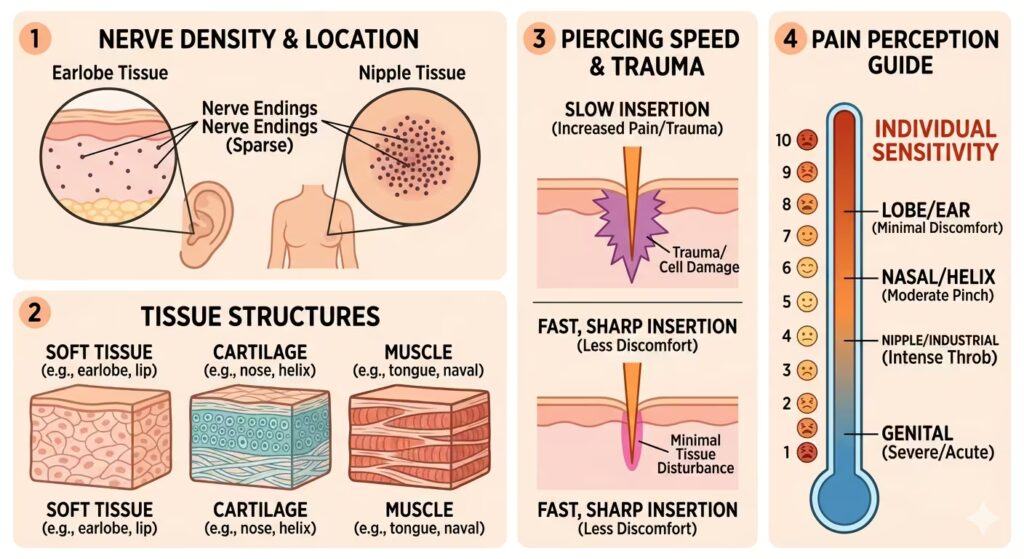
Body piercing goes far beyond the ear. The range of placements available across the face, torso, and body is broader than most people realise before they start researching, and each placement comes with its own specific character: its own pain profile, healing demands, jewellery requirements, and long-term considerations.
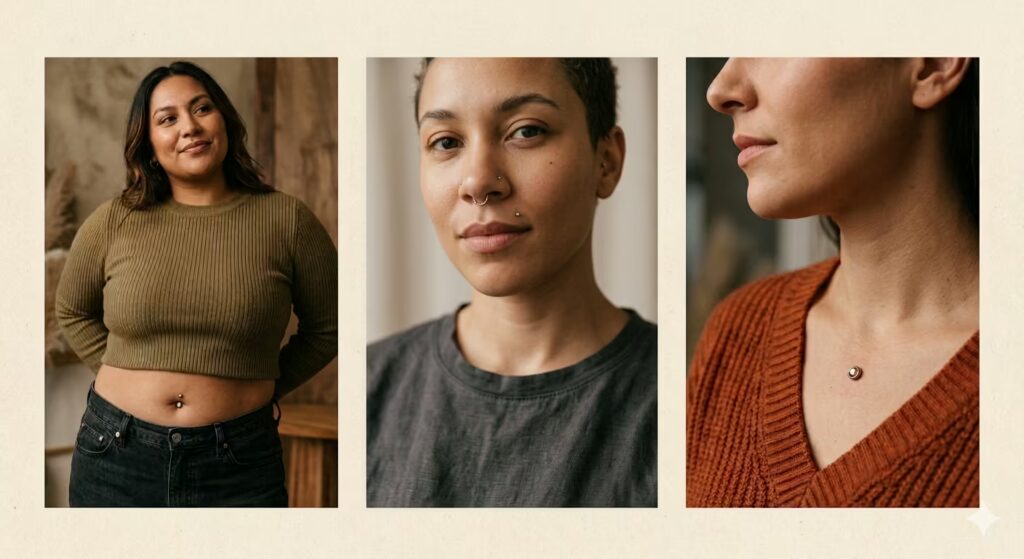
This guide covers every major body piercing category with honest detail. Whether you are curious about a specific placement, comparing options before booking, or building knowledge before your first non-ear piercing, this is the comprehensive reference you need.
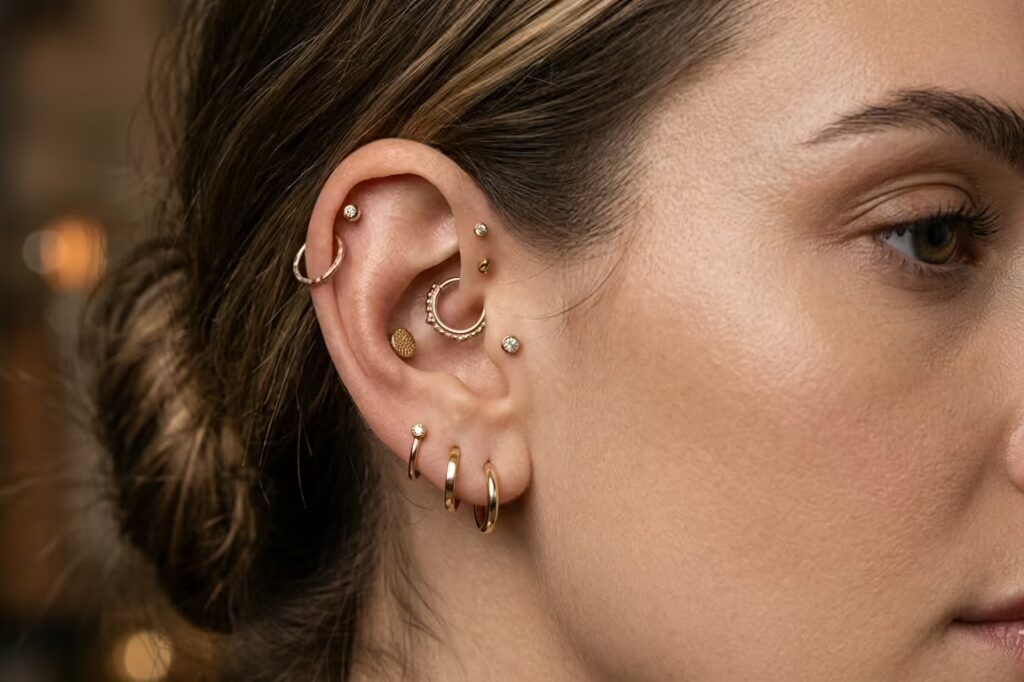
For ear piercings specifically, this guide covers the most common ear placements, but our dedicated article on ear piercing types and pain levels goes into much greater depth on every ear placement, from lobe to industrial. The current guide focuses on everything below the ears.
❝ Every body piercing carries a commitment to healing that goes beyond the procedure itself. Consistent aftercare over months is what separates a great result from a frustrating one.
Complete Body Piercing Reference Table
| Piercing | Category | Pain (1-10) | Heal Time | Key Consideration |
| Nostril | Facial | 3–5 | 4–6 months | Most popular facial piercing. Watery eye reflex is normal. |
| Septum | Facial | 4–6 | 3–6 months | Can flip up to hide. Sweet spot placement is critical. |
| Bridge | Facial | 4–5 | 8–12 weeks | Surface piercing. Higher rejection risk. Lifespan of 1–3 years typical. |
| Eyebrow | Facial | 3–4 | 6–9 months | Surface piercing. Migration and rejection are long-term considerations. |
| Medusa / Philtrum | Facial | 4–6 | 3–6 months | Interior disc contacts upper teeth and gums. Downsize essential. |
| Labret | Facial | 4–5 | 3–6 months | Interior disc contacts lower teeth and gums. Most versatile lip piercing. |
| Cheek / Dimple | Facial | 4–6 | 8–15 months | Long heal. Parotid gland risk. Requires a specialist piercer. |
| Tongue | Oral | 5–6 | 4–8 weeks | Fast healing but serious dental risk. Swelling significant in week 1. |
| Tongue Web / Frenulum | Oral | 3–4 | 6–8 weeks | Under the tongue. Fast heal. Can be hidden easily. |
| Smiley / Upper Frenulum | Oral | 3–5 | 4–6 weeks | Inside the upper lip. Visible when smiling. High rejection risk. |
| Belly Button / Navel | Body | 4–5 | 6–12 months | Very popular. Surface-adjacent. Clothing friction slows healing. |
| Nipple | Body | 7–9 | 9–12 months | High nerve density. Intense but brief. Breastfeeding considerations. |
| Dermal / Microdermal | Body | 4–6 | 1–3 months | Single-point anchor. No exit hole. Rejection risk increases over time. |
| Surface Piercing | Body | 4–6 | 6–12 months | Flat skin areas. Rejection is common long-term. Plan accordingly. |
| Corset / Spine | Body | 5–7 | Varies | Often temporary for events. Multiple surface piercings in a row. |
| Genital (various) | Genital | 5–10 | 4 wks–6 mths | Wide range by type. Some heal very fast. Specialist piercer essential. |
Facial Piercings
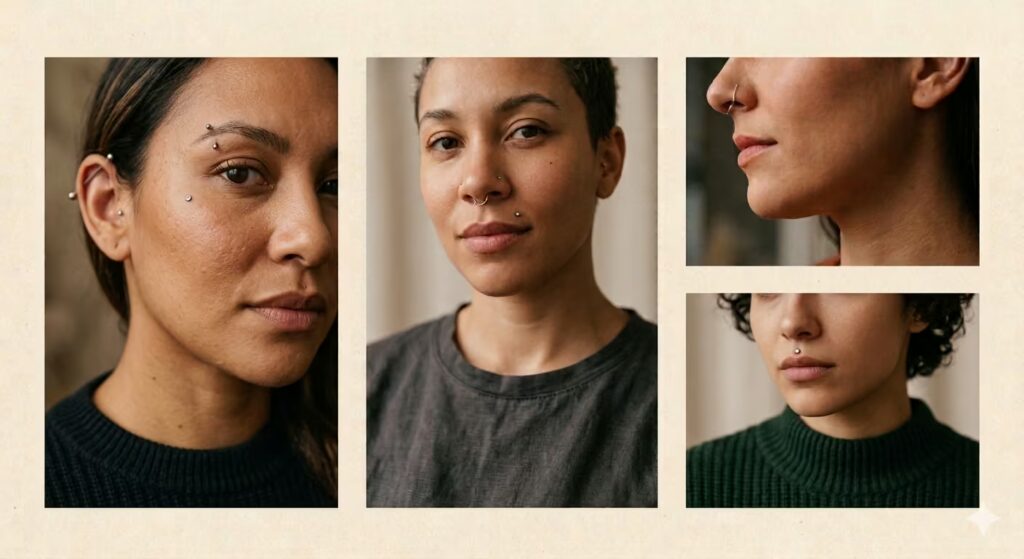
Facial piercings are among the most visible and expressive body modifications available. Because they sit on the face, they are seen in every interaction and cannot be easily hidden during the healing period. That visibility is part of their appeal and commitment.
Nostril piercing
The nostril is the most popular facial piercing worldwide. It sits on the side of the nose and accepts a wide range of jewellery from tiny studs to small rings. The watery eye reflex during the procedure is a nervous system response, not a measure of pain, and settles within a minute.
Our complete guide to types of nostril piercings covers every nose-piercing variation from standard nostril to high nostril, septum, nasallang, and bridge, with full details on each.
Septum piercing
The septum piercing passes through the soft tissue sweet spot below the cartilage wall between the nostrils. When placed correctly, it rates 4 to 6 out of 10 for pain. When placed through cartilage instead, it is significantly more intense.
The septum’s most practical advantage is concealability. A horseshoe barbell flipped upward sits completely inside the nostrils, making the piercing invisible on demand. This makes it one of the most practical facial piercings for people navigating professional environments with piercing restrictions.
For the full septum piercing picture, including anatomy, jewellery, healing, and cost, see our guide to how much is a septum piercing.
Eyebrow piercing
The eyebrow piercing is a surface piercing that passes through the thin skin over the brow ridge. The procedure is one of the less intense facial piercing experiences at 3 to 4 out of 10. The long-term consideration is migration and rejection rather than healing pain.
Surface piercings are positioned in a shallow skin layer with no natural anchor point. Over time, the body gradually pushes the jewellery toward the surface. Most eyebrow piercings last one to three years before the migration becomes significant enough to warrant removal. Going in with that expectation allows you to enjoy the time it lasts rather than feel disappointed when it moves.
Our full eyebrow piercing guide covers rejection signs, migration timelines, and the best jewellery for extending lifespan.
Medusa and labret piercings
The Medusa sits centered above the upper lip in the philtrum groove. The labret sits centered below the lower lip. Both use flat-back labret studs with an interior disc that sits against the teeth and gum line, creating a dental management consideration that is real but manageable with correct jewellery sizing.
Our dedicated guides to the Medusa piercing and to different types of lip piercings cover both in full detail, including dental risk management, healing, and the full range of lip piercing combinations available.
Cheek/dimple piercing
Cheek piercings are placed through the cheek tissue to create the appearance of dimples. They are one of the more complex facial piercings to perform safely because of the proximity to the parotid gland, which produces saliva and runs through the cheek tissue.
Damage to the parotid gland during a cheek piercing can cause persistent swelling and saliva leakage. This is rare in an experienced piercer who understands anatomy, which makes choosing a highly experienced specialist particularly important for this placement.
Cheek piercings also leave visible scars when removed. The scar often resembles the dimple created by the piercing. For many people, this is an acceptable long-term outcome. For others, it is a reason to think carefully before committing.
Oral Piercings
Oral piercings are inside or immediately adjacent to the mouth. They heal in contact with saliva, food, and drink, creating a different aftercare environment from that of skin piercings. They also involve dental and gum health considerations that require ongoing management while the jewellery is worn.
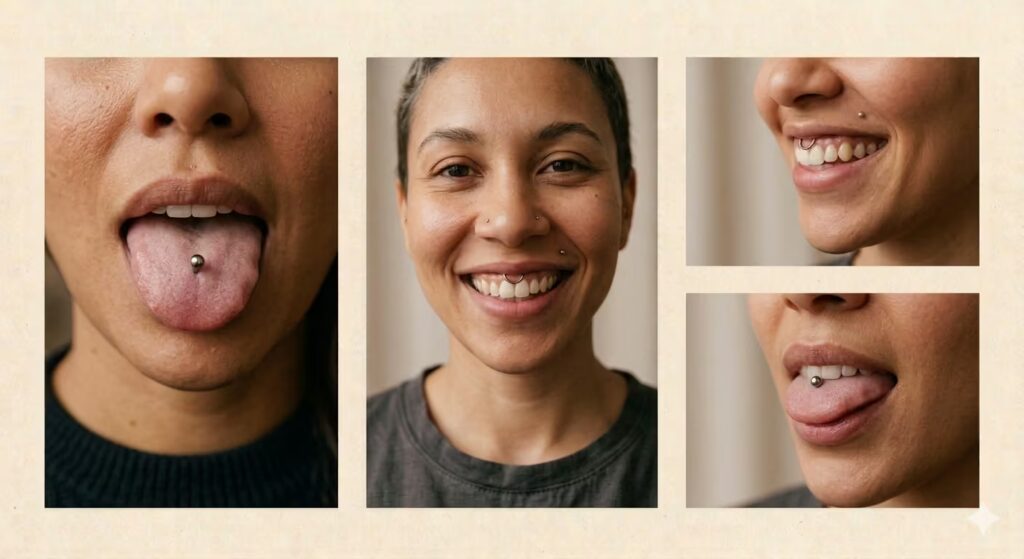
Tongue piercing
The tongue is one of the most popular body piercings and one of the most surprising in terms of pain. Most people rate the procedure at 5 to 6 out of 10, which is lower than they expected given the location. The tongue is a well-vascularised muscle that recovers quickly from piercing.
The week following the piercing is the real challenge. Significant swelling makes speaking and eating genuinely difficult for several days. The swelling subsides by the end of the first week for most people, and the piercing heals within four to eight weeks.
The long-term dental consideration is significant. The barbell ball ends contact the teeth and gums during normal tongue movement. Over the years, this creates enamel chips and gum recession in many tongue piercing wearers. Smaller ball ends, shorter barbells after healing, and regular dental monitoring are the key management strategies. Our full tongue piercing cost and care guide covers this in detail.
Tongue web/frenulum piercing
The tongue web piercing passes through the small piece of tissue that connects the underside of the tongue to the floor of the mouth. It is one of the least painful oral piercings at 3 to 4 out of 10, and heals quickly in six to eight weeks.
It is also almost completely hidden in normal interactions. The jewellery is only visible when the tongue is lifted deliberately. This makes it a popular choice for people who want an oral piercing that does not announce itself.
Not everyone has a prominent enough tongue web to pierce safely. A piercer will assess this in person. The jewellery is usually a small curved barbell or a seamless ring.
Smiley / upper frenulum piercing
The smiley piercing passes through the small fold of tissue that connects the upper lip to the gum above the front teeth. It is visible only when the person smiles broadly, which is the source of its name.
It is a quick-healing piercing that takes four to six weeks, but it carries a high risk of rejection. The tissue it passes through is thin and subject to significant movement with every smile and lip expression. Most smiley piercings migrate within one to two years.
It is also worth noting that the jewellery sits directly against the gum tissue above the front teeth. Gum recession from this contact is a real risk over the long term. Regular dental monitoring is advised for anyone keeping a smiley piercing long-term.
Body Piercings
Body piercings cover the torso, limbs, and any surface of the body beyond the face and ears. They range from the extremely popular belly button to the more specialist dermal anchor and surface piercing categories.
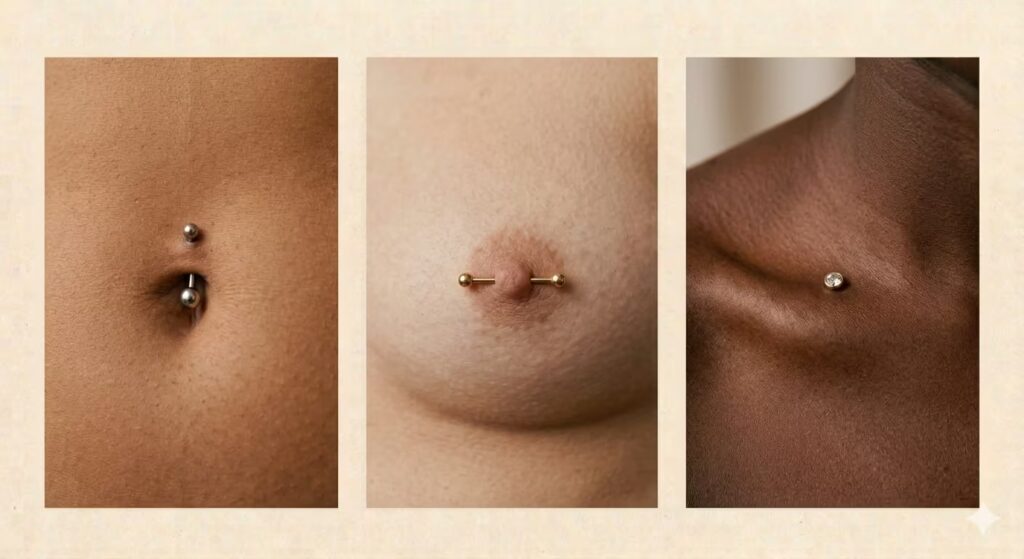
Belly button/navel piercing
The belly button piercing is one of the most popular body piercings worldwide, particularly among younger adults. A curved barbell passes through the skin fold at the top rim of the navel, with one ball end inside and one sitting above on the surface.
It rates 4-5 out of 10 for pain. The healing timeline is longer than most people expect, at six to twelve months. Clothing that sits at the waistband creates friction against the healing piercing throughout the day, which is the primary reason healing is slower than the pain level might suggest.
High-waisted clothing, waistbands, and tight jeans all come into contact with a belly button piercing during healing. Loose, low-waisted clothing or a healing pad between the piercing and the waistband significantly helps. Our complete belly button piercing cost guide covers healing, rejection, and jewellery in full.
Nipple piercing
The nipple piercing passes a straight barbell horizontally through the base of the nipple. It rates 7 to 9 out of 10 for pain due to the very high concentration of nerve endings in the nipple. The procedure is brief but intense.
Healing takes nine to twelve months. During that time, the nipple remains sensitive, and the jewellery should be protected from snagging on clothing. Loose, soft fabrics and a protective disc cover during sport and sleep are practical management tools.
For people who may breastfeed, the nipple piercing requires jewellery removal during feeding. A fully healed nipple piercing that has been in place for at least a year can typically be removed and reinserted between feeds without the channel closing, though this varies by individual. Our full nipple piercing cost and care guide covers the question of breastfeeding in detail.
Dermal / microdermal piercing
A dermal anchor, also called a microdermal, is a single-point piercing. A small flat anchor plate is inserted beneath the skin surface through a small puncture or incision, and a decorative top screws into the anchor above the skin. There is one visible end and no exit hole.
Dermals can be placed almost anywhere on the body where there is a flat skin surface: the collarbone, cheek, back of the neck, temple, chest, hip, and wrist are all popular positions. The healing period is relatively short, at one to three months, but the long-term rejection risk increases over time as the body continues to work at pushing the anchor out.
Removal of a rejected or migrating dermal requires a professional and can leave a small scar. Our full dermal piercing cost and removal guide covers the full lifecycle from placement to removal.
Surface piercings
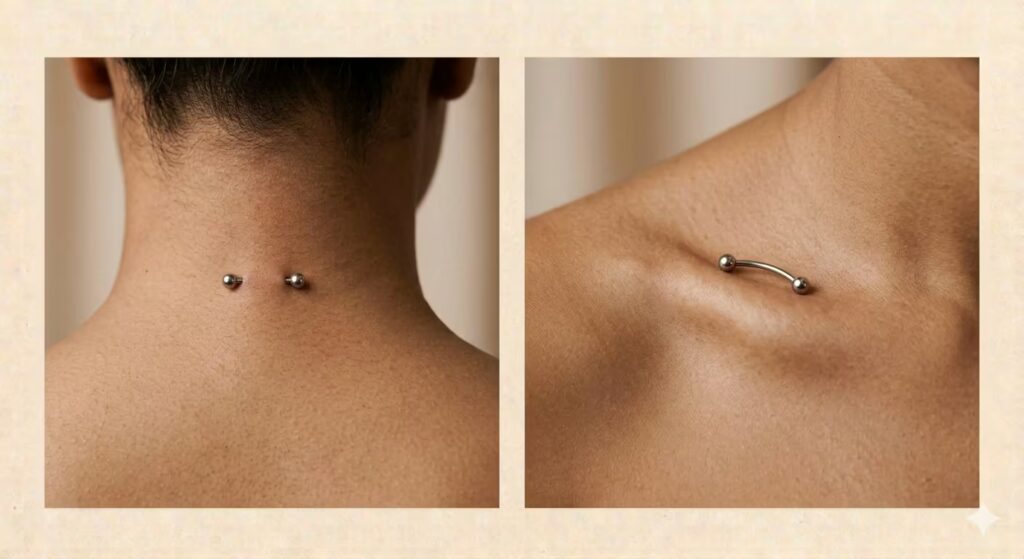
Surface piercings are placed in flat areas of skin where there is no fold or natural anchor. A small, curved or flat surface barbell sits beneath the skin, with both ends visible above the skin. Popular placements include the nape of the neck, sternum, collarbone, wrist, and lower back.
All surface piercings carry an inherent rejection risk. Without a natural anchor point, such as a skin fold or a channel of tissue, the body gradually pushes the jewellery toward the surface over time. This is biology rather than an aftercare failure, though poor aftercare can accelerate the process.
The best approach to surface piercings is to plan for a lifespan rather than permanence. Getting a surface piercing, knowing it may last two to five years with excellent care, allows you to enjoy the time it is there without disappointment when rejection eventually begins.
Clavicle/collarbone piercing
The clavicle piercing is a surface piercing placed on or near the collarbone. It is one of the most visually striking surface piercings because of the prominent bone structure it frames. It is also one of the more challenging surface piercings to heal because the collarbone area experiences significant movement from arm and shoulder activity throughout the day.
Our dedicated guide to clavicle piercing: everything you need to know covers the rejection timeline, how to identify early migration, and how to get the most from this placement before it eventually moves.
Genital Piercings
Genital piercings cover a wide range of placements across the anatomy. They vary enormously in pain level, healing time, and practical considerations depending on the specific placement. Some heal remarkably quickly due to the excellent blood supply in genital tissue. Others are among the most intense piercings available.
What is consistent across all genital piercings is the importance of choosing a piercer with specific experience in genital piercing anatomy. The range of placements and anatomical variations involved makes specialist knowledge significantly more important here than in most other piercing categories.
Genital piercings are legal for consenting adults in most jurisdictions. Studios that perform them operate under the same sterilisation and safety standards as all professional piercers. A reputable studio with a piercer experienced in genital anatomy is the only appropriate setting for these piercings.
❝ Genital piercings are not discussed in detail in this guide out of respect for the breadth of individual anatomies and considerations involved. A consultation with a specialist piercer is the most appropriate source of specific advice for this category.
Surface Piercings vs. Tissue Piercings: What Is the Difference?
Understanding the distinction between surface piercings and tissue piercings helps you make sense of why some piercings last a lifetime, and others eventually reject.
Tissue piercings
A tissue piercing passes through a defined piece of body tissue from one side to the other. The lobe, the cartilage rim, the nostril, the septum sweet spot, the tongue, the nipple, and the belly button skin fold are all examples. The body can form a stable fistula through this tissue because the jewellery provides a clear path along a defined anatomical feature.
Tissue piercings, when well-placed and well-healed, can last indefinitely. A lobe piercing placed at age eighteen can be worn comfortably at age sixty. The body has no biological incentive to reject jewellery sitting in a stable, fully healed fistula through tissue.
Surface piercings
A surface piercing passes through a shallow layer of flat skin where there is no natural channel or tissue fold. The body recognises the jewellery as a foreign object sitting too close to the surface and gradually moves it outward. This is not an aftercare failure. It is a predictable biological response to the placement’s anatomy.
The speed of rejection varies enormously. Good placement with surface-specific jewellery, minimal trauma during healing, and consistent aftercare can significantly extend the lifespan of a surface piercing. But rejection is the eventual outcome for most surface piercings, regardless of care quality.
| Factor | Tissue Piercings | Surface Piercings |
| Rejection risk | Low when well placed and healed | Moderate to high. Increases over time. |
| Lifespan | Indefinite with good care | Typically 1 to 5 years |
| Examples | Lobe, helix, septum, tongue, nipple, navel | Eyebrow, bridge, nape, sternum, wrist |
| Healing mechanism | A fistula forms through defined tissue | Shallow skin channel. The body eventually pushes outward. |
| Best jewellery | Standard labret studs, rings, barbells | Flat surface barbells, low-profile anchors |
How to Choose Your Next Body Piercing
With so many options across the body, the decision-making process benefits from a few honest questions asked before you walk into a studio.
How visible do you want it?
Facial piercings are visible in every interaction. Ear and nose piercings are the most socially accepted. Body piercings like the navel, nipple, and dermals are only visible when uncovered. Oral piercings can be largely hidden. Surface piercings in creative locations can be tucked entirely under clothing.
What is your pain tolerance, honestly?
Our most painful piercings guide gives honest ratings across all body piercings. The earlobe, eyebrow, nostril, tongue web, and smiley are the gentlest starting points. The nipple, snug, and genital piercings are the most intense. Everything else sits in the middle range.
Can you commit to the healing timeline?
A belly button piercing needs six to twelve months of clothing management. A nipple piercing needs nine to twelve months of protection from snagging. A cheek piercing needs up to fifteen months of careful care. Be honest about which healing commitments fit your lifestyle before choosing.
Is it a tissue or surface piercing?
If you want a piercing you can wear for decades, choose a tissue piercing. If you are happy with a piercing that may last a few years and then be retired gracefully, a surface piercing or dermal piercing gives you access to placements that tissue piercings cannot offer.
Universal Aftercare Principles for Body Piercings
Regardless of placement, the core aftercare principles are consistent across all body piercings.
Sterile saline, twice daily
Sterile saline is the universal wound wash for healing piercings. Spray directly onto the piercing from front and back, leave for thirty seconds, rinse with clean water. Twice daily is the standard frequency. More frequent cleaning does not help and can irritate the tissue.
Hands off
The most damaging thing most people do to a healing piercing is touch it unnecessarily. Every touch introduces bacteria and creates mechanical disturbance to the forming fistula. Clean it twice daily and otherwise leave it completely alone.
Quality jewellery throughout
Implant-grade titanium is the professional standard for all new piercings. It is lightweight, hypoallergenic, available in a range of colours through anodising, and the safest material for healing tissue. Avoid mystery metals, fashion jewellery, acrylic, and any material that cannot be confirmed as implant-grade.
The downsize appointment
For any piercing done with a labret stud or barbell, the initial jewellery is slightly longer than the final piece to accommodate swelling during healing. At six to eight weeks, once swelling has fully settled, return to your piercer to have it replaced with a correctly fitting shorter piece. This step is often skipped, and its absence is one of the most common causes of prolonged irritation.
Patience is the most underrated aftercare tool
Most piercing complications that come to piercers are caused by impatience: changing jewellery too soon, switching to hoops before the piercing is ready, and stopping aftercare once the surface looks healed. Every healing timeline in this guide exists for a biological reason. Respecting it is the most effective aftercare decision you can make.
Frequently Asked Questions
What is the most popular body piercing?
The earlobe remains the most common site for piercing worldwide, across all demographics and cultures. Among non-ear piercings, the nostril is the most popular facial piercing globally, and the belly button is consistently the most popular body piercing, particularly in Western markets.
Which body piercing heals the fastest?
The tongue web and smiley piercings heal fastest at four to eight weeks. Standard oral piercings, including the tongue and labret, heal in four to eight weeks. The nose and eyebrow heal in two to six months. Cartilage piercings take six to eighteen months. Nipple and navel piercings take nine to twelve months.
Which body piercing is easiest to hide?
The septum is the easiest to hide on demand by flipping the horseshoe barbell upward. Tongue and tongue web piercings are invisible in normal interaction. Navel, nipple, and surface body piercings are hidden under clothing. Dermals can be covered with clothing or a small bandage when needed.
Can I get multiple body piercings at once?
Yes, but with practical limits. Two or three lobe piercings in one session is very manageable. Mixing a facial and a body piercing in one session is fine if both aftercare routines are manageable. Getting five or six piercings in one session creates significant healing demand and aftercare complexity.
A better approach for ambitious piercing plans is to build incrementally. Each piercing gets its own healing window; each one heals better as a result, and the financial cost is spread out over time.
Do body piercings leave scars?
Most well-healed piercings leave a small, flat, nearly invisible mark when removed. Surface piercings and dermals that are often rejected leave a slightly more visible scar because rejection involves the jewellery migrating through tissue. Piercings that were infected or removed forcibly are more likely to leave noticeable marks.
Most piercing marks fade significantly over one to two years after removal. The size and visibility of the mark generally reflect how the piercing was placed, healed, and removed rather than simply the fact that it existed.
Your Body, Your Map
Body piercing is one of the oldest and most universal forms of human self-expression. Across every culture and every era, people have used piercings to communicate identity, mark transitions, express beauty, and claim ownership over their own appearance.
The range of placements available today is broader than at any point in history, and the quality of jewellery and professional practice has never been higher. Whether you are choosing your first piercing or planning your tenth, you are making a decision that millions of people have made before you and have not regretted.
The key to a great result is always the same: accurate information, an experienced piercer, implant-grade jewellery, and consistent patient aftercare. This guide gives you the information. The rest is your choice to make.
For individual deep dives into specific piercings, our site covers the helix, tragus, industrial, septum, nipple, belly button, eyebrow, dermal, all lip types, all nostril types, and many more in dedicated full-length guides. Explore them from the types of ear piercings and pain levels article for ear piercings, and through the internal links woven throughout this guide for specific body placements.