A Complete Guide to Every Nose Piercing Style, Placement, and What to Expect

Nose piercings are one of the oldest and most widespread forms of body adornment in the world. They appear in ancient texts, religious ceremonies, bridal traditions, and modern street fashion alike. And within the category of nose piercing, there is far more variety than most people realise before they start looking into it.
This guide covers every common type of nostril piercing in detail. Each one has its own placement, pain level, healing timeline, jewelry options, and practical considerations. Whether you are planning your first nose piercing or thinking about adding to an existing one, this is the reference you need.
Nose piercings carry centuries of cultural meaning across many traditions. For the deeper story of how nose piercing traditions developed in India and the Middle East, see our article on nose piercings in Indian and Middle Eastern traditions. And for the full global story of septum piercings specifically, see our guide on tribal septum piercings: symbols and rituals worldwide.
❝ The “nostril piercing” covers more distinct placements than most people realise. The standard nostril, the high nostril, the septum, and the nasallang are all technically nose piercings, but are anatomically and technically quite different from each other.
Quick Reference: All Nostril Piercing Types
| Type | Placement | Pain (1-10) | Heal Time | Key Notes |
| Standard Nostril | Side of one nostril | 3–5 | 4–6 months | Most common nose piercing. Versatile jewelry options. |
| High Nostril | Higher on the nose bridge, above standard | 4–6 | 6–9 months | Limited jewelry options. Requires a specialist piercer. |
| Double Nostril | Two piercings on the same nostril | 3–5 each | 4–6 months each | Usually done sequentially, not simultaneously. |
| Triple Nostril | Three piercings on one nostril | 3–5 each | 4–6 months each | Bold statement. Spacing precision is critical. |
| Septum | Soft tissue between the nostrils | 4–6 | 3–6 months | Can be hidden by flipping the jewelry up. Versatile. |
| Nasallang | Through both nostrils and the septum | 7–9 | 6–9 months | Rare, complex, three piercings in one pass. Expert only. |
| Bridge | Horizontal across the nose bridge | 4–5 | 8–12 weeks | Surface piercing. Higher rejection risk. |
Standard Nostril Piercing
The standard nostril piercing is the most popular nose piercing worldwide. A single hole is placed through the soft tissue on one side of the nostril, typically at the curve where the nostril begins to flare outward from the nose.
Most people choose the left nostril, though this is a personal preference with no universal rule. In some traditional Indian and South Asian cultures, the left nostril holds specific Ayurvedic significance for reproductive health. In Western fashion contexts, both sides are equally popular.
Placement
The standard placement sits at the natural curve of the nostril, roughly halfway up the side of the nose. The exact height varies by anatomy. A good piercer marks the spot with a skin-safe pen and shows you the placement in a mirror before proceeding.
The nostril tissue at this location is relatively thin and well-vascularised, which contributes to a faster healing time than cartilage piercings. The needle passes through skin and a small amount of cartilage in some anatomies, but primarily through the fleshy nostril tissue.
Pain level: 3 to 5 out of 10
The standard nostril produces a sharp pinch and an involuntary watery reflex in the eye on the pierced side. The reflex is not an indicator of pain level. It is a nervous system response to stimulation near the eye and nose and settles within thirty seconds.
Healing: 4 to 6 months
Initial healing takes 4 to 6 months. Full maturation of the tissue takes closer to 6 to 9 months. The nose is in constant motion with every breath, facial expression, and touch, which is why nostril piercings take longer than many people expect.
Jewelry options
The standard nostril accepts the widest range of jewelry of any nose piercing. Studs, L-shaped pins, nose screws, seamless rings, and small hoops all work well in a healed standard nostril. For fresh piercings, a flat-back labret stud in implant-grade titanium is the current professional recommendation.
High Nostril Piercing
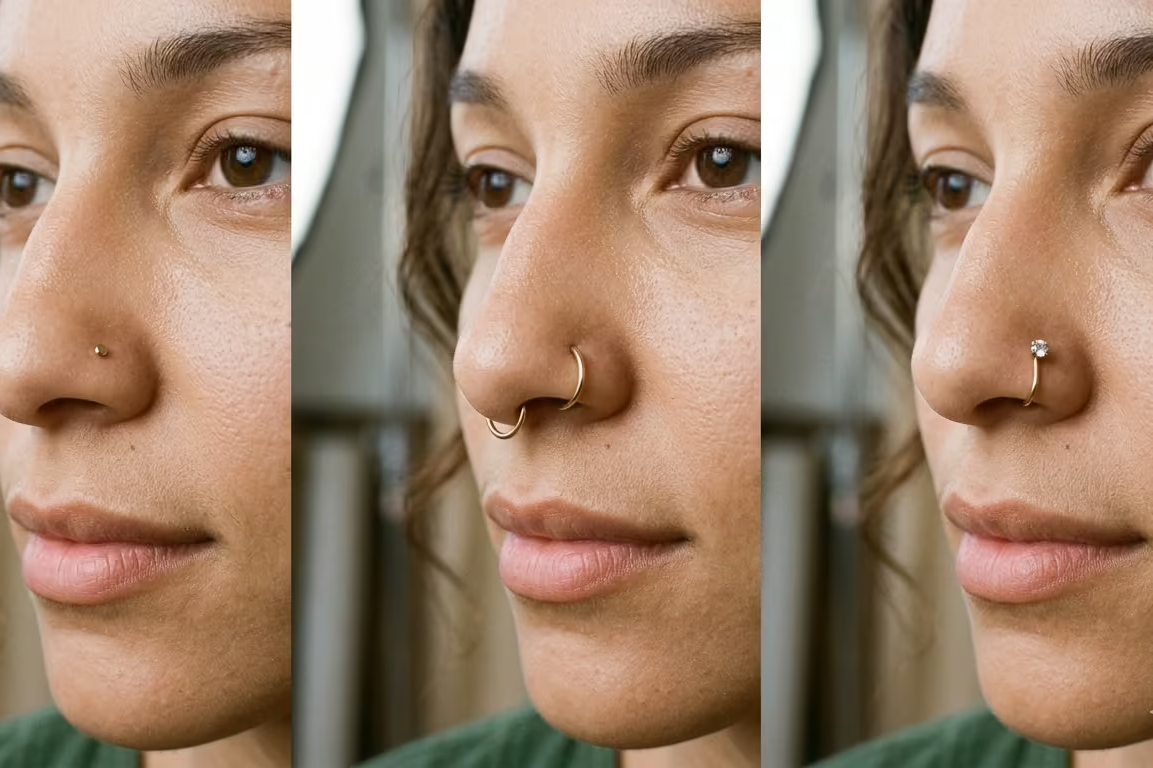
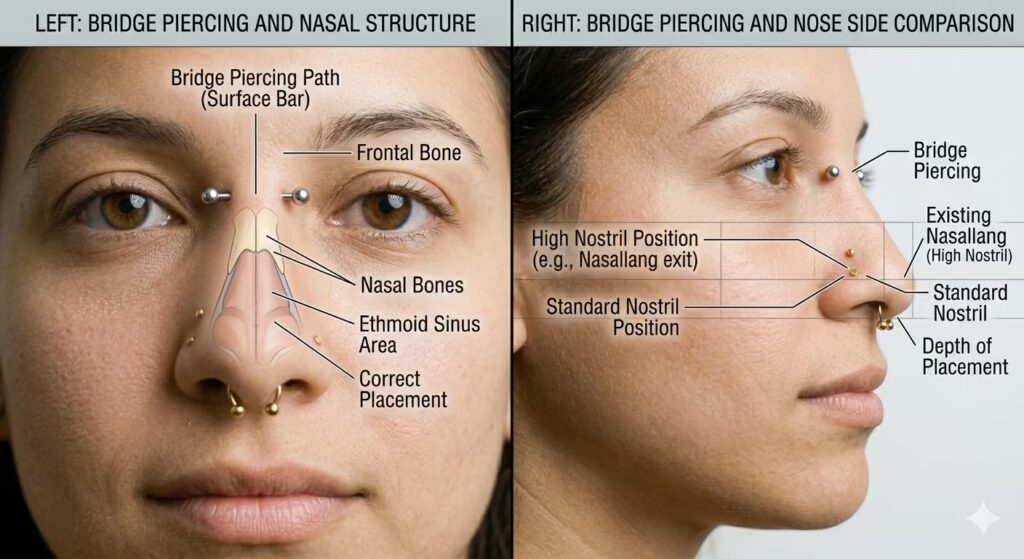
The high nostril piercing sits further up the nose than the standard placement, closer to where the nose bridge begins. It creates a more distinctive look because the placement is less common and the jewelry sits higher on the nose profile.
It is often paired with a standard nostril piercing on the same or opposite side to create a layered nose-piercing look. The combination of a standard and high nostril piercing on one side creates a striking stacked effect that has become popular in curated nose jewelry arrangements.
What makes it different
At the high nostril position, the tissue is thinner and sits closer to the cartilage of the nose. This changes the healing experience compared to the standard placement. The tissue is less forgiving of disturbance, and the position is harder for many people to clean effectively.
The jewelry options for a high nostril are also more limited. The standard L-shaped nose pin and nose screw do not reach the high nostril position. Flat-back labret studs are the primary option for this placement, both during healing and in the long term.
Pain level: 4 to 6 out of 10
Slightly more intense than the standard placement because of the proximity to thinner, more sensitive tissue near the nose bridge. Most people who have had a standard nostril first describe the high nostril as noticeably sharper.
Healing: 6 to 9 months
The high nostril takes longer to heal than the standard nostril due to thinner tissue and a more limited blood supply in that part of the nose. Consistent aftercare is particularly important for this placement.
Double and Triple Nostril Piercings
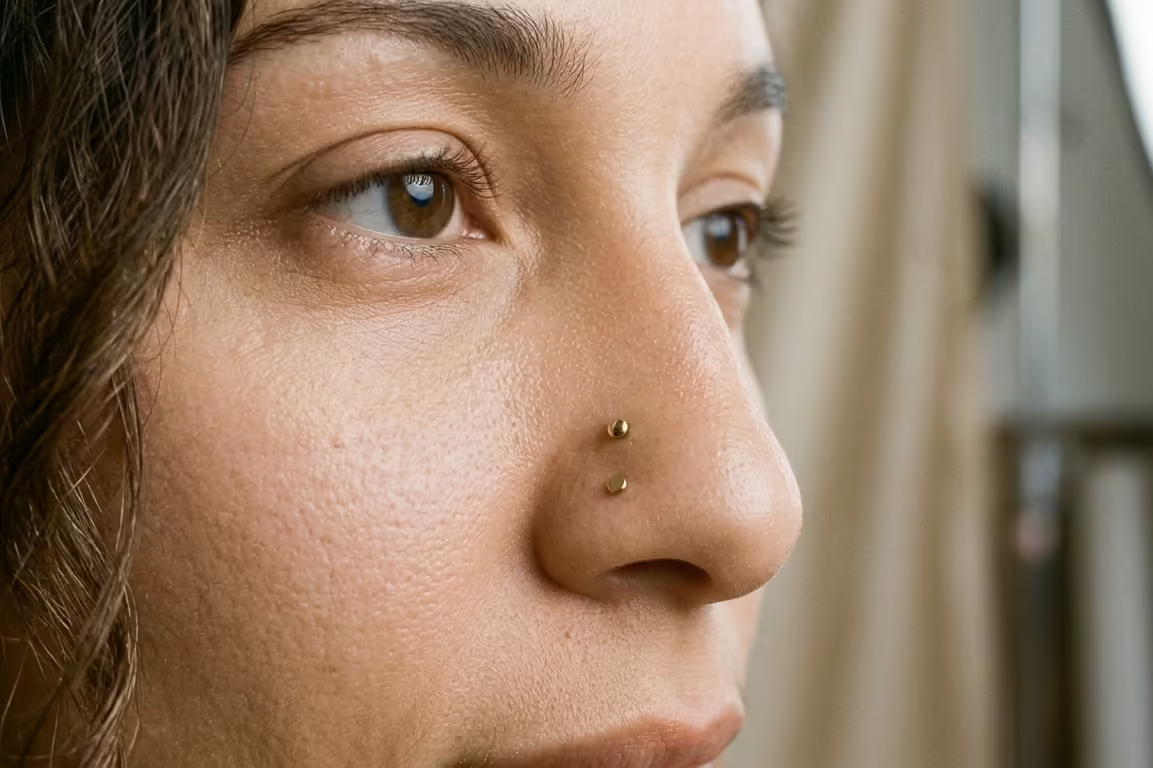
Double nostril piercings place two piercings on the same nostril, either at the same height side by side or stacked vertically. Triple nostril piercings add a third. Both styles create a bold, layered look that stands out from single nostril piercings.
The visual effect is most effective when the spacing between piercings is precisely planned. Too close and the piercings crowd each other, creating competition for tissue and increasing the risk of complications. A piercer with specific experience in multiple nostril placements is essential for getting the spacing right.
Getting them sequentially
Most piercers recommend getting multiple nostril piercings one at a time, allowing each to fully heal before adding the next. Getting two or three simultaneously is possible, but it significantly increases the healing demands, the complexity of aftercare, and the risk that one or more will develop irritation issues.
The minimum wait between nostril piercings in the same nostril is typically 3 to 4 months, and many piercers prefer to wait 6 months for full healing before adding the next one. This patience produces better results than rushing.
Pain level: 3 to 5 out of 10 per piercing
Each individual’s piercing rate is similar to that of a standard nostril. The cumulative experience of two or three in a single session is more intense than one, but each individual piercing remains in the low to moderate range.
Septum Piercing
The septum piercing passes through the soft tissue at the base of the nose between the two nostrils. It is technically a nasal piercing rather than a nostril piercing, but it is consistently grouped with nostril piercings because of its position on the nose.
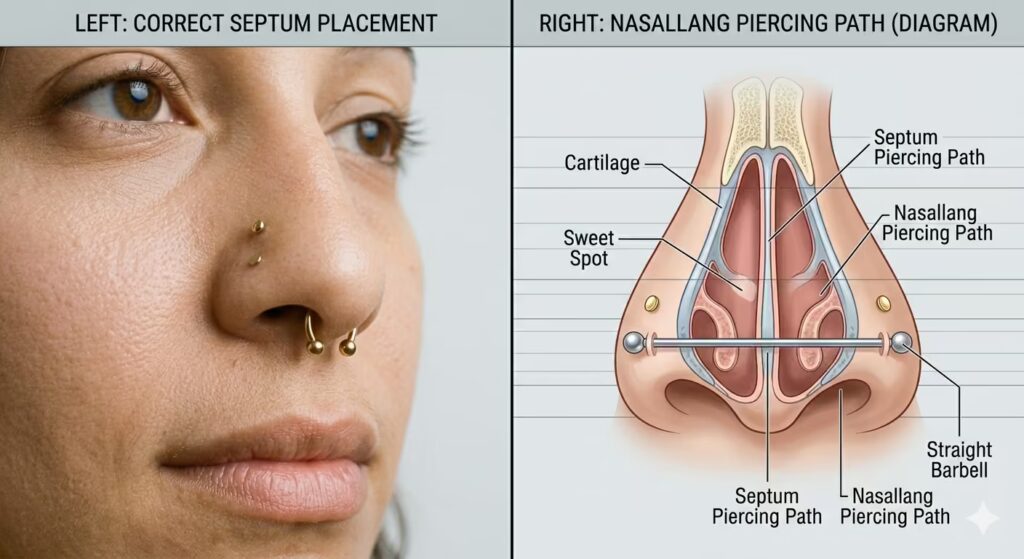
The septum has one significant practical advantage over all other nose piercings: it can be completely hidden. A horseshoe barbell can be flipped upward so both ends sit inside the nostrils, making the piercing invisible. This makes it uniquely popular among people in professional environments that restrict visible facial piercings.
The septum also has one of the richest cultural histories of any piercing. Our full guide to how much is a septum piercing covers everything from the anatomy of the sweet spot to jewelry types, healing, and the historical traditions that have made this one of the most universally worn piercings in the world.
The sweet spot
A correctly placed septum piercing does not go through the cartilage wall of the septum. It passes through the columella, a small pocket of soft tissue just below where the cartilage ends. Finding and using this sweet spot is what makes the difference between a septum piercing that rates 4 to 6 out of 10 and one that is significantly more painful.
Nasallang Piercing
The nasallang is one of the rarest and most complex nose piercings available. A single straight barbell passes horizontally through both nostrils and the septum in one continuous line, creating three piercings in a single procedure.
The visual effect is striking and immediately distinctive. Only the two ball ends of the barbell are visible, one on each side of the nose, with the bar running invisibly through the full width of the nose underneath.
Why does it require a specialist?
The nasallang requires the piercer to align three separate piercing points in perfect horizontal symmetry across the full width of the nose. If the alignment is even slightly off, the bar sits at an angle that creates pressure on one or more of the three tissue passages it runs through.
This is not a piercing to get at a general studio. Find a piercer who has performed nasallang piercings specifically, ask to see healed results, and understand fully what the procedure involves before booking.
Pain level: 7 to 9 out of 10
The nasallang is significantly more intense than any other nose piercing. The needle must pass through three points of tissue in one continuous motion. The sensation is more prolonged and intense than that of a standard nostril or septum.
Healing: 6 to 9 months
Three simultaneous piercing channels healing at once, connected by a single piece of jewelry that passes through all of them. Any movement of the bar affects all three healing points. The nasallang requires meticulous aftercare and significant patience.
Bridge Piercing
The bridge piercing is placed horizontally across the top of the nose between the eyes. Despite appearing to go through bone, it is a surface piercing that passes through the thin skin over the nose bridge rather than through the nasal cartilage or bone beneath.
Because it is a surface piercing, it carries a higher risk of rejection than tissue-based nose piercings. The skin over the nose bridge is thin and relatively taut, giving the body less tissue to anchor the jewelry in. Many bridge piercings eventually reject, even with excellent aftercare.
Pain level: 4 to 5 out of 10
The skin over the nose bridge is thin with moderate nerve density. The needle passes through quickly, and the sensation is a sharp but brief pressure. Many people rate it lower than they expected, given its dramatic location.
The rejection reality
A bridge piercing with a realistic lifespan of one to three years is a success story for many people who get it. Some last longer with excellent placement and care. Going into a bridge piercing with eyes open to the risk of rejection lets you make the most of it while it is there, rather than being disappointed when it eventually migrates.
For more on surface piercing rejection and what it looks like, our guide to clavicle piercing: everything you need to know covers the rejection and migration process in detail.
Nostril Piercing Jewelry: What Works at Every Stage
Nostril piercings have one of the widest ranges of jewelry options of any piercing. Understanding which styles work at each stage of healing prevents the common mistake of switching to a preferred style too early.
For fresh piercings
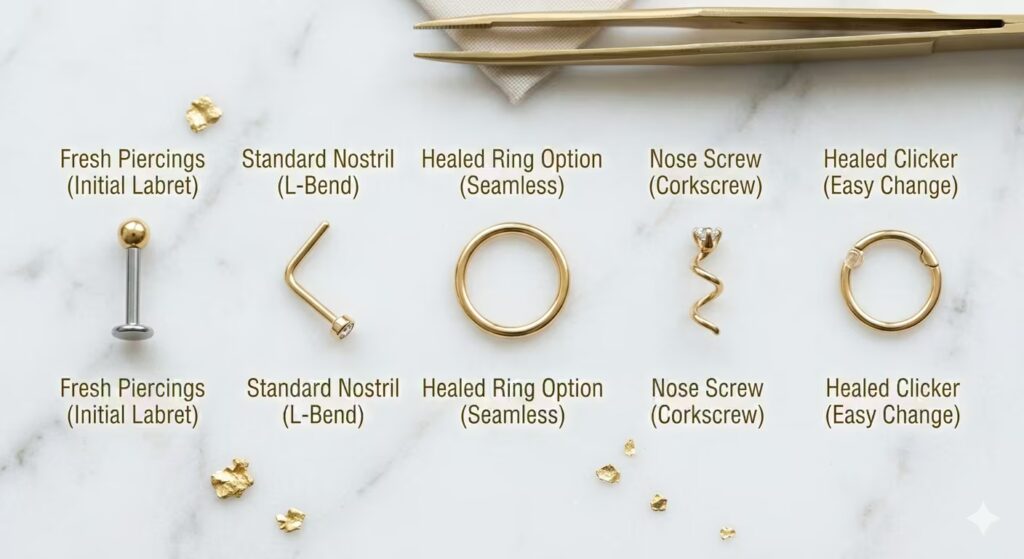
A flat-back labret stud in implant-grade titanium is the current professional standard for fresh nostril piercings. It sits flush against the inside of the nostril, without creating a visible bump, which both improves comfort and reduces the risk of the interior component pressing against delicate nasal tissue during healing.
The L-shaped nose pin and nose screw are older styles that are still used in many studios. They are acceptable for healing but create more interior movement than a flat-back stud when the nose moves. For piercers who offer flat-back options, that is usually the better choice.
For healed piercings
Once the nostril is fully healed, the range opens up considerably. Seamless rings, small hoops, clicker rings, and a wide variety of stud styles, including prong-set gems, bezel-set stones, and shaped ends, all become viable.
| Jewelry Style | Best For | Fresh Piercings | Healed Piercings |
| Flat-back labret stud | Standard, high nostril | Yes. Current professional standard. | Yes. Most comfortable long-term option. |
| L-shaped nose pin | Standard nostril only | Acceptable. More movement than labret. | Yes. Widely available and easy to change. |
| Nose screw/corkscrew | Standard nostril only | Acceptable but tricky to insert. | Yes. Secure once inserted correctly. |
| Seamless ring/hoop | Standard nostril, septum | No. Too much rotation during healing. | Yes. Classic nose ring look. |
| Clicker ring | Septum, standard nostril | No. The mechanism creates too much handling. | Yes. Easy to insert and remove. |
| Horseshoe barbell | Septum primarily | Yes for septum. Can flip up to hide. | Yes. Best septum option for concealability. |
Aftercare for Nostril Piercings
All nostril piercings share the same core aftercare approach, with some minor variations by placement.
Cleaning routine
Clean twice daily with sterile saline wound wash. Spray directly onto the outside of the piercing and gently rinse. For standard nostril piercings, you can also clean the inside of the nostril gently with a saline-dampened piece of non-woven gauze, moving it carefully around the interior end of the jewelry.
Do not use cotton wool near nostril piercings. Cotton fibres catch on the jewelry and leave residue inside the nostril, irritating healing tissue. Non-woven gauze or simple rinsing is safer and more effective.
Blowing your nose
You will need to blow your nose during the healing period. Do it gently rather than forcefully, and clean the piercing afterward. Rough nose-blowing creates pressure on the healing tissue and can shift the jewelry position in a fresh piercing.
Makeup and skincare
Keep foundation, concealer, powder, and skincare products away from the piercing during the healing process. These products are not designed for open healing tissue and can cause persistent irritation that appears and behaves like infection but resolves once contact with the product stops.
What to avoid
Swimming in pools and open water should be avoided for the first two to three months. Both chlorinated pool water and natural water carry bacteria that can enter the healing piercing channel.
Choosing Which Nostril Piercing Is Right for You
With seven distinct types to choose from, the right question is not just which one looks best in photos, but which one fits your anatomy, your lifestyle, and your long-term piercing vision.
For first-time nose piercings
The standard nostril is the obvious starting point. It is the most studied, most widely performed, and most versatile nose piercing available. The healing timeline is manageable, the jewelry options are the widest of any nose piercing, and it suits virtually every face shape and nose anatomy.
For people who need concealability
The septum is the only nose piercing that can be completely hidden on demand. If your workplace or family situation requires your piercing to be invisible at certain times, the septum’s flip-up capability makes it uniquely practical, in a way no nostril piercing can match.
For an unusual, striking look
The high nostril, bridge, or nasallang create looks that are significantly less common than the standard nostril. The high nostril is the most accessible of the three. The bridge requires accepting the reality of rejection. The nasallang demands a specialist piercer and exceptional aftercare commitment.
For building a nose piercing collection
Standard nostril first, fully healed, then a second placement is added once the first is stable. The most popular combination is a standard nostril stud and a septum ring, which creates a layered nose-jewelry look that works across many styles, from minimal to bold.
For the full picture of how Indian and Middle Eastern nose piercing traditions built multi-piercing nose adornment into one of the richest jewelry traditions in the world, our article on nose piercings in Indian and Middle Eastern traditions is a fascinating read alongside this practical guide.

Frequently Asked Questions
Which side of the nose should I pierce?
There is no universal rule in modern Western piercing culture. It is entirely personal. In traditional South Asian cultures, the left nostril is associated with Ayurvedic health benefits for the female reproductive system and is considered the more spiritually significant side. In everyday Western fashion, both sides are equally popular.
Choose the side that looks and feels right to you in the mirror. Some people find one side more flattering based on the natural asymmetry of their face. Others simply choose based on preference or on which side their hair parts.
Do nose piercings leave a scar?
Most healed nostril piercings leave a small, nearly invisible mark when removed. The mark is typically flat and fades significantly over time. Piercings that were infected, rejected, or left in place for many years may leave a slightly more visible mark, but are usually still less noticeable than people fear.
Can I get a nose piercing if I have a deviated septum?
A deviated septum does not prevent standard nostril piercings. It affects septum piercings more directly, as the sweet spot placement may need to account for the deviation. An experienced piercer will assess your specific anatomy and advise on placement. See the septum section of this guide and our full septum piercing guide for more details.
How much does a nose piercing cost?
A standard nostril piercing at a reputable studio costs between $30 and $70 for the service fee, with jewelry adding $15 to $40. The realistic all-in cost is $55 to $120. Specialist placements like the nasallang or high nostril cost more due to the increased skill required.
For a full cost guide covering the septum specifically, including regional pricing for Kenya, the US, UK, Australia, and Canada, see our guide to how much a septum piercing costs.
What is the fastest-healing nose piercing?
The septum generally heals the fastest of all nose piercings, at 3 to 6 months, because it passes through the soft-tissue sweet spot, which has a good blood supply. The standard nostril typically heals in 4 to 6 months. The high nostril, nasallang, and bridge all take longer due to their anatomical complexity.
Can I swim with a new nose piercing?
Avoid swimming in pools, hot tubs, and open water for the first 2 to 3 months of healing. Both chlorine and natural bacteria in water can enter the healing piercing channel and cause infection. After the initial healing phase, if you must swim, a small waterproof adhesive dressing over the piercing provides some protection.
Which Nose Piercing Will You Choose?
Nose piercings are among the most personal and versatile forms of facial piercing. From the minimal elegance of a tiny gold nostril stud to the bold statement of a nasallang or the flip-up practicality of a septum ring, there is a style for every aesthetic and every lifestyle.
The standard nostril remains the starting point for most people and a lifelong favourite for many. The septum is the most versatile for people who need concealability. The high nostril and bridge are for those looking for something genuinely distinctive.
Whatever you choose, get it done by an experienced piercer who marks the placement carefully, uses implant-grade titanium, and gives you clear aftercare instructions. A well-placed, well-healed nose piercing is one of the most characterful and lasting additions to your personal style.