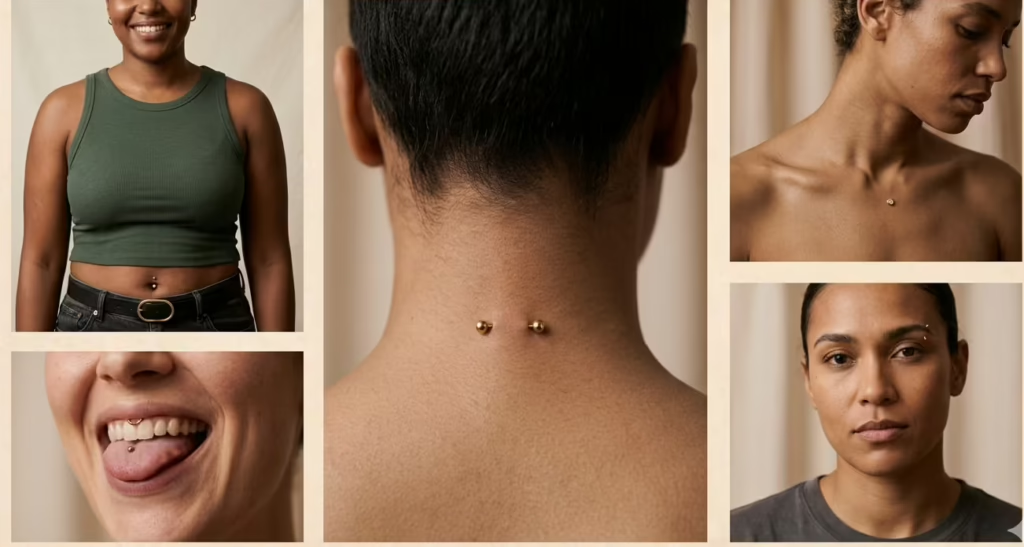
Wondering Why People Get Multiple Piercings?
The Psychology, Culture, and Practical Reality Behind Multiple Piercings
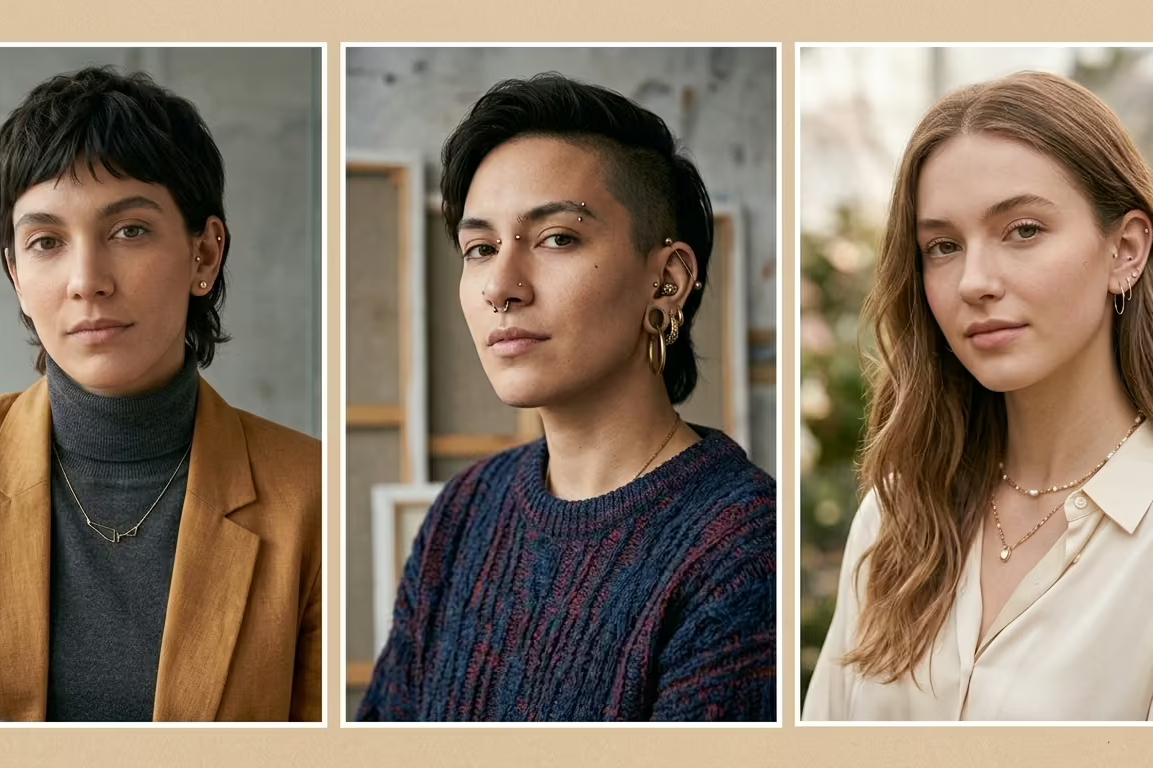
Walk into any professional piercing studio today, and you will meet people at wildly different points on the same journey. Someone is getting their very first lobe piercing. Someone is adding a seventh cartilage piercing to a curated ear they have been building for three years. Someone returning to upgrade jewelry on piercings they have worn for a decade.
The question “why do people get multiple piercings?” sounds simple, but the honest answer is layered and genuinely fascinating. The motivations range from deeply personal to culturally rooted, from purely aesthetic to psychologically meaningful. Often, several of these reasons exist in the same person at the same time.
This article goes beyond the surface answer. It explores the real reasons people choose multiple piercings, the cultural history behind the impulse, what psychology and research tell us about body modification, and the practical questions people ask before committing to more than one piercing.
❝ Multiple piercings are one of the most personal forms of self-expression available. The reasons behind them are as individual as the people wearing them.
The Most Common Reasons People Get Multiple Piercings
Self-expression and personal identity
The most frequently cited reason for multiple piercings is self-expression. Piercings are one of the most direct and visible ways a person can communicate something about who they are without saying a word.
The specific choices involved in multiple piercings carry meaning. Which placements you choose, what jewelry you wear in them, how you combine them, and what order you put them in — all of this is a form of self-authorship. You are composing a visual story about yourself on your own body.
For many people, each piercing added over time marks a different chapter. The first lobe piercing might be a rite of passage for teenagers. The helix was added at the university. The daith during a difficult year, when reclaiming agency over the body felt important. Multiple piercings accumulate meaning as much as they accumulate jewelry.
The curated ear aesthetic
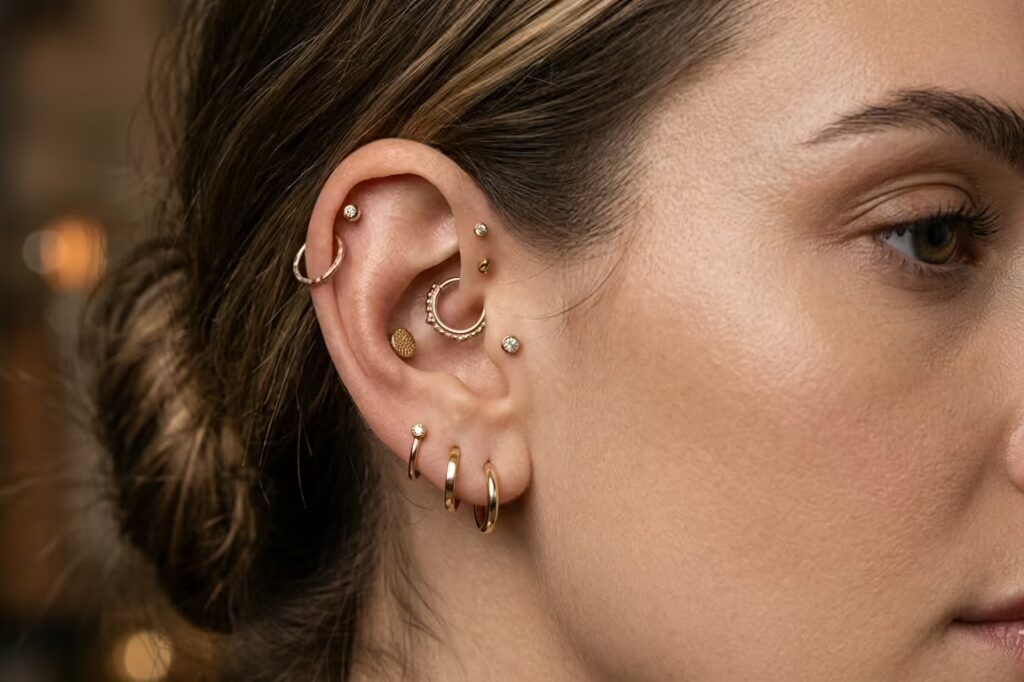
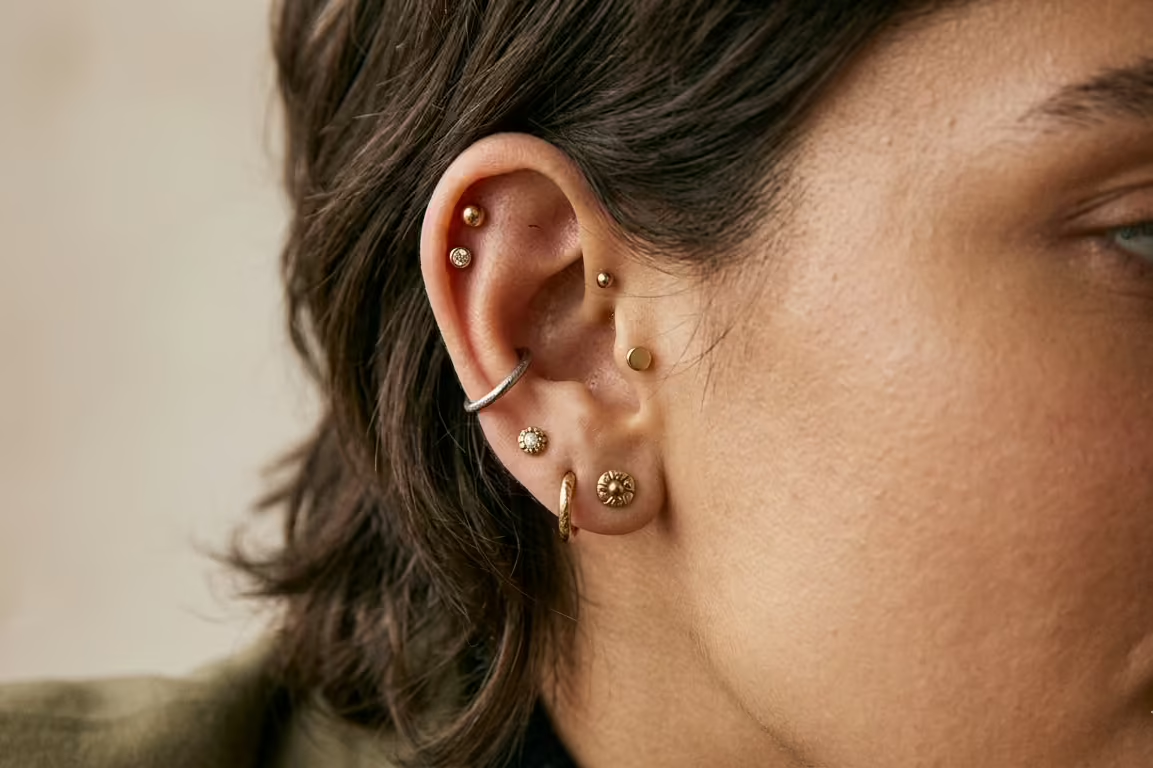
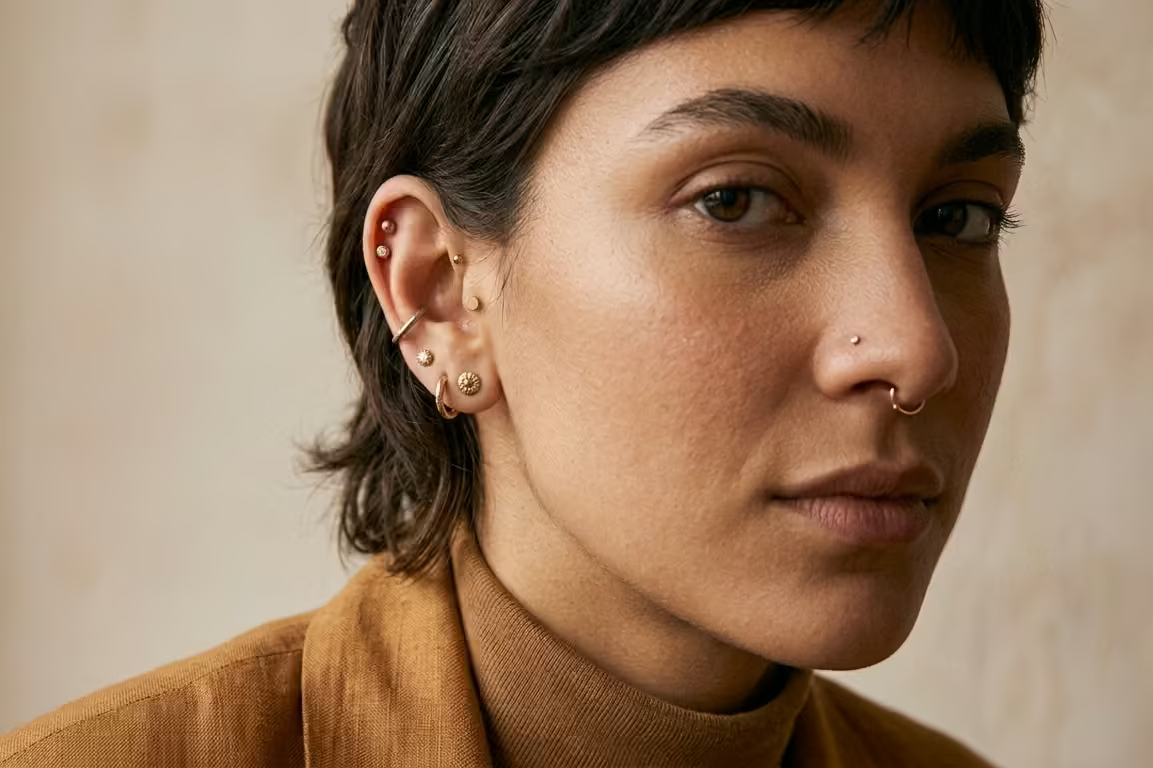
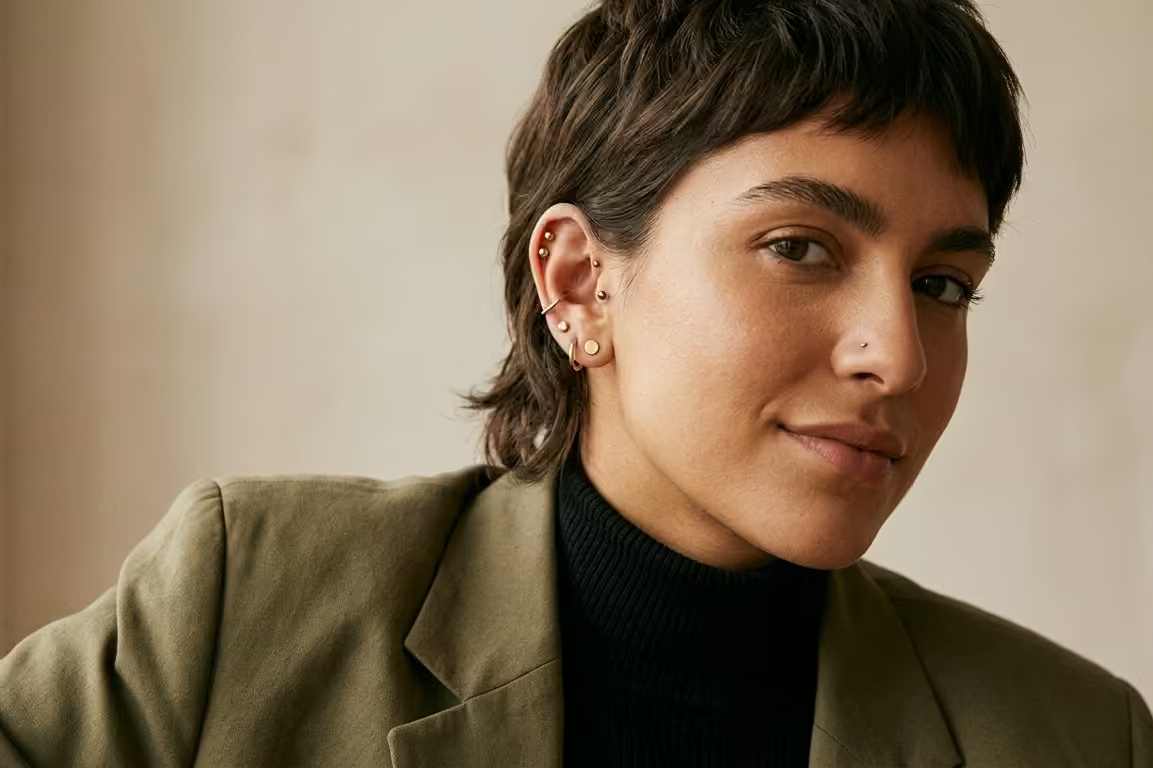
The curated ear trend has transformed how people think about ear piercings. Rather than a single statement piece, a curated ear is a carefully arranged arrangement of multiple piercings across the lobe and cartilage, chosen to work together as a cohesive composition.
This approach treats the ear as a canvas. The mix of placements, jewelry sizes, metal tones, and styles is carefully considered rather than accumulated randomly. Professional piercers now offer consultation specifically for curated ear planning, helping clients map out a multi-piercing vision that will be built over months or years as each piercing heals.
The helix is usually the anchor of a curated ear arrangement. If you are thinking about building a curated ear and want to understand what each placement entails, our guide to the types of ear piercings and pain levels covers every placement from lobe to industrial, with honest detail.
Cultural and historical roots
Multiple piercings are not a modern invention. They are one of the oldest forms of human adornment, practiced continuously across every continent for thousands of years. The desire to mark the body with meaningful jewelry is deeply embedded in human culture.
In many African cultures, elaborate combinations of ear, nose, and body piercings simultaneously communicate clan identity, age group, social status, and spiritual connection. In Indian tradition, multiple ear piercings have long been standard practice, each placement carrying its own significance in Ayurvedic medicine and ritual.
For a deep dive into the cultural history of multiple piercings across civilisations, our article on the evolution of ear piercings: from ancient Egypt to modern trends, traces the full historical arc. Our piece on piercing jewelry in African cultures: materials and heritage explores the specific traditions of African piercing culture in detail.
Marking life transitions
For many people, a new piercing marks a specific moment in time. A birthday. The end of a relationship. A move to a new city. A recovery. A celebration. The piercing becomes a physical marker of that moment, worn on the body as a kind of personal memorial.
This is one reason people with multiple piercings often have a story for each one. The jewelry is not just decoration. It is a timeline. Multiple piercings are multiple timestamps, each associated with a specific experience or phase of life.
Aesthetic satisfaction and the creative impulse
Some people get multiple piercings simply because they find the visual result beautiful. The composition of multiple jewelry pieces across the ear or face is genuinely artistic, and the creative satisfaction of building and refining that composition over time is real.
Jewelry design has also become increasingly sophisticated to meet this aesthetic demand. Implant-grade titanium in anodised colours, solid gold in intricate designs, mixed-metal combinations, matching sets, and stackable styles have all been developed specifically for the multiple-piercings market.
The Psychology Behind Multiple Piercings
Body modification research is a growing field, and what it tells us about why people get multiple piercings is more nuanced than popular assumptions might suggest.
Body autonomy and self-ownership
One of the most consistent findings in body modification research is the connection between piercings and a sense of ownership over one’s own body. Choosing to pierce, deciding what and where to pierce, and watching the result become part of your permanent appearance are forms of agency over your physical self.
This resonates particularly strongly for people who have experienced periods of feeling out of control of their bodies or their lives. Getting a piercing during or after a difficult experience is frequently described not as self-harm but as the opposite: an act of reclamation, of writing a new chapter in one’s own terms.
The role of ritual and pain
The experience of getting pierced, including the brief pain involved, functions as a kind of ritual for many people. Ritual, in the psychological sense, is any deliberate act that marks a transition and is witnessed in some way.
Even a solo trip to a piercing studio has ritual elements: the decision, the preparation, the appointment itself, and the care of the healing piercing afterward. For people who get multiple piercings over time, this ritual becomes a recurring practice that structures significant moments in their lives.
This does not mean pain-seeking is the motivation. The vast majority of people getting multiple piercings are not seeking pain. The pain is accepted as the cost of the desired result, in the same way a tattoo or a surgical procedure involves discomfort as part of the process.
Community and belonging
Multiple piercings are associated with specific communities, subcultures, and aesthetic tribes. Punk, alternative, body modification, and various online communities have long used piercings as markers of shared identity and belonging.
Getting piercings that align with a community you identify with is a way of visibly declaring membership and affiliation. For people who have felt marginalised or who have found their community outside mainstream culture, that visible declaration can be genuinely significant.
❝ Research consistently finds that people with multiple piercings report high levels of satisfaction with their choice. The idea that multiple piercings are impulsive or regretted is not supported by the evidence.
Multiple Piercings Across Different Cultures
Looking at how different cultures have approached multiple piercings historically and today gives a richer picture of what this practice means to human beings.
| Culture / Region | Multiple Piercing Tradition | Primary Meaning |
| Maasai, East Africa | Stretched earlobes with multiple lobes and cartilage piercings in beadwork | Age, clan identity, marital status, beauty |
| India (Hindu tradition) | Multiple ear piercings in both lobes and cartilage, nose piercing | Spiritual, Ayurvedic health, rite of passage |
| Papua New Guinea | Ear, nose, and septum piercings with natural materials | Warrior status, tribal identity, ritual transition |
| Elizabethan England | Single male earring and multiple female ear piercings in court fashion | Wealth, worldliness, fashion status |
| Modern Western cultures | Curated ears, facial piercings, body piercings in combinations | Self-expression, aesthetic composition, personal identity |
What is striking across all these traditions is the consistency of the underlying impulse. Whether it is Maasai beadwork that communicates clan identity or a modern, curated ear that communicates personal aesthetic, the motivation is the same: using the body as a site of meaningful communication.
For a detailed exploration of how these cultural traditions developed, our nose piercings in Indian and Middle Eastern traditions and tribal septum piercings: symbols and rituals worldwide, articles explore two of the richest piercing traditions in depth.
Multiple Piercings and Professional Life
One of the most practical questions people ask before committing to multiple piercings is whether they will create problems at work. The honest answer has shifted significantly in the past decade.
In many industries, multiple piercings are increasingly unremarkable. Technology, creative industries, media, hospitality, retail, and many others have moved well past policies that restrict visible piercings. The idea that multiple piercings automatically signal unprofessionalism is significantly less true in 2025 than it was even ten years ago.
In some fields, multiple visible piercings may still create challenges. Legal, medical, financial services, and traditional corporate environments in some regions maintain more conservative dress code expectations. Education, particularly with younger children, varies widely by institution and country.
Practical strategies
Many people with multiple piercings manage the professional context through placement strategy. Lobe piercings are almost universally accepted in professional settings. Cartilage piercings are less noticeable than facial piercings. Septum piercings can be flipped up to become completely invisible. Tongue and body piercings are invisible in normal interactions.
Retainers made from clear or flesh-toned material can reduce visibility of piercings that cannot be removed during work hours while they are still healing. Once fully healed, piercings can usually be removed and reinserted for work situations if needed.

Planning Multiple Piercings: What You Need to Know
If you are planning to get multiple piercings, either all at once or over time, understanding the practical realities helps you get the best results from each one.
Healing multiple piercings simultaneously
Getting multiple piercings in one session is possible, but has real implications. Your body is managing multiple healing processes at the same time, which means greater overall physical demand, more aftercare to track, and a greater risk of cross-contamination if you are not careful.
For lobe piercings, two at once is very manageable for most people. For cartilage piercings, most professional piercers recommend getting no more than two at a time, and some advise getting one and waiting for it to settle before adding another.
Mixing cartilage and facial piercings in the same session is generally fine as long as the individual’s aftercare for each is manageable. The risk is not that it cannot heal, but that aftercare fatigue sets in and the quality of care for each piercing drops.
Spacing out piercings over time
Building a curated ear or multiple facial piercings over months and years is actually the approach most professional piercers recommend. Each piercing gets its own dedicated healing window. You can see how each one heals before adding the next, and the financial cost is spread out rather than hitting at once.
Planning ahead matters here. If you know you eventually want a helix, a forward helix, and a daith in the same ear, an experienced piercer can suggest placements that will work harmoniously together from day one rather than creating spacing conflicts later.
The financial reality
Multiple piercings add up. A realistically budgeted single ear piercing at a reputable studio is $55 to $120 all in. A curated ear with six placements, built over 18 months, totals $330 to $720. That number is useful to know before you start rather than after.
Spreading the cost over time by building slowly is one reason why the “one at a time” approach has practical financial advantages alongside the healing benefits.
❝ The best multiple-piercing plans are those built with patience. Rushing multiple piercings creates more complications, more cost, and less satisfying results than taking the time to do each one well.
Common Questions About Multiple Piercings
How many piercings are too many?
There is no universal answer. The concept of “too many” is entirely personal and cultural. Anatomically, the only real limits are the availability of placement space and the body’s capacity to heal multiple piercings simultaneously.
What matters is that each piercing is placed with care, healed properly, and wears jewelry that is appropriate for the tissue it sits in. Ten well-placed, well-healed piercings in quality jewelry is always going to be a better result than three poorly placed ones with cheap metal.
Do multiple piercings affect how you are perceived?
Yes, to varying degrees depending on context and audience. Perceptions of multiple piercings have shifted dramatically in the past decade toward greater acceptance in most Western contexts. In some professional, religious, or traditional family environments, they still carry a stigma.
Most people with multiple piercings report that the reality has been far less challenging than they feared. The people who matter are usually far more interested in you as a person than in your jewelry.
Can I get multiple piercings if I have sensitive skin or metal allergies?
Yes. Sensitive skin and nickel allergies are extremely common and are well catered for in professional piercing. Implant-grade titanium is completely nickel-free and is the standard recommendation for anyone with skin sensitivity. Solid gold is another excellent option for healed piercings.
The key is to communicate your sensitivity to your piercer before booking so they can ensure the studio stocks the appropriate jewelry. Avoid studios that cannot clearly tell you what metal their jewelry is made from.
Is it classy to have multiple piercings?
Classiness in jewelry is determined by how it is worn, not by how many pieces there are. Multiple piercings in quality materials, thoughtfully placed and well-maintained, look sophisticated. Multiple piercings in low-quality metal, poorly healed, look untended.
The curated ear trend has been embraced by high-end jewelry brands and fashion publications specifically because the result, when done well, is genuinely elegant. Quantity is not the issue. Quality and intentionality are what matter.
Are multiple piercings a sin?
Views on body modification vary across religious traditions. Some faiths have specific teachings about the body that some interpret as discouraging piercing. Others have no prohibition at all, and many have strong traditions of body adornment themselves.
This is a question that sits between personal faith and personal choice. If it is a genuine concern for you, the most useful resource is your own faith community and your own conscience, rather than a general guide like this one.
Do multiple piercings hurt more than one?
Each piercing hurts in its own way during the procedure. Getting three piercings in one session means experiencing three brief, sharp sensations rather than one. The cumulative physical experience is more than one piercing but not dramatically so for most people.
The healing period is where multiple simultaneous piercings create the most additional demand. Each one needs daily cleaning, has its own healing timeline, and can be disrupted by sleeping position, clothing, or accidental contact. That accumulation of care is more significant than the pain of the procedures.
Getting Started: If You Are Considering Your Next Piercing
If this article has you thinking about your next piercing or planning the beginning of a curated collection, the most important thing is to take the planning seriously from the start.
Find a studio with a strong portfolio of healed multiple piercing results, not just fresh ones. Talk to a piercer about your longer-term vision rather than just booking a single appointment. Use implant-grade materials. Budget for aftercare and healing time is included in the cost.
For specific placement guides, our articles on individual piercings give you the honest information you need. If you are starting with an ear, types of ear piercings and pain levels are the most practical starting point. If you are considering adding a facial piercing, different types of lip piercings, and our guide to types of body piercings with pictures covers the full landscape of options.
The Short Answer to a Big Question
People get multiple piercings because the body is a meaningful surface and jewelry is a language. They get them to mark time, to declare identity, to connect with culture and community, to reclaim autonomy, to create beauty, and sometimes simply because they love the way a particular piece of jewelry looks in a particular placement.
None of these reasons requires justification. The impulse to adorn the body with intention is one of the most deeply human things there is. The evidence for that stretches back at least 70,000 years, through every culture and civilisation that has ever existed.
Whether you have one piercing or twenty, the question behind the choice is always the same: what do you want to say about yourself, and how do you want to say it? Multiple piercings just give you more ways to answer.