Medusa Piercing: Everything You Need to Know
Placement, Cost, Healing, and Why It Has That Name

The Medusa piercing sits right at the center of the face. One small stud, placed in the philtrum groove above the upper lip, and suddenly your whole face reads differently. It draws the eye to your mouth and changes the geometry of your features in a way that no other single piercing quite replicates.
It is one of the most searched facial piercings online, and the questions people ask about it go well beyond just the name. What does it feel like? How long does it take to heal? What does it look like paired with other piercings? Is it right for your face shape? This guide answers all of it.
And yes, we will get to the mythology. Because the story behind the name is genuinely interesting and tells you something real about why this piercing resonates so deeply with those who choose it.
❝ The Medusa piercing is also known as a philtrum piercing. Both names refer to exactly the same placement. The name Medusa is the widely used popular name; the anatomical term is philtrum.
Why Is It Called a Medusa Piercing?
Medusa was one of the three Gorgons of Greek mythology. She was beautiful and terrifying in equal measure. Her gaze could turn anyone who looked at her directly to stone, and her hair was a mass of living serpents.
The piercing takes its name from that mythology for a reason that is more specific than just “it sounds cool.” Medusa’s power was located entirely in her face, and specifically in her gaze. The piercing sits at the exact center of the face, directly below the nose, commanding the same kind of bold, central presence that defined her mythological image.
There is also a cultural thread around reclaiming the Medusa figure. In many modern interpretations of her myth, Medusa is reframed not as a monster but as a powerful woman. Choosing a piercing named after her carries that sense of intentional boldness and self-possession for many of the people who get it.
It is also sometimes called the philtrum piercing, after the anatomical groove it is placed in. You will see both names used interchangeably in studios and online. They mean the same thing.

What Exactly Is a Medusa Piercing?
A Medusa piercing is a single lip piercing placed in the philtrum, which is the vertical groove that runs from the base of the nose down to the center of the upper lip. The needle passes through this groove from front to back, and a flat-back labret stud is inserted, with the flat disc inside the mouth and the decorative top visible on the outside.
The placement is centered on the face, which is what gives it such a strong visual impact. It sits on the face’s symmetry axis, and because of that position, even a small, simple stud makes a significant aesthetic impression.
Because the flat disc sits against the gum line behind the upper front teeth, dental health is a real consideration for this piercing. We cover the dental risk fully in its own section below. It is not a reason to avoid the piercing, but it is something every potential Medusa piercing owner should understand before booking.
The Medusa is closely related to several other lip piercings. It is the upper component of a cyber bites piercing, which combines it with a labret below the lower lip. The jestrum piercing is a variation where the barbell exits through the lip itself rather than through the philtrum skin, creating a double-visible end. For a full overview of how the Medusa fits within the lip piercing family, see our guide to different types of lip piercings.
How Much Does a Medusa Piercing Cost?
At a reputable studio, a Medusa piercing costs between $40 and $80 for the service fee, typically including basic implant-grade jewelry. With aftercare and a tip, the realistic all-in cost is $65 to $125.
| Cost Component | Typical Range (USD) |
| Piercing service fee | $40–$80 |
| Implant-grade titanium labret stud | $15–$40 |
| Sterile saline aftercare spray | $8–$15 |
| Alcohol-free mouthwash | $5–$10 |
| Tip for piercer (recommended) | $10–$20 |
| Realistic total all-in | $78–$165 |
The Medusa sits in the mid-range for facial piercing costs, similar in price to a nostril or labret. The most important cost consideration is not the upfront price but the long-term dental management, which we cover below.
Regional Pricing Guide
| Country | Budget Studio | Reputable Studio |
| United States | $40–$60 | $70–$110 |
| Canada | CAD 45–65 | CAD 75–120 |
| United Kingdom | £25–£45 | £55–£90 |
| Australia | AUD 50–70 | AUD 85–135 |
| Kenya / East Africa | KES 2,000–3,500 | KES 4,500–8,000 |
How Painful Is a Medusa Piercing?
Most people rate a Medusa piercing at 4 to 6 out of 10. The skin of the philtrum is relatively thin, and the area has moderate nerve density. The sensation is a sharp pinch with brief throbbing that settles within a few minutes.
The area above the upper lip is more sensitive than some other lip piercing locations, but less so than the tongue or the inside of the lip. Most people say the anticipation is worse than the actual procedure.
The days following the piercing tend to be more noticeable than the procedure itself. The philtrum area swells, eating and speaking feel slightly awkward, and the stud feels larger than it looks. This settles significantly within the first week.
To see where the Medusa sits compared to other piercings on the overall pain scale, our guide to what are the most painful piercings ranks every common piercing from least to most intense.
How Long Does a Medusa Piercing Take to Heal?
A Medusa piercing takes 3 to 6 months to fully heal. Initial surface healing, in which the skin closes at the entry point, occurs in 6 to 10 weeks. The deeper tissue beneath takes longer to fully stabilise.
The philtrum area heals faster than some other oral piercings because it lies on the outside of the skin rather than within internal oral tissue. But the proximity to the mouth still means it is exposed to movement during eating and speaking throughout the healing process.
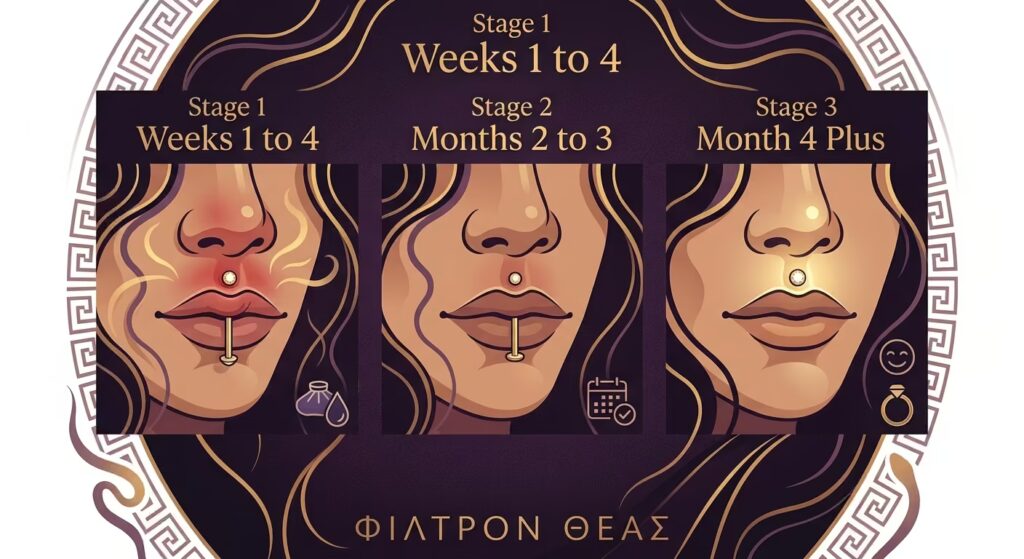
Week by week
In the first two weeks, expect swelling, tenderness, and clear or whitish discharge from the entry point. The stud will feel prominent, and the area will be sensitive to touch. Soft foods and cool liquids are your best friends during this phase.
From weeks three to eight, swelling reduces significantly, and tenderness becomes occasional rather than constant. The discharge becomes minimal. The piercing starts to feel like a part of your face rather than a recent wound.
At three to six months, a well-cared-for Medusa is fully healed. The skin around the entry point looks clear, the stud sits flush and comfortable, and the interior disc no longer feels intrusive inside the mouth.
❝ The Medusa heals from the outside in. The skin at the surface may look closed and fine well before the tissue beneath is genuinely stable. Changing jewelry too early is one of the most common causes of setbacks.
Aftercare: Both Inside and Outside the Mouth
Medusa aftercare is unique because it involves two distinct cleaning zones: the exterior entry point and the interior disc inside the mouth. Neglecting either creates problems in both.
Exterior cleaning
Clean the entry point twice daily with sterile saline wound wash. Spray directly onto the philtrum area and leave for thirty seconds. Rinse gently with clean water. Avoid cotton wool near the jewelry — fibres catch on the stud end and leave residue that irritates healing skin.
Interior cleaning
Rinse your mouth with alcohol-free mouthwash after every meal. This removes food particles from around the interior disc before they have a chance to sit against the gum line. Alcohol-based mouthwash is too harsh for healing oral tissue and will delay healing rather than help it.
What to eat and avoid
Soft foods are your most practical tool during the first two weeks. Anything that requires minimal chewing and is not spicy, acidic, or very hot reduces the disruption to healing tissue. Alcohol, smoking, and kissing during the initial healing period all introduce bacteria and slow healing.
Skincare and makeup
Keep skincare products, foundation, and lip products away from the piercing site during the healing process. These products are not designed to come into contact with open healing tissue and can cause irritation that may look and feel like infection.
The Dental Risk: What You Need to Know
The interior disc of the Medusa labret stud sits against the gum line and the backs of the upper front teeth. Over time, that contact creates two specific dental risks: enamel wear and gum recession.
Enamel wear happens when the hard metal disc repeatedly contacts the backs of the teeth. The friction is small with each contact, but accumulated over months and years, it causes gradual erosion of the tooth enamel. Once enamel is lost, it does not grow back.
Gum recession is caused by the disc pressing against the gum tissue at the base of the upper front teeth. Receded gums expose the tooth’s root surface and can lead to sensitivity and decay over time.
How to minimise dental risk
Jewelry sizing is the most important protective factor. A labret stud that is too long creates more movement and more contact pressure. Getting the stud downsized to the correct length at six to eight weeks, once initial swelling has fully settled, significantly reduces dental impact.
Flat-back studs with a smaller, thinner disc create less contact surface area inside the mouth. Bioplast or PTFE disc backs are softer than metal and cause less enamel abrasion. Ask your piercer specifically about low-profile options designed to protect teeth and gums.
Tell your dentist you have a Medusa piercing. They can monitor enamel wear and gum health during regular check-ups and advise you if any changes become concerning.
❝ The dental risk from a Medusa piercing is real but very manageable with the right jewelry sizing and regular dental check-ups. It is not a reason to avoid the piercing. It is a reason to manage it intelligently.
Medusa Piercing Jewelry: Options at Every Stage
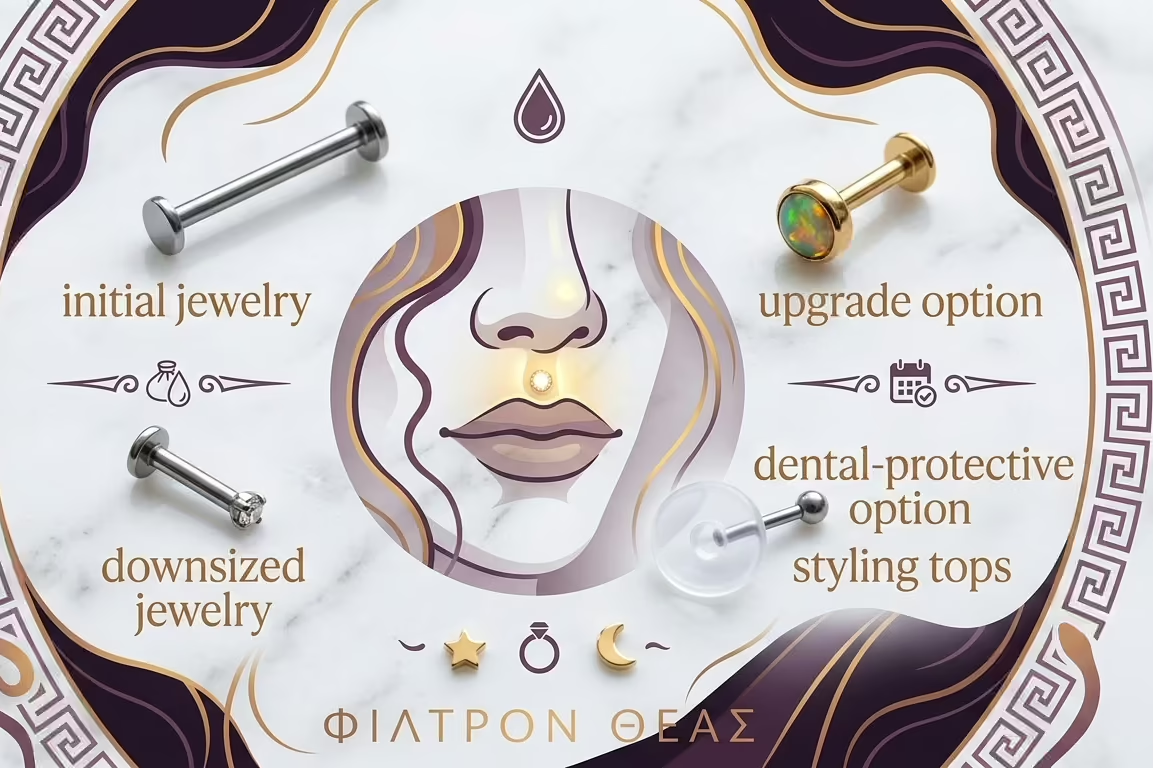
Initial jewelry
Fresh Medusa piercings are pierced with a flat-back labret stud in implant-grade titanium. The post is slightly longer than your final jewelry to accommodate swelling during the first six to eight weeks. The decorative top is typically a small flat disc, a ball end, or a tiny gem.
The downsize appointment
At six to eight weeks, once initial swelling has fully settled, return to your piercer for a downsize. The longer initial post is replaced with a shorter one that fits your healed anatomy correctly. This step reduces interior disc movement, protects your teeth, and makes the stud sit more naturally on the face.
| Material | Cost Range | Best For | Notes |
| Implant-grade Titanium | $15–$45 | Fresh and healed piercings | Best all-round choice. Lightweight, hypoallergenic. |
| Implant-grade Steel | $10–$30 | Non-sensitive individuals | Trace nickel. Heavier than titanium. |
| Solid 14k/18k Gold | $55–$150+ | Healed piercings | Premium long-term choice. Too heavy for fresh philtrum tissue. |
| Bioplast disc back | $5–$15 | Disc backs on any healed piercing | Softer material significantly reduces enamel and gum abrasion. |
Medusa Piercing Pros and Cons
Every piercing has its tradeoffs. Understanding both sides of the Medusa honestly helps you decide whether it is the right choice for your face, lifestyle, and long-term priorities.
| Pros | Cons |
| Unique, striking facial placement that commands attention | Dental risk requires ongoing management |
| Sits on the symmetry axis of the face, flattering most face shapes | Moderate healing time of 3 to 6 months |
| Relatively fast-healing compared to other oral piercings | Visible on the face — cannot easily be hidden during healing |
| A wide range of jewelry styles is available once healed | Requires aftercare in two locations: inside and outside the mouth |
| Pairs beautifully with labret, nostril, and other facial piercings | Dietary restrictions during early healing |
What Face Shapes Suit a Medusa Piercing?
The Medusa sits on the central vertical axis of the face. Because of that, it works with almost any face shape. The piercing does not need to balance asymmetry or draw attention away from any particular feature. It draws attention to the center, a universally flattering effect.
People with fuller lips tend to find the Medusa sits particularly well, as the philtrum groove is more defined and the stud has a natural frame around it. People with thinner lips find that the Medusa actually makes their lips appear more prominent, an effect many actively seek.
The only anatomical consideration that genuinely affects suitability is the depth of the philtrum groove. A very shallow philtrum can make placement more difficult, and the stud may not sit as flush as it does on a deeper groove.
A consultation with an experienced piercer will tell you in minutes whether your specific anatomy is well-suited to the placement.

The Medusa and Other Piercings: Popular Combinations
The Medusa pairs naturally with several other piercings, and planning combinations in advance helps you choose placements that work harmoniously.
The most popular combination is the cyber bites piercing, which adds a centered labret below the lower lip. The two piercings create a vertical symmetry that frames the entire mouth. If you are planning to get cyber bites, reading the full cyber bites guide first is highly recommended since it covers the specific dental and healing considerations of having both piercings simultaneously.
A Medusa paired with nostril piercings on one or both sides creates a layered nose-and-lip combination that is among the most popular facial piercing arrangements. The Medusa acts as the anchor, and the nostril piercings provide flanking balance.
Monroe and Madonna piercings, which sit off-center on the upper lip, are often worn alongside a Medusa piercing for an asymmetric upper-lip arrangement that has become popular in alternative fashion. For a full breakdown of every lip piercing type and how they relate to each other, see our complete guide to different types of lip piercings.
The Spiritual and Symbolic Meaning of the Medusa Piercing
Beyond the mythology, many people who choose the Medusa piercing attach their own personal meaning to it. The questions “what does a Medusa piercing mean?” and “what is the spiritual meaning of a Medusa piercing?” come up frequently in searches, which suggests this is more than just an aesthetic choice for many people.
In Greek mythology, Medusa represents duality: beauty and danger existing together, the power of the gaze, and in modern reinterpretations, a woman reclaiming her power from those who sought to diminish her. Choosing a piercing named after her is, for many wearers, an act of that same self-reclamation.
The philtrum itself holds symbolic significance in many cultural traditions. In some accounts, it is believed to be the place where an angel pressed their finger to seal the soul’s secrets before birth. Others associate the philtrum with the seat of breath and the boundary between internal thought and external expression.
None of this meaning is mandatory. A Medusa can simply be a piercing that you find beautiful and that suits your face. But if you want the depth, it absolutely is.
Frequently Asked Questions
Can I hide a Medusa piercing for work?
A Medusa piercing sits on the face and is visible in all normal interactions. A clear or flesh-toned retainer significantly reduces visibility at a distance but does not make the piercing invisible up close.
If your workplace has a strict facial piercing policy, check it before booking. During healing, even a retainer needs to be made of implant-grade material to avoid irritating healing tissue. A bioplast retainer is the most body-safe option.
Can I get a Medusa piercing with thin lips?
Yes. The Medusa sits in the philtrum above the upper lip rather than through the lip itself. The depth of the philtrum groove is more relevant to placement suitability than the size of the lips.
Many people with thinner lips find that the Medusa actually enhances the appearance of their lips by drawing attention and adding definition to the upper lip. A consultation with your piercer will confirm whether your specific anatomy suits the placement well.
What is the difference between a Medusa and a jestrum piercing?
A Medusa passes through the philtrum skin from front to back, with the decorative top visible and the flat disc hidden inside the mouth. Only one end is visible.
A jestrum is a curved barbell that enters through the philtrum and exits through the actual upper lip, so both curved ends are visible above and below the lip surface. The jestrum is less common, more painful, and carries a higher risk of rejection than the Medusa.
How long until I can change my Medusa jewelry?
The first change from your initial longer post to a shorter downsized one should happen at six to eight weeks at your piercer’s studio. This is not optional. Do not attempt this change yourself.
A full style change to different jewelry designs should wait until the piercing is fully healed, at three to six months. Have your piercer perform the first style change to confirm the piercing is ready before attempting it yourself.
Is the Medusa the same as a philtrum piercing?
Yes. Medusa and philtrum piercing are two names for exactly the same placement. Medusa is the popular name used in piercing culture. Philtrum is the anatomical term for the groove that the piercing passes through. Many piercers use both terms interchangeably.
Is a Medusa Piercing Right for You?
A Medusa piercing costs between $78 and $165, all-in, at a reputable studio. It is one of the most visually impactful facial piercings available at that price point, and for the people who wear it, it often becomes one of their most defining features.
The commitment is real but not extreme. Three to six months of consistent aftercare, long-term dental management, and a follow-up appointment at six to eight weeks. That is the full deal, and for most people, it is very manageable.
If you want a piercing with presence, symmetry, and a name that comes with thousands of years of meaning behind it, the Medusa delivers all of that. Choosing to wear it on your face is a bold statement — and if there is one thing Medusa herself was never short of, it was boldness.