Think about the last time you noticed someone’s ears. Maybe it was a friend’s sleek constellation of tiny gold studs. Maybe it was a bold statement hoop that framed someone’s face perfectly. Or maybe it was a beautifully curated ear full of mixed metals and shapes. Whatever it was, ear piercings have a way of catching the eye.
But here’s what most people never stop to think about: that self-expression has been going on for thousands of years. The desire to decorate and adorn our ears is one of the oldest human impulses we know of. It spans every continent, culture, and era of recorded history.
This article takes you on a journey. We’re going from ancient Egyptian royalty to Elizabethan noblemen, from tribal rituals to Victorian parlors, and all the way through to the modern ear-stacking trend that’s all over your social media feed right now. Along the way, you’ll discover just how much meaning, identity, and creativity human beings have poured into one small piece of body art.
❝ Ear piercing is one of the oldest forms of body modification in recorded human history — and it shows no sign of slowing down.
Ancient Egypt: Where It All Began
If you want to find the earliest evidence of ear piercing, you head straight to ancient Egypt. Archaeological excavations have uncovered mummies with stretched earlobes dating back to around 3000 BCE. These aren’t small piercings either. The stretched earlobes found on some mummies suggest the use of large-gauge jewelry — quite similar to what we’d call gauge or plug piercings today.
Perhaps the most famous example is Tutankhamun, the boy pharaoh. Examined closely, his mummified ears show clear signs of stretched piercings. Despite being buried without ear jewelry — possibly because his attendants considered it inappropriate for the afterlife — the physical evidence is undeniable.
In ancient Egypt, ear jewelry wasn’t just decorative. It carried social status and spiritual weight. Gold earrings in the shape of lotus flowers, serpents, and scarabs were worn by both men and women of the upper class. Gold itself was considered the skin of the gods, so wearing it brought the wearer closer to the divine. Piercing your ears was, in a very real sense, a spiritual act.
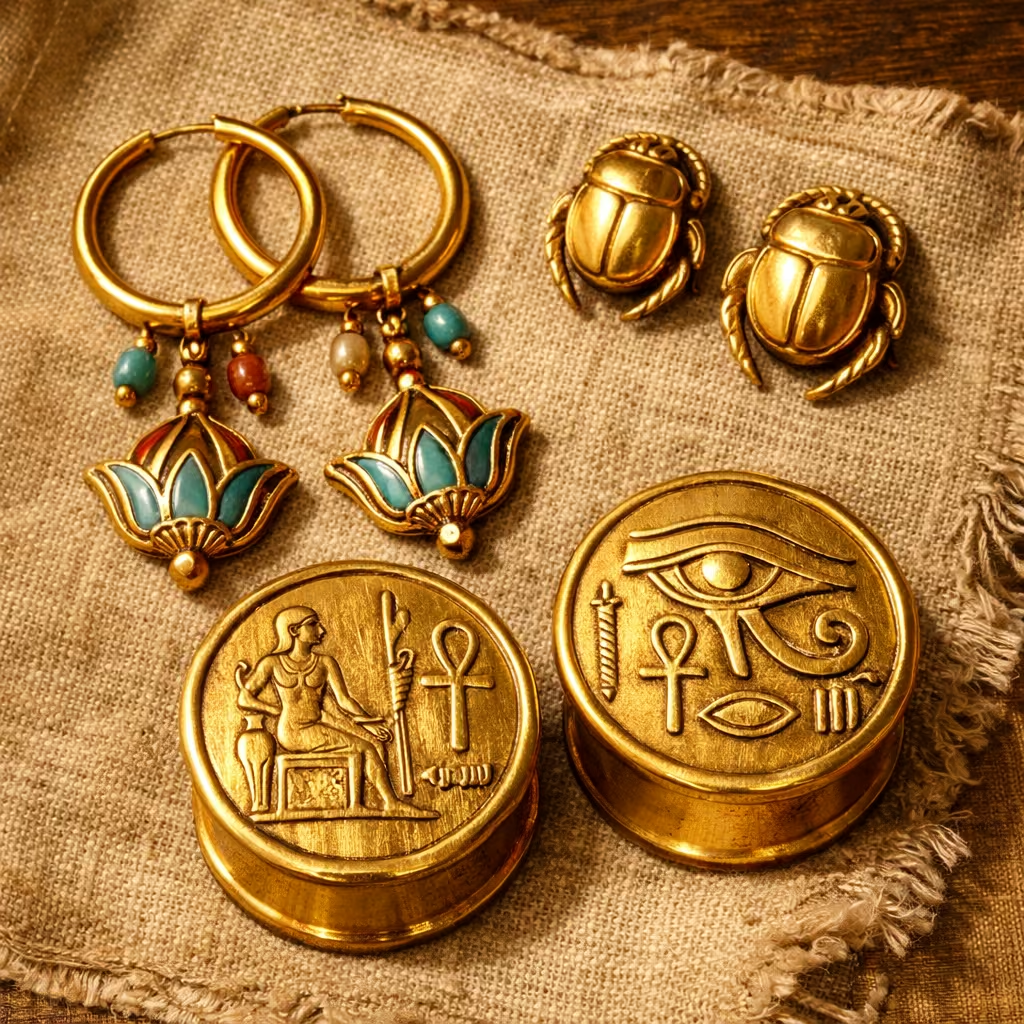
Egyptian ear jewelry evolved significantly over centuries. During the Old Kingdom period, simple gold hoops were most common. By the New Kingdom (around 1550–1070 BCE), earring designs had become increasingly complex—multi-drop earrings, elaborate pendants, and earrings incorporating precious stones such as carnelian, turquoise, and lapis lazuli had become fashionable.
Children in ancient Egypt also wore earrings. This is significant because it indicates that ear piercing wasn’t primarily about adult identity or rites of passage in this culture; it was simply part of how Egyptians adorned themselves from a young age. It was normal, widespread, and deeply embedded in everyday life.
The Ancient World Beyond Egypt: Greece, Rome, and Beyond
Egypt wasn’t the only ancient civilization that loved ear jewelry. Across the ancient world, cultures independently developed their own traditions of ear adornment. And the stories behind each one are genuinely fascinating.
In ancient Greece, ear piercing was common but had a particular nuance. Earrings were largely associated with women and were seen as a marker of femininity and beauty. Greek earrings from around 400 BCE often featured intricate goldwork — tiny birds, insects, and human figures suspended from fine gold chains. The craftsmanship was extraordinary for its time.
The Romans had a slightly more complicated relationship with ear piercing. For Roman men of the upper class, wearing earrings was sometimes considered effeminate or a mark of Eastern influence. Yet Roman women adored earrings, and elaborate drop earrings featuring gemstones like emeralds and pearls have been found across the Roman Empire. Roman soldiers, interestingly, were explicitly banned from wearing earrings — though they often pierced their nipples instead, as a mark of valor.
❝ Ancient Roman earrings have been recovered from archaeological sites stretching from Britain to Egypt — evidence of how widely these decorative traditions traveled with the empire.
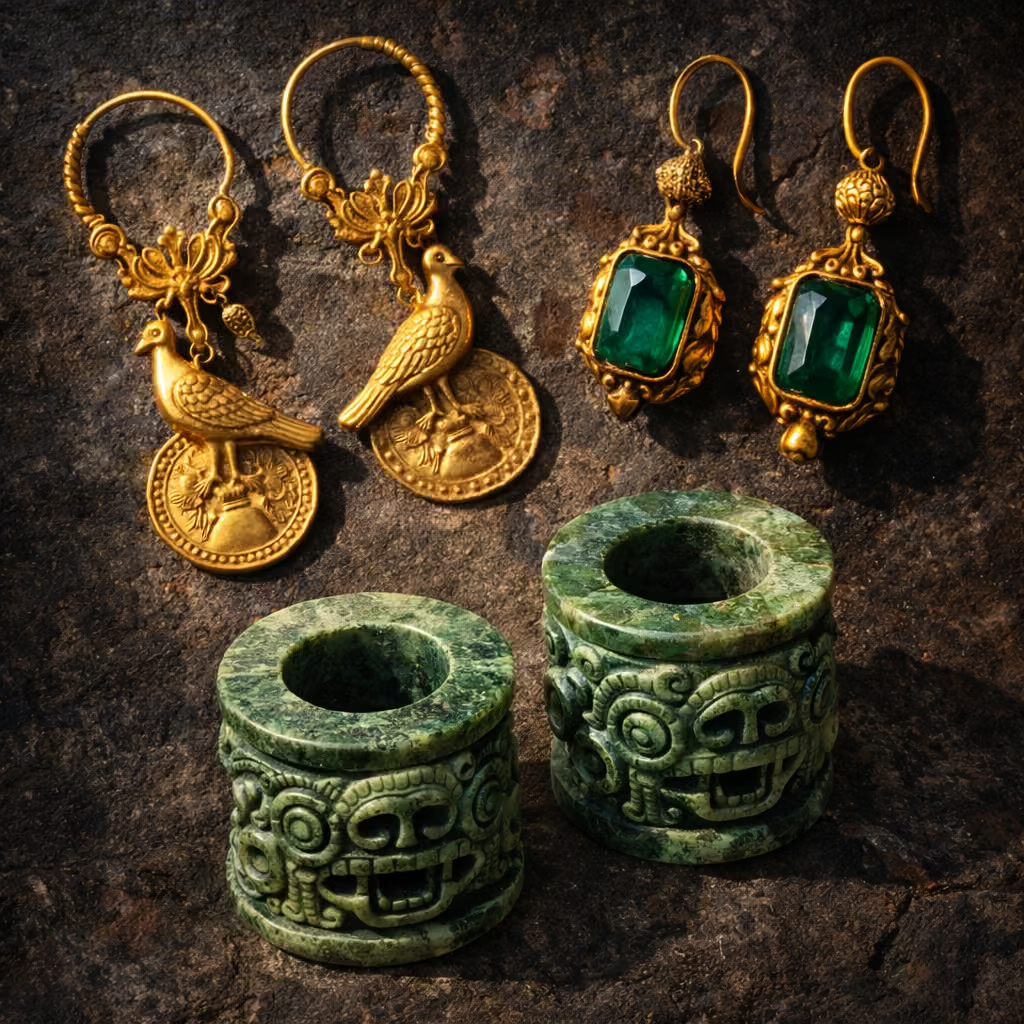
In the ancient Americas, ear piercing was widespread among the Aztec, Maya, and Inca civilizations. Here, stretched ear piercings held enormous cultural significance. Inca nobility — including the emperor himself — wore large ear spools that stretched the lobe dramatically. Upon encountering this practice, the Spanish conquistadors nicknamed the Inca nobility “Orejones,” which roughly translates to “big ears.” It wasn’t a compliment, but it’s a testament to how defining this practice was for Inca identity.
The Middle Ages: A Pause and Then a Comeback
Here’s where the history of ear piercing gets a little surprising. In medieval Europe, ear piercing largely fell out of fashion for several centuries. The primary reason? Hairstyles and headwear.
During much of the medieval period, both men and women wore elaborate headdresses, hoods, and head coverings that completely covered the ears. When your ears are always hidden, there’s not much point in piercing them. Earrings were neither visible nor relevant as a fashion statement.
The Christian Church’s influence also played a role. Some clergy spoke against body modification, viewing it as an alteration of God’s creation. While this didn’t entirely stop body adornment, it did dampen enthusiasm in certain regions and social classes.
However, ear piercing never truly disappeared during this period. Among the general public, sailors, and non-Christian cultures across Europe and Asia, piercing continued. Jewish communities, for example, maintained traditions of ear piercing for women throughout the medieval period, and traders along the Silk Road carried ear jewelry across vast distances.
The real European comeback began in the 16th century, and it came back with style.
The Renaissance and Elizabethan Era: Men, Women, and Dramatic Earrings
The Renaissance period (roughly the 14th through 17th centuries) saw a dramatic revival of interest in body adornment, including ear piercing. As fashion became more elaborate and hairstyles changed — with women wearing their hair up and men cutting theirs shorter — the ear became a visible, fashionable canvas once again.
What’s remarkable about this era is that ear piercing became genuinely fashionable for men. And not just any men — the most powerful, masculine men of the age. William Shakespeare reportedly wore a gold earring. Sir Walter Raleigh was known for his pearl drop earring. Francis Drake, the circumnavigator and sea captain, wore earrings. King James I of England wore them.
For men of this era, a single earring — typically worn in the left ear — was a mark of wealth, adventure, and worldliness. It signaled that you had traveled, had status, and weren’t afraid to make a statement. Far from being considered feminine, male ear jewelry in the Elizabethan era was deeply masculine.
❝ Want to explore how Victorian society later changed the meaning of piercings? Read our deep dive into Victorian-era piercings and their social meanings.
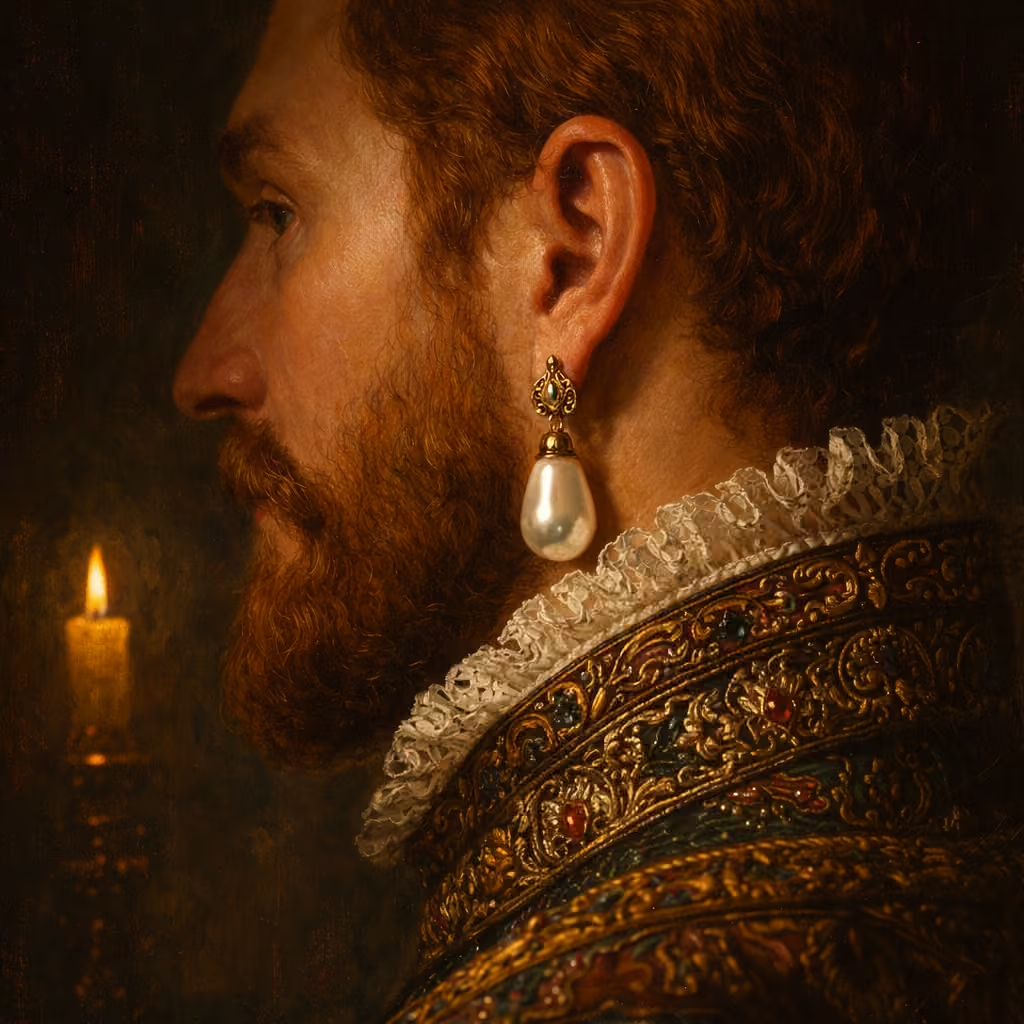
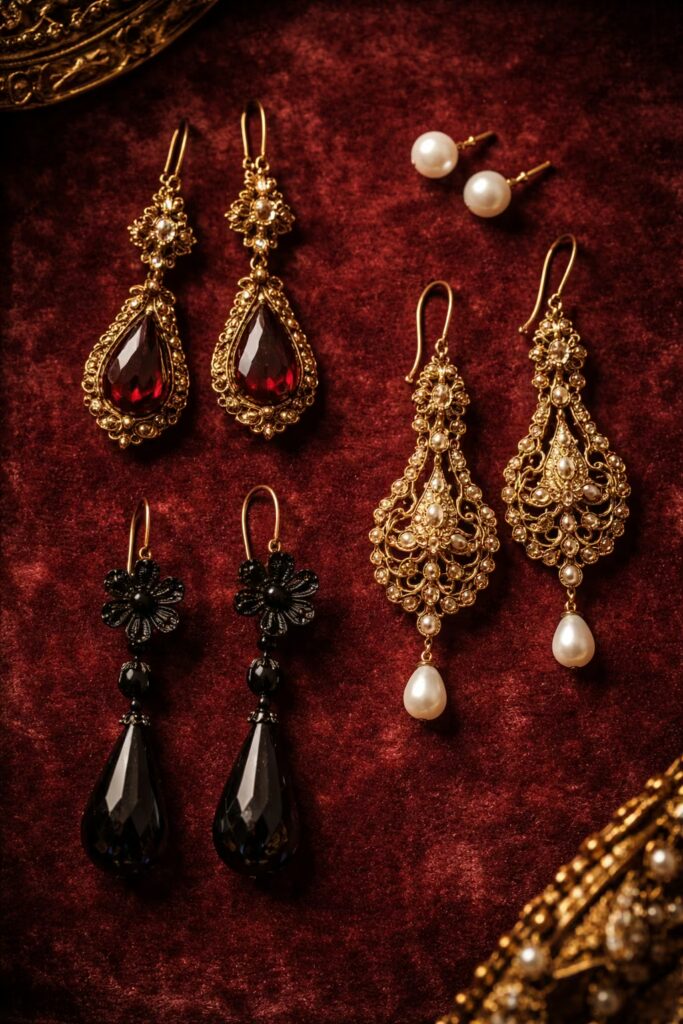
For Elizabethan women, earrings had become elaborate. Long drop earrings featuring pearls — the fashion obsession of the era — dangled from pierced ears. Queen Elizabeth I herself was a noted lover of pearl jewelry, and earrings were a central part of her iconic look. The pearl earring became a symbol of femininity, wealth, and refined taste.
This era also saw the rise of earring gifting as a romantic gesture. Giving a lover a pair of earrings was a meaningful, intimate act. The literature of the period is full of earrings as tokens of affection, devotion, and, occasionally, betrayal. Johannes Vermeer’s famous 1665 painting “Girl with a Pearl Earring” — though technically from the Dutch Golden Age — perfectly captures the intimate, almost magnetic quality of a single earring.
Ear Piercings Across Asian and Middle Eastern Cultures
While European fashion was going through its cycles of enthusiasm and restraint, ear piercing in Asia and the Middle East followed its own unbroken trajectory of cultural richness.
In India, ear piercing has been a continuous tradition for thousands of years. The practice is rooted in Ayurvedic medicine, which identifies specific ear points as acupressure points that connect to vital organs. Piercing the lower lobe, in particular, is believed to support reproductive health and ease childbirth. This medical-spiritual reasoning gave ear piercing a significance that went far beyond decoration.
The ceremony of Karnavedha — the ritual ear-piercing of children — is one of the sixteen sacred rites of passage (samskaras) in the Hindu tradition. It’s typically performed when a child is between one and five years old. The ritual involves prayers, blessings, and the careful piercing of both ears, usually by a trained jeweler or priest. It’s both a spiritual initiation and a deeply family-centered celebration.
If you’re interested in the rich traditions of piercing in South Asian culture, be sure to read our article on nose piercings in Indian and Middle Eastern traditions, which explores the deeper cultural significance of nasal jewelry in these regions.
In China, ear piercing for women dates back at least to the Zhou Dynasty (1046–256 BCE). Chinese earring designs evolved from simple gold hoops to elaborate jade pendants, and later to the delicate goldwork of the Tang Dynasty, when trade along the Silk Road brought influence from Central Asia, India, and Persia into Chinese jewelry design.
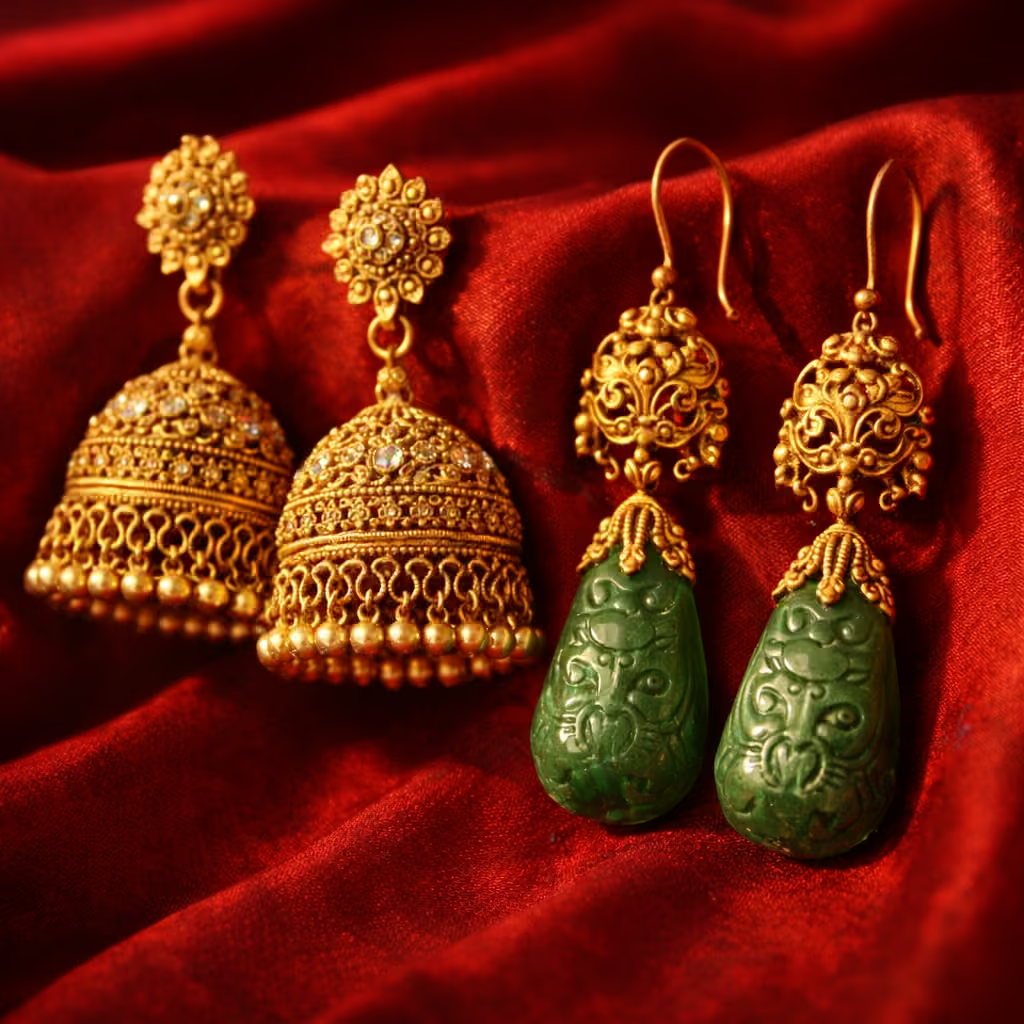
In the Middle East, ear jewelry has been documented in archaeological records stretching back to ancient Mesopotamia. Sumerian tomb excavations at Ur revealed gold earrings dating to around 2500 BCE. These were crescent-shaped gold pieces — elegant in their simplicity. Over millennia, Middle Eastern ear jewelry became increasingly sophisticated, incorporating techniques like filigree, granulation, and enamel work that later influenced jewelry-making traditions across Europe and Asia.
Tribal and Indigenous Traditions: Ear Piercing as Identity and Ritual
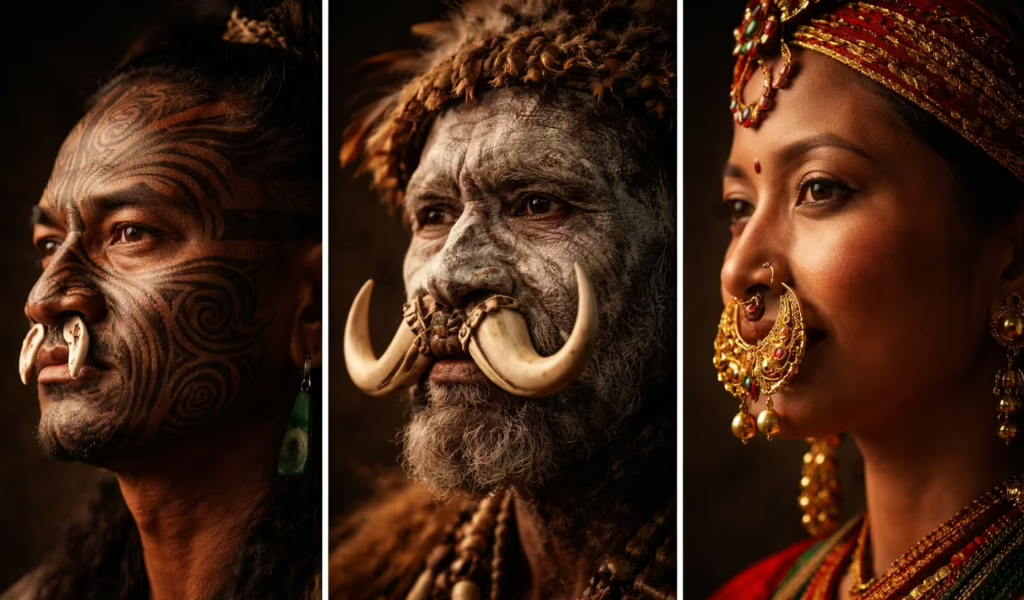
Across Africa, the Pacific Islands, and the Americas, ear piercing in indigenous cultures has served purposes beyond aesthetics. It marks identity, signals social status, communicates spiritual connection, and marks life transitions.
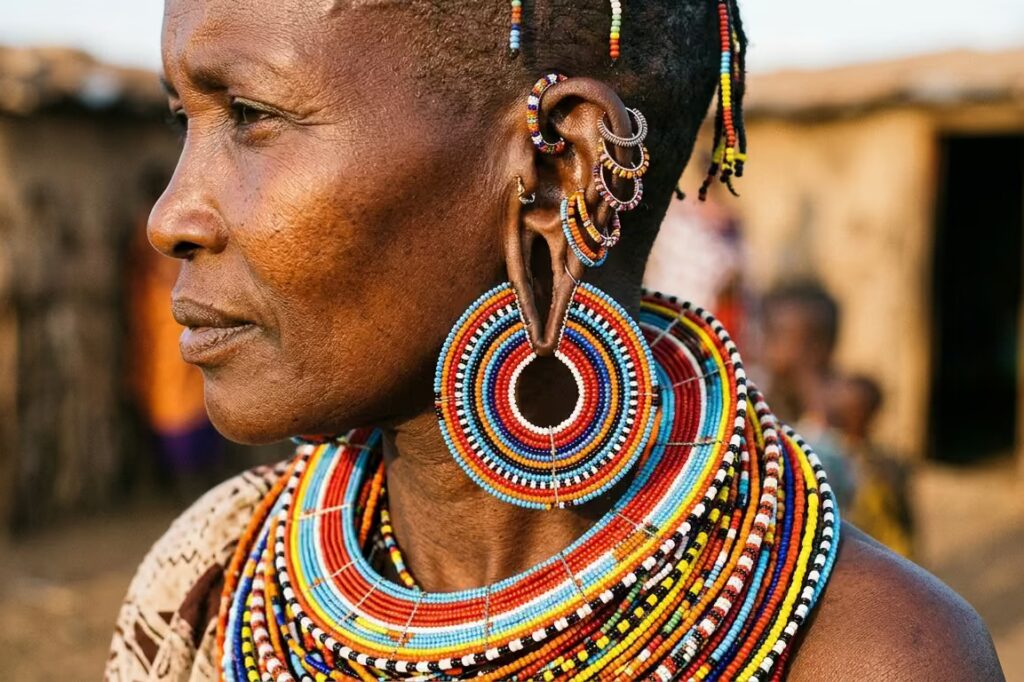
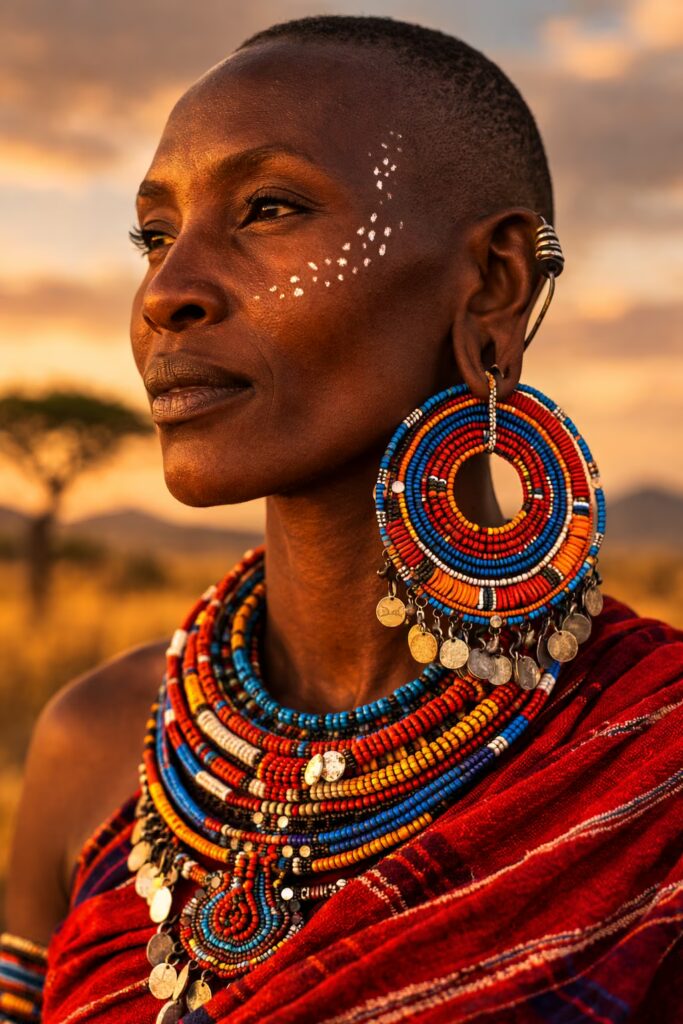
Among the Maasai people of Kenya and Tanzania, stretched earlobes are a traditional mark of beauty and cultural identity. Women and men traditionally stretch their lower lobes using progressively larger plugs of wood or stone, sometimes achieving dramatic results. The process is gradual, patient, and deeply rooted in Maasai concepts of beauty and belonging. The jewelry worn in these stretched piercings — often elaborate beadwork and metalwork — tells the story of the wearer’s clan, age group, and marital status.
In many Amazonian tribes, ear piercing is part of coming-of-age rituals that mark a young person’s transition from childhood to adulthood. The piercing ceremony is communal, witnessed by the tribe, and accompanied by specific songs, dances, and prayers. The physical act of piercing is less important than the social and spiritual transformation it represents.
❝ Curious about how different cultures use piercings as ritual symbols? Our article on tribal septum piercings: symbols and rituals worldwide explores these traditions in depth.
African cultures have developed some of the world’s most innovative approaches to piercing jewelry materials. Bone, ivory, wood, shell, copper, brass, and iron have all been used to create ear jewelry with deep cultural significance. Our upcoming piece on piercing jewelry in African cultures: materials and heritage explores these traditions beautifully.
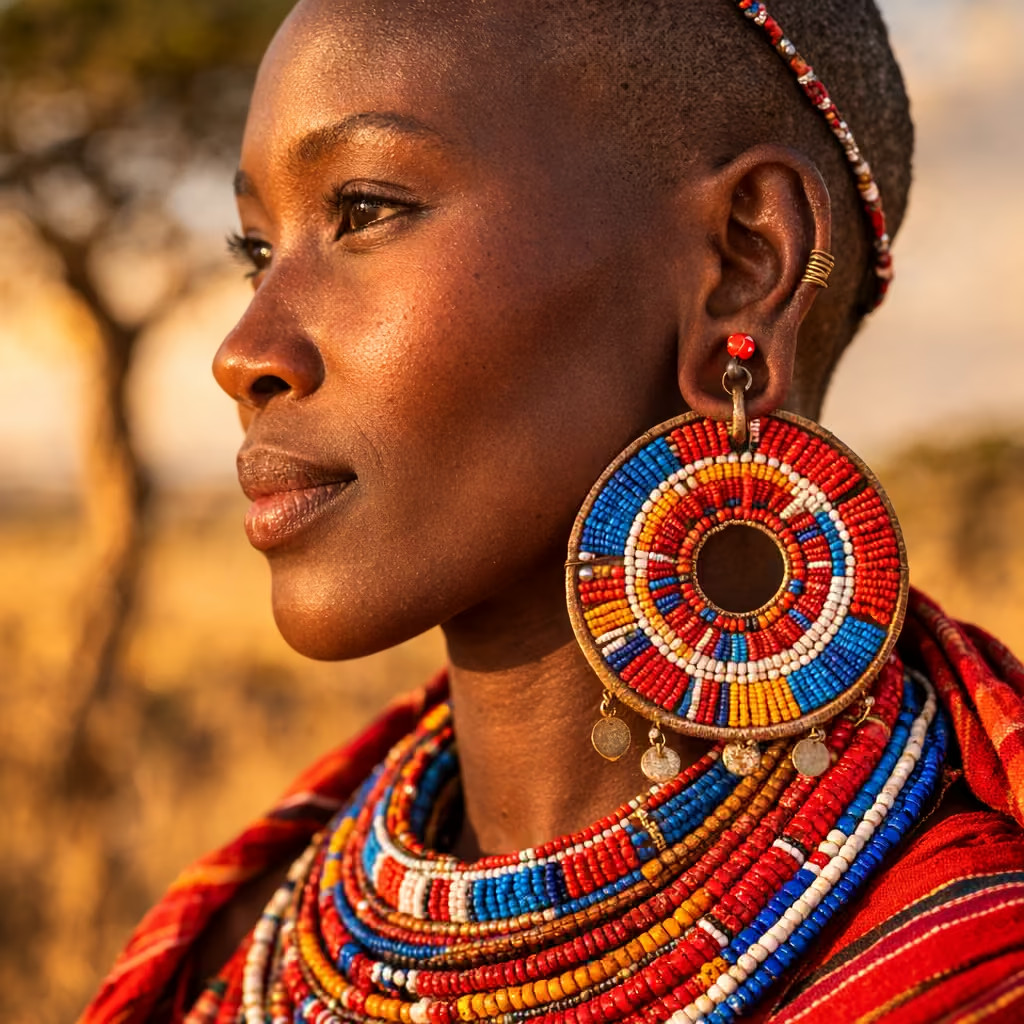
In the Pacific Islands, ear adornment among cultures such as the Māori of New Zealand and the Indigenous peoples of Hawaii and Polynesia held deep spiritual significance. Maori men and women wore ear pendants called kuru and kapeu, made from jade (pounamu), whalebone, and shell. These weren’t merely decorative — they were taonga (treasures) imbued with the spiritual power (mana) of their wearers and ancestors.
The 18th and 19th Centuries: Decline, Revival, and Medical Fashion
By the 18th century, fashion had once again shifted in ways that pushed ear piercing to the margins — at least in Europe. Elaborate wigs and powdered hair became the dominant fashion for upper-class men and women, and hairstyles that covered the ears made earrings less visible. Earrings and screw-back jewelry (which didn’t require piercing) became fashionable alternatives.
The 19th century brought another unexpected development: Prince Albert of Saxe-Coburg and Gotha — Queen Victoria’s beloved consort — reportedly wore a genital piercing. Whether this is a historical fact or a legend remains debated, but it speaks to the era’s complicated relationship with body modification. Privately, piercings were practiced across society. Publicly, they were rarely discussed.
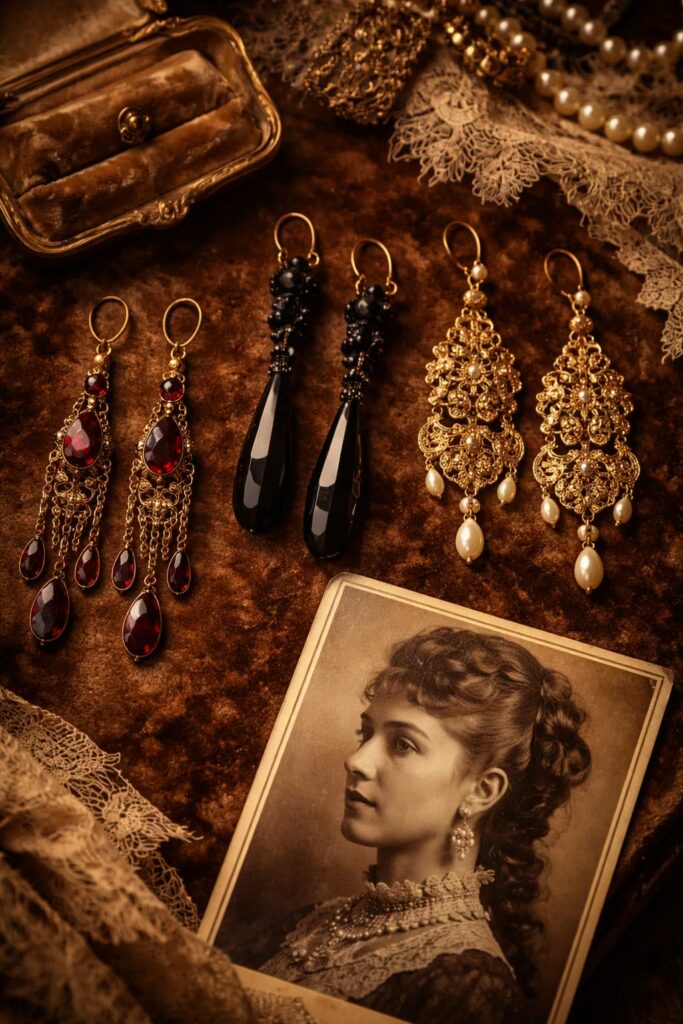
Victorian women, however, maintained a consistent love of ear jewelry. The mid-19th century saw a revival of pierced earrings—particularly long, dangling earrings—as hairstyles changed and ears became visible again. Medical advice from this era is fascinating: Victorian doctors actually recommended ear piercing for young girls, claiming it improved eyesight. This was based on the same acupressure logic as the Indian Ayurvedic tradition, and while the science was dubious, it gave respectable cover for a fashionable practice.
❝ The Victorians had surprisingly complex attitudes toward body piercing. Discover the full story in our article on Victorian-era piercings and their social meanings.
The 20th Century: Rebellion, Mainstreaming, and the Punk Revolution
The 20th century transformed ear piercing from a culturally specific practice into a global fashion phenomenon — and the journey was anything but smooth.
In the early and mid-20th century, pierced earrings were considered somewhat working-class or ethnic in Western culture. Clip-on earrings dominated mainstream fashion in the 1940s and 1950s, particularly in America. Getting your ears pierced was something immigrants did, something older women from “traditional” cultures did — it wasn’t considered particularly refined.
The 1960s changed everything. As youth culture exploded and counterculture movements embraced anything that challenged establishment norms, pierced ears made a comeback. Young women began piercing their ears in growing numbers. By the early 1970s, pierced earrings had completely overtaken clip-ons as the fashionable choice.
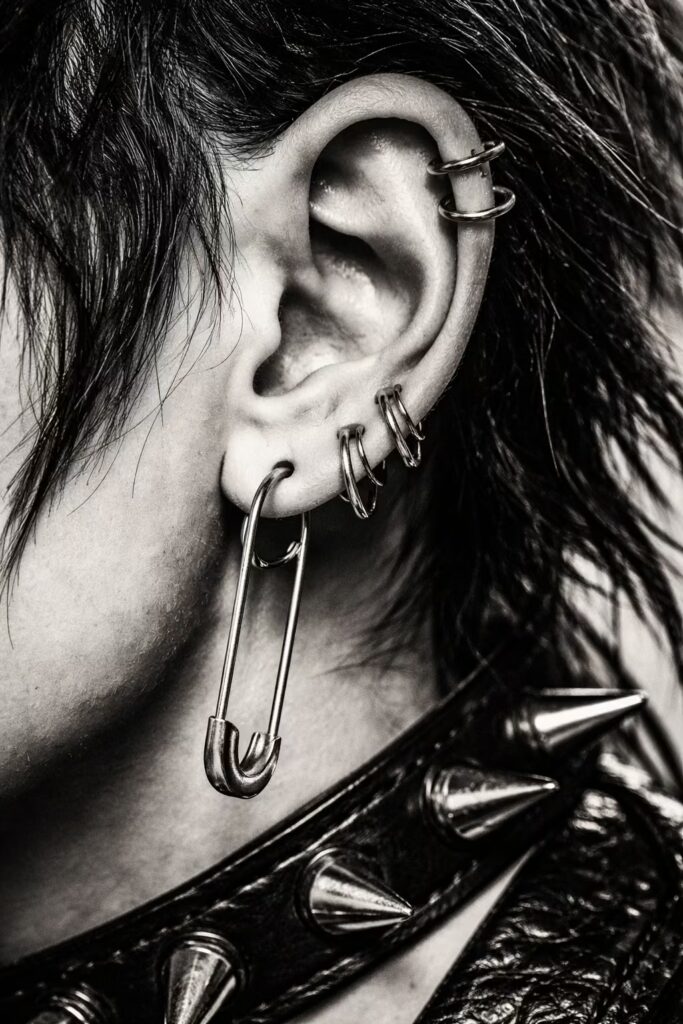
Then came punk. In the mid-1970s, the punk movement exploded out of London and New York, characterized by aggressive self-expression through appearance. Multiple ear piercings, safety pins through the ear, industrial bars, and unusual placements, such as the cartilage and helix, became associated with rebellion, nonconformity, and a deliberate rejection of mainstream aesthetics. Bands like the Sex Pistols and The Clash made multiple ear piercings as much of a statement as a mohawk or a torn t-shirt.
The 1980s saw multiple ear piercings enter mainstream pop culture. Pop stars like Madonna, Cyndi Lauper, and later Janet Jackson made dangling earrings and multiple piercings a pop-culture staple. In hip-hop culture, large hoop earrings became iconic—a visual language of boldness and confidence that remains central to the genre’s identity today.
By the 1990s, ear piercing had become widely normalized across genders and cultures. The cartilage piercing — specifically the helix — became one of the most popular piercings of the decade. Claire’s and similar mall kiosks were piercing millions of ears annually. Getting your ears pierced was no longer countercultural. It was just something you did.
The 21st Century: Curated Ears and the Art of Ear Stacking
If the 20th century made ear piercing mainstream, the 21st century turned it into an art form. Welcome to the era of the curated ear.
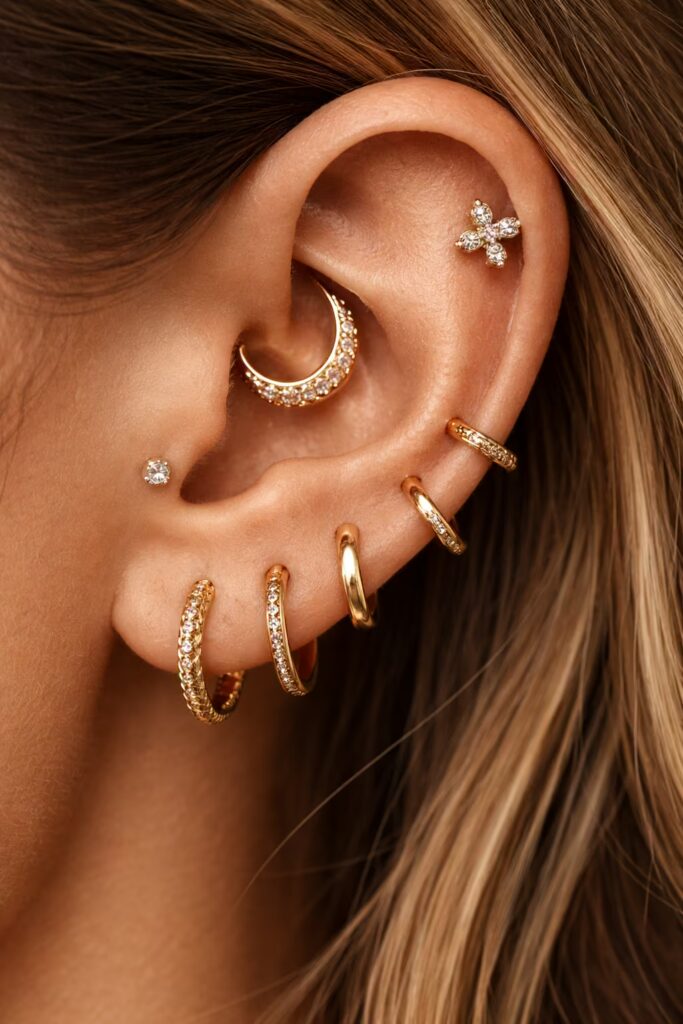
The curated ear trend — the practice of thoughtfully designing multiple piercings across the entire ear as a cohesive aesthetic composition — emerged in the early 2010s and gained popularity throughout the decade. It was driven partly by social media, where close-up ear shots became their own content genre, and partly by a new generation of jewelers creating delicate, stackable, mix-and-match pieces designed specifically for multiple-piercing looks.
Today, the vocabulary of ear piercing is astonishingly rich. Lobe piercings remain the foundation, but they’re now joined by helix, forward helix, tragus, anti-tragus, daith, rook, conch, snug, orbital, and industrial piercings. Each placement has its own aesthetic personality, its own healing timeline, and its own devoted community of enthusiasts. Getting a daith piercing feels completely different from getting a tragus, and both feel different from a classic lobe.
❝ Modern ear curation treats the ear like a canvas — every placement, every piece of jewelry, every combination tells a story about the person wearing it.
The rise of dedicated piercing studios — as opposed to mall kiosks — has significantly professionalized the industry. Studios like Studs, Maria Tash, and BVLA have made high-quality piercing with implant-grade titanium and solid gold jewelry accessible and desirable. Getting pierced is now an experience, not just a transaction.
Sustainability and ethical sourcing have also entered the conversation. A growing number of piercing enthusiasts are asking where their jewelry comes from, what it’s made of, and the environmental impact of their accessories. Recycled metals, lab-grown gemstones, and brands with transparent supply chains are increasingly popular choices.
Gender norms around ear piercing have continued to dissolve. Men with multiple earrings, men with curated ears, men wearing dainty jewelry — none of this raises eyebrows in the way it might have even twenty years ago. Celebrities and athletes have played a huge role in normalizing male ear piercing, but the shift goes deeper than celebrity influence. It reflects a broader cultural rethinking of what jewelry means and who it’s for.
What Ear Piercings Tell Us About Human Beings
Step back and look at the full sweep of ear piercing history, and something profound becomes clear. Across every culture, every era, and every social context, human beings have found reasons to pierce their ears. The specific reasons shift constantly — spiritual protection, social status, beauty, rebellion, identity, art — but the impulse itself never goes away.
There’s something deeply human about wanting to mark our bodies with meaning. An earring is a tiny thing, but the decision to wear one — where to place it, what material to choose, how many to get — is a form of self-authorship. You’re writing something about yourself on your own body. That’s been true for an Egyptian pharaoh, a Maasai elder, an Elizabethan nobleman, a London punk, and a teenager getting their first lobe piercing at a professional studio today.
Ear piercing is also a fascinating lens through which to view cultural exchange. Jewelry styles, piercing techniques, and adornment philosophies have traveled along trade routes, migration paths, and cultural exchange networks for thousands of years. The granulation technique used in ancient Sumerian earrings reappears in Greek jewelry. Indian acupressure-based piercing logic echoes in Victorian medical recommendations. African stretched-lobe traditions resonate with modern gauge culture. Nothing about ear piercing happens in isolation.
❝ The story of ear piercing is, in many ways, the story of human culture itself — how we communicate, how we celebrate, how we rebel, and how we connect.
Today, the conversation around ear piercing is richer than ever. It includes questions about cultural appropriation—particularly the adoption of traditionally meaningful styles without cultural knowledge or respect. It includes ongoing debates about professional dress codes and whether visible piercings affect career prospects (they increasingly don’t). It includes the growing intersection of piercing with mental health, as many people describe getting pierced as a way of reclaiming autonomy over their own bodies during difficult times.
It includes an ever-expanding artistic landscape in which jewelers are pushing the boundaries of design, materials, and wearable sculpture. Modern ear jewelry is genuinely art. It’s conceived by designers, crafted by artisans, curated by wearers, and appreciated by an audience that brings aesthetic literacy to the experience.
Final Thoughts: A 5,000-Year Story Still Being Written
From stretched lobes on ancient Egyptian mummies to the curated ear stacks filling your Instagram feed, ear piercing has come a long way. It has meant different things to different people in different times — and that flexibility, that richness of meaning, is exactly why it endures.
Whether you have a single pair of lobe piercings you got as a child, or a fully curated ear with a dozen carefully chosen pieces, you’re part of a tradition that stretches back at least five millennia. That’s nothing. That’s a profound connection to the long, creative, meaning-making history of your species.
The ear piercing story is still being written — in studios, on runways, in cultural communities, and in individual moments of personal choice every single day. And if history is any guide, the story will keep getting more interesting.
Want to keep exploring the world of piercing history and culture? These articles dive deeper into the traditions we’ve touched on here:
→ Nose Piercings in Indian and Middle Eastern Traditions
→ Tribal Septum Piercings: Symbols and Rituals Worldwide
→ Victorian-Era Piercings and Their Social Meanings
→ Piercing Jewelry in African Cultures: Materials and Heritage