Of all the piercings a person can get, the septum piercing might be the most universally human. It appears in cultures on every inhabited continent. It has been worn by warriors and priests, by brides and shamans, by tribal elders and teenage rebels. It has been made from bone, tusk, gold, silver, wood, shell, and surgical steel.
In nearly every culture where it appears, the septum piercing carries meaning. It is rarely just decoration. It marks status, signals danger, invokes protection, celebrates a life transition, or connects the wearer to the spiritual world. The specific meaning varies enormously from culture to culture — but the instinct to pierce the septum and hang something meaningful from it is one of the most widely shared human impulses in recorded history.
This article takes you on a journey around the world and through thousands of years of septum-piercing traditions. We will explore the specific cultures that have made this piercing central to their identity, the rituals that surround it, and the symbols it carries. Along the way, you will see just how much human creativity and meaning can hang from one small piece of cartilage.
This is the third article in our series on the history and culture of piercing. If you are just joining us, you might also enjoy The Evolution of Ear Piercings: From Ancient Egypt to Modern Trends and our deep dive into Nose Piercings in Indian and Middle Eastern Traditions.
❝ The septum piercing is one of the most geographically widespread forms of body modification on Earth — found independently in cultures from Papua New Guinea to the Amazon, from the Himalayas to sub-Saharan Africa.
What Is a Septum Piercing, and Why the Septum?
Before we go into specific cultures, it helps to understand what makes the septum such a universal choice for piercing. The septum is the cartilage wall that divides the two nostrils. The actual piercing, however, does not usually go through the cartilage itself. It passes through the soft tissue — called the columella — just below the cartilage. This makes it one of the less painful piercings available, which is part of why it has been performed in cultures without modern anesthetics for thousands of years.
Symbolically, the nose and the breath it draws have sacred significance across many spiritual traditions. Breath is life. The nose is the primary gateway through which life enters the body. Marking that gateway with jewelry or ritual scarification is a way of acknowledging its sacred importance. In many shamanic traditions, the nose is seen as a channel between the physical and spiritual worlds — adorning it is a way to open or mark that channel.
The septum’s central position on the face also makes a septum piercing one of the most visible forms of facial adornment possible. Unlike an ear piercing, which requires people to look at your profile, a septum ornament sits right at the center of your face. It commands attention. In cultures where the goal is to signal power, status, or spiritual authority, that visibility is exactly the point.
Papua New Guinea: The Tusked Warriors of the Highlands
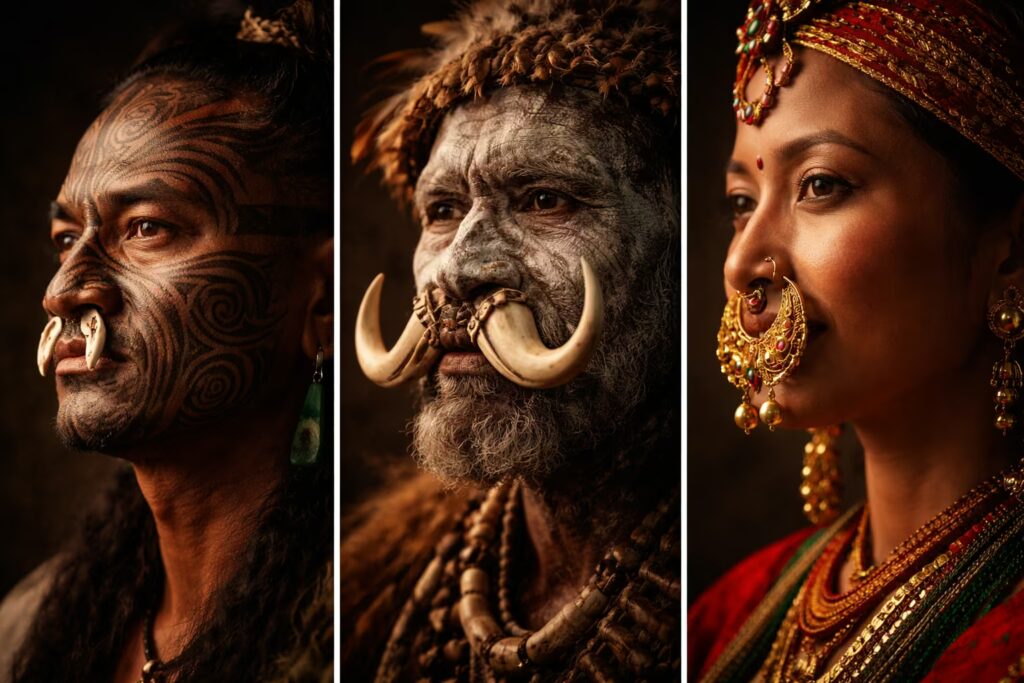
Perhaps the most dramatic septum piercing tradition in the world comes from the indigenous peoples of Papua New Guinea. Across dozens of distinct tribal cultures in the island’s highlands, lowlands, and coastal regions, septum piercings adorned with wild boar tusks have been central to male identity, warrior status, and ceremonial life for thousands of years.
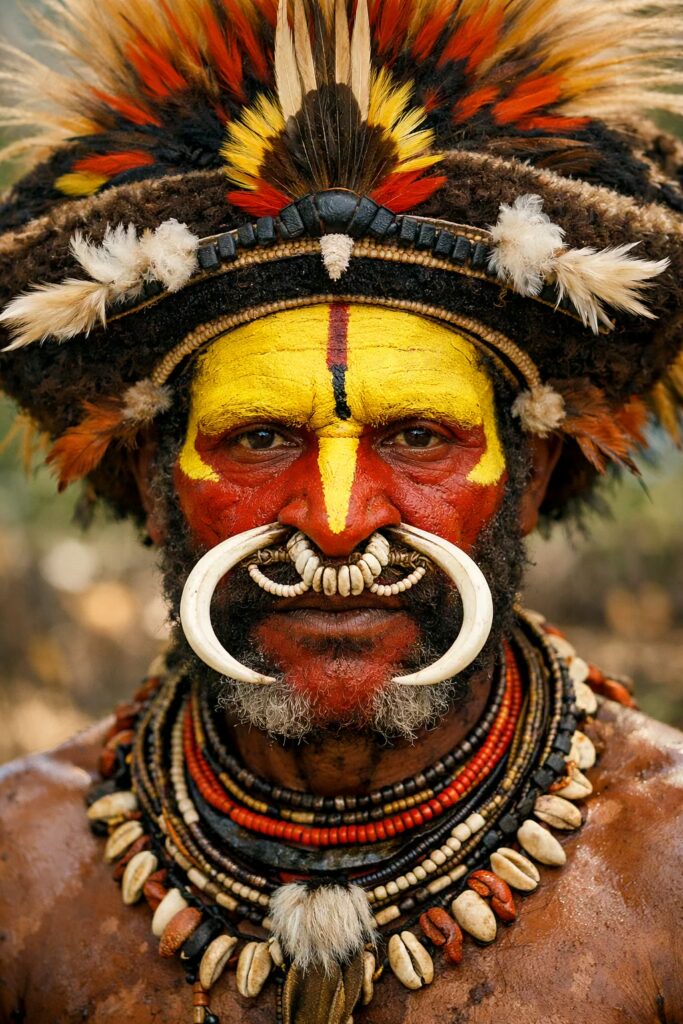
The wild boar tusk is not chosen arbitrarily. In many Papua New Guinean cultures, the boar is the most valued animal — a symbol of wealth, power, and masculine prowess. Boar tusks are used as currency, given as gifts in elaborate ceremonial exchanges, and worn as the highest form of personal adornment. A man who wears boar tusks through his septum is displaying his status in the most visible way possible.
Among the Huli people of the Southern Highlands — famous for their extraordinary wigs made from their own hair and elaborate body decoration — septum ornaments made from bone and tusk are part of a complete ceremonial appearance that also serves as a declaration of identity. The Huli wigmen are one of the most photographed peoples in the world, and their septum adornments are central to the visual language of their culture.
Septum piercing among young men in many Papua New Guinean cultures is performed as part of initiation into adulthood. The ceremony marks the end of boyhood and the beginning of a man’s responsibilities to his tribe. The pain of the piercing is part of the point — enduring it without flinching demonstrates the courage and self-control expected of a man in these communities. The ornament he then wears is a permanent record of that courage.
Women in many Papua New Guinean cultures also wear septum ornaments, though the styles and meanings differ from those of men. Smaller bone pins, shell pieces, and flower decorations are common for women. In some cultures, the specific style of a woman’s septum ornament signals her clan affiliation and marital status at a glance — the piercing functions as a form of visible identity documentation.
The Māori of New Zealand: Mana, Identity, and Sacred Adornment
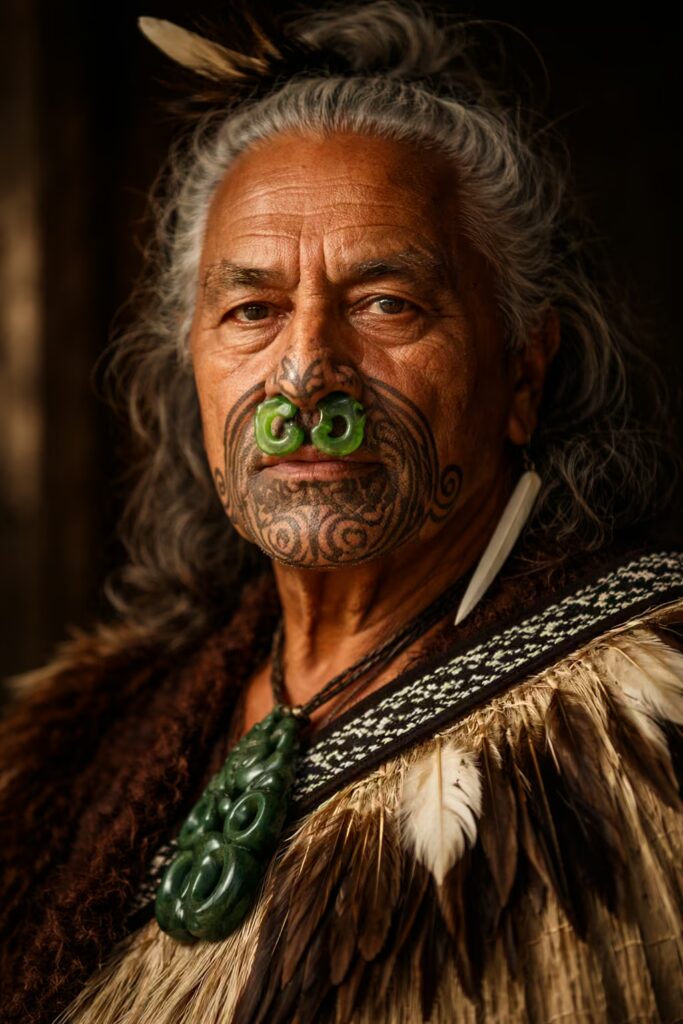
Among Māori in New Zealand, the head is the most sacred part of the body. The face, in particular, carries a person’s mana — their spiritual power, authority, and prestige. Tā moko, the traditional facial tattooing of Māori, is perhaps the best-known form of this facial sacredness. Still, septum piercing and other forms of nasal adornment have also been part of Māori aesthetic and spiritual traditions.
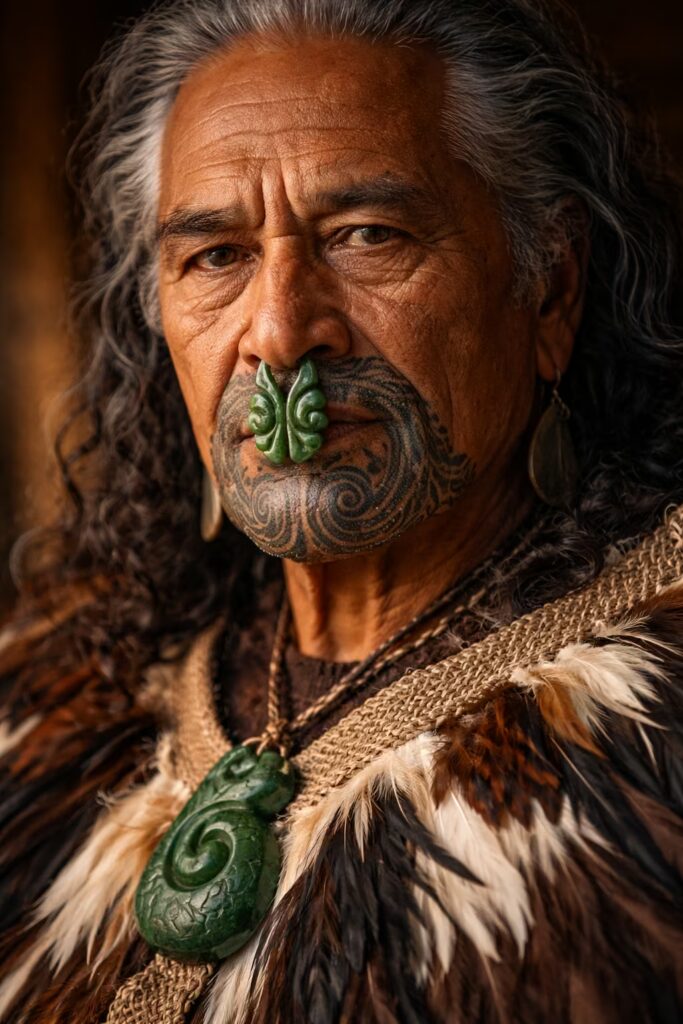
Traditional Māori septum ornaments were made from materials with deep cultural significance. Pounamu — New Zealand greenstone, also known as jade — was among the most precious materials in Māori culture, imbued with spiritual power and used to make the most important taonga (treasured objects). Whale bone and carved wood were also used. Wearing these materials through the septum was a way of bringing their mana into direct contact with the most sacred part of the body.
For Māori rangatira (chiefs and people of high rank), facial adornment, including nasal ornaments, was a visible marker of their authority and connection to their ancestors. The specific designs and materials used could communicate genealogy, tribal affiliation, and spiritual status to anyone who knew how to read them. In this context, adornment is language, not merely decoration.
❝ In Māori tradition, the head and face are so sacred that to touch them without permission is a serious transgression. Facial adornment — including septum ornaments — participates in this sacredness rather than violating it.
The Amazon Basin: Ritual, Protection, and the Forest World
Across the Amazon rainforest, numerous indigenous cultures have developed distinct septum-piercing traditions, each rooted in their specific relationship with the surrounding forest and with the spiritual forces they believe animate it.
Among the Kayapó people of Brazil, septum piercings are part of an elaborate system of body adornment that communicates social identity, spiritual status, and group membership. Young Kayapo men undergo septum piercings during initiation ceremonies that mark their transition from boyhood to full participation in adult community life. The ceremony involves the whole community — it is a collective celebration as much as a personal rite of passage.
The Kayapo use a variety of materials for their septum ornaments, including wood and resin plugs, feathers, and, more recently, metal. The specific style and material often communicate the wearer’s age group and social status within Kayapo society, where progressively more elaborate forms of adornment mark different life stages. Reading someone’s body decoration is reading their biography.
Among the Yanomami people — one of the largest relatively isolated indigenous groups in the Amazon — septum piercings are worn by both men and women. Thin sticks, feathers, and plant materials are passed through the pierced septum as everyday adornment. In ceremonial contexts, more elaborate ornaments are used. The Yanomami also pierce the lower lip and the ears, creating a complete system of body adornment with its own internal grammar.
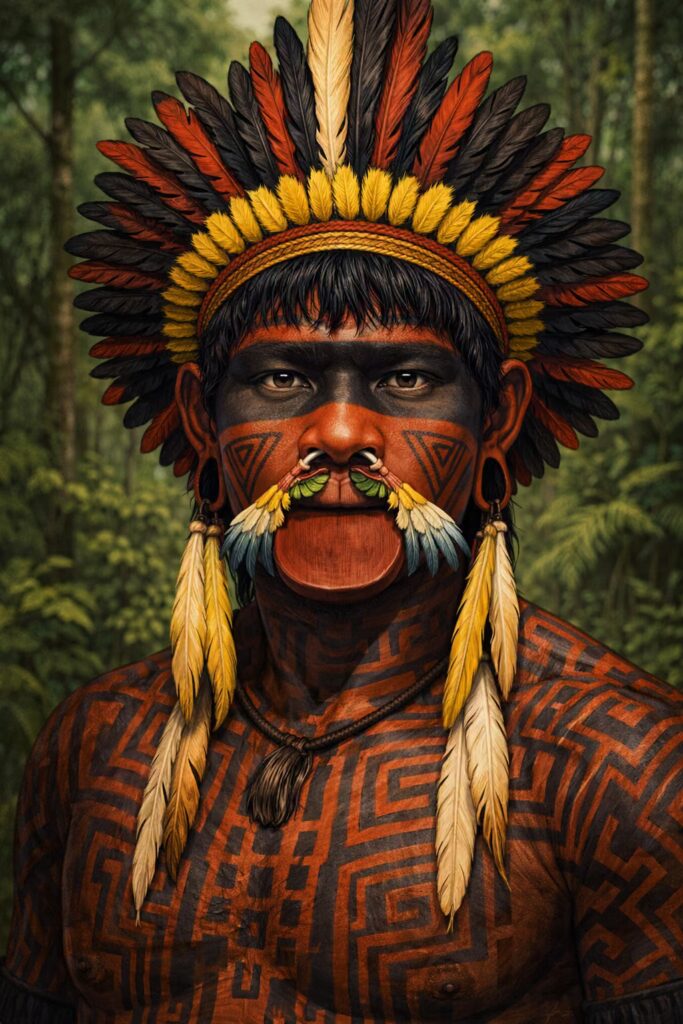
Across many Amazonian cultures, septum piercings are associated with the spirit world and with shamanic practice. In some traditions, the septum is considered a gateway between the human and spirit worlds, and piercing it is a way to open it. Shamans may wear specific ornaments believed to enhance their ability to communicate with spirits or protect them during spiritual journeys.
The materials used for septum ornaments in Amazonian cultures often carry their own spiritual significance. Feathers from specific birds are prized for their connection to particular spirits. Certain types of wood are believed to have protective qualities. The construction of a ceremonial septum ornament is a ritual act, performed with specific intentions and prayers.
South and Southeast Asia: The Bulaki, the Nath, and Beyond
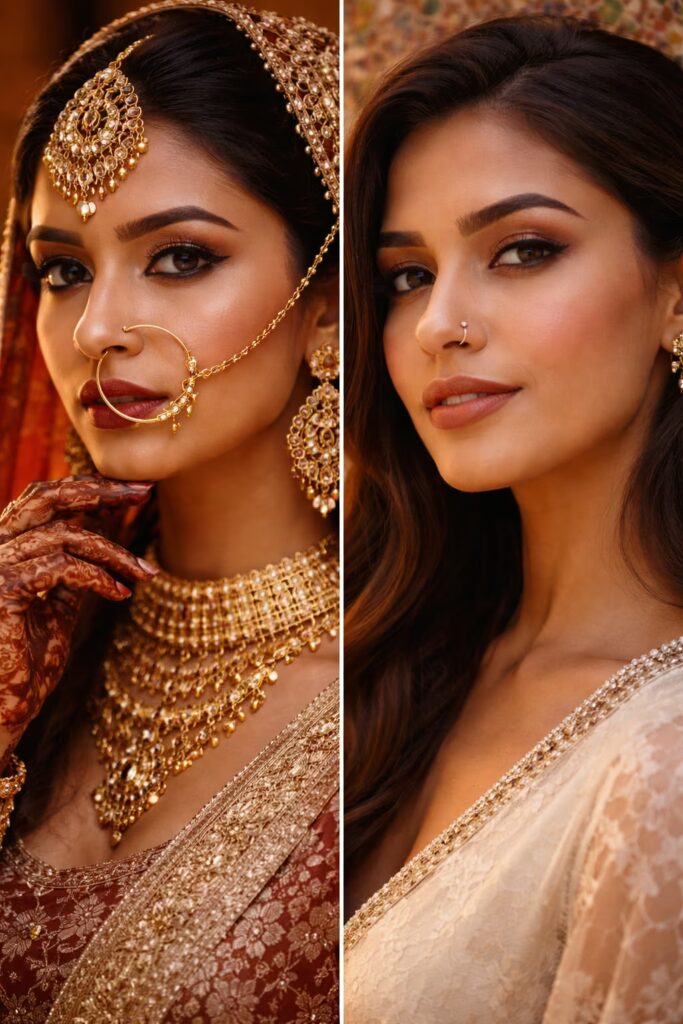
We examined nostril piercings in Indian tradition in detail in our article, “Nose Piercings in Indian and Middle Eastern Traditions.” Still, the septum has its own distinct story in South and Southeast Asian cultures that deserves separate attention.
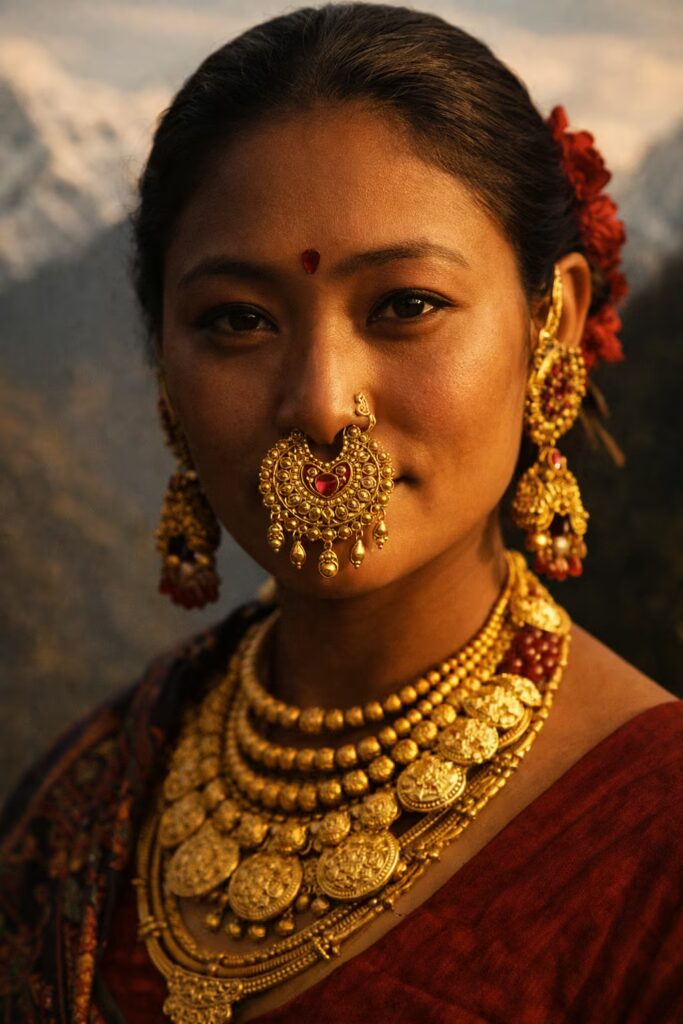
In Nepal, the bulaki is a traditional septum ornament worn by women of the Newar, Gurung, Tamang, and other ethnic groups. The bulaki typically hangs below the nose, connecting the septum piercing to a decorative pendant that may be gold, silver, or gemstone-set. The specific style of bulaki varies by ethnic group and region, making it an immediate visual identifier of cultural origin.
Among the Gurung people of the Himalayan foothills, the bulaki is one of the most important pieces of a woman’s traditional jewelry. It is typically given to a woman at her wedding and represents not just beauty but also the family’s investment in her adornment. A fine bulaki is a form of portable wealth and a marker of family prosperity. In communities where women have traditionally had limited access to formal financial assets, jewelry has served as both an adornment and a source of economic security.
❝ In the Himalayan foothills, a woman’s bulaki is not just jewellery — it is wealth she wears on her face, a form of financial security that belongs entirely to her.
In Southeast Asia, septum piercings appear across multiple distinct cultural traditions. Among the Dayak peoples of Borneo, both men and women traditionally wore septum ornaments made from brass, bone, and hornbill feathers. The Dayak — whose elaborate tattoo traditions and longhouse culture have made them one of the most studied indigenous peoples in Southeast Asia — integrated septum adornment into a complete system of body decoration that communicated everything from warrior status to spiritual protection.
Among the indigenous Apatani women of Arunachal Pradesh in northeastern India, a striking tradition involved large wooden nose plugs inserted in the nostrils alongside septum piercings. Historical accounts suggest this tradition was originally adopted to make women less attractive to raiding tribes from neighboring areas — though the practice became deeply embedded in Apatani identity and beauty standards over time. The Indian government’s efforts to discourage the practice in the 20th century are a reminder of how colonial and post-colonial powers have often tried to suppress indigenous body modification traditions.
Sub-Saharan Africa: Diversity, Craft, and Living Traditions
Africa’s cultural, linguistic, and traditional diversity makes it impossible to speak of a single “African” septum-piercing tradition. What we can say is that septum piercings are found across a wide range of African cultures, each with its own distinct aesthetic and meaning.
Among the Fulani people — one of the largest ethnic groups in West Africa, spread across more than twenty countries — nose jewelry is a central element of traditional female adornment. While nostril piercings are more common among Fulani women than septum piercings, the elaborate gold nose jewelry associated with Fulani culture is immediately recognizable and deeply meaningful. Fulani women have traditionally worn large gold hoop earrings and gold nose jewelry as markers of their ethnic identity and as a form of stored wealth.
The Mursi and Surma peoples of Ethiopia are perhaps most famous for their lip plates — large clay or wooden discs inserted into stretched lower lips — but they also practice ear and nose piercings as part of their elaborate adornment traditions. Among the Surma, scarification, body painting, and piercing work together as a complete system of bodily communication that expresses age, status, and beauty according to their own distinct aesthetic values.
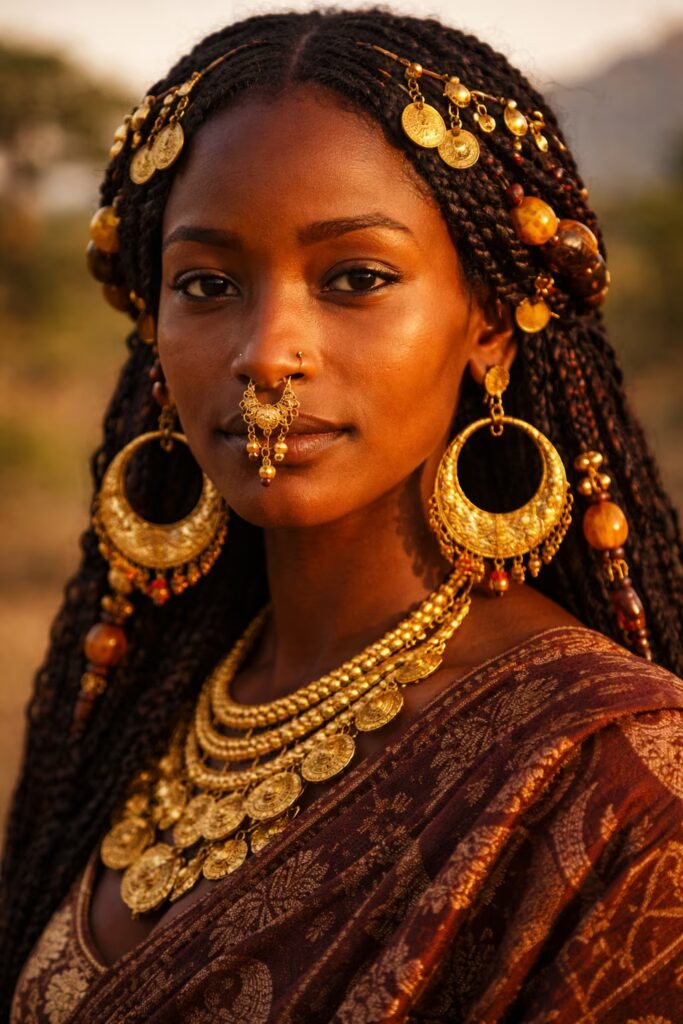
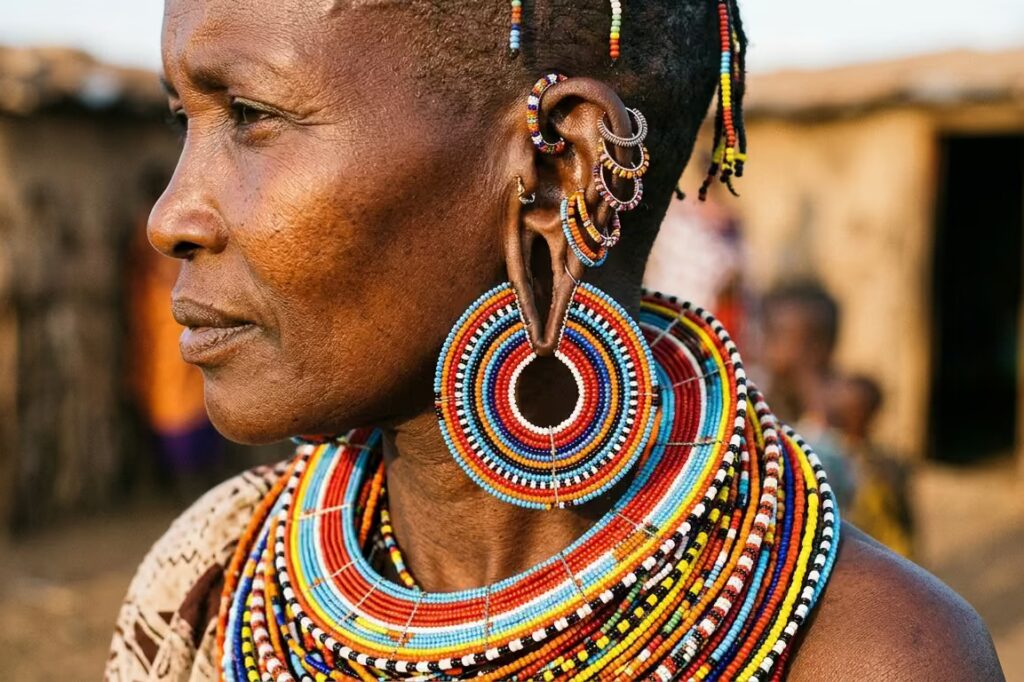
In East Africa, among the Maasai — whose stretched earlobe traditions we discussed in our article on The Evolution of Ear Piercings: From Ancient Egypt to Modern Trends — nose piercings, including septum piercings, are common in some communities alongside the elaborate beadwork ear adornment the Maasai are famous for. The Maasai system of adornment is comprehensive and age-graded—different stages of life are marked by distinct jewelry, and the specific combination of piercings, beadwork, and other adornment worn by a Maasai woman or man communicates precisely where they stand in the life cycle of their community.
Our article, “Piercing Jewelry in African Cultures: Materials and Heritage,” delves into the extraordinary materials and craftsmanship traditions of African piercing jewelry. It is well worth reading in conjunction with this article.
North America: Indigenous Traditions from the Pacific Northwest to the Southwest
Among the indigenous peoples of North America, septum piercings are found across cultures from the Pacific Northwest to the Great Plains and into the Southwest. Each tradition has its own specific context, materials, and meaning.
Among the peoples of the Pacific Northwest Coast — including the Haida, Tlingit, and Tsimshian — nose piercings, including septum ornaments, were worn alongside the elaborate carved masks, totem poles, and copper shields that made Northwest Coast art one of the most visually distinctive artistic traditions in the world. Septum ornaments were typically made from abalone shell, bone, and copper — materials that carried their own symbolic weight within Northwest Coast cultures.
Copper was among the most prestigious materials in the Pacific Northwest. The elaborate “coppers” — shield-shaped copper plates that were given and destroyed in potlatch ceremonies as demonstrations of wealth — were among the most important ceremonial objects in the region. Wearing copper as a septum ornament placed the wearer in the same symbolic universe as these great ceremonial objects.
Among the Nez Perce people of the Columbia River Plateau — whose name, given to them by French fur traders, actually means “pierced nose” — both men and women traditionally wore septum piercings. The Nez Perce wore dentalium shells through their septums, and these shells were themselves a form of currency traded across a vast network that stretched from the Pacific Coast deep into the interior of the continent. A septum ornament made of dentalium shells was simultaneously a personal adornment and a visible display of wealth and trading connections.

In the American Southwest, among the Pueblo peoples and the Navajo, nose and septum piercings were part of traditional adornment systems that integrated turquoise, shell, and silver jewelry. Navajo silversmithing — now one of the most celebrated jewelry-making traditions in North America — evolved from earlier adornment traditions, including nose jewelry. The distinctive blue-green of turquoise, believed by many southwestern cultures to carry protective properties and ward off negative spiritual forces, was a natural choice for jewelry meant to adorn a sacred part of the body.
The Ritual of the Piercing: Ceremony Across Cultures
Across all these cultures, one of the most striking patterns is how rarely a traditional septum piercing is casual or private. Across cultures, the piercing itself is a communal event—witnessed, celebrated, and embedded in ritual.
The common elements are remarkable in their consistency across wildly different cultures. There is almost always a specific time for the ceremony — an auspicious date determined by calendar, season, or life stage. There is almost always a community witness—the piercing is not done in private but in the presence of family, elders, or the entire tribe. There is almost always a ritual specialist performing the piercing — not just anyone, but someone with specific knowledge, skill, or spiritual authority.
There is almost always a period of preparation before the ceremony — fasting, bathing, prayer, or other purification practices. And there is almost always a celebration afterward — feasting, dancing, singing, or gift-giving that marks the significance of the transition that has just taken place.
❝ The pain of a traditional septum piercing ceremony is rarely incidental. In many cultures, enduring it with courage is part of the point — a public demonstration of readiness for the responsibilities that come next.
In most traditional contexts, the materials used for the first ornament in a new septum piercing are carefully selected. The first piece is not simply whatever is convenient — it is selected for its spiritual properties, its connection to the wearer’s lineage, or its symbolic relationship to the transition being marked. Among some people, the first ornament is made specifically for the ceremony by a craftsperson with ritual knowledge. Among other things, it is a family heirloom — a piece used in the same ceremony for generations.
Septum Piercings and the Spirit World: Shamanic and Sacred Connections
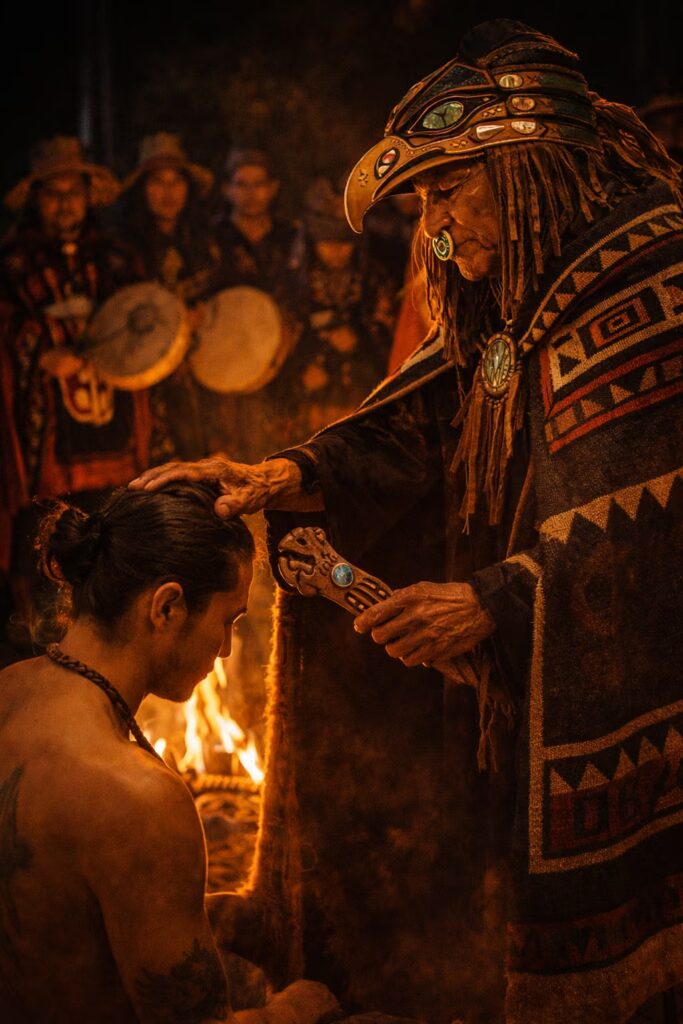
Across many of the cultures we have explored, septum piercings have a specific connection to the spirit world that deserves its own discussion. The association between nose piercings and spiritual power is not coincidental — it reflects deeply held beliefs about the body, breath, and the boundaries between the human and non-human worlds.
In shamanic traditions from Siberia to the Amazon, the shaman is a specialist in crossing the boundary between the ordinary world and the spirit world. Their bodies are often marked in specific ways that signal this capacity — and in many shamanic cultures, nose adornment, including septum ornaments, is part of that marking. The nose, as the seat of breath and life, is an appropriate location for ornaments that signal connection to the forces of life beyond the physical body.
Among some Siberian shamanic traditions, the specific ornaments worn by a shaman — including nose and ear jewelry — are believed to be inhabited by helping spirits. The ornaments are not passive decorations. They are active participants in the shaman’s spiritual work, channels through which spiritual power flows and focuses. Losing or damaging these ornaments is a serious spiritual matter, not merely a material loss.
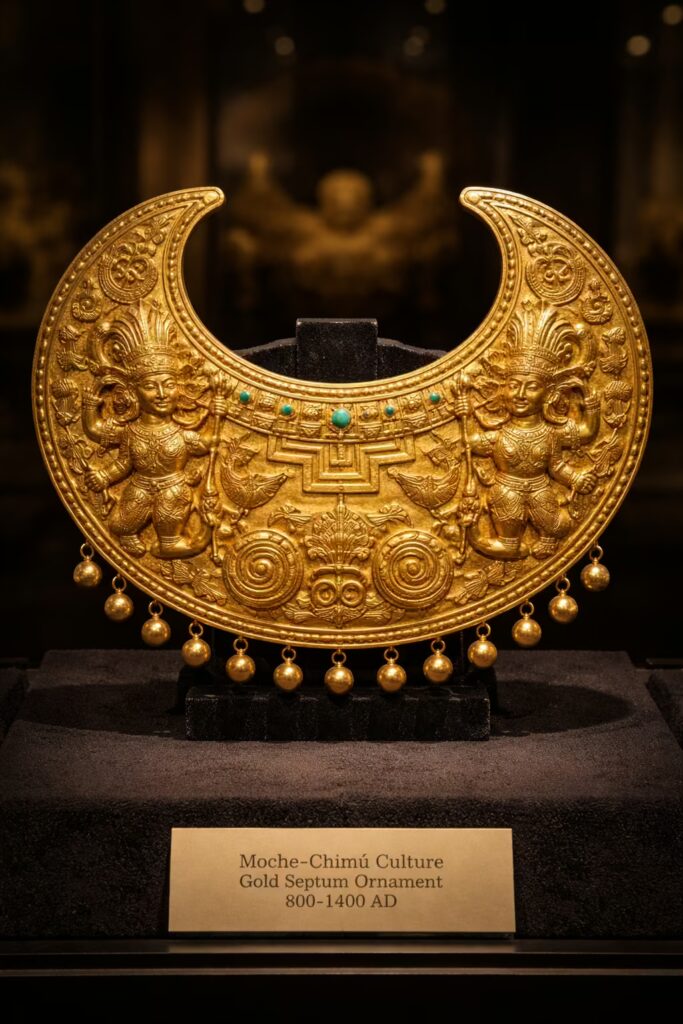
In the Andes, among the peoples who preceded and surrounded the Inca civilization, nose ornaments — including large gold septum pieces — were among the most important spiritual objects a person could own. Archaeological excavations of burial sites from cultures such as the Moche and Chimú have found extraordinary gold nose ornaments buried with high-status individuals. These pieces were clearly not merely decorative — they were part of the person’s spiritual identity, important enough to accompany them into death.
❝ Gold nose ornaments buried in Andean archaeological sites thousands of years old tell us something profound: the septum piercing was considered part of a person’s spiritual identity, not just their appearance.
Colonial Suppression and Cultural Survival
The history of tribal septum piercings is not only a story of celebration and meaning. It is also a story of suppression, survival, and resilience. Across the world, the arrival of European colonial powers and Christian missionaries brought systematic efforts to eradicate indigenous body modification practices — including septum piercings — as part of broader campaigns to destroy traditional cultures and replace them with European norms.
Missionaries across the Pacific, the Americas, and Africa consistently targeted body piercing and decoration as markers of “savagery” that needed to be overcome. Indigenous peoples were pressured — and in many cases physically forced — to remove their piercings, stop their ceremonies, and adopt European dress and appearance. This was not a neutral cultural exchange. It was a deliberate attack on the practices through which indigenous peoples expressed and transmitted their identities.
The consequences were devastating for many traditions. In some communities, knowledge of the specific rituals, materials, and meanings associated with traditional piercings was lost within a generation or two. In other cases, practices were driven underground—maintained secretly within families or communities while publicly suppressed. In still others, the tradition was openly maintained in defiance of colonial pressure, at a high personal cost to those who refused to abandon it.
The 20th and 21st centuries have seen significant efforts at cultural revitalization across many indigenous communities. Young people in Papua New Guinea, the Amazon, and the Pacific Northwest are reclaiming traditional adornment practices, including septum piercings, as part of broader movements to reconnect with their ancestral cultures. These efforts are not merely nostalgic. They are political acts—assertions that indigenous cultures are living, valuable, and worthy of continued existence.
❝ Reclaiming a traditional septum piercing today, in many indigenous communities, is not just a personal choice. It is an act of cultural resistance and a refusal to let colonial suppression have the final word.
The Modern Septum Piercing: From Subculture to Mainstream
In Western cultures, the septum piercing has a distinct modern history—quite separate from the traditional contexts we have been exploring, though increasingly in conversation with them.
In the Western world, septum piercings first entered mainstream visibility through punk culture in the 1970s and 1980s. In the punk aesthetic — which deliberately drew on “primitive” and non-Western visual cultures as a way of shocking mainstream society — large rings through the septum were a powerful symbol of rejection of bourgeois norms. The septum ring said, “I am not playing by your rules.” It was confrontational by design.
Throughout the 1990s and 2000s, the septum piercing spread from the punk subculture into the broader alternative and underground communities, including metal, goth, hip-hop, and the emerging body modification community. Professional body modification artists and the Association of Professional Piercers (APP) developed standardized safe practices for septum piercing, making the procedure much safer and more consistent than in informal settings.
Then came the 2010s, and the septum piercing went mainstream in a way that would have seemed impossible twenty years earlier. Celebrities, pop stars, and fashion models began openly wearing septum rings. Social media brought the “septum flip”—a horseshoe-shaped piece that can be flipped up inside the nostrils to conceal a piercing—to millions of people who appreciated the ability to hide it for work or family occasions.
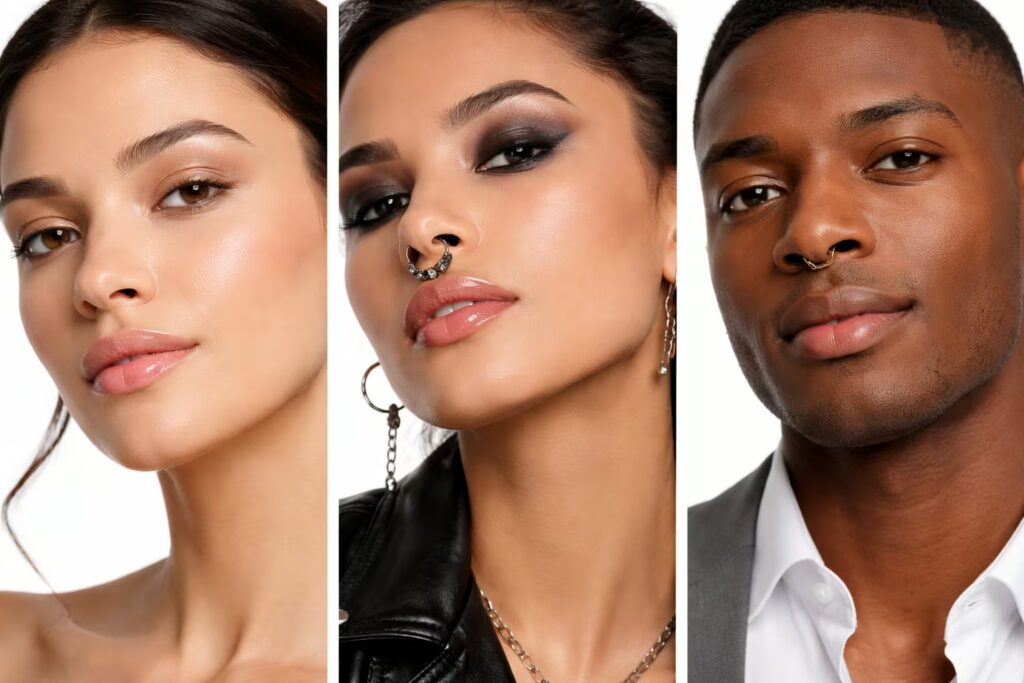
Today, the septum piercing is among the most popular piercings worldwide, worn by people of every age, gender, culture, and style. Modern septum jewelry has become an art form in its own right — from delicate gold seamless rings and ornate clicker pieces set with precious stones, to bold statement pieces that reference tribal aesthetics. The best contemporary piercing jewelry combines modern metalworking technology with design sensibilities that sometimes deliberately echo the traditional ornaments we have been exploring throughout this article.
This brings us to the question of cultural sensitivity. As the septum piercing has gone global, it has inevitably brought non-Western aesthetic traditions into contact with mainstream Western fashion. Large septum rings that reference tribal aesthetics are common in fashion and festival contexts. Whether this constitutes cultural appreciation or cultural appropriation depends on context, intent, and execution — and it is a conversation worth having thoughtfully.
Final Thoughts: One Piercing, a Thousand Stories
We have traveled from the highlands of Papua New Guinea to the rainforests of the Amazon, from the Himalayan foothills to the Pacific Northwest Coast, from ancient Andean burial sites to modern piercing studios. In each place, we have found the septum piercing remarkable — carrying meaning, marking transitions, and connecting wearers to their communities and spiritual worlds.
The diversity of forms this takes is extraordinary. A boar tusk through the septum of a Huli wigman in Papua New Guinea and a delicate gold ring on a person walking down a city street are technically the same piercing — and yet the worlds of meaning surrounding them could hardly be more different. That is not a problem to be resolved. It reflects the richness of human culture.
What unites all these traditions, across all their differences, is the basic human insistence that the body is a meaningful surface. What we put on it and through it says something about who we are, where we come from, what we believe, and what we are willing to endure. The septum piercing has been said in languages as different as Huli and English, Quechua and Māori, for thousands of years.
Keep exploring the world of piercing history and culture with these articles in our series:
→ Victorian-Era Piercings and Their Social Meanings
→ Piercing Jewelry in African Cultures: Materials and Heritage