The Victorians had a reputation for being buttoned-up, repressed, and rigidly proper. And in many ways, that reputation is deserved. Victorian society ran on rules — rules about dress, behaviour, class, and respectability that governed every aspect of daily life.
But underneath all that propriety, something surprising was going on. The Victorians were quietly piercing themselves in ways that would raise eyebrows even today. Ear piercings, nipple piercings, and genital piercings all have documented histories in the Victorian era. And even the most respectable forms of Victorian jewellery carried coded social meanings that most modern wearers would never guess.
This is the fourth article in our series on the history of piercing. We have already covered the ancient history of ear piercings, nose piercing traditions in India and the Middle East, and tribal septum piercings around the world. Now we step into the drawing rooms, bedrooms, and jewellery shops of Victorian Britain — and what we find there is far more interesting than you might expect.
❝ The Victorians were far more complicated about body adornment than their prim public image suggests. Underneath the corsets and top hats, a fascinating culture of piercings was quietly flourishing.
Ear Piercings: Respectable, Medical, and Fashionable
Ear piercing in the Victorian era occupied an interesting middle ground. For much of the early 19th century, it had fallen somewhat out of fashion among upper-class British women, who preferred clip-style earrings and ear screws that did not require piercing. But by the 1860s and 1870s, pierced ears had made a strong comeback — and this time they came with a medical endorsement.
Victorian doctors, drawing on a long tradition of folk wisdom with roots in Ayurvedic medicine, recommended ear piercing to improve eyesight. The claim was that piercing the earlobes stimulated nerves connected to the eyes. The science was entirely without basis, but the authority of medical opinion gave middle-class women who wanted their ears pierced a respectable reason to do it. Ear piercing was not vanity — it was healthcare.
By the 1880s and 1890s, long drop earrings had become enormously fashionable. Queen Victoria herself wore earrings, which gave the practice an unimpeachable stamp of respectability. The styles of the era favoured drops featuring pearls, garnets, amethysts, and paste gemstones — pieces that were delicate, feminine, and appropriately restrained in their elegance.
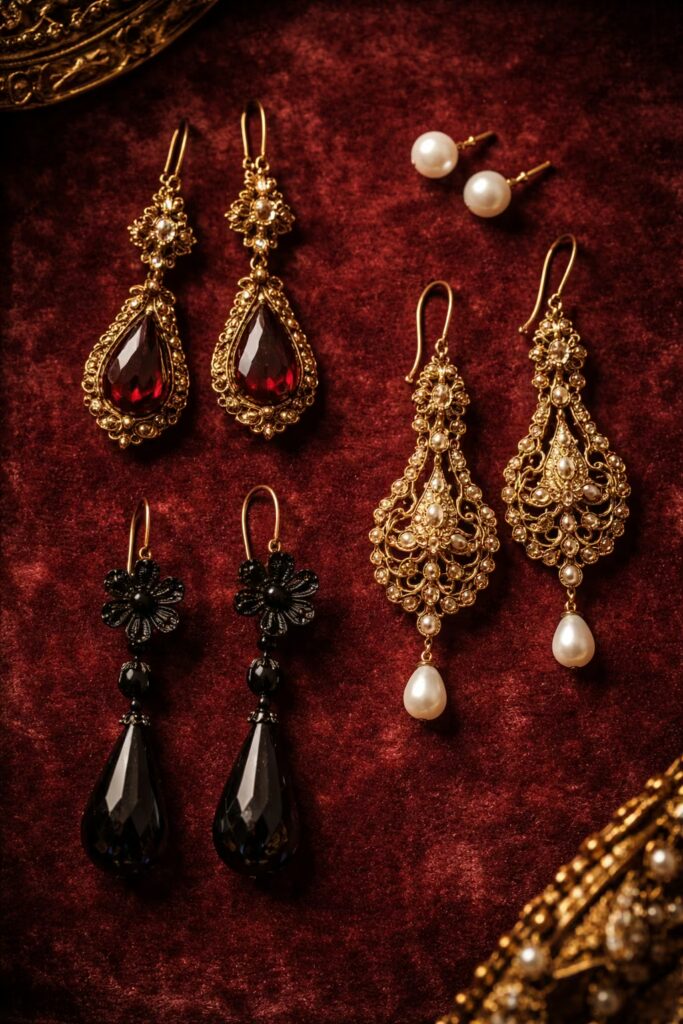
Class distinctions were evident in earring styles. Wealthy women wore earrings made from solid gold set with genuine gemstones. The growing middle class wore gold-filled or gold-plated pieces set with paste or semi-precious stones. Working-class women, if they wore earrings at all, wore simple brass or silver hoops. The earring you wore told anyone who looked exactly where you stood in the social hierarchy.
Mourning Jewellery: Grief Made Visible
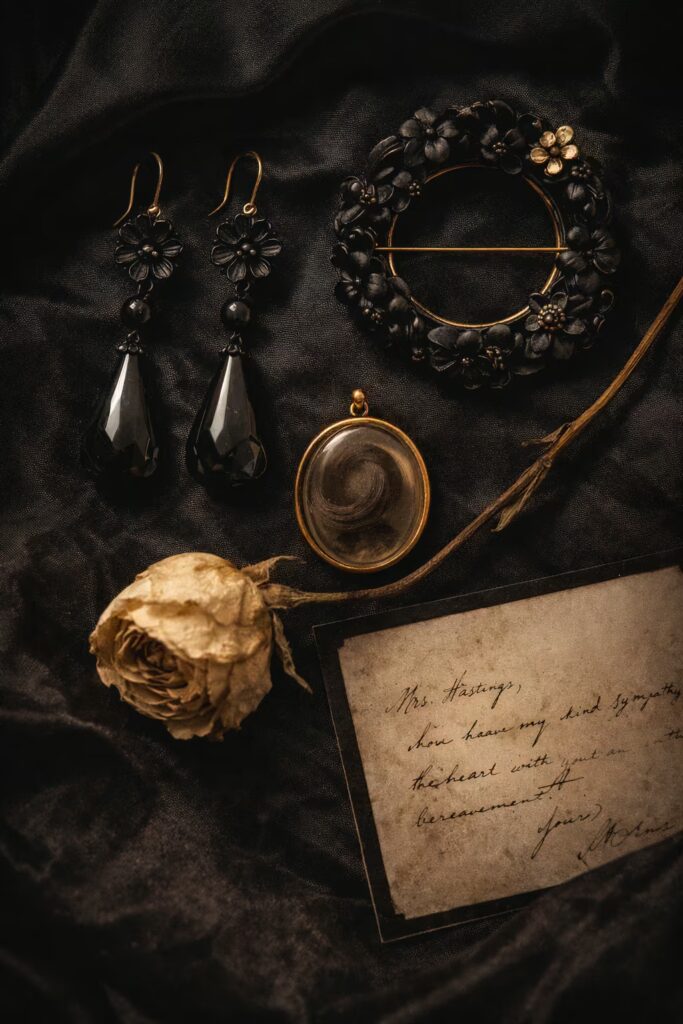
One of the most distinctive and emotionally powerful aspects of Victorian jewellery culture was mourning jewellery — pieces worn specifically to display and communicate grief after the death of a loved one. This tradition reached its peak after the death of Prince Albert in 1861, when Queen Victoria entered a prolonged period of mourning that lasted until her own death in 1901 and set the tone for the entire country.
Mourning earrings and other mourning jewellery were made primarily from jet — a form of fossilised wood mined in Whitby, Yorkshire, that produces a deep, lustrous black. Jet earrings, brooches, necklaces, and bracelets became the uniform of respectable grief. Wearing them was not merely a personal expression. It was a social obligation. Appearing in public without mourning jewellery during the prescribed mourning period was a serious breach of social etiquette.
❝ After Prince Albert’s death, Queen Victoria wore mourning jewellery every day for forty years. Her grief was displayed on her body — and the whole country followed her lead.
The Victorians had an elaborate and rigidly codified system of mourning periods and dress requirements. Full mourning — which lasted up to two years for a widow — required all-black clothing and jet jewellery. Half mourning enabled the gradual introduction of grey, mauve, and white, with jewellery shifting from jet to amethyst, then to pearls, and eventually to colour. Moving through these stages too quickly was socially condemned. Jewellery was the visible evidence of the sincerity and duration of your grief.
Hair jewellery was another deeply personal form of Victorian mourning adornment. Earrings, brooches, and rings incorporating locks of hair from deceased loved ones were common. This sounds macabre by modern standards, but within the Victorian emotional framework, it was an act of profound tenderness — keeping the physical presence of a loved one literally on your body.
The Language of Gemstones: Saying What You Could Not Speak
Victorian society was governed by strict rules about what could be said openly, especially between men and women who were not yet married. Direct declarations of romantic interest were hedged about with convention and chaperones. This constraint gave rise to one of the most charming codes in jewellery history: the acrostic gemstone message.
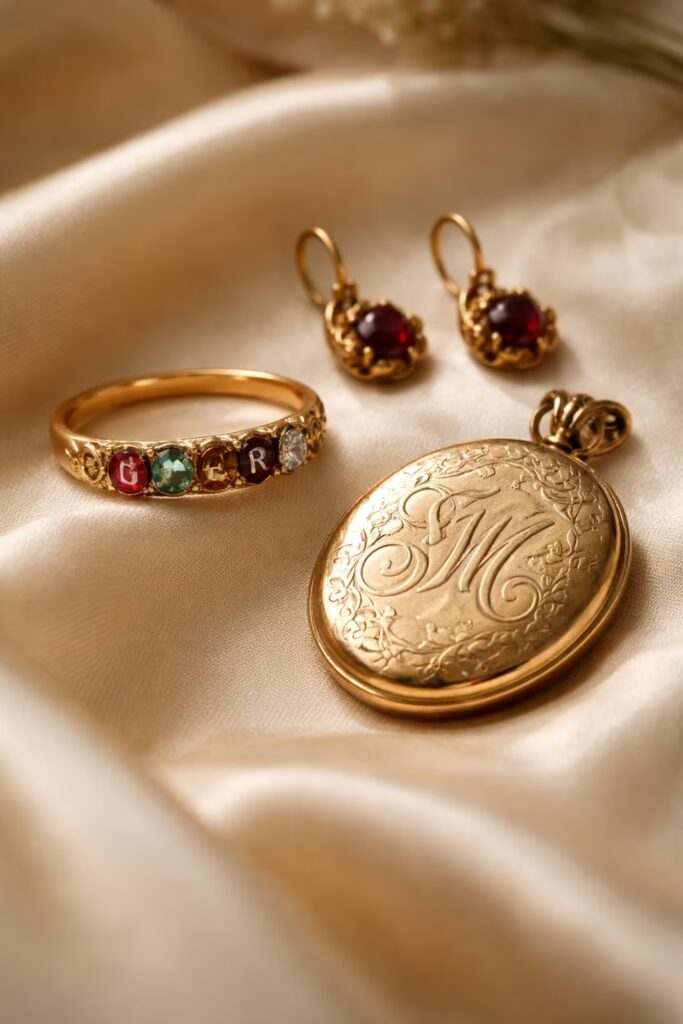
Acrostic jewellery spelled out words using the first letter of each gemstone in a piece. A ring or earring set with a Ruby, an Emerald, a Garnet, an Amethyst, a Ruby, and a Diamond spelled out REGARD. A piece with a Lapis lazuli, an Opal, a Vermeil (hessonite garnet), an Emerald, and a Diamond spelled LOVED. These pieces were given as tokens of affection between people who could not simply say what they meant.
The recipient would know how to read the message. The giver could deny any improper intent if challenged — it was just a piece of jewellery, after all. The code allowed both parties to communicate genuine feelings while maintaining complete social deniability. It was romantic, clever, and perfectly calibrated to the constraints of the era.
❝ REGARD rings — Ruby, Emerald, Garnet, Amethyst, Ruby, Diamond — were one of the most popular romantic gifts of the Victorian era. The feeling was in the stones, hidden in plain sight.
Nipple and Genital Piercings: The Victorian Secret
Here is where the Victorian story gets genuinely surprising. Despite their public image of rigid propriety, there is credible historical evidence that nipple piercings — and possibly genital piercings — were practiced among fashionable Victorian society, both by women and by men.
The most widely cited piece of evidence for Victorian nipple piercings comes from a letter published in The Society Journal in 1899. The letter describes “bosom rings” as a fashionable accessory among society women, claiming they were sold by jewellers in Paris and London. The writer notes that women who wore them reported that they enhanced the shape visible beneath thin fabrics—a concern relevant to the era’s fashions, which featured tight bodices and considerable attention to the bust silhouette.
How widespread this practice actually was is impossible to verify. The evidence is largely anecdotal, and the Victorians’ well-documented tendency to keep private behaviour very private means we are unlikely to find detailed records. What we can say is that the idea was circulating in fashionable circles, was sufficiently well known to be referenced in a published letter, and was not so shocking as to prevent that letter from being published.
The “Prince Albert” genital piercing — named, by legend, after Queen Victoria’s consort — has an even more contested history. The story claims Prince Albert wore a penile piercing to keep himself neatly arranged within his tight trousers. Whether this is a historical fact or a colourful fiction invented in the 20th-century body modification community remains genuinely unresolved. No direct contemporary evidence confirms it. But the persistence of the story tells us something about how the Victorians have been mythologised — as people whose private lives were very different from their public faces.
Piercing Parlours and the Working Class: A Different Story
The history of Victorian piercings is not limited to the upper and middle classes. Working-class piercing traditions in the Victorian era had a distinct character, driven by different motivations.
Sailors were among the most enthusiastic piercers of the era. The belief that a gold earring paid for a sailor’s funeral if he drowned far from home was widespread. A gold earring was portable wealth that stayed with you even in death. Sailors also believed that pierced ears improved their eyesight — the same folk wisdom the Victorian doctors were citing, applied with practical rather than fashionable intent.
Roma communities across Britain and Europe maintained strong ear-piercing traditions throughout the Victorian period. Elaborate gold earrings were a central element of Roma adornment and also served as portable financial security in communities facing persistent discrimination and limited access to conventional financial institutions. Jewellery you wear is not as easily seized or stolen as other property, making it a genuine form of economic protection.
In urban working-class communities, ear piercing for young girls was a common practice performed at home or by local women with experience in the procedure. It was practical, inexpensive, and largely invisible to the middle-class commentators who documented Victorian life. The working-class piercing history of the Victorian era is incompletely documented precisely because it was so ordinary as not to merit comment.
What Victorian Piercings Tell Us About the Era
Pull back from the specific details, and the Victorian piercing story reveals something fascinating about the era as a whole. The Victorians were a society of surfaces and codes. Appearance was enormously important — but what you showed on the surface was not always what was happening beneath it.
The elaborate rules about mourning jewellery, the coded messages in gemstones, the class-signalling in earring quality — all of this reflects a society that had developed extraordinarily sophisticated ways of communicating through objects and adornment. Jewellery was a language, and Victorians were fluent in it.
At the same time, the evidence for private piercing practices that would have been publicly scandalous reminds us that the Victorian surface was always just that — a surface. Private behaviour frequently departed from public norms, as it does in every era. The gap between the image the Victorians projected and the reality of their private lives is part of what makes them such endlessly fascinating historical subjects.
❝ The Victorians used jewellery to say everything they could not say out loud — love, grief, class, identity, and occasionally desires that polite society would never acknowledge.
Final Thoughts
The Victorian era may be the most underappreciated chapter in the history of piercing. Overshadowed by the ancient civilisations that preceded it and the countercultural revolutions that followed, it is often overlooked. But it deserves attention.
It gave us mourning jewellery as one of the most emotionally serious uses of adornment in Western history. It gave us gemstone codes as one of the most romantic. It provided clear evidence that piercing cultures thrive even—and perhaps especially—in societies that officially disapprove of them. And it gave us the enduring legend of Prince Albert, whatever its true origins may be.
The Victorian story connects to every other chapter in the history of piercing. The same instinct that drove a Kayapó elder to pierce a young man’s septum in a ritual ceremony drove a Victorian woman to pierce her ears for the first time in her drawing room. The body is always being made meaningful. The forms change. The impulse does not.
Continue exploring the full story of piercing history with these articles from our series:
→ The Evolution of Ear Piercings: From Ancient Egypt to Modern Trends
→ Nose Piercings in Indian and Middle Eastern Traditions
→ Tribal Septum Piercings: Symbols and Rituals Worldwide
→ Piercing Jewelry in African Cultures: Materials and Heritage