A Complete Guide to Every Shape and Closure
Labrets, hoops, barbells, clickers, and everything in between
The range of piercing jewellery styles available today is considerably wider than most people realise when they first start building a collection.
Each style has a specific shape, a specific closure mechanism, and specific placements in which it works well. Choosing the wrong style for a piercing, or the wrong style during the healing stage, is one of the most common causes of complications unrelated to aftercare.
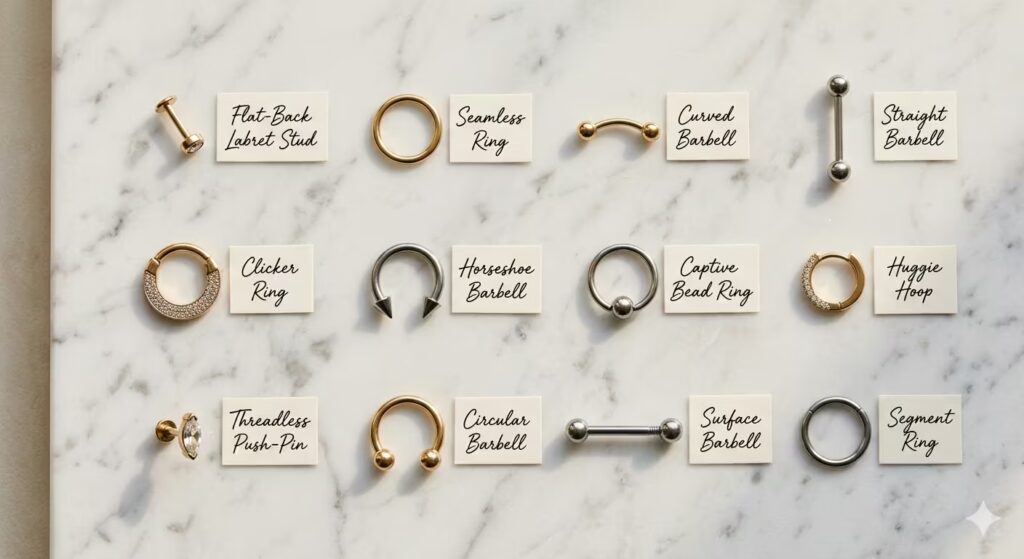
This guide covers every major jewellery style in detail. You will know exactly what each one looks like, how the closure works, which piercings it suits, and when it is and isn’t appropriate to use.
❝ The two most important questions for any piercing jewelry are: is this the right style for my placement, and is this appropriate for my current healing stage? This guide answers questions for every style covered.
Quick Reference: Every Style at a Glance
| Style | Closure | Best Placements | Fresh or Healed |
| Flat-back labret stud | Threadless or internal thread | Helix, tragus, nostril, lip, medusa, forward helix | Both. Current professional standard for fresh piercings. |
| Seamless ring | Pinch open/close | Septum, nostril, helix, daith | Healed only. Rotation disrupts healing tissue. |
| Clicker ring | Hinged segment | Septum, daith, nostril, tragus | Healed only. Easy to insert and remove. |
| Segment ring | Removable segment | Septum, nostril, helix, tragus | Healed only. Seamless look, easier than seamless to open. |
| Curved barbell (banana) | Threaded ball ends | Eyebrow, navel, rook, daith, tongue web | Both. Standard initial jewellery for several placements. |
| Straight barbell | Threaded ball ends | Tongue, nipple, industrial | Both. The industrial and tongue standard. |
| Horseshoe / circular barbell | Threaded ball ends | Septum, eyebrow, daith, nostril | Both. Septum standard. Flips up inside the nostrils to hide. |
| Captive ring (CBR) | Captured the ball between ends | Nostril, septum, ear, nipple | Healed. Requires ring-opening pliers to open safely. |
| Huggie hoop | Hinged click closure | Helix, tragus, lobe | Healed only. Close-fitting, minimal movement. |
| Push-pin / threadless stud | Bent a post into a hollow tube | Helix, nostril, tragus, medusa, labret | Both. Very popular for easy style changes on established posts. |
| Surface barbell | Flat anchor plate ends | Surface piercings: nape, sternum, collarbone, wrist | Both. Designed specifically for flat skin placements. |
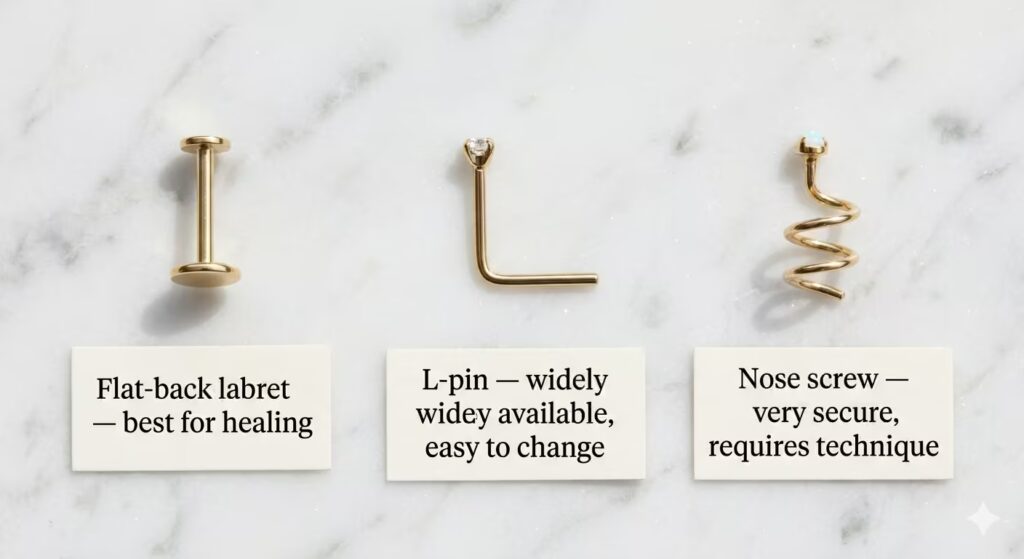
| L-shaped nose pin | L-bend holds in the nostril | Standard nostril only | Both. Widely used. More movement than a flat-back stud. |
| Nose screw/corkscrew | Spiral holds in the nostril | Standard nostril only | Both. Secure once inserted. Tricky to change solo. |
Individual Style Guides
Flat-back labret stud
The flat-back labret stud is the most widely used style in professional piercing today.
It has a straight post with a flat circular disc on the interior end and a decorative top on the exterior. The flat disc sits flush against the inside of the tissue without creating pressure points or rotating with movement.
This makes it the most stable option for healing piercings. No part of the jewellery needs to move or rotate during cleaning, changing, or daily wear.
Threading systems: internal, external, and threadless
The top attaches to the post in one of three ways, and the system matters more than most people realise.
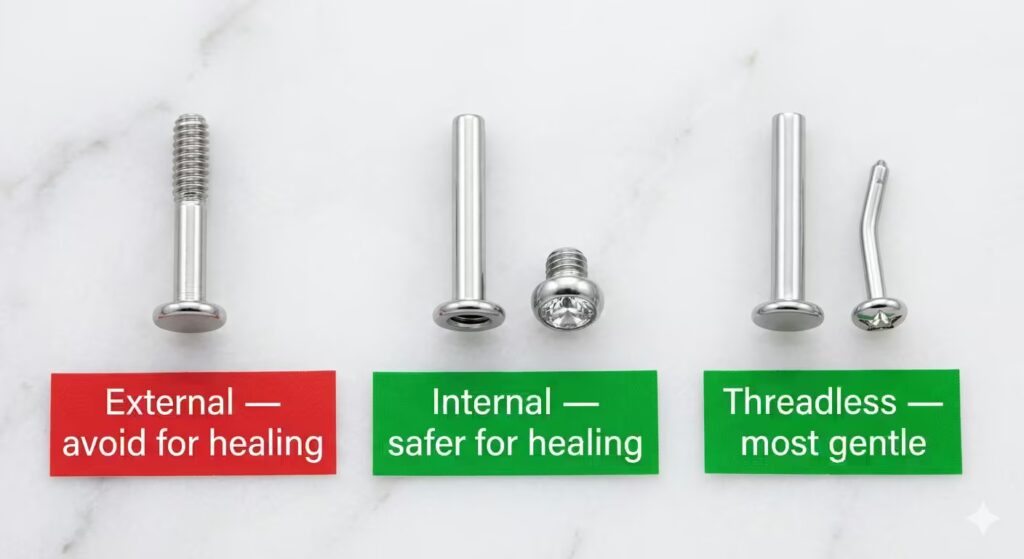
External threading has the threads on the outside of the post end. The decorative top screws onto these external threads. The problem is that the threaded post must pass through the piercing channel during insertion, and those threads can scratch the inside of the healing fistula.
Internal threading puts the threads inside a hollow post. The decorative top has a small post with threads that screws inward. The post end that enters the piercing channel is completely smooth, which is significantly safer for healing tissue.
Threadless or push-pin systems have no threading. The decorative top has a slightly bent post that inserts into a hollow tube post and is held by tension. This is one of the most popular professional systems currently because the tops can be swapped quickly without tools, and the insertion is gentle on healing tissue.
❝ For any healing piercing, always choose internal threading or threadless over external threading. The smooth post end makes a real difference to the inside of the healing channel.
Seamless ring
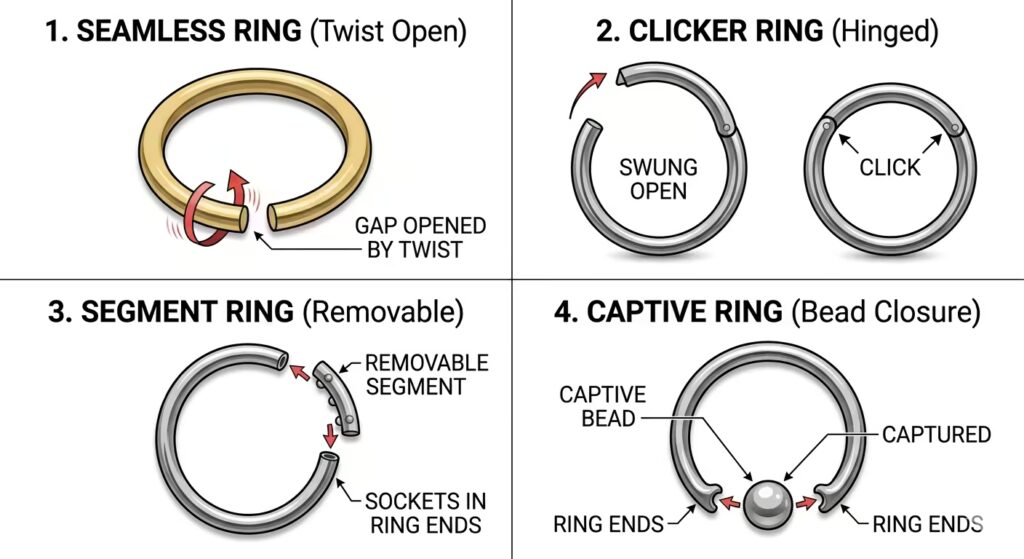
A seamless ring is a continuous circle of metal with a small gap that allows it to be opened and closed by twisting the ring at the gap.
When properly closed, the join is nearly invisible. This creates the clean, uninterrupted ring look that the style is named for.
The correct opening technique is a gentle twist, not a pull apart. Pulling stretches the ring out of round and permanently distorts the shape. Use two pairs of smooth-jaw jewellery pliers and twist the ends past each other, then twist back to close.
Seamless rings are not suitable for healing piercings. Even a perfectly closed, seamless ring rotates with movement, and that rotation continuously disturbs forming tissue.
For healed piercings, seamless rings are one of the most elegant options available. They work particularly well in septum, nostril, helix, and daith placements.
Clicker ring
A clicker ring has a hinged segment that swings open and then clicks securely shut. To open it, apply light pressure to the segment at the hinge point. It swings away from the ring body, creating a gap for insertion. It then clicks back into the closed position when pressed shut.
Clicker rings are popular for septum and daith piercings because insertion and removal require no tools, and the closure is completely reliable once clicked into place.
Decorative clickers come in an enormous range of designs, from simple, minimal metal to elaborate gem-set pieces. Heart-shaped clickers in the daith are one of the most recognised piercing jewellery styles in curated ear photography.
Like seamless rings, clickers are for healed piercings only. The insertion process requires handling the jewellery while it is in the piercing, which disrupts healing tissue.
Segment ring
A segment ring looks identical to a seamless ring when worn. The difference is that a small section of the ring is a removable, separate segment rather than part of a continuous piece of metal.
To open it, gently pull the segment outward. It pops free, leaving a gap for insertion. To close, align the segment and press it back into position.
Segment rings are easier to open than seamless rings because you are removing a piece rather than twisting a continuous ring. They suit the same placements as seamless rings and share the healed-piercings-only restriction.
Curved barbell
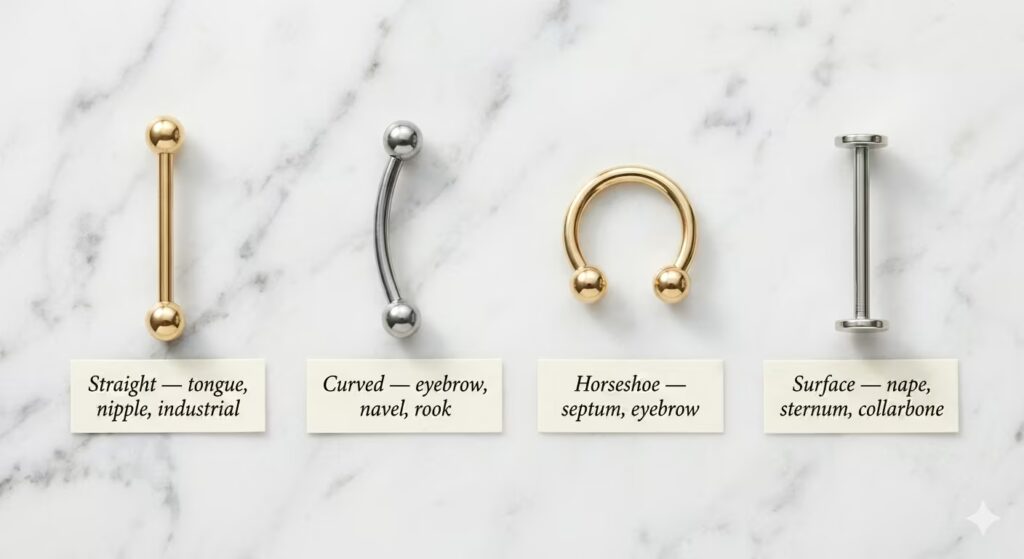
A curved barbell is a gently banana-shaped post with threaded balls or decorative ends on each tip.
The curve follows the natural shape of tissue, which is why it is the standard jewellery for eyebrow, navel, rook, daith, and tongue web piercings. The shape allows the jewellery to sit with minimal pressure in curved or folded tissue.
Ball ends thread on in two ways. Internally threaded means the ball has a small post that screws into the end of the barbell. Externally threaded means the barbell has a thread on its end that the ball screws onto.
Internal threading is preferable for the same reason as with flat-back studs. The smooth barbell end passes through the piercing channel during insertion rather than a threaded surface.
The post length of a curved barbell is measured along the inside of the curve, not the outside. Getting the right length matters: too short creates pressure on the tissue, too long creates excessive movement.
Straight barbell
A straight barbell is a simple straight post with threaded ball ends. It is the standard jewellery for tongue, nipple, and industrial piercings. Each placement requires a different gauge and post length.
For tongue piercings, the initial barbell is longer than the final piece to accommodate the significant swelling of the first week. The downsize to a shorter, correctly fitting bar at six to eight weeks is essential for reducing dental contact and improving comfort.
For industrial piercings, the bar length must precisely span the distance between the two cartilage holes. Too short creates pressure on both healing channels. Too long means the bar moves excessively.
Decorative industrial bars with shaped ends, gem clusters, or sculptural designs are available for healed industrials and are among the most personalised jewellery choices for ear piercing.
Horseshoe / circular barbell
A horseshoe barbell is a U-shaped piece with threaded ball ends on each tip.
It is the defining jewellery style for septum piercings. The horseshoe can be rotated so both ball ends point upward into the nostrils, making the piercing completely invisible from the outside.
This flip-up capability is one of the most practical features in all of body piercing. It is why the septum is the most concealable facial piercing available.
Horseshoe barbells are also used in eyebrow, daith, and some nostril piercings as a healed jewellery option. They come in a wide range of gauges, diameters, and ball styles.
For our complete septum piercing guide, including sizing guidance for horseshoe barbells, see our article on how much is a septum piercing.
Captive bead ring (CBR)
A captive bead ring holds a decorative ball between its two ends.
The ball is held in place by slight inward tension from the ring ends, which fit into small indentations on either side of the ball. Opening the ring requires gently spreading the ring body to release the ball, which is safest done with ring-opening pliers.
Captive rings create a clean, continuous look similar to a seamless ring. They are common in nostril, ear, and nipple piercings.
The main practical limitation is that the ball can fall free if the ring is spread too wide during opening. Getting the technique right takes practice. Using the correct ring-opening pliers rather than improvised tools prevents the ring from being distorted.
Captive rings are for healed piercings. They require more handling to insert and remove than most other styles, which makes them unsuitable during the healing period.
Huggie hoop
A huggie hoop is a small, thick hoop with a hinged click closure that sits close against the ear or piercing site. The name describes its fit: it hugs the tissue rather than hanging freely. This close fit minimises movement at the piercing site without putting pressure on the tissue.
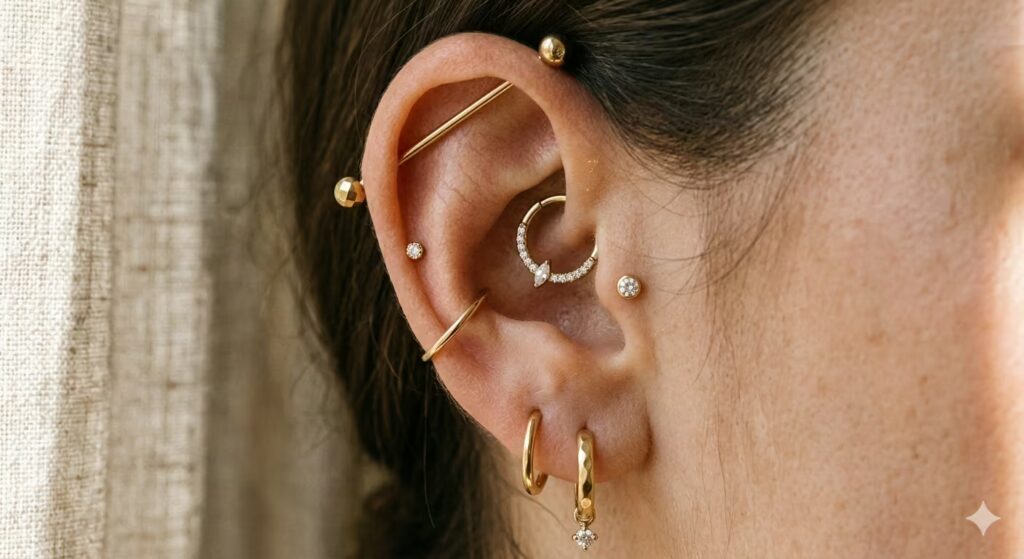
Huggie hoops are extremely popular for healed helix, tragus, and lobe piercings. They suit curated ear arrangements particularly well because their compact size keeps the visual arrangement tight and intentional rather than open and dangly.
They come in a wide range of designs, from plain metal to pavé-diamond-set styles. The hinge closure is very user-friendly: lift the hinge arm to open, push it back to click shut.
Huggie hoops are for healed piercings only.
Push-pin / threadless stud
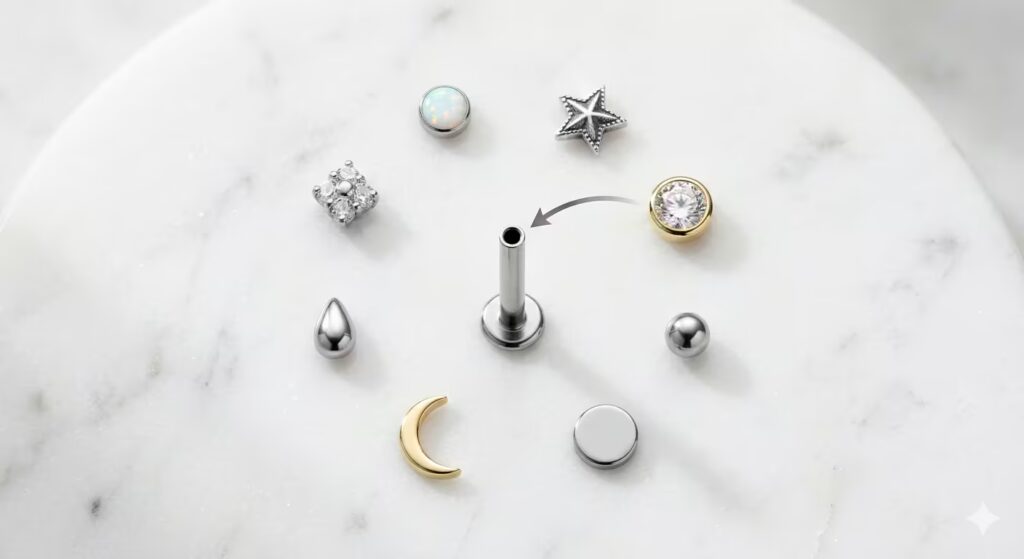
A push-pin or threadless stud uses a bent-post mechanism to hold the top in place on the post without threading.
The decorative top has a small post with a deliberate slight bend. This post inserts into a hollow tube post already in the piercing. The bend creates tension against the inside of the tube, holding the top securely in place.
To remove the top, hold the back tube steady and pull the top directly outward. The bent post slides free.
The great practical advantage of threadless systems is that the decorative top can be swapped without changing the post. One implant-grade post can hold dozens of different tops if they all use the same system, making it very economical to build variety in a jewellery collection.
Threadless systems are suitable for both fresh and healed piercings when the post itself is implant-grade. The gentle insertion mechanism is one reason they have become a favourite among professional piercers for initial jewellery.
Surface barbell
A surface barbell has a flat 90-degree bent post with two visible ends that sit on the skin surface.
Instead of passing through a tissue fold like a conventional barbell, the surface barbell sits beneath a shallow layer of flat skin with both decorated ends visible on top. The flat anchor shape distributes pressure across a wider area of tissue, reducing migration compared to a standard barbell used in surface placements.
Surface barbells are designed specifically for flat skin placements: the nape of the neck, sternum, collarbone, wrist, and similar areas.
They are still surface piercings, meaning rejection risk is inherent. But a correctly sized surface barbell gives a surface piercing the best possible chance of a reasonable lifespan. Our clavicle piercing guide covers surface piercing migration and rejection in detail.
L-shaped nose pin
The L-shaped nose pin is a straight post with a 90-degree bend at the end, forming an L shape.
The shorter arm of the L sits against the inside of the nostril, holding the jewellery in place without any threading or closure mechanism. The decorative end sits on the outside of the nostril in the standard position.
L-shaped pins are one of the most widely available nostril jewellery styles and are very easy to change. The trade-off is that the L-bend creates slightly more interior movement than a flat-back labret stud, which matters during healing but is inconsequential for healed piercings.
They are only suitable for standard nostril piercings. The L-bend does not reach or work correctly in high nostril placements.
Nose screw/corkscrew
A nose screw has a decorative end followed by a spiral twist in the post. The spiral is inserted through the nostril and turned until the decoration sits correctly on the outside. The corkscrew shape holds the jewellery in place by anchoring against the inside of the nostril wall.
Once correctly inserted, a nose screw is very secure. The trade-off is that insertion and removal require rotating the piece through the nostril, which is more complex than other styles and can be tricky to do solo, particularly in front of a mirror.
Like the L-pin, the nose screw is for standard nostril piercings only. For all nostril style options, see our guide to types of nostril piercings.
Understanding Gauge: Post Thickness
Gauge refers to the thickness of the jewellery post or wire. It uses a counterintuitive numbering system: higher gauge numbers mean thinner jewellery.
Always match replacement jewellery to your original piercing gauge. Inserting the wrong gauge forces the piercing channel to stretch or compress, causing tissue trauma and potentially restarting the healing process.
| Gauge | Diameter | Common Piercings |
| 20g | 0.8mm | Nostril (some), very delicate forward helix. Thinnest common option. |
| 18g | 1.0mm | Nostril, tragus, forward helix, and some standard helix piercings. |
| 16g | 1.2mm | Standard helix, labret, medusa, lip piercings, septum, eyebrow, daith. |
| 14g | 1.6mm | Tongue, nipple, navel, industrial, rook, conch. |
| 12g | 2.0mm | Stretched lobes at early stages, some larger body piercings. |
If you are unsure of your gauge, your piercer can measure it for you in seconds. Do not guess.
Post Length and Why the Downsize Matters
Post length is the distance between the two ends of the jewellery, measured along the post.
For flat-back labret studs, it is the length of the post itself, excluding the disc back. For barbells, it is the interior measurement between the two ball ends.
Fresh piercings are always fitted with a longer post than the final jewellery will have. This extra length accommodates swelling in the first weeks of healing.
Once swelling has fully settled, at around six to eight weeks for most piercings, that extra length becomes a problem. A post that is too long moves around inside the piercing channel more than it should, catches on hair and clothing, and creates continuous low-level trauma to the healing tissue.
The downsizing appointment, in which your piercer replaces the longer initial post with a correctly fitting shorter one, is a required step in healing, not an optional add-on. Budget for it from the start.
❝ A post that is too long is one of the most overlooked causes of prolonged healing and persistent irritation bumps. Getting the downsize done on schedule is one of the highest-impact things you can do for your piercing.
A Quick Reminder on Materials
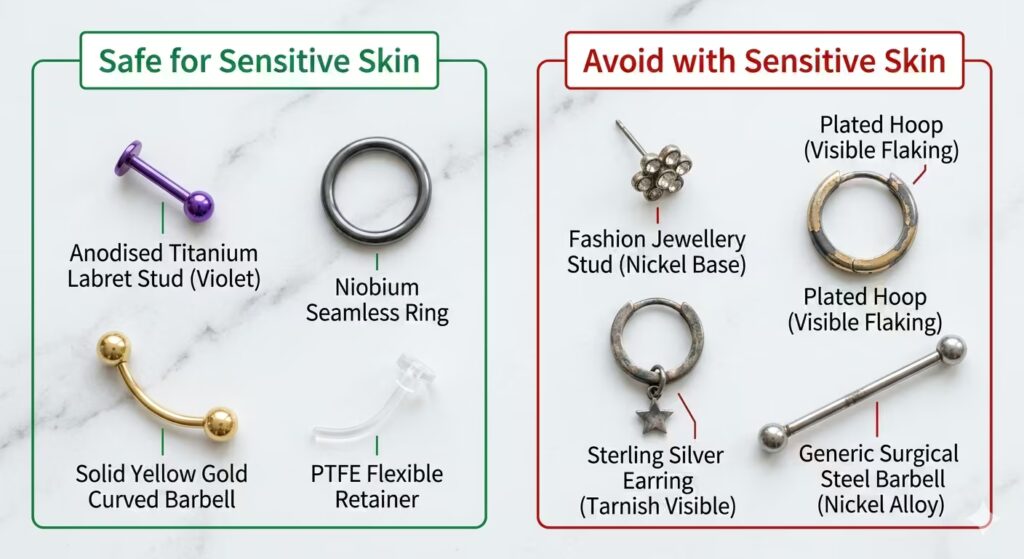
Jewellery style and jewellery material are separate decisions. The best closure mechanism in the world does not help if the material it is made from is causing an allergic reaction.
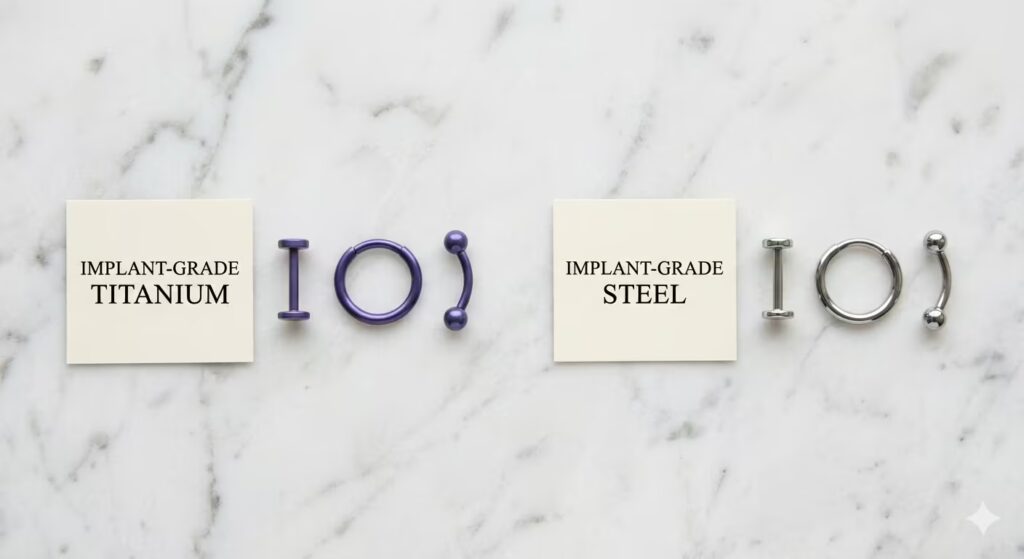
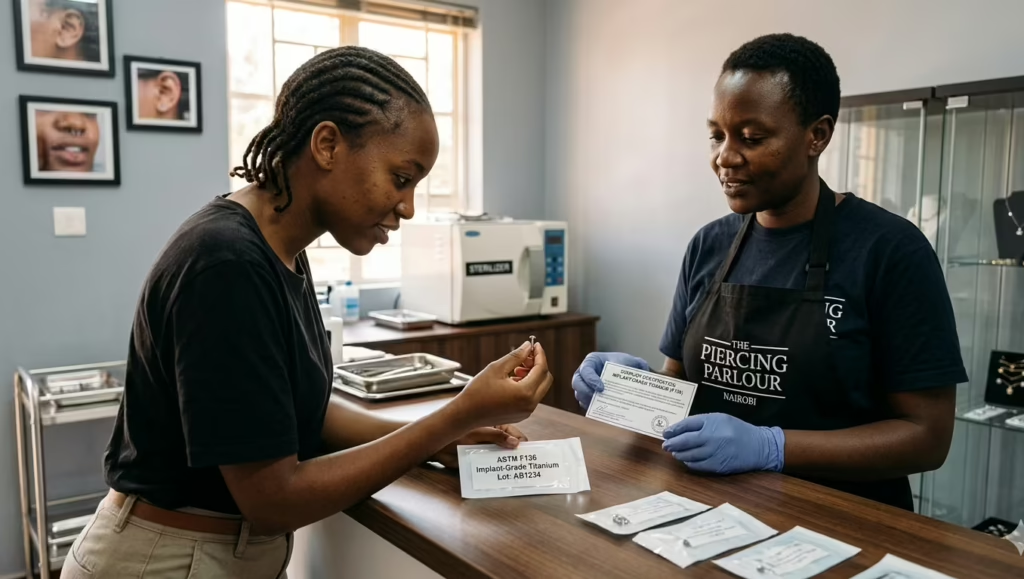
For fresh piercings, implant-grade titanium (ASTM F136) is the professional standard for almost all styles. For healed piercings, implant-grade steel, solid gold, and niobium also become appropriate options.
Avoid acrylic, plated metals, and any jewellery that cannot state a specific material standard. The style guide in this article assumes you are choosing within body-safe materials. For the full materials breakdown, see our guide to what is implant-grade jewelry and why it matters.
And for specific guidance on titanium versus steel, our article on implant-grade titanium vs. surgical steel provides a full comparison.
How to Choose the Right Style for Your Piercing
The process is simpler than the range of options suggests.
Step 1: Identify your healing stage
Fresh piercing means a flat-back labret stud, a curved barbell, or a straight barbell, depending on the specific placement. No rings, hoops, or styles that rotate.
Healed piercing means the full range of appropriate styles for that placement becomes available.
Step 2: Match the style to the placement anatomy
Curved placements such as the rook, daith, and navel require curved barbells. Flat cartilage rim placements like the helix suit flat-back studs and rings. Inner fold placements, such as the daith and septum, suit rings and clickers. Through-lip placements suit flat-back labrets.
Step 3: Get the gauge and length right
Ask your piercer what gauge and post length your piercing was done at. Match both in any replacement jewellery. If you are downsizing, have your piercer do it rather than guessing at home.
Step 4: Get the first change done at your studio
Your first jewellery change, particularly the downsize and the first style change, should happen at your piercing studio. The piercer confirms the healing stage, selects the correct sizing, and inserts the new jewellery safely.
For the full guide on when each piercing type is ready for a change, see our article on when I can change my ear piercing.
Frequently Asked Questions
What is the difference between a flat-back stud and a regular stud?
A regular earring stud has a butterfly or push-back clasp on the back. A flat-back labret stud has a smooth flat disc on the back that sits flush against the inside of the tissue.
Butterfly backs create pressure points on healing tissue and can harbour bacteria in their mechanism. Flat-back studs are significantly safer and more comfortable for healing piercings, which is why professional piercers prefer them over standard earring studs.
Can I use a regular earring in a helix piercing?
A standard earring stud with a butterfly back can be worn in a well-healed helix if the gauge matches and the material is body-safe. However, the butterfly back tends to be less comfortable against the inner ear cartilage than a flat disc, and the butterfly mechanism catches on hair more easily.
For healed cartilage piercings, a flat-back labret, huggie hoop, or seamless ring in the correct gauge is a more practical long-term choice than repurposing a regular earring.
What is internally threaded vs. externally threaded?
Internal threading means the threaded post is inside the hollow end of the barbell. The decorative top has a smooth exterior post that screws into the barbell. The smooth exterior means nothing rough passes through the piercing channel during insertion.
External threading means the threads are on the outside of the barbell end. These threads pass through the piercing channel when the jewellery is inserted and can abrade the delicate lining of the fistula. Always choose internal or threadless for healing piercings.
What size ring fits a septum piercing?
The most common diameters for a septum ring are 8mm or 10mm in most anatomies. The gauge is typically 16g (1.2mm) or 14g (1.6mm).
The correct size depends on your specific anatomy and how the piercing was done. Your piercer will advise on the correct septum diameter at the time of piercing and at the downsize appointment. Do not order rings online to have them changed at home without knowing your specific measurements first.
How do I open a seamless ring without pliers?
Very small seamless rings in thin gauges can be opened with fingers using the correct twisting motion. Grip each side of the ring close to the gap with your thumbs and forefingers. Twist one side forward and the other backward, moving the ends past each other rather than pulling them apart.
For anything larger than 18g or 1mm, smooth-jaw jewellery pliers are safer and give you better control. Ring-opening pliers designed specifically for body jewellery are available from body jewellery suppliers and are a worthwhile investment if you change rings frequently.
Know Your Styles, Choose With Confidence
Piercing jewellery styles are not interchangeable. Each one has a specific mechanism, a specific set of appropriate placements, and a specific relationship to the healing stage of the piercing it sits in.
The flat-back labret stud and the threadless push-pin are where almost every healing piercing should start. Seamless rings, clickers, huggies, and captive rings are the rewards of a fully healed piercing. Barbells in the right curve and gauge are the standard for piercings that need them at every stage.
Get the style right. Get the gauge right. Get the post length right. Have the first changes done at your studio. Those four steps give every piece of jewellery the best possible chance of looking exactly the way you imagined it would.