What the karat, alloy, and colour mean for safety
Gold jewelry and body piercings feel like a natural match.
Gold is associated with quality, luxury, and permanence. The instinct that it must therefore be safe for a new piercing makes intuitive sense.
The reality is more specific. Whether gold is safe in a piercing depends on the karat, the alloy composition, the colour, and the healing stage of the piercing. Get those four things right, and gold is an excellent choice. Get one of them wrong, and gold will cause exactly the same problems as cheap fashion jewellery.
This guide covers everything you need to know to use gold in a piercing correctly.
❝ The question is never just “is it gold?” The correct questions are: what karat is it, is the alloy nickel-free, and is this a fresh or fully healed piercing? All three need good answers before gold is appropriate.
The Short Answer
Solid 14k or 18k gold in a nickel-free alloy is an excellent choice for fully healed piercings.
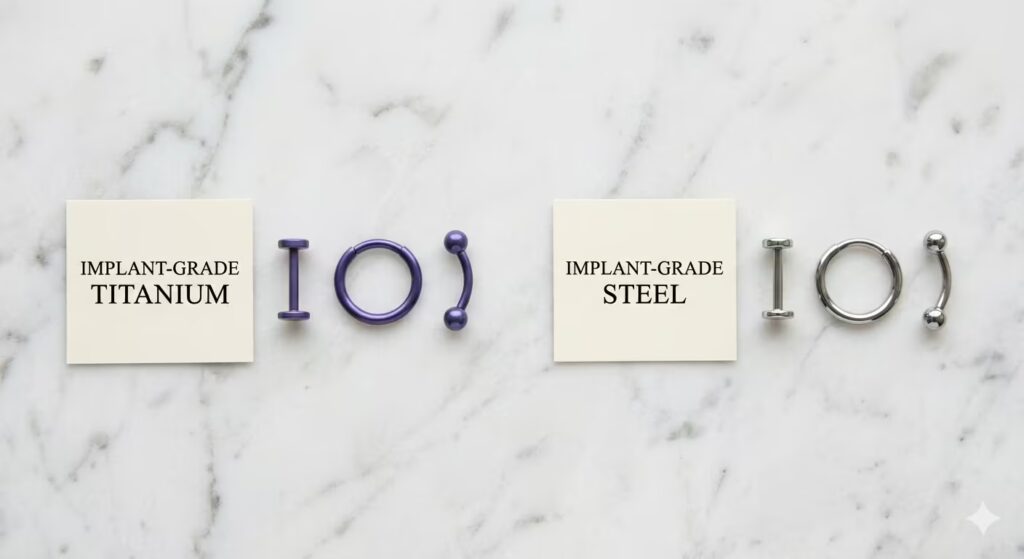
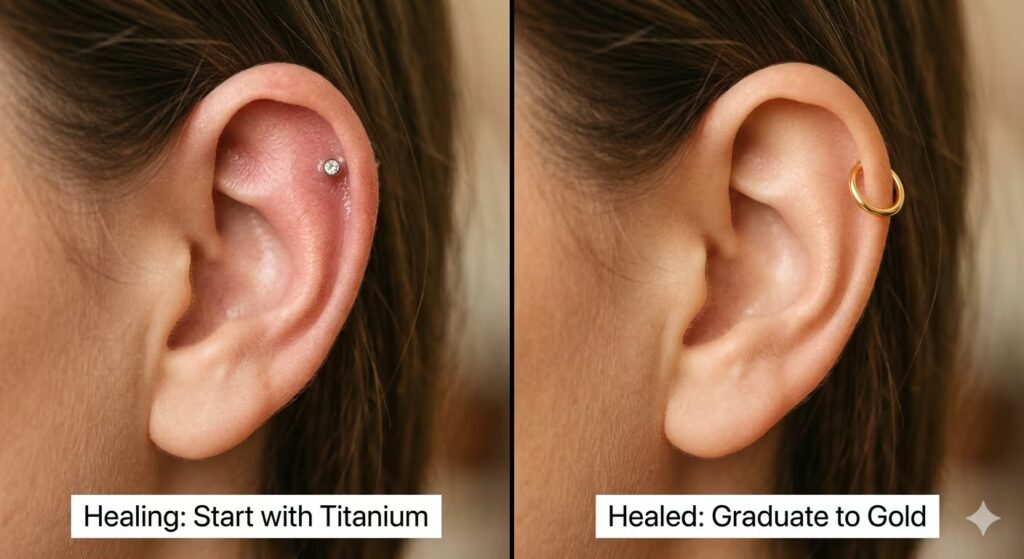
For fresh piercings, the professional consensus is to start with implant-grade titanium and graduate to gold once the piercing is fully healed.
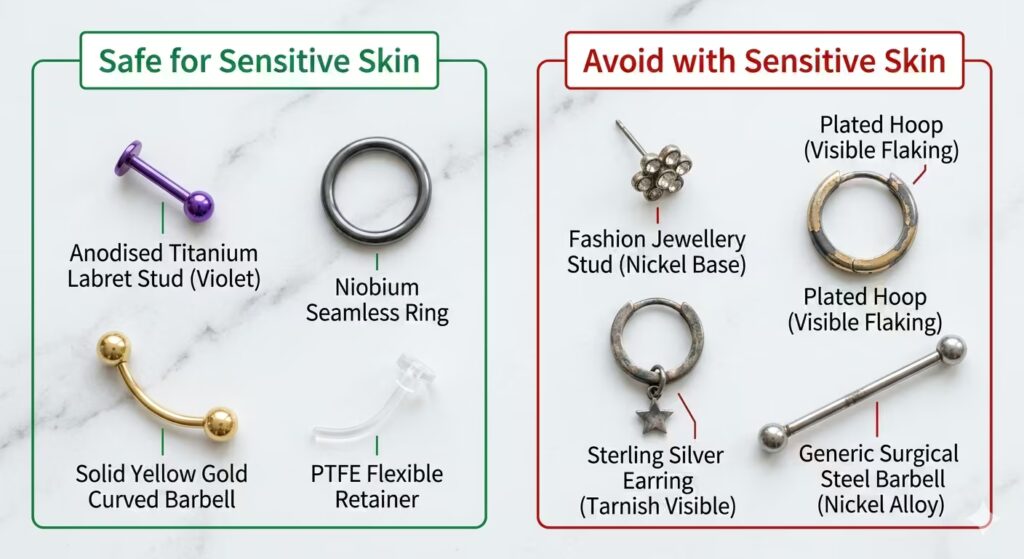
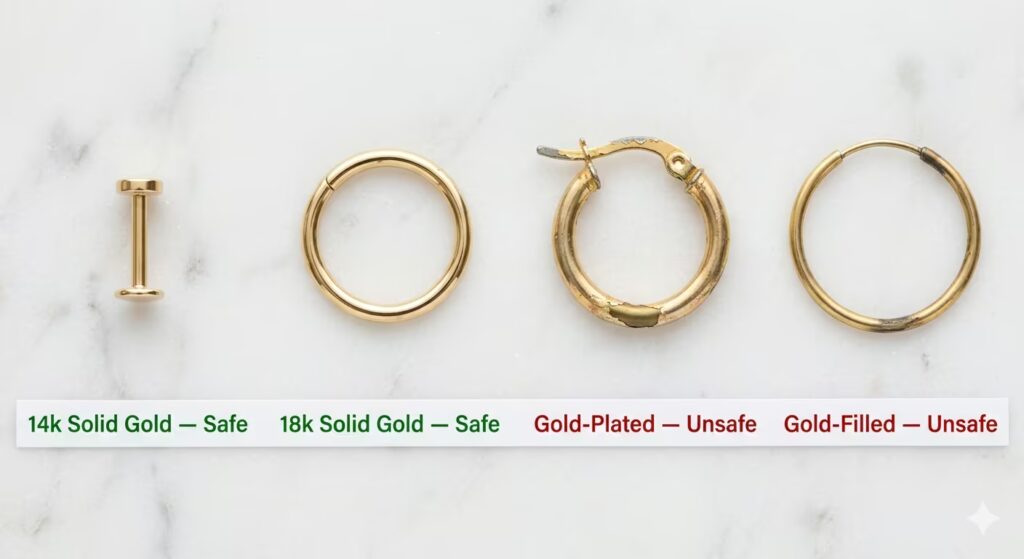
Gold-plated, gold-filled, and gold vermeil jewellery is not safe for any piercing at any stage, regardless of how thick the gold layer appears to be.
Understanding Gold Karats
Karat measures the purity of gold in an alloy.
Pure gold is 24 karats. Because pure gold is too soft for durable jewellery, it is alloyed with other metals. The karat number tells you the proportion of the alloy that is pure gold.
| Karat | Gold Content | Safe for Piercings | Notes |
| 24k | 99.9% | Too soft | Pure gold deforms easily. Not used in body jewellery. |
| 18k | 75% | Yes (nickel-free alloy) | Premium choice. Richer colour, excellent durability. Most popular for high-end body jewellery. |
| 14k | 58.5% | Yes (nickel-free alloy) | Most widely used karat in body jewellery. Good balance of durability and gold content. |
| 10k | 41.7% | Use caution | Higher non-gold content. Alloy composition varies more widely. Verify nickel-free. |
| 9k | 37.5% | Use caution | Common in the UK and Australia. Lower gold content increases alloy variability. |
| Gold-plated | Surface layer only | Never | Base metal is almost always a high-nickel alloy. Layer wears through. |
| Gold-filled | Bonded layer | Never | Thicker than plated, but still a base-metal product. Not body-safe for piercings. |
| Gold vermeil | Thick plating on silver | Never | Base is sterling silver. Both the silver base and any nickel content cause issues. |
The minimum recommended karat for piercing jewellery is 14k.
14k gives you a good balance of gold content, durability, and workability for body jewellery manufacturing. 18k is slightly softer but has a richer, more saturated colour.
The Alloy Matters as Much as the Karat
The non-gold portion of a gold alloy determines whether the jewellery is safe for sensitive skin.
Pure gold is inert and hypoallergenic. The problem is what it is mixed with.
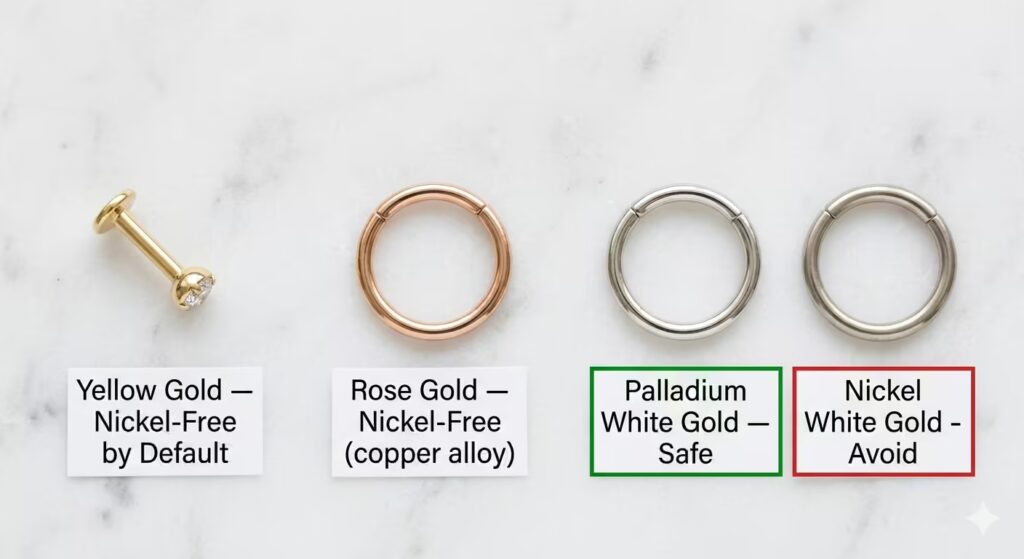
Yellow gold
Traditional yellow gold alloys use copper and silver as the primary alloying metals alongside the gold.
Copper and silver are not nickel. Yellow gold alloys in 14k and 18k are typically nickel-free by default.
This makes yellow gold the straightforward choice for piercings. If it is solid 14k or 18k yellow gold from a reputable body jewellery supplier, it is almost certainly nickel-free.
Rose gold
Rose gold gets its warm pink colour from a higher copper content in the alloy.
Copper is not nickel. Nickel-free rose gold alloys are completely safe for healed piercings.
A very small number of people have copper sensitivity, but this is significantly rarer than nickel sensitivity. For the vast majority of people, nickel-free rose gold behaves identically to yellow gold in terms of safety.
White gold: the important exception
This is where gold gets complicated for piercings.
Traditional white gold achieves its colour by adding nickel to the alloy. Nickel is an effective whitening agent for gold, and it is how most white gold jewellery in general retail is made.
Nickel-alloyed white gold is not appropriate for piercings, particularly for anyone with nickel sensitivity. The nickel content is higher than in implant-grade steel and leaches more readily.
Modern body jewellery manufacturers use palladium instead of nickel to achieve the white gold colour. Palladium white gold is nickel-free and completely safe for piercings.
The practical implication: always confirm whether white gold jewellery is a palladium alloy or a nickel alloy before using it in a piercing. Yellow and rose gold do not require this confirmation. White gold always does.
❝ If you want white gold in a piercing, ask specifically: “Is this palladium white gold or nickel white gold?” Any reputable body jewellery supplier will know the answer immediately. If they cannot tell you, do not use it.
Why Gold Jewelry Is Not Ideal for Fresh Piercings
If solid gold is body-safe, why does the professional recommendation suggest starting with titanium?
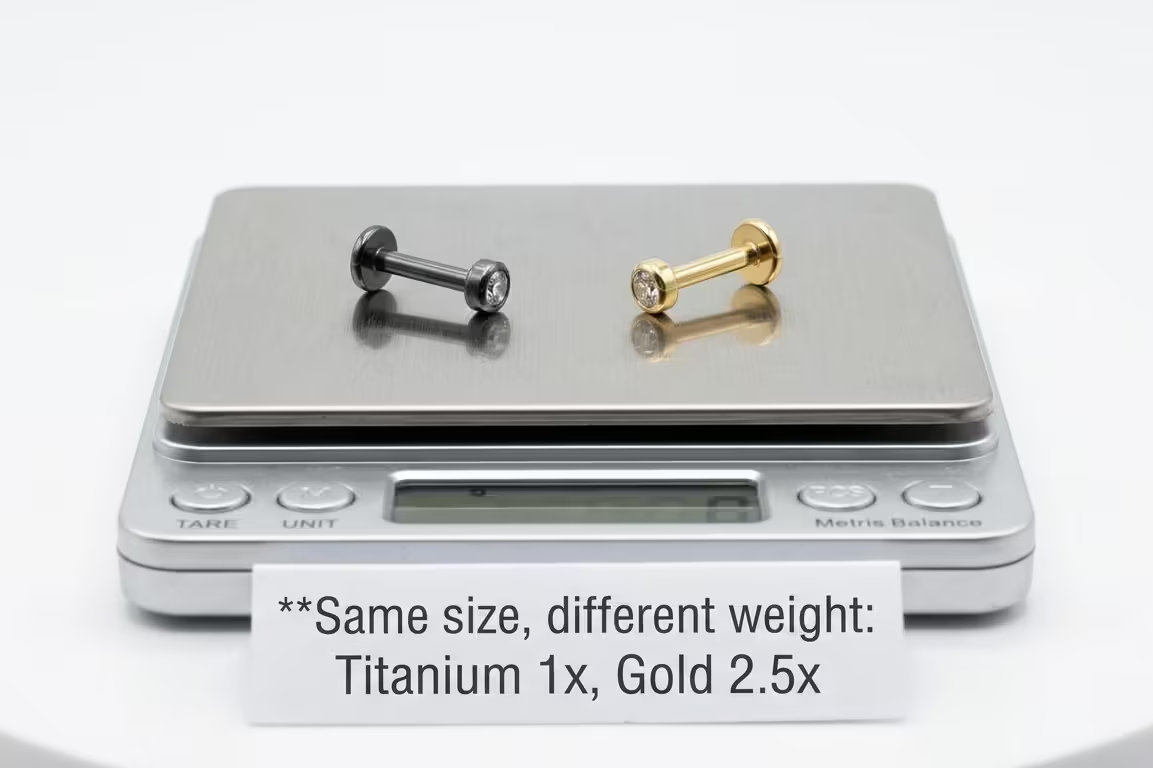
The answer is weight.
The weight comparison
Gold is dense. A solid 14k gold flat-back labret stud weighs roughly two to three times as much as the same piece in implant-grade titanium.
For lobe piercings in soft tissue, that difference is relatively minor. The lobe heals quickly, has a good blood supply, and the extra weight does not significantly affect the outcome.
For cartilage piercings, the weight difference matters considerably more.
Why does weight matter in cartilage?
Cartilage has a very limited blood supply. It heals slowly, over six to twelve months, and is more sensitive to mechanical disturbance than soft tissue.
Heavier jewellery creates more downward pressure on the healing cartilage channel. It also moves slightly more with each turn of the head, each contact with a pillow, and each brush of hair across the ear.
Over months of healing, that additional weight and movement accumulate. It does not necessarily prevent healing, but it consistently produces slower and more irritation-prone outcomes than lightweight titanium in the same placements.
This is why professional piercers recommend titanium for fresh cartilage piercings and allow the switch to gold only once full healing is confirmed.
What about fresh lobe piercings?
Some studios do use solid 14k or 18k gold for fresh lobe piercings. The lobe’s faster healing timeline and the more forgiving soft tissue make this more viable.
It is not the dominant professional practice, but it is not unreasonable for the lobe specifically.
The rule remains: fresh cartilage means titanium. Fresh lobe with gold is acceptable, but titanium is still the safer default.
Gold-Plated, Gold-Filled, and Vermeil: Why They Are Never Safe
These three product categories are the source of most gold-related piercing problems.
They look like gold. They are sold as gold. They are marketed as hypoallergenic in many cases. None of them is appropriate for piercings.
Gold-plated
Gold-plating is a thin electrodeposited layer of gold on a base metal.
The gold layer is typically 0.5 to 2.5 microns thick. For reference, a human hair is approximately 70 microns in diameter. The gold layer is vanishingly thin.
Underneath that layer is almost always a high-nickel alloy. The layer wears through within weeks to months of regular use, exposing the nickel-based metal directly to the piercing tissue.
Even before the layer wears through, body fluids can penetrate microscopic imperfections in the plating and reach the base metal beneath. In a healing piercing, this happens continuously.
Gold-filled
Gold-filled jewellery has a thicker gold layer than plated, mechanically bonded to the base metal rather than electrodeposited.
It is more durable, and the gold layer lasts longer in everyday jewellery wear. But the base metal remains and is eventually exposed.
Gold-filled is not a synonym for solid gold. It is a base metal product with a gold exterior. Not appropriate for piercings.
Gold vermeil
Gold vermeil is gold-plating over a sterling silver base.
Sterling silver itself is not a safe material for piercings. It tarnishes inside body tissue, and the tarnish compounds can permanently stain the surrounding skin. Adding a thin gold layer on top does not resolve the underlying silver problem.
Vermeil is sometimes marketed as a premium alternative to standard gold-plated jewellery. For piercings, it carries all the same risks, plus the silver base problem underneath.
❝ The only gold that is safe for piercings is solid gold: 14k or 18k with a verified nickel-free alloy. Plated, filled, and vermeil are not solid gold and are not safe for any piercing at any stage of healing.
When Can You Switch from Titanium to Gold?
The timing depends on the type of piercing.
| Piercing Type | Earliest Switch to Gold | What to Look For First |
| Earlobe | 6–8 weeks | No discharge, no redness, jewelry moves freely with no resistance. |
| Nostril | 4–6 months | Surface looks healed, no tenderness, no discharge, full mobility. |
| Septum | 3–6 months | No tenderness when flipping jewelry up and down. |
| Helix | 9–12 months | No discharge at any point in the day, no soreness on touch. |
| Tragus | 9–12 months | Comfortable with earbuds, no tenderness after phone calls or sleep. |
| Daith / Rook / Conch | 12+ months | Piercer confirmation is recommended before switching inner cartilage. |
| Nipple | 9–12 months | No sensitivity, no discharge, comfortable during exercise. |
| Navel | 9–12 months | No redness or irritation after wearing jeans or waistbands. |
These are minimum timelines, not targets. A piercing that meets the visible healing criteria is more reliable guidance than the calendar date alone.
For the complete healing timeline guide covering all ear piercing types, see our article on when to change ear piercings.
How to Make the Switch to Gold Safely
The first time you change from titanium to gold deserves some care, even if the piercing looks and feels fully healed.
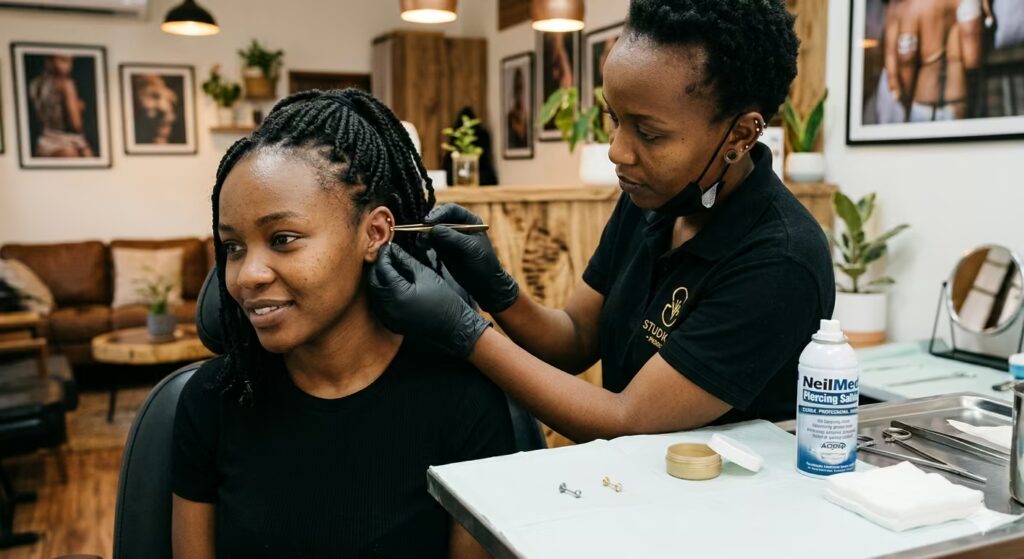
Have the first gold change done at your studio
Your piercer can confirm the piercing is genuinely ready before the new jewellery is inserted.
They can also insert the gold piece safely without the risks that come with self-changing a cartilage piercing for the first time.
Once you have had one successful professional change, subsequent self-changes are straightforward.
Clean both the piercing and the new jewellery first
Even brand-new jewellery from a reputable supplier should be cleaned before insertion.
Wipe the gold piece with a sterile saline wipe, then leave it to air-dry. Spray the piercing with sterile saline before attempting the change.
Start with a simple style
The first gold piece does not need to be the most decorative piece in your collection.
A simple 14k gold flat-back stud or a small seamless ring is the ideal starting piece. It confirms the piercing tolerates gold before you invest in more elaborate styles.
If the piercing responds well over the next two to four weeks, you can confidently move on to more decorative gold options.
How to Identify Genuine Solid Gold Jewellery
Not all gold jewellery sold for piercings is what it claims to be. These steps help you verify before you buy.
Look for the hallmark
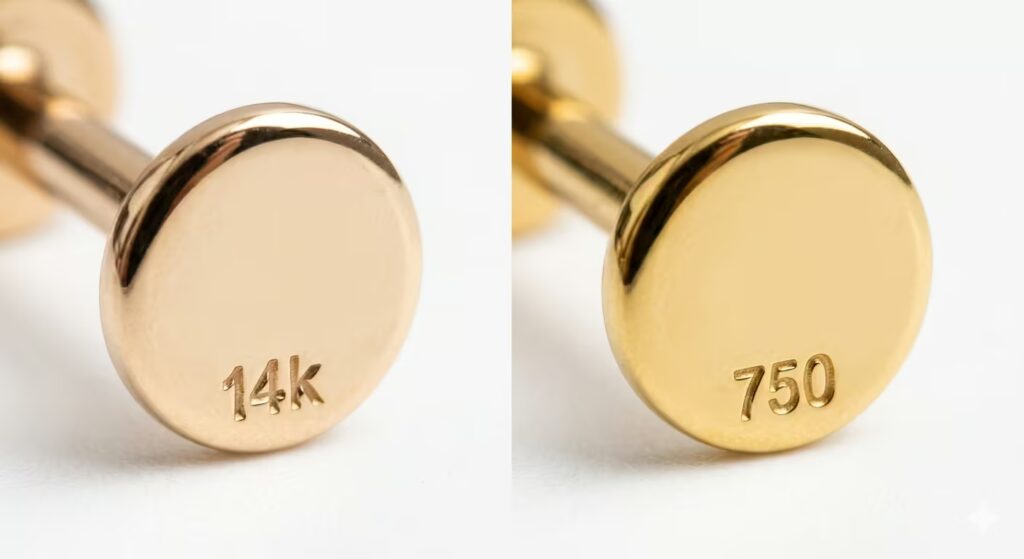
Solid gold jewellery should be stamped with its karat designation: 14k, 18k, 585 (the European equivalent of 14k), or 750 (18k).
This hallmark is a legal requirement in many countries. The stamp is usually on the flat disc back of a labret stud or on the inner surface of a ring.
No hallmark is a red flag. It does not prove the piece is not solid gold, but it removes the most direct form of verification.
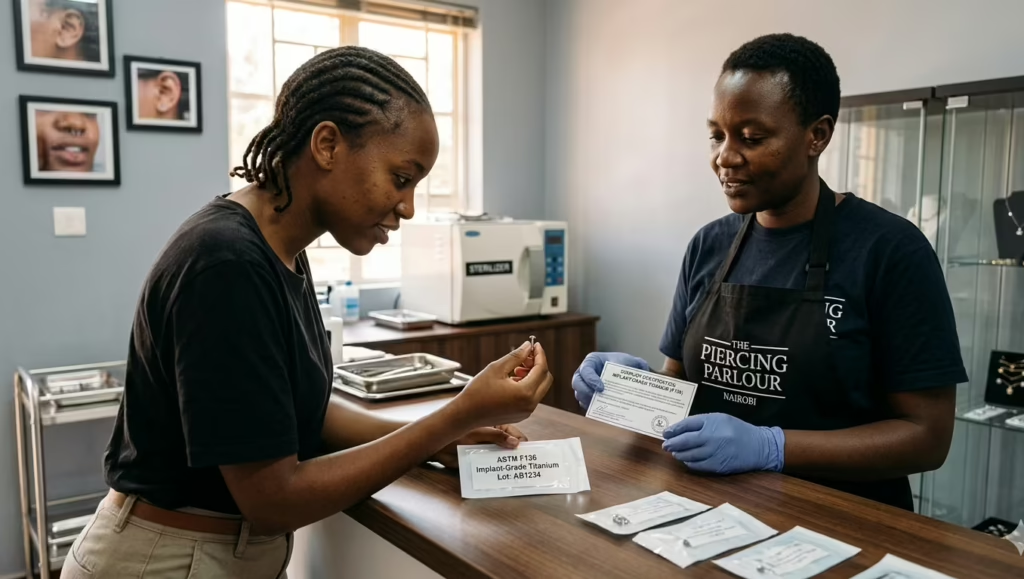
Buy from body jewellery-specific suppliers
General jewellery retailers do not always use the same alloy standards as body jewellery manufacturers.
Established body jewellery suppliers, including BVLA, Junipurr Jewelry, Anatometal, LeRoi, and Buddha Jewelry Organics, produce solid gold pieces specifically for piercings with documented nickel-free alloy compositions.
Buying from these suppliers provides significantly greater certainty than purchasing from a general jewellery store or marketplace.
Price as a verification tool
Solid 14k gold body jewellery from a reputable supplier starts at around $55 to $80 for a simple flat-back stud or seamless ring.
18k gold pieces start higher, typically $80 to $150 for simple styles, more for decorative pieces.
Anything significantly below these price points claiming to be solid gold warrants careful scrutiny. The raw material cost of genuine solid gold sets a floor on the price that cannot be undercut without compromising the material.
Frequently Asked Questions
Can I use gold-plated jewellery in a healed piercing?
No. Gold-plated jewellery is not safe for any piercing, healed or healing.
The gold layer wears away with regular insertion, removal, and exposure to body fluids, exposing the nickel base metal. In a healed piercing, the process is slower than in a healing one, but the outcome is the same: nickel exposure against tissue.
The only gold safe for piercings is solid gold.
My piercing keeps reacting to gold. What is happening?
The most likely explanations are: the gold is plated rather than solid, the white gold alloy contains nickel, or the specific piece contains an allergy-causing non-gold alloying metal.
Start by confirming whether the piece is genuinely solid gold. If it is, ask the supplier about the specific alloy composition.
If the piece is confirmed to be solid nickel-free gold and you are still reacting, you may have sensitivity to copper (present in yellow and rose gold alloys) or to palladium (present in some white gold alloys). These are rare but real. Switching to implant-grade titanium will confirm whether the reaction is material-based.
Is rose gold safer than yellow gold for piercings?
Both yellow gold and rose gold in nickel-free alloys are equally safe for piercings.
Rose gold uses a higher copper content to achieve its warm pink colour. Copper is not nickel and does not cause the same allergic responses. For most people, the two are interchangeable.
The very small number of people with copper sensitivity will find rose gold more reactive than yellow gold. But copper allergy is far less common than nickel allergy.
Can I get my first piercing done with a gold flat-back stud?
For lobe piercings, some studios will pierce with solid gold if you specifically request it. It is more expensive but not harmful.
For cartilage piercings, most professional piercers will advise starting with titanium regardless of budget. The lighter weight gives cartilage the best healing environment. Gold can come later.
What is the difference between 14k and 18k for piercings?
Both are safe. The practical differences are subtle.
18k gold has a higher gold content (75%) and a slightly richer, more saturated colour. It is also slightly softer, which means decorative ends with fine details hold their shape marginally less well over the years of wear than 14k.
14k gold is more durable and more widely available in body jewellery styles. It is the more practical everyday choice. 18k is the premium option when you want the richest gold colour possible.
How do I clean solid gold piercing jewellery?
Solid gold is easy to maintain. Clean it with warm water and mild soap, rinse thoroughly, and dry with a soft cloth.
Avoid harsh chemicals, bleach, and ultrasonic cleaners for pieces with gemstones, as these can affect stone settings. Plain gold pieces without stones can be ultrasonically cleaned professionally if needed.
For jewellery being reinserted into a piercing after storage, wipe with a sterile saline wipe and allow to dry before insertion.
Does gold tarnish inside a piercing?
Solid 14k and 18k yellow gold does not tarnish. Pure gold is highly resistant to oxidation, and at 14k and 18k, the gold content is high enough that the piece behaves like gold rather than like the base alloy metals.
Rose gold may develop a very slight colour shift over the years of wear due to the copper content oxidising slowly. This is surface-level and can be polished away. It does not affect the piece’s safety.
White gold (palladium alloy) may show slight colour changes over extended wear. This is normal and does not affect safety.
Building a Gold Piercing Jewellery Collection
Once your piercings are healed and you are ready to invest in gold, a thoughtful approach to building the collection pays off.
Start with the basics
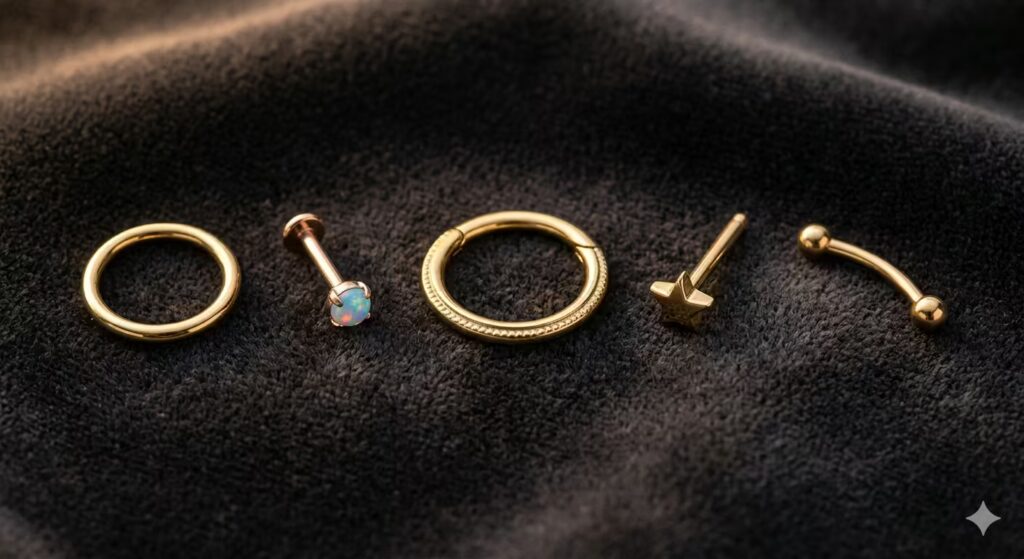
A simple 14k yellow gold flat-back stud and a 14k yellow gold seamless ring cover most piercing placements.
One of each in the correct gauge for your piercings gives you a versatile starting collection that works across lobe, nostril, helix, septum, and most other healed placements.
Add colour thoughtfully
Mixing metal tones in a curated ear is a deliberate aesthetic choice, not a compromise.
Yellow gold and rose gold together create a warm layered look. Yellow gold and silver-tone titanium create contrast. All-yellow gold creates cohesion. The choice depends on the look you are building.
White gold (palladium alloy) reads similarly to titanium in colour and can be mixed seamlessly with silver-tone pieces.
Use a threadless system for versatility
Threadless push-pin posts in implant-grade titanium, paired with solid-gold decorative tops, give you the material benefits of both.
The titanium post is the lightest option for the piece sitting in the piercing channel. The gold top provides the aesthetic you want on the visible surface.
Many high-end body jewellery manufacturers produce gold decorative tops that are compatible with standard threadless posts. This is one of the most practical and cost-effective ways to build a gold collection.
Gold in Piercings: Worth the Wait
Solid 14k or 18k nickel-free gold is one of the most rewarding materials you can wear in a healed piercing.
It is beautiful, durable, and completely body-safe when the alloy is correct. Yellow gold and rose gold are the most straightforward choices. Palladium white gold is safe, confirmed. Anything plated, filled, or vermeil is not.
The path to gold is simple. Start with implant-grade titanium. Let the piercing heal fully. Confirm it is ready at your studio. Then make the switch.
The wait is always worth it. A fully healed piercing wearing a well-chosen piece of solid gold looks and feels exactly the way you imagined when you first decided to get pierced.