And what to actually do about piercing irritation or infection
Something is wrong with your piercing, and you are not sure what it is. Maybe there is a lump. Maybe the skin is red and sore. Maybe there is discharge. Maybe it has been weeks, and the piercing still does not look right.
The most important first step is to determine whether you are dealing with piercing infection or irritation. They can look similar in the early stages. They have completely different causes. And they require completely different responses.
Getting this wrong in either direction causes problems. Treating an irritation as an infection leads to unnecessary panic and often to harmful interventions that worsen the problem. Treating an infection as mere irritation and waiting it out allows a bacterial infection to spread and become a genuine medical problem.
This guide gives you a clear, honest framework for telling them apart and knowing exactly what to do about each one.
❝ The single most important rule: do not remove the jewellery without professional advice, regardless of the problem. Removing jewellery traps the problem inside a closing channel and almost always makes things worse.
The Fundamental Difference
Irritation is caused by a mechanical or chemical disturbance of the healing tissue.
Infection occurs when bacteria establish themselves within the piercing channel, triggering an immune response to fight them.
These are fundamentally different problems with distinct causes, progressions, and solutions.
Irritation is extremely common during the healing of piercings. It is the most frequent reason piercing owners contact their piercer during healing. In most cases, it is completely manageable without any medical intervention.
Infection is significantly less common than most people fear. Professional piercing studios using sterile equipment, implant-grade jewellery, and proper technique create an environment where true infection is relatively rare. When an infection does occur, it requires prompt attention.
Irritation: What It Is, What It Looks Like, What Causes It
What irritation looks like
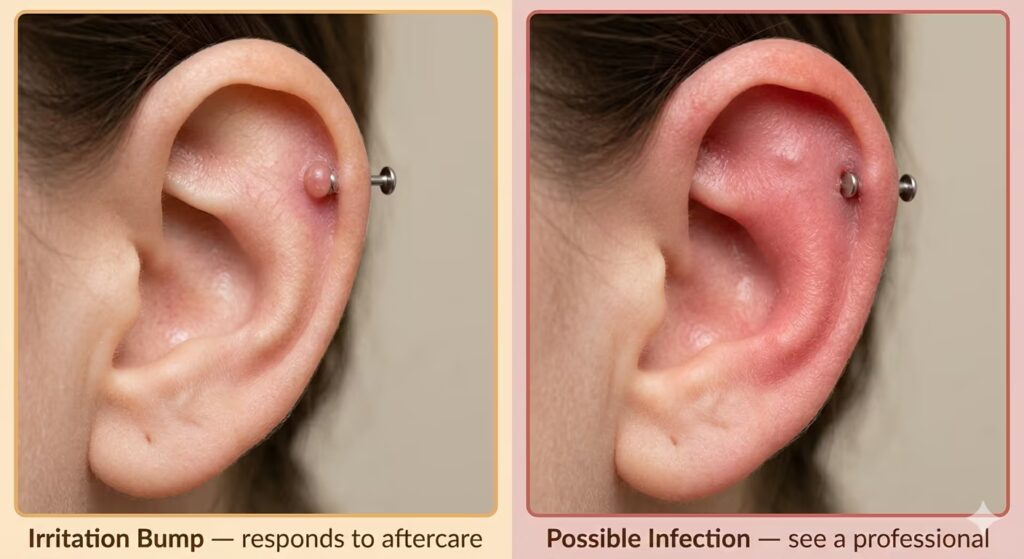
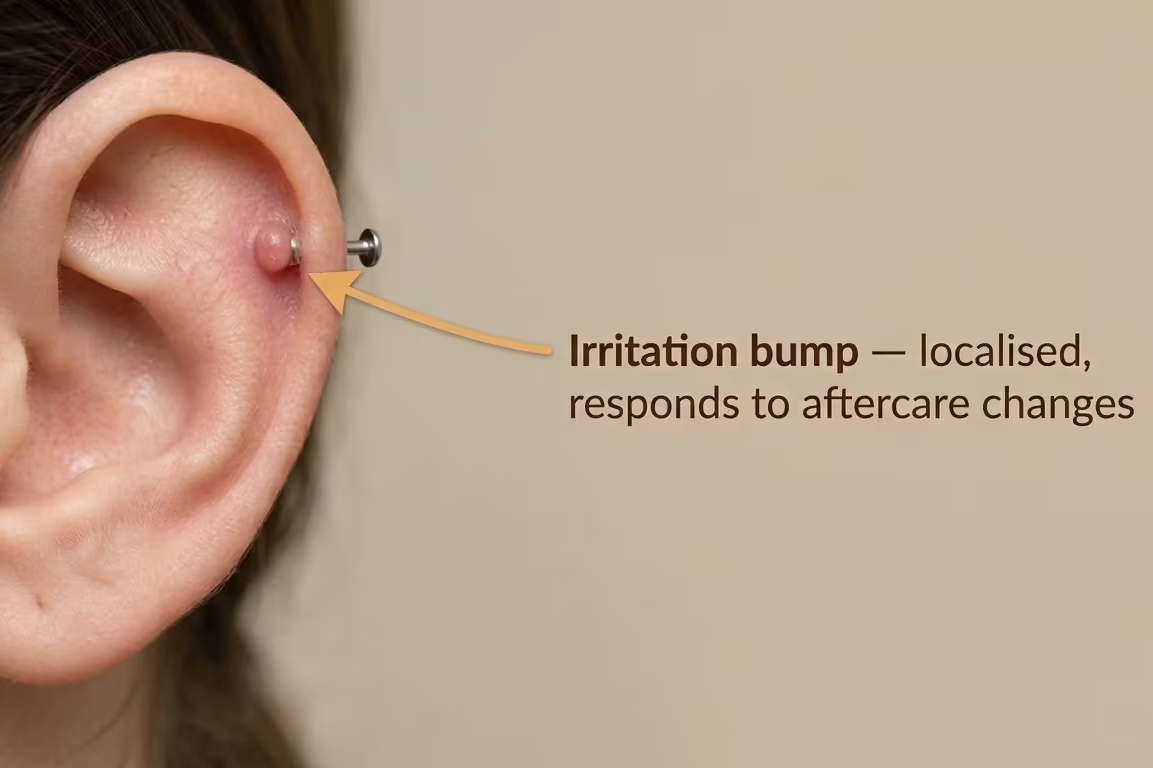
An irritation bump is the most visible sign of piercing irritation. It is a small raised area, sometimes called a keloid by people online, though it rarely is one, that forms around one or both ends of the jewellery.
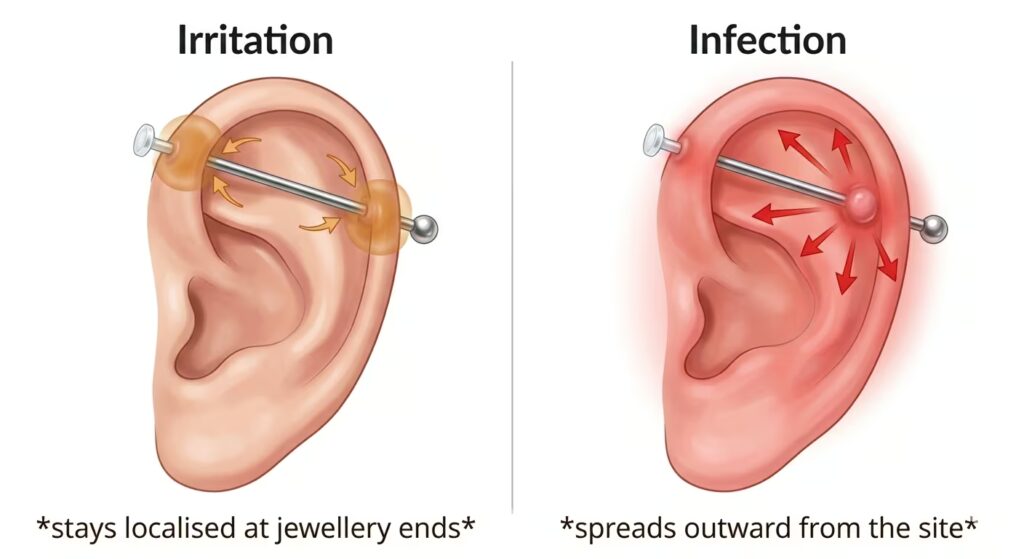
The bump is localised. It sits right at the entry or exit point of the jewellery. The redness and swelling, if any, are concentrated at the bump itself and the immediately surrounding tissue. It does not spread.
The discharge, if any, is clear or slightly whitish. It dries to a crust around the jewellery end. It does not smell strongly, and it is not coloured yellow or green.
The bump may be tender to the touch. It is not throbbing independently. It does not produce heat in the surrounding tissue.
What causes irritation
Sleeping on the piercing is the most common single cause of irritation bumps, particularly for cartilage piercings. Hours of direct pressure every night accumulate into significant tissue disturbance over weeks.
Jewellery that is too long for the healed anatomy moves excessively within the piercing channel, creating continuous friction. This is the second most common cause, and the reason the downsize appointment matters so much.
Hair snagging on jewellery, repeated touching, harsh cleaning products, and changing jewellery too early are all frequent causes.
Material sensitivity to nickel in substandard jewellery produces persistent irritation that looks and feels similar to mechanical irritation but has an allergic rather than a mechanical cause.
For the full guide on jewellery materials and nickel sensitivity, see our article on what jewelry is safe for sensitive skin and metal allergies.
How to resolve irritation
Identify and remove the source of irritation first. This is the most important step.
If you are sleeping on the piercing, start using a travel pillow. If the jewellery is too long, book an appointment to have it downsized. If you have been touching it, stop. If you have been using harsh products, switch to sterile saline only.
Once the irritant is removed, maintain a consistent twice-daily sterile saline cleaning routine and leave the piercing completely alone between cleaning sessions.
Most irritation bumps resolve within two to four weeks once the cause is identified and addressed. If the bump has not changed at all after six weeks of consistent improved aftercare, book an appointment with your piercer for an in-person assessment.
Infection: What It Is, What It Looks Like, What to Do
What does an infection look like?
The key distinguishing feature of infection is its spread.
Redness that moves outward from the piercing site rather than staying localised around the jewellery ends is the clearest warning sign. It may spread across the surrounding skin in an expanding pattern. This is not irritation behaviour.
Significant swelling beyond the immediate piercing area. Warmth in the tissue surrounding the piercing. Throbbing pain that pulses independently rather than only hurting when touched.
Discharge that is yellow or green, has a strong or unpleasant smell, or is produced in significant quantity. A small amount of clear or whitish discharge is normal healing. Coloured, smelly, or copious discharge is not.
Fever, chills, or general unwellness, along with local piercing symptoms, indicate the infection may be systemic. This requires immediate medical attention.
Why is infection less common than people fear
A professional studio using an autoclave-sterilised single-use needle, implant-grade jewellery, and correct technique creates a very low-risk environment for infection at the time of piercing.
The most common route of infection in healing piercings is post-procedure contamination: dirty hands touching the piercing, swimming in contaminated water, or close physical contact with another person’s bacteria.
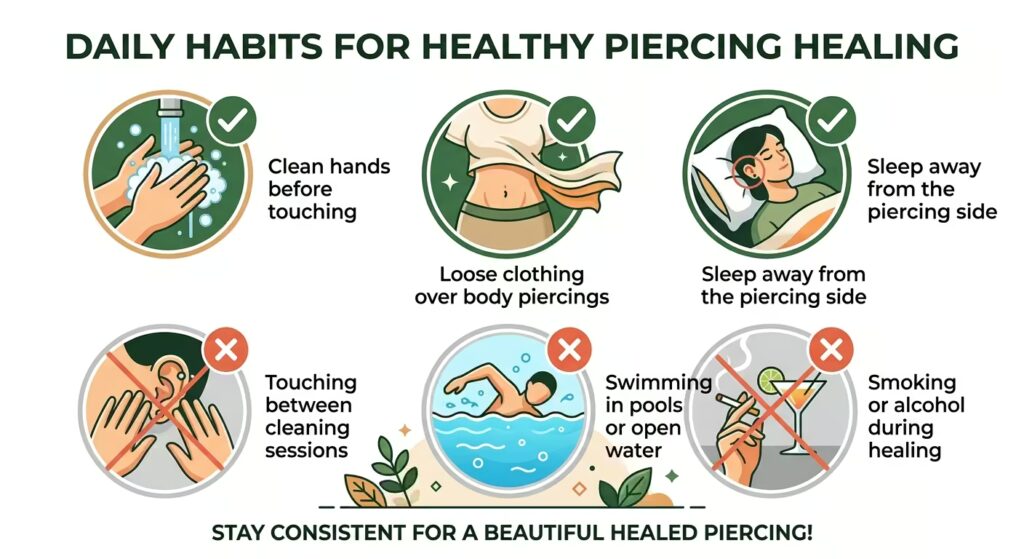
Good aftercare practices — clean hands, no touching between cleaning sessions, and avoiding pools — dramatically reduce the already low infection risk.
What to do if you suspect an infection
Do not remove the jewellery.
This is counterintuitive but critical. Removing the jewellery closes the skin over the infection, trapping bacteria inside a closed space. The body then has to fight the infection without the drainage route provided by the piercing channel. This can cause a much more serious abscess.
See a doctor promptly. A genuine piercing infection requires medical assessment and typically antibiotic treatment. The doctor can assess whether the jewellery needs to stay in or come out, and make that decision with the full clinical picture.
Contact your piercer as well. They can advise on what they are seeing from their experience and coordinate with any medical advice you receive. A good piercer and a good doctor working together is the best possible response to a genuine infection.
❝ Never attempt to treat a suspected infection by cleaning it more aggressively or applying antiseptics. Aggressive cleaning with alcohol or peroxide damages healing tissue and does not resolve a bacterial infection. See a doctor.
Side-by-Side Comparison
| Sign | Irritation | Infection |
| Redness location | Localised. Only around jewellery ends. | Spreading. Moves outward from the site. |
| Swelling | Minimal. May be a small bump at the entry or exit point. | More significant. Extends beyond the piercing site. |
| Discharge colour | Clear or whitish. Dries to crust. | Yellow or green. May have an odour. |
| Discharge amount | Small amount, mainly on jewellery ends. | More significant. May be continuous. |
| Pain type | Tender when touched. Not throbbing independently. | Throbbing, pulsing pain. Hurts without being touched. |
| Warmth | Little or none beyond normal skin temperature. | Noticeably warm tissue around the piercing. |
| Systemic symptoms | None. You feel well otherwise. | Possible fever, chills, feeling unwell. |
| Response to aftercare | Improves within 2–4 weeks of the identified cause being removed. | Does not improve with changes to aftercare alone. |
| What to do | Identify and remove the irritant. Improve aftercare. Visit the piercer if there is no change in 6 weeks. | See a doctor promptly. Do not remove jewellery without medical advice. |
Types of Bumps: Not All Are the Same
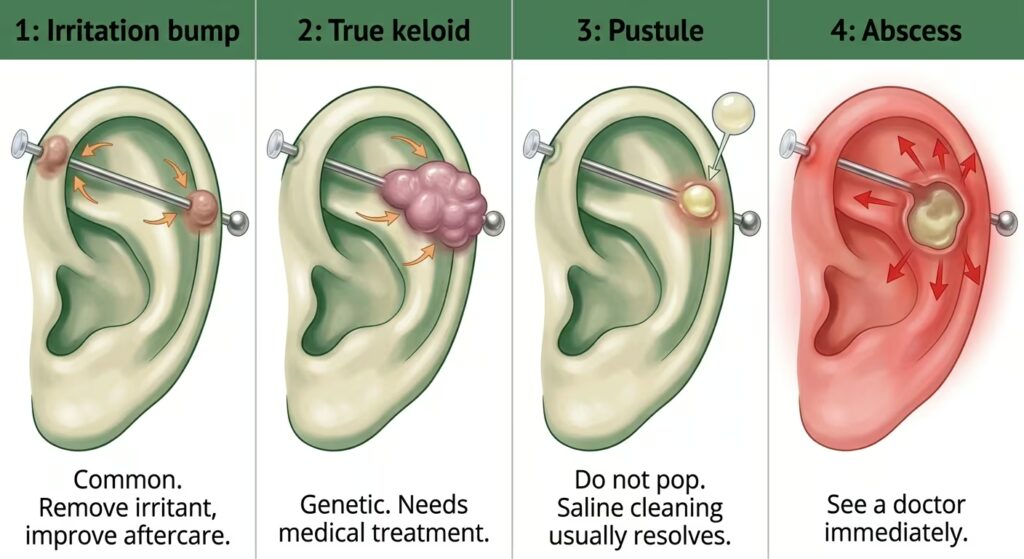
People commonly use the word “keloid” for any bump that forms around a piercing. Most of the time, they are wrong. Understanding the different types of bumps helps you respond correctly.
Irritation bump (hypertrophic scarring)
By far the most common type of bump around a piercing.
It is a small raised area of excess scar tissue that forms in response to repeated mechanical disturbance of the healing tissue. It sits directly at the jewellery end, is usually smooth-surfaced, resolves when the irritant is removed and consistent aftercare is maintained, and remains consistent after removal.
This is what most people mean when they say they have a “keloid” around their piercing. It is not a keloid. It is an irritation bump. The distinction matters because they respond differently to treatment.
True keloid
A true keloid is a specific type of overgrown scar tissue that extends significantly beyond the original wound boundary.
It is firm, raised, and typically larger than an irritation bump. It does not respond to improved aftercare in the way an irritation bump does. True keloids are genetic in nature and more common in people with darker skin tones, particularly those of African, Asian, and Hispanic heritage.
If you have a history of keloid scarring from other wounds, discuss this with your piercer before getting pierced. Certain placements carry a higher risk of keloid formation than others, and your piercer can advise accordingly.
True piercing keloids require medical or dermatological treatment. They do not resolve on their own.
Pustule
A pustule is a small fluid-filled bump, similar in appearance to a pimple, at or near the jewellery end.
It contains clear or whitish fluid, not yellow-green pus. Pustules in healing piercings are usually caused by irritation or mild localised bacterial activity rather than true infection.
Do not pop or squeeze a pustule on a healing piercing. This introduces bacteria into the wound and typically worsens it. Consistent saline cleaning usually resolves them within one to two weeks.
Abscess
An abscess is a collection of pus caused by a localised bacterial infection that the body has walled off.
It is significantly larger than an irritation bump, feels fluctuant or fluid-filled when pressed, and is painful. It may have a visible head or feel like a large, deep lump beneath the skin surface.
An abscess around a piercing requires medical treatment. Do not attempt to drain it yourself. See a doctor.
Common Scenarios and What They Mean
My piercing was fine for months, and suddenly it has a bump
A piercing that was healing well and developed a new bump usually means something changed in your routine or environment.
Common triggers include: a new pillow you are sleeping on, a new hair product, new clothing that comes into contact with the piercing, a jewellery change that was done too early, or accidentally snagging the jewellery.
Think back to what changed in the days before the bump appeared. That change is almost certainly the cause. Remove it and return to consistent saline aftercare.
My piercing has had a bump for months, and it is not going away
A bump that has persisted for more than six weeks without responding to improved aftercare needs an in-person assessment from your piercer.
The most likely issues are: the jewellery is too long and needs downsizing, the jewellery material is causing a reaction, the placement has a specific issue the piercer can identify, or, in rare cases, it is beginning to behave like a true keloid.
None of these can be reliably diagnosed from a photograph or a description. A visit to your piercer resolves most of them quickly.
My piercing smells bad
A mild, slightly earthy smell from a healing piercing is normal. It comes from the combination of dead skin cells, sebum, and lymph fluid in and around the piercing channel.
A strong, unpleasant, or sharp smell combined with coloured discharge and other signs of infection is not normal. That combination warrants a doctor visit rather than a piercer visit.
To reduce the normal piercing odour, ensure you are cleaning both the exterior and interior of the jewellery during cleaning sessions. Jewellery that is never removed accumulates sebum on its surface over time.
My piercing is red, but it does not hurt much
Mild, localised redness with little or no pain is usually irritation rather than infection.
Infection almost always involves pain, often throbbing pain, alongside the redness. Painless redness that stays localised and appears only around the jewellery ends is the typical presentation of a mild irritation response.
Review your recent aftercare and habits for the most likely irritant and address it.
There is clear fluid coming out of my piercing
Clear or whitish fluid that crusts around the jewellery end is lymph fluid. It is not pus. It is not an infection. It is a completely normal part of the healing process.
Lymph fluid is the body’s way of keeping the wound clean while it heals. It contains immune cells and proteins that support the healing process. Its presence, particularly in the first months of healing, is a sign that healing is actively underway.
The only discharge that is concerning is coloured discharge — yellow, green, or grey — particularly if it has an odour.
When to See Your Piercer vs. When to See a Doctor
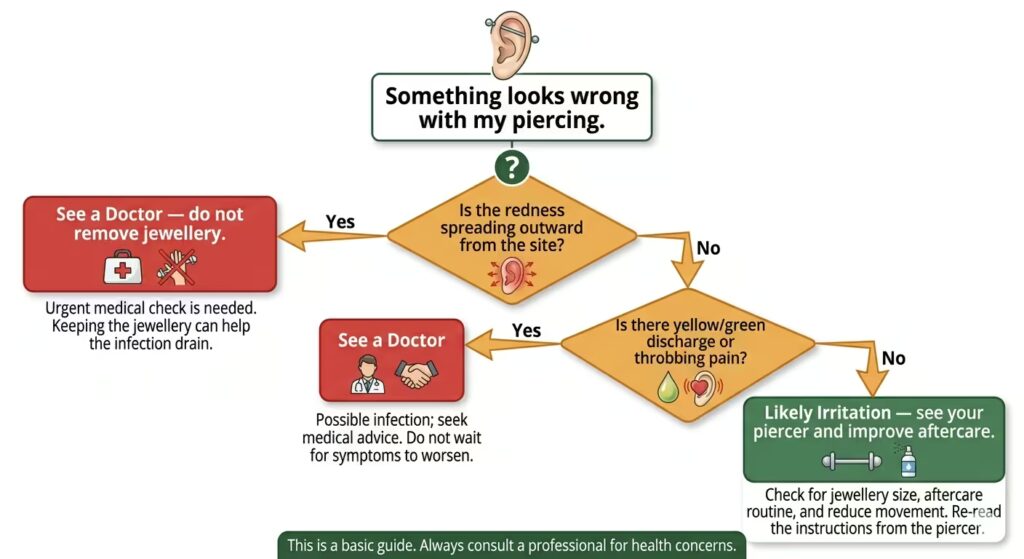
| See Your Piercer | See a Doctor |
| Irritation bump present for more than 2 weeks | Spreading redness beyond the piercing site |
| Jewellery may need downsizing | Yellow or green discharge with odour |
| Uncertain whether the jewellery material is the issue | Throbbing pain that pulses without touching the piercing |
| Bump has not responded to 6 weeks of improved aftercare | Warmth in the surrounding tissue beyond the piercing site |
| Piercing looks misaligned or migrating | Fever, chills, or feeling unwell with local symptoms |
| Need guidance on what is and is not normal | Visible abscess or deep fluid-filled lump |
| Uncertainty about whether the piercing is healed | Symptoms not improving after 48 hours of any intervention |
When in doubt, see both. A piercer and a doctor approaching the same problem from different perspectives produce the most complete picture.
What Not to Do in Either Situation
Do not remove the jewellery
Covered above, but worth repeating: removing jewellery from a piercing that has a problem — whether irritation or infection — closes the skin over the issue.
For irritation, this ruins months of healing progress for no benefit. For infection, it traps bacteria inside a closing wound.
Jewellery removal should only happen on professional advice.
Do not apply antiseptics aggressively
Alcohol, hydrogen peroxide, tea tree oil, and Betadine are all too harsh for healing piercing tissue.
They kill bacteria, but they also kill the cells forming the fistula. Using them on an irritated or infected piercing consistently worsens tissue damage rather than improves it.
For irritation: sterile saline only. For infection: see a doctor and use whatever they prescribe.
Do not Google photograph diagnoses
Photographs of piercing complications online are rarely accurately labelled. What is described as a “keloid” in a forum post is almost always an irritation bump. What is described as “fine, just a bit red” in a photo can look very different in person.
Use this guide to assess your situation. Then visit the appropriate professional in person. A piercer can tell you in thirty seconds what they are seeing. No photograph or description online can replicate that.
Do not wait if infection signs are present
True piercing infections can escalate quickly. Spreading redness, coloured discharge, throbbing pain, and systemic symptoms are not things to monitor at home while trying improved aftercare.
See a doctor within 24 to 48 hours of recognising those signs. Early antibiotic treatment resolves most piercing infections without significant complications. Delayed treatment allows the infection to spread and become significantly harder to manage.
Preventing Both Problems: The Basics
Both irritation and infection are significantly more preventable than most people realise.
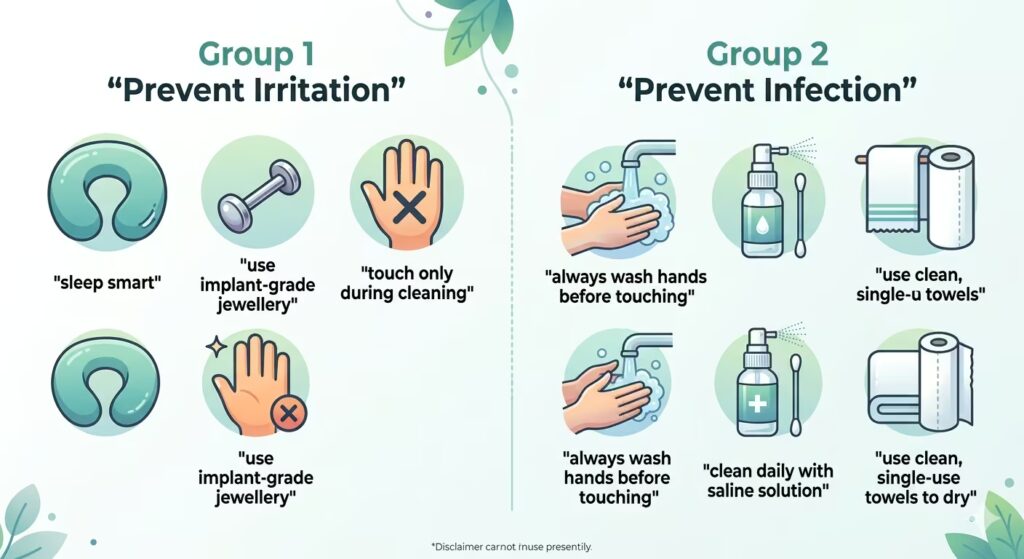
For irritation prevention
Get the jewellery downsized in six to eight weeks. This single step removes the most common mechanical irritant for most piercings.
Use implant-grade titanium jewellery from a verified supplier. Nickel in substandard jewellery is a persistent irritant that no amount of aftercare can overcome.
Manage your sleeping position for cartilage piercings. A travel pillow is a $15 investment that prevents months of setbacks in healing.
Leave the piercing alone. The fewer times you touch it, handle the jewellery, or clean it beyond twice daily, the less mechanical disturbance the healing tissue experiences.
For infection prevention
Wash your hands every single time before touching a healing piercing. Without exception.
Avoid pools, hot tubs, and open water for the first two to three months of healing.
Avoid contact between healing oral piercings and other people’s saliva during the healing period.
Keep aftercare simple and consistent. The twice-daily sterile saline routine is not just about cleanliness. It is about maintaining the correct biological environment for healing without introducing unnecessary substances.
For the complete aftercare guide covering every piercing type, see our article on how to clean a new piercing: the complete aftercare guide.
Frequently Asked Questions
Can an irritation bump become an infection?
An irritation bump itself does not turn into an infection. They have different causes.
However, a piercing with an irritation bump has compromised tissue that is more vulnerable to contamination. If you introduce bacteria into an already irritated piercing through dirty hands, pool water, or other contamination, an infection can develop alongside the existing irritation.
This is why keeping hands clean and maintaining the aftercare routine is important, even when dealing with an irritation problem.
How long does an irritation bump take to go away?
Most irritation bumps resolve within two to four weeks once the source of irritation is identified and removed.
Bumps that have been present for a long time and have received repeated interventions, including harsh product application, may take longer to heal because additional damage has been done to the surrounding tissue.
If a bump has not changed after six weeks of consistent improved aftercare with the irritant removed, visit your piercer for an in-person assessment.
Should I put anything on a piercing infection?
Only what a doctor prescribes after examining the infection.
Over-the-counter antiseptics and antibiotic creams are not appropriate for treating piercing infections and can interfere with healing. Prescribing appropriate oral or topical antibiotics based on an examination of the specific infection is the correct approach.
My friend had the same problem and told me to use tea tree oil. Should I?
No. Tea tree oil is consistently among the most harmful products used to heal piercings. It is a strong essential oil that causes contact dermatitis in healing tissue, creating additional inflammation on top of whatever the original problem was.
What works for one person’s skin in one situation does not translate reliably to another person’s healing tissue. Anecdotal advice from friends, however well-intentioned, is a major driver of piercing complications.
Can I use antibiotic cream on an irritation bump?
No. An antibiotic cream is for bacterial infections, not for mechanical irritation. Applying antibiotic cream to an irritation bump does not address the mechanical cause, and the cream itself can irritate the healing tissue further.
The correct treatment for an irritation bump is identifying and removing the mechanical cause and maintaining consistent sterile saline cleaning.
Is it normal to have some redness months into the healing process?
Mild, localised redness that stays at the jewellery entry and exit points is within the range of normal for cartilage piercings, particularly in the first six months.
Persistent redness that does not resolve over time, particularly if accompanied by a bump, suggests an ongoing irritant that has not been identified and removed. The piercing is telling you something. Identifying what changed or what consistent habit is causing the disturbance is the priority.
Know What You Are Dealing With Before You React
Most piercing problems are irritation, not infection.
Most irritation is caused by identifiable, removable factors: sleeping position, jewellery length, material, and frequency of touching.
Most irritation resolves within weeks of addressing the cause and maintaining consistent saline aftercare.
Infection is less common, more serious, and does not respond to changes in aftercare alone. It requires a doctor.
The framework is simple: is the problem localised or spreading? Is the discharge clear or coloured? Is the pain only on touch, or is it throbbing on its own? Those three questions get you most of the way to the correct answer.
When you are not sure, visit your piercer. When the signs point toward infection, visit a doctor. Do not remove the jewellery in either case without being told to by a professional.
For complete guidance on caring for a healing piercing and preventing both problems from arising, see our full aftercare guide on how to clean a new piercing: the complete aftercare guide.