Anti-Eyebrow Piercing Quick Facts
| Detail | Info |
|---|---|
| Also Known As | Teardrop piercing, butterfly kiss piercing, upper cheek piercing, crow’s feet piercing |
| Piercing Type | Surface piercing |
| Placement | Along the upper cheekbone, below the outer corner of the eye |
| Pain Level | 3–4 out of 10 |
| Healing Time | 3–5 months |
| Jewelry Type | Surface bar or surface anchor (microdermal); curved barbells are not recommended |
| Standard Gauge | 14G (16G occasionally) |
| Cost | $40–$80 (jewelry sold separately) |
| Permanence | Long-term temporary — typically lasts 1–5 years before rejection |
| Scarring Risk | High scarring is likely upon rejection or removal |
What Is an Anti-Eyebrow Piercing?
An anti-eyebrow piercing is a surface piercing placed on the upper cheekbone, just below the outer corner of the eye. It sits in the opposite position to the eyebrow — hence the name.
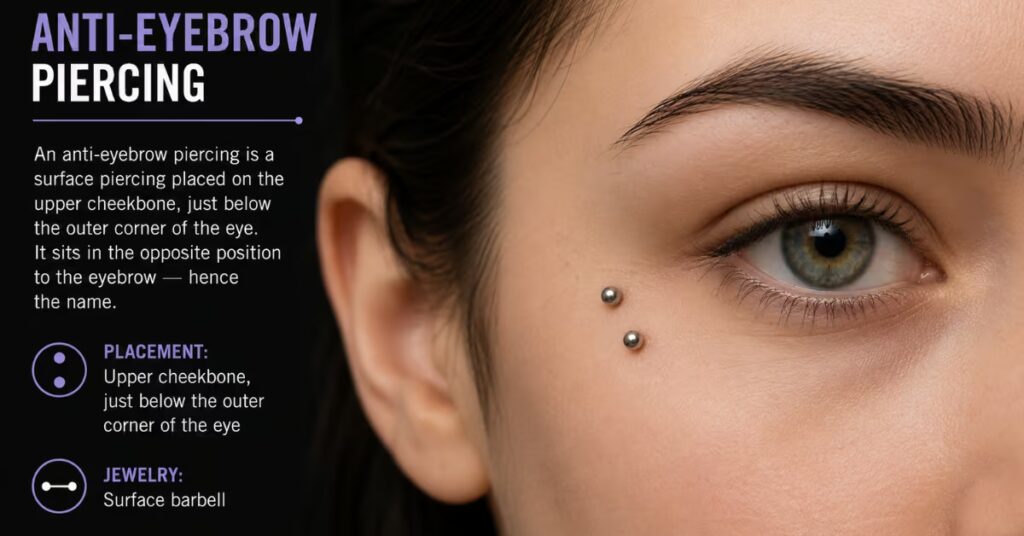
The piercing runs horizontally, vertically, or diagonally, depending on facial anatomy and personal preference. It passes through only a superficial layer of skin, not through cartilage or a natural fold.
Because it is a surface piercing, the body treats the jewelry as a foreign object. The immune response means this piercing will eventually be rejected — it is considered long-term temporary, not a lifetime commitment.
Anti-Eyebrow Piercing Placement and Anatomy
Almost everyone has the anatomy for an anti-eyebrow piercing. The key requirement is a pinchable area of skin above the cheekbone where the jewelry can sit without excessive movement.
Your piercer will assess more than just whether you can get this piercing. They will evaluate how long it is likely to last and which jewelry style suits your face.
Before marking the placement, a good piercer will ask you to scrunch your nose, raise your eyebrows, and smile widely. These movements reveal where the skin creases naturally. Placing the piercing directly in a crease line accelerates rejection.
People with fuller, rounder cheeks have different placement options than those with more defined cheekbones. Anatomy determines placement — not just aesthetics.
The Black Eye Risk
A bruised, black eye after an anti-eyebrow piercing is not rare. The tissue around the cheekbone and lower orbital area contains a high density of small capillaries. If one is nicked during the piercing, blood spreads into the surrounding skin, causing visible bruising around the eye.
This can look alarming, but it is not dangerous. The discoloration typically clears within a few days to two weeks.
To manage post-piercing bruising: apply a cold pack to reduce swelling, sleep with your head slightly elevated, and avoid blood thinners — including alcohol, aspirin, and caffeine — immediately after getting pierced.
Anti-Eyebrow Piercing Jewelry Options
Surface Bar
The surface bar is the traditional and most recommended jewelry for this piercing. It has two decorative ends and a flat bar that lies flush against the skin, with 90-degree bends at each end. This design minimizes movement and reduces pressure on the tissue.
A flat surface bar (as opposed to a round-backed one) is preferable because a round back creates a visible ridge under the skin.
For those who heal well, surface bars can last several years — occasionally even longer. If rejection occurs, surface bars tend to leave more noticeable scarring than anchors.
Surface Anchor (Microdermal)
A surface anchor uses a single decorative top attached to a small base that sits under the skin. Placement options are more flexible since the footprint is smaller.
Anchors are growing in popularity for this piercing. They tend to produce less scarring than surface bars upon rejection. They typically last 1–5 years, though some individuals get significantly more.
One downside: anchors can lift slightly over time due to facial movement. A lifted anchor needs prompt attention from a piercer before complications arise.
What to Avoid
Curved barbells are not appropriate for this piercing. The curvature creates movement within the tissue, which the body interprets as repeated trauma. The result is accelerated migration, rejection, and deep scarring. Some piercers used curved barbells for anti-eyebrow piercings in the early years of the style. The long-term outcomes — visible scars, early rejection — demonstrated clearly that they are unsuitable.
Anti-Eyebrow Piercing Jewelry Materials
The Association of Professional Piercers (APP) recommends implant-grade materials for all surface piercings. Suitable options include:
- Implant-grade titanium (ASTM F136) — lightweight, hypoallergenic, available in anodized colors
- Implant-grade steel (ASTM F138) — durable and affordable, but not ideal for those with nickel sensitivity
- Solid 14k or 18k gold — biocompatible; avoid gold-plated or gold-filled options, which can shed coating
- Niobium — hypoallergenic and suitable for sensitive skin
Nickel allergy is the most common cause of jewelry-related reactions at piercing sites. If you have experienced itching or a rash from costume jewelry in the past, opt for titanium or niobium.
Anti-Eyebrow Piercing Healing Timeline
Anti-eyebrow piercings take 3–5 months to heal on average. Individual factors — including immune function, lifestyle, climate, and jewelry choice — can extend this.
| Phase | What to Expect |
|---|---|
| Weeks 1–2 | Redness, swelling, tenderness, and possible bruising around the eye |
| Weeks 3–6 | Swelling subsides; dried lymph fluid (“crusties”) may form around the jewelry ends |
| Months 2–3 | Tissue settles; the piercing feels less fragile |
| Months 3–5 | Surface healing completes; full internal healing may continue beyond this |
A piercing can look and feel healed before it fully is. Avoid changing jewelry or reducing aftercare until the minimum healing period has passed.
Anti-Eyebrow Piercing Aftercare
Saline solution is the standard aftercare for surface piercings. Use a sterile, pre-made saline spray (0.9% sodium chloride, no additives) rather than a homemade mix. DIY salt solutions are often too concentrated, leading to dryness and delayed healing.
Spray the solution onto unwoven gauze and apply it as a warm compress to the piercing for 3–5 minutes, twice daily. Warm compresses do more than clean — the heat increases local blood flow, softens debris, and helps the body drain secretions from the piercing channel.
If a hot shower is more practical, letting clean water run over the piercing for a few minutes is an acceptable alternative.
To remove crusties: do not use your fingers or pull at the tops of the jewelry. Use a toothpick or a piece of unscented dental floss to gently loosen debris from the ends of the surface bar. Come in from multiple directions with minimal pressure.
Avoid:
- Makeup, foundation, or skincare products directly over or around the piercing
- Towels (use disposable gauze to pat dry)
- Swimming pools, hot tubs, or open water during healing
- Snagging on clothing, scarves, or eyewear
- Sleeping on the side of the piercing
Because anti-eyebrow piercings sit near a high-movement area of the face, any friction or repeated snagging poses a significant risk of rejection. Be deliberate when getting dressed and undressed.
Anti-Eyebrow Piercing Rejection: What It Is and What to Watch For
Rejection occurs when the body treats the jewelry as a foreign object and pushes it progressively closer to the skin’s surface. Surface piercings reject at a higher rate than piercings through cartilage or natural folds because there is less tissue resisting the body’s response.
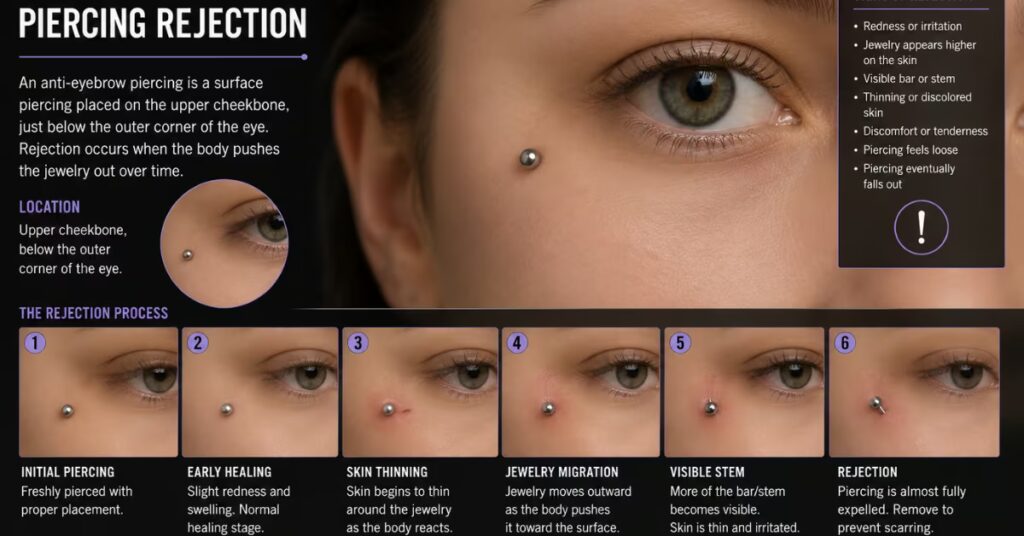
According to Medical News Today, the body’s wound-healing process involves skin contraction — pulling itself back together — which, in surface piercings, often results in the jewelry being pushed outward rather than being walled off with scar tissue.
Signs of rejection:
- The jewelry has visibly moved from its original placement
- The skin between the entry and exit points is thinning
- The entry or exit holes are enlarging
- The skin over the piercing looks shiny, red, or is beginning to peel
- A significant portion of the bar is becoming visible under the skin
If rejection is progressing, it is better to have the jewelry removed professionally and promptly. Leaving it in until it fully rejects increases the severity of scarring.
Scarring
Scarring is highly likely with an anti-eyebrow piercing. Anyone considering this piercing should accept the probability of a visible scar when the jewelry is eventually removed.
Facial changes over time — smiling, squinting, aging, loss of skin elasticity — all accelerate rejection. These are not avoidable. Even well-healed, carefully maintained anti-eyebrow piercings will eventually reach a point where removal is the right choice.
Surface bars tend to leave more pronounced scars than anchors. Prompt, professional removal before complete rejection reduces the depth and visibility of scarring.
People prone to keloid or hypertrophic scarring are generally advised against surface facial piercings.
Anti-Eyebrow Piercing Risks and Complications
| Risk | Details |
|---|---|
| Rejection and migration | Most likely complication: higher rate than non-surface piercings |
| Black eye and bruising | Common immediately after piercing; usually resolves within 1–2 weeks |
| Scarring | Expected upon rejection; severity depends on jewelry type and timing of removal |
| Infection | Signs include yellow or green discharge, worsening redness, warmth, and pain. Seek medical attention promptly. |
| Allergic reaction | Usually caused by nickel; presents as itching, rash, or dry skin around the site |
| Snagging | High risk given proximity to hair, eyewear, and clothing; can cause acute trauma to the piercing |
A 2024 review published via All About Vision noted that complications from eyebrow-area piercings can affect one in three people, underscoring the importance of choosing an experienced piercer and following aftercare diligently.
How Long Does an Anti-Eyebrow Piercing Last?
Most anti-eyebrow piercings last between one and five years. Some individuals with excellent healing responses and ideal anatomy get significantly longer, occasionally a decade or more.
Longevity depends on jewelry quality and type, placement (avoiding crease lines), the quality of aftercare, and individual biology. No anti-eyebrow piercing is permanent. Facial movement, aging, and the immune system all work against it over time.
Anti-Eyebrow Piercing Cost
A standard anti-eyebrow surface piercing costs $40–$80 for the piercing service, not including jewelry. Jewelry adds $40 and up, depending on material and design.
If you opt for two microdermal anchors to achieve the same look, each anchor is typically priced individually — expect to pay $40–$100 per anchor.
Always tip your piercer. A standard tip is at least 20%.
Anti-Eyebrow Piercing FAQs
Does an anti-eyebrow piercing always reject?
Not always, but the rejection rate is significantly higher than with ear or nose piercings. Proper jewelry choice, correct placement, and consistent aftercare reduce the risk, but cannot eliminate it.
Can I get an anti-eyebrow piercing if I wear glasses?
Glasses frames that sit across the cheekbone can press on or snag a healing anti-eyebrow piercing. Discuss placement with your piercer to find a position that minimizes contact with your frames.
Will I definitely have a scar from an anti-eyebrow piercing?
Most people are left with some degree of scarring after the piercing is removed. Starting with the right jewelry, having the piercing removed at the right time (before full rejection), and having it removed professionally all reduce scar severity.
Can I get an anti-eyebrow piercing redone after it was rejected?
Possibly, depending on how much scar tissue has formed. Your piercer can assess whether the tissue is suitable for re-piercing. It is generally not advisable to pierce through established scar tissue.
How do I know if my anti-eyebrow piercing is infected vs. just irritated?
Irritation typically presents as a small bump at one end of the bar, mild redness, and occasional tenderness — often triggered by snagging or pressure. Infection involves yellow or green discharge, spreading redness, heat, increasing pain, and sometimes swelling beyond the immediate piercing site. If you suspect infection, consult a medical professional. Do not remove the jewelry unless a doctor advises it, as this can trap bacteria inside the healing channel.
Is the anti-eyebrow piercing the same as the teardrop piercing?
Yes. Teardrop, butterfly kiss, and upper cheek piercing are all alternative names for the same placement. Some piercers use “teardrop” specifically for a single microdermal anchor below the eye, while “anti-eyebrow” typically refers to the surface bar version with two visible ends — but the terms are used interchangeably across the industry.