Sternum Piercing Quick Facts
| Detail | Info |
|---|---|
| Placement | Skin over the sternum (breastbone), between or below the breasts |
| Piercing Type | Surface piercing or dermal anchor (single-point) |
| Needle Gauge | 14g (standard for surface bars); 14g–16g for dermals |
| Pain Level | 4–6 out of 10 |
| Healing Time | 6–12 months (surface); 2–6 months (dermal) |
| Cost | $50–$120, not including jewelry |
| Best Jewelry | Implant-grade titanium surface bar or dermal anchor |
| Rejection Risk | High — classified as “long-term temporary” |
| Aftercare | Sterile saline solution twice daily |
What Is a Sternum / Cleavage Piercing?

A sternum piercing is a surface or single-point piercing placed on the skin overlying the sternum bone — the flat bone running down the center of the chest. It sits between the breasts, along the cleavage line, or just below the collarbones. Unlike ear or nostril piercings, there is no natural fold of tissue to anchor it; the jewelry rests entirely in shallow skin. That anatomical reality is what makes it both visually striking and uniquely high-maintenance.
Types of Sternum Piercings
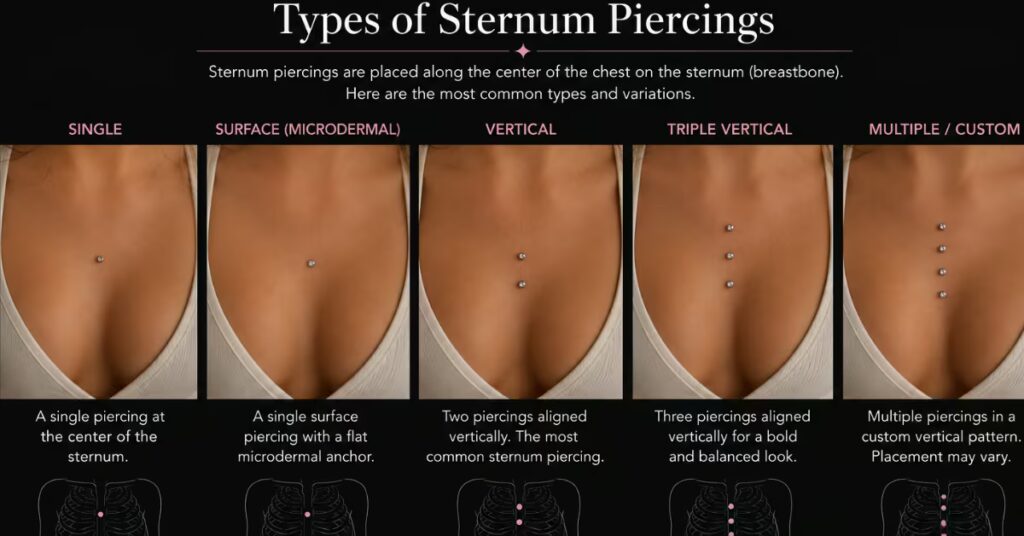
Vertical Sternum Piercing
A surface bar is inserted vertically beneath the skin, creating two visible points running down the breastbone. It produces an elongated, symmetrical look. Because the jewelry spans a longer track of tissue, it carries a slightly higher rejection rate than the other types. It is done with a staple-shaped surface barbell, not a standard curved barbell.
Horizontal Sternum Piercing
The jewelry sits horizontally across the chest, typically placed near the upper sternum, closer to the collarbones. It is bolder and more immediately visible in low-cut tops. The surface bar lies flat under the skin, with two decorative ends emerging at either side.
Sternum Dermal (Cleavage Dermal)
A dermal anchor is a single-point piercing. A small titanium foot is inserted into the dermis, and a decorative top gem, flat disc, or dome screws into it. There is no exit hole. The jewelry appears to float on the skin. Dermals are generally considered the better option for the sternum, specifically because they sit flatter, snag less, and tend to cause fewer friction issues than a two-point surface bar.
Surface Bar vs. Dermal: Which Is Right for the Sternum?
This is the most important decision before getting a sternum piercing.
A surface bar creates two visible points connected by a bar running beneath the skin. It looks like a line or a paired set of gems. It requires the piercer to create two punctures and is more likely to snag on clothing and seat belts. The body can treat the bar like a splinter and slowly push it out.
A dermal anchor has a single entry point and no bar running under the skin. It lies closer to the surface, heals faster (typically 2–6 months versus 6–12), and is far less likely to snag. However, even a single accidental pull can dislodge the anchor. Removal requires a professional — the anchor cannot be slid out the way a barbell can.
For the sternum area, most experienced piercers recommend a dermal if the goal is a single-gem accent at the cleavage. A surface bar is better suited to those wanting the vertical line or paired-gem aesthetic.
Sternum Piercing Pain Level
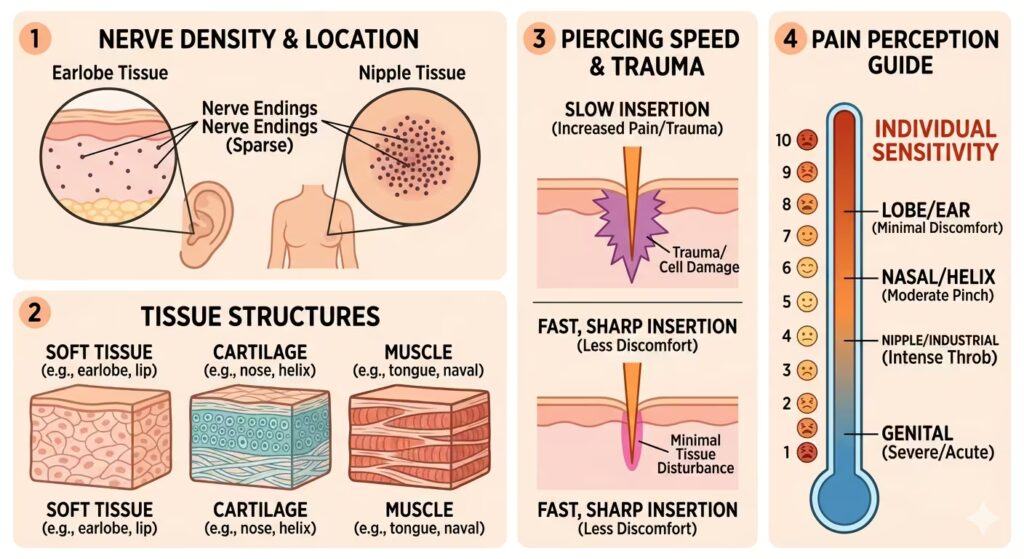
Sternum piercings are typically rated around 4–6 out of 10 on a pain scale. The skin in this area is relatively thin, and the sternum beneath provides limited tissue cushioning. The sensation is usually described as a sharp pinch followed by brief pressure. The area may feel tight or sore for a day or two afterward. A numbing cream can be applied beforehand if you have a low pain tolerance — ask your piercer.
Sternum Piercing Healing Time
| Type | Initial Healing | Full Healing |
|---|---|---|
| Surface (vertical or horizontal) | 6–8 weeks | Up to 12 months |
| Dermal anchor | 8–12 weeks | 2–6 months |
“Initial healing” refers to surface closure. The tissue underneath takes considerably longer to fully stabilize. Avoid changing jewelry or reducing your aftercare routine just because the outside looks healed.
Sternum Piercing Rejection and Migration: What You Need to Know
Rejection is the single biggest concern with sternum piercings. The body identifies the jewelry as a foreign object and slowly pushes it toward the skin’s surface. This is not a failure of aftercare — it is an immune response, and it is especially common in flat, tension-prone areas like the chest.
According to research published in the American Family Physician, surface piercings are among those most likely to result in rejection and scarring due to their shallow tissue placement. The chest, in particular, is subject to constant movement due to breathing, friction from clothing, and body positioning during sleep.
Signs your sternum piercing is rejecting:
- The entry and exit holes appear to be getting larger or farther apart
- More of the bar is visible through the skin than before
- The skin above the jewelry looks thin, shiny, or transparent
- The piercing feels persistently sore beyond the normal healing window
- The jewelry has visibly shifted from its original placement
If you notice these signs, do not wait. Remove the jewelry with your piercer’s help before the bar migrates fully through the skin. Allowing full rejection leaves a visible track scar, making re-piercing the area difficult.
Surface piercings are widely considered “long-term temporary” in the professional piercing community. Some last years; others reject within months. Body weight changes, illness, stress, and physical trauma (even sleeping on the chest) can trigger migration in a previously stable piercing.
Who Is — and Isn’t — a Good Candidate
Better candidates:
- Those with a flat, relatively fleshy sternum area
- People whose clothing choices allow them to avoid tight chest pressure daily
- Individuals who sleep on their backs, reducing friction on the piercing at night
Higher rejection risk:
- People with very flat, bony chests (less tissue depth for the jewelry to sit in)
- Those who frequently wear underwire bras, tight sportswear, or seatbelts that cross the sternum
- Anyone prone to keloid scarring — the sternum area is particularly prone to raised scarring after rejection
- People who are very active or involved in contact sports during the healing period
A consultation with a piercer before committing is essential. They will assess your anatomy and advise on placement depth and jewelry choice.
Sternum Piercing Aftercare
The Association of Professional Piercers (APP) recommends sterile saline solution as the standard aftercare for all surface piercings. Follow this routine for the full duration of the healing process.
Daily routine:
- Spray the piercing with a sterile 0.9% saline solution (wound wash) twice a day
- Pat dry gently with a clean paper towel — fabric towels can snag and harbor bacteria
- Do not rotate or twist the jewelry
- Do not use alcohol, hydrogen peroxide, or antibacterial soaps containing triclosan — these delay healing by damaging new tissue
Lifestyle adjustments during healing:
- Wear loose, soft-fabric tops that do not press against the piercing
- Avoid underwire bras until the piercing is fully healed; soft bralettes or bra-free options are better
- Sleep on your back to reduce nightly friction
- Avoid swimming pools, hot tubs, lakes, and oceans — all carry bacteria that can infect a healing piercing
- Pat the area dry after showering rather than rubbing
What not to do:
- Do not cover with a bandage long-term; the piercing needs airflow to heal
- Do not apply lotions, makeup, or perfume near the site
- Do not change the jewelry early — wait until the piercing is confirmed fully healed, and have your piercer handle the first swap
Sternum Piercing Jewelry: Types and Materials
Types
Surface bar (staple bar): The standard for vertical and horizontal sternum piercings. It has a flat bar that runs under the skin with 90-degree bends at each end, so the tops sit flush to the surface. Regular curved barbells (the type used for navel piercings) should not be used for surface placements — they apply incorrect pressure and significantly increase the risk of rejection.
Dermal anchor: A small flat-footed base inserted into the dermis. The decorative top screws into the post. Common top styles include flat discs, gems, opals, and dome caps.
Materials
Implant-grade titanium is the first-choice material for fresh sternum piercings. It is lightweight, hypoallergenic, and the safest option for new tissue. Implant-grade steel is acceptable for those without nickel sensitivity. Niobium is another hypoallergenic option. For gold, use 14-karat solid yellow or white gold — not plated, not filled, and not above 18 karats (which is too soft). Avoid nickel-containing alloys entirely; nickel is a documented allergen that triggers allergic contact dermatitis in a significant portion of the population, as confirmed by published dermatological research.
Sternum Piercing Risks and Complications
- Infection: Caused by bacterial exposure during or after piercing. Symptoms include green or foul-smelling discharge, significant swelling, and heat around the site. Mild white or clear crusting is normal — that is, lymph fluid, not infection. A published clinical review (Body Piercing Infections, NCBI) notes that improper aftercare and non-sterile environments are the primary drivers of infection.
- Keloids and scarring: Those genetically prone to keloid formation — raised, thickened scar tissue that grows beyond the original wound — carry an elevated risk with sternum piercings. The chest is a common site for keloids. If you have a history of keloid scarring, discuss this explicitly with your piercer before proceeding.
- Migration: The jewelry shifts from its original placement. Migration does not always result in full rejection, but a migrated piercing rarely returns to its original position and usually will not heal in its new position.
- Nerve impact: Rare cases of nerve sensitivity changes have been documented with deep surface piercings, per published body modification literature. Choosing an experienced piercer who understands tissue depth significantly reduces this risk.
How Long Does a Sternum Piercing Last?
There is no fixed answer. With optimal jewelry, excellent placement, and consistent aftercare, some sternum piercings last 10+ years. Others reject within six months despite perfect care. The flat, mobile nature of the sternum area means even well-healed piercings can become destabilized years later by weight fluctuations, pregnancy, or an injury.
Setting realistic expectations is part of caring for the piercing. If it rejects, waiting until the area has fully healed — typically 6–12 months — before attempting a re-piercing is important. The same exact placement may not be viable if the tissue has scarred.
Sternum Piercing Cost
Sternum piercings generally cost $50–$120, depending on:
- The piercer’s experience and studio location
- Whether you choose a surface bar (two holes) or a dermal (one)
- The jewelry material selected
High-quality implant-grade titanium jewelry costs more upfront but significantly reduces the risk of complications and rejection. Cutting costs on jewelry for a high-rejection-risk piercing is a false economy.
Sternum Piercing FAQs
Can I wear a bra with a sternum piercing?
Yes, but with care during the healing process. Underwire bras press directly onto the sternum and should be avoided until the piercing is fully healed. Soft bralettes, bralette-style sports bras, or going bra-free are better options during the healing period. After full healing, underwire is fine as long as it does not sit directly on the piercing site.
Does a sternum piercing leave a scar?
Most sternum piercings leave some mark — usually two small dots at the entry and exit points for surface piercings, or a faint depression for dermals. If the piercing is fully rejected before removal, it typically leaves a more visible linear scar. Removing jewelry at the first signs of rejection significantly minimizes scarring.
Can I get a sternum piercing if I’m larger-chested?
Yes, but placement must be carefully considered. Greater tissue depth can help the piercing sit more stably, but increased chest movement — particularly with underwire bras or during physical activity — increases the risk of rejection. Discuss your anatomy and lifestyle with your piercer to determine the most viable placement and jewelry type.
How do I change the top of a dermal sternum piercing?
Wait at least three months after the piercing has fully healed before changing the top. The first change should ideally be done by your piercer. After that, you can change the decorative top at home using sterile hands and small forceps or tweezers wrapped in tape to avoid scratching the post. Do not rotate the anchor while unscrewing — this tears the surrounding tissue. The base stays permanently in place; only the top is changed.
Can a sternum piercing be removed?
A surface bar can be removed by unscrewing the end beads and sliding it out, though you should have your piercer do this if the piercing has healed tightly. A dermal anchor cannot be removed at home; the anchor requires a professional to extract. Attempting self-removal of a healed dermal risks tearing the skin and increasing scarring.
Can I get a tattoo over a sternum piercing?
Only after the piercing is fully healed. Getting tattooed near an unhealed piercing can introduce bacteria and irritate the surrounding tissue. Your piercer and tattoo artist should coordinate on placement to ensure both pieces work aesthetically and do not compromise each other’s healing.
Sources: Association of Professional Piercers (APP) Aftercare Guidelines; Meltzer, D.I., “Complications of Body Piercings,” American Family Physician (2005); “Body Piercing Infections,” NCBI StatPearls; “Body Piercing,” Journal of Clinical and Aesthetic Dermatology (NCBI PMC1496593); “Piercing Rejection,” Medical News Today / Healthline.