Belly Button Piercing Quick Facts
| Info | Detail |
|---|---|
| Placement | Through the upper rim of the navel (most common); variations include lower rim, floating, and double placements |
| Piercing Type | Surface piercing through soft tissue (no cartilage) |
| Pain Level | 3–5 out of 10 |
| Healing Time | 6 to 12 months, up to 2 years for full internal healing |
| Initial Jewellery | 14g curved barbell, 10–12mm length |
| Best Materials | Implant-grade titanium (ASTM F-136), 14k/18k solid gold, niobium |
| Average Cost | $30 to $100, including starter jewelry |
| Aftercare | Sterile saline rinse, twice daily |
| Main Risks | Rejection, migration, infection, keloid formation |
| Age Restrictions | Varies by region; most US states require 18+ or parental consent |
What Is a Belly Button Piercing?
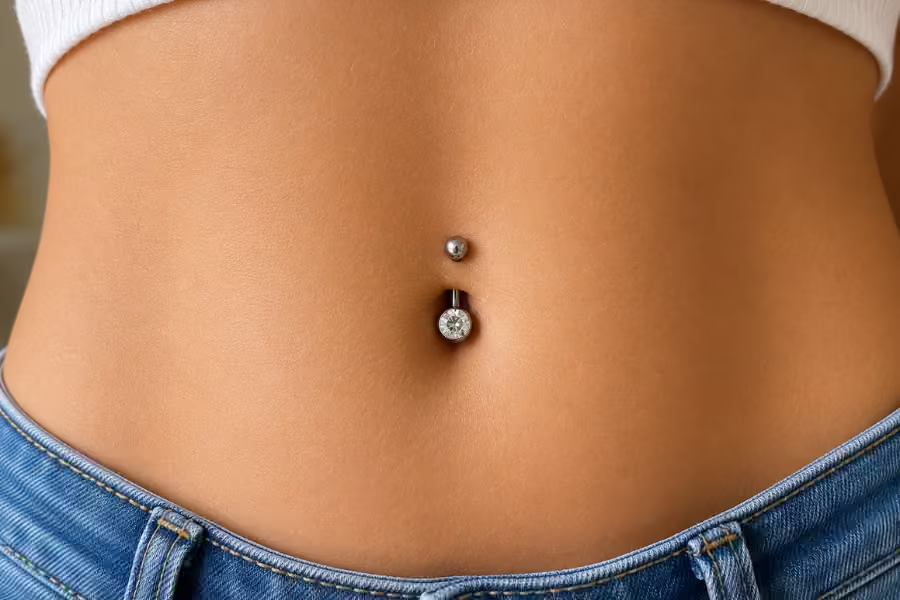
A belly button piercing sits through the skin rim of the navel, almost always the upper rim. The needle passes through soft tissue, not cartilage, which is why it ranks low in pain but high in difficulty to heal. It is technically a surface piercing, meaning jewelry enters and exits on the same plane of skin. That single fact explains nearly every quirk that follows, including the long healing window and the elevated risk of rejection.
Anatomy Decides Whether You Can Get One
Not every navel can hold a piercing. The piercer looks for a defined lip or flap of skin above the navel with a clear front and back edge. There must be enough space behind it for jewelry to sit without pressure.
Your piercer should assess the tissue while you stand, sit, and recline. Movement matters as much as appearance. A navel that folds shut or collapses when you sit is a poor candidate.
Outies are generally not suitable for a standard navel piercing. The protected fold isn’t there, and the umbilical tissue is more reactive. A piercer may suggest a floating navel or no piercing at all.
People with no upper lip, very flat navels, or non-pliable skin in the area are often turned away. Going to another piercer who agrees to do it anyway is how piercings end up rejected within months.
The Six Placements
Standard (upper) navel — Through the upper rim, jewelry curves into the navel. The classic look, suited to most pierceable anatomies.
Inverse (lower) navel — Through the lower rim. Requires a distinct flap of skin underneath the navel, which is less common.
Floating navel — Pierced through the upper rim, but uses a flat disc on the bottom end instead of a ball. Built for shallow navels or navels that crowd jewelry when seated.
Double navel (vertical) — One piercing on the upper rim, one on the lower. Requires both rims to be pierceable.
Double navel (horizontal) — Two piercings on either side of the navel. Needs a wide navel with enough flat tissue laterally.
True navel — Pierced through the actual navel skin, not the rim. Rare and aesthetically specific.
Belly Button Piercing Pain Level
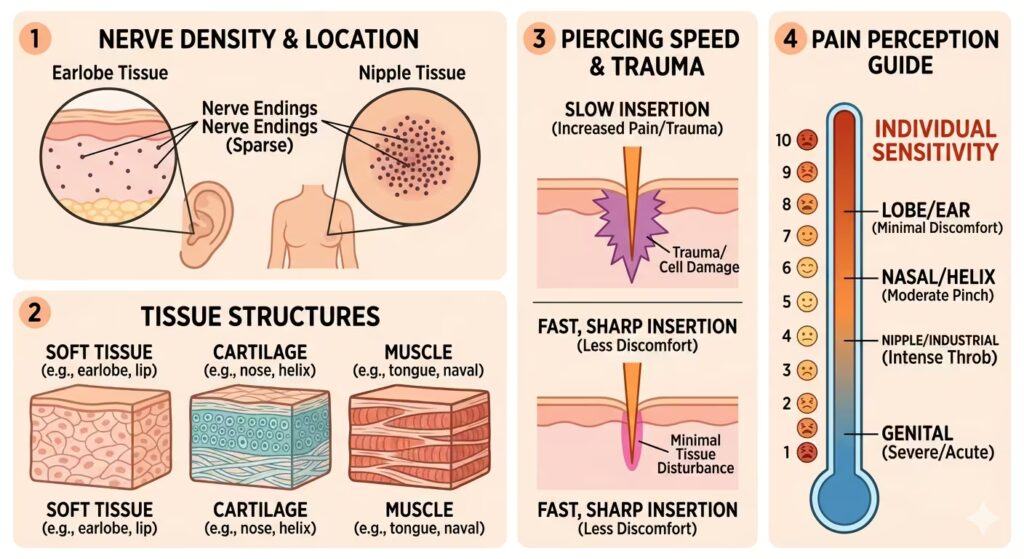
Most people rate it 3 to 5 out of 10. The sharp moment is brief, usually under two seconds. Soreness, throbbing, and tenderness follow for several days.
Bending, laughing, and sitting up will tug on the piercing during the first week. Topical lidocaine creams applied 30 to 60 minutes before the appointment can reduce the initial sting if your piercer permits them.
Belly Button Piercing Jewelry: Get This Right or the Piercing Fails
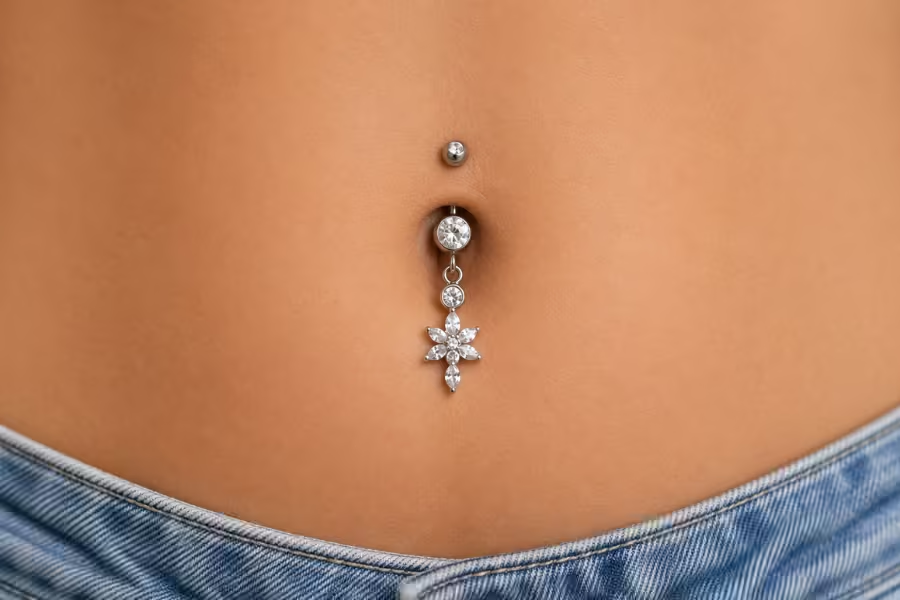
Initial jewelry is a 14g curved barbell. Some piercers use 12g for extra stability. Anything thinner risks the body treating the jewelry like a splinter and pushing it out.
Material matters more here than in most piercings. Implant-grade titanium (ASTM F-136 or F-1295) is the gold standard for fresh navels. Surgical steel works for most but contains nickel. Niobium and 14k or 18k solid gold are also safe.
Avoid during healing: nickel alloys, brass, plated jewelry, captive bead rings, dangle charms, and externally threaded pieces. Internally threaded or threadless ends only.
A starter bar is typically 10mm to 12mm to allow for swelling. Once swelling subsides, the piercing usually needs a downsize to 8mm or 10mm. Downsizes should be done by your piercer, not at home.
Belly Button Piercing Healing Timeline
The healing window is the longest among popular piercings. A review published in the American Journal of Clinical Dermatology found that belly button piercings can take a year to heal, and complications occur in roughly 20 percent of body piercings overall.
The Canadian Medical Association Journal places navel healing at six months to two years, noting that body parts subject to constant movement, like the navel and tongue, take longer than other sites.
A realistic schedule looks like this:
- Weeks 1 to 4: swelling, soreness, clear or pale yellow lymph crusting. Sleeping on your back is easiest.
- Months 2 to 4: the surface appears healed, but the channel inside remains raw. Changing jewelry now triggers irritation.
- Months 4 to 9: crusting stops, jewelry moves freely without discomfort.
- Months 9 to 12: the internal channel continues to mature.
Stress, smoking, poor sleep, and tight waistbands all stretch this timeline.
Why Navel Piercings Get Rejected
Rejection occurs when the body treats the jewelry as a foreign object and pushes it toward the skin surface until it exits. Navels are among the most rejection-prone piercings on the body.
The American Academy of Family Physicians attributes the elevated infection and complication rate to a specific mechanism. Friction from clothing with tight-fitting waistbands and subsequent skin maceration accounts for delayed healing and higher infection rates at this site.
Research published in Wounds International confirms that tight clothing increases moisture around the navel. That trapped moisture promotes bacterial growth on top of the friction problem.
The biggest preventable cause is placement. Shallow piercings, or piercings done at the wrong angle, drive migration and rejection within months.
Early warning signs:
- The bar starts to look more visible under the skin
- Skin between the entry and exit points thins or becomes translucent
- The piercing appears to sit shallower than when it was done
- The holes elongate or widen
See your piercer immediately if you notice any of these signs. Catching migration early sometimes saves the piercing with a jewelry change.
Infection vs. Irritation
These look similar but mean different things. Irritation is mechanical, caused by bumping, rubbing, or sleeping on the piercing. Infection is bacterial.
According to StatPearls (NCBI/NIH), localized cellulitis is the most common infectious complication of body piercings. Staphylococcus, Streptococcus, and Pseudomonas are the usual causative organisms.
Infection signs include hot, spreading redness beyond the piercing site, yellow or green pus, throbbing pain that worsens beyond day three, a foul odor, or fever. Clear or pale lymph fluid is normal and not a sign of infection.
Mild irritation usually resolves with a few days of gentler care. Suspected infection means a doctor visit. Keep the jewelry in unless a clinician tells you otherwise, because removing it can trap the infection inside the closing channel.
Belly Button Piercing Aftercare
The Association of Professional Piercers (APP) currently recommends a simple protocol:
- Wash your hands thoroughly before touching the piercing
- Saline rinse twice daily using packaged sterile saline labeled as wound wash, with 0.9% sodium chloride as the only ingredient
- Pat dry with disposable paper, never a cloth towel
- Avoid submerging in lakes, pools, and hot tubs, or covering with a waterproof wound-sealant bandage
- No cosmetics, lotions, sprays, or charms on the jewelry during healing
- Leave the initial jewelry in for the full healing period unless there’s a fit problem
The APP no longer recommends homemade sea salt soaks. Self-mixed solutions are commonly too salty and over-dry the piercing.
Skip hydrogen peroxide, rubbing alcohol, Bactine, Neosporin, undiluted tea tree oil, and antibacterial soaps. All of these damage healing tissue and prolong recovery.
Lifestyle Adjustments During Healing
Clothing: Soft, loose tops. High-waisted jeans, leggings, and waistbands that sit at the navel are the main mechanical cause of irritation.
Sleep: On your back when possible. A vented hard eye patch held with a soft elastic band can shield the piercing from rolling pressure during the first weeks.
Exercise: Light movement is fine within days. Avoid abdominal-focused workouts, contact sports, and anything that causes heavy sweat to pool in the navel for the first few months. Rinse with saline after sweating.
Swimming: Avoid open water and pools for at least the first three months. After that, cover with a waterproof dressing made for the navel.
Sex and intimate contact: Body fluids and friction around the piercing slow healing. Keep the area protected.
Belly Button Piercing Cost
In the US, expect $30 to $100, including starter jewelry, with most reputable studios charging $50 to $80. Higher-end studios using premium implant-grade titanium and gem-set ends can run $100 to $200 or more.
Tipping the piercer 15 to 20 percent is standard. Cheap shops cutting corners on jewelry quality are the most common cause of nickel reactions and prolonged healing.
Pregnancy and the Navel Piercing
A fully healed navel piercing can usually stay in during early pregnancy. As the abdomen expands, three things happen: the skin stretches and thins, the bar pulls on the channel, and waistbands rub the area more aggressively.
Most people switch to a PTFE or BioFlex pregnancy bar around weeks 16 to 25. These flex with the bump and avoid the tearing risk a rigid metal bar creates. Some remove the jewelry entirely once it becomes uncomfortable.
Avoid getting a new navel piercing while pregnant. Pregnancy can weaken the immune response and slow healing, and the body will stretch the area you just wounded.
If the piercing tears or scars during pregnancy, re-piercing six to twelve months postpartum is usually possible. A piercer should first confirm that the tissue has fully settled.
Scarring After Removal
A removed navel piercing usually leaves two small dot scars at the entry and exit. A migrated or rejected piercing leaves a thin, pale line of scar tissue between the two points.
Keloids are raised, thickened scars that grow beyond the original wound boundary. They are not the same as hypertrophic scars, which stay within the wound. People with darker skin tones and a family history of keloid formation carry a higher risk.
Belly Button Piercing Frequently Asked Questions
How old do I need to be to get a belly button piercing?
Laws vary by jurisdiction. Most US states require parental consent under 18. Florida requires notarized consent forms for those between 16 and 18. UK studios generally pierce 16+ with photo ID.
Can I get a belly button piercing done with a piercing gun?
No. Guns crush tissue rather than cleanly cutting it, increase the risk of infection, and cannot be properly sterilized between clients. A hollow needle is the only acceptable tool.
Does a belly button piercing close up if I take the jewelry out?
A fresh navel piercing can close within hours. A piercing under a year old often closes within days to weeks. Fully matured piercings may stay open for weeks or months, but eventually shrink without jewelry.
Can I get a belly button piercing if I’m overweight or have a larger belly?
Yes, if your anatomy supports it. The deciding factor is whether you have a pierceable upper rim with enough space behind it. A skilled piercer will assess your anatomy in person.
Will a belly button piercing leave a scar if I remove it later?
Almost always, yes. Two small dots at a minimum. A migrated piercing leaves a longer mark. Scars fade significantly over a year but rarely vanish.
How soon can I change the jewelry?
Not until your piercer confirms the channel is healed. That is typically nine to twelve months in. Downsizing between weeks four and eight is an exception and should be done at the studio.
Is sleeping on my stomach a problem with a belly button piercing?
For at least the first three to six months, yes. Direct pressure on a healing navel piercing can cause irritation, angle shifts, and increased risk of migration.
What if my belly button piercing rejects?
Remove the jewelry once your piercer confirms rejection. Allowing the body to push it out entirely results in a worse scar. You can usually re-pierce after 12 months, once the scar tissue has settled.
Can I drink alcohol after getting it pierced?
Avoid heavy alcohol for the first 24 to 48 hours. Alcohol thins the blood and increases swelling and bruising at a fresh piercing site.
Does pregnancy automatically ruin the piercing?
No. Many people keep navel piercings through pregnancy with a flexible PTFE bar. The piercing may stretch slightly, but a healthy channel often returns close to normal postpartum.
Can I use Neosporin if it looks irritated?
No. Neosporin and similar petroleum-based ointments trap bacteria against the wound and slow healing. Stick to sterile saline only.
Why is my belly button piercing still crusty months later?
Light crusting throughout healing is normal. Persistent thick crust usually means the jewelry is irritating the channel, often due to a bar that’s too long after swelling has gone down. See your piercer for a downsize