Quick Facts: Eyebrow Piercing
| Detail | Info |
|---|---|
| Piercing Type | Vertical surface piercing |
| Placement | Along the eyebrow ridge; most commonly the outer third |
| Standard Gauge | 16g (range: 12g–18g) |
| Needle Size | 12–18 gauge cannula needle |
| Pain Level | 3–4 out of 10 |
| Healing Time | 6–8 weeks initial; 6–12 months full |
| Jewelry | Curved barbell (recommended), captive bead ring |
| Jewelry Materials | Implant-grade titanium, 14k–18k gold, ASTM F138 steel |
| Average Cost of Eyebrow Piercing | $30–$80 (jewelry may be additional) |
| Rejection Risk | Moderate — anatomy-dependent |
| Scarring Risk | High if rejected or removed prematurely |
What Is an Eyebrow Piercing?
An eyebrow piercing is a vertical surface piercing. A cannula needle passes through the bottom of the eyebrow and exits from the top. Jewelry then sits through that channel.
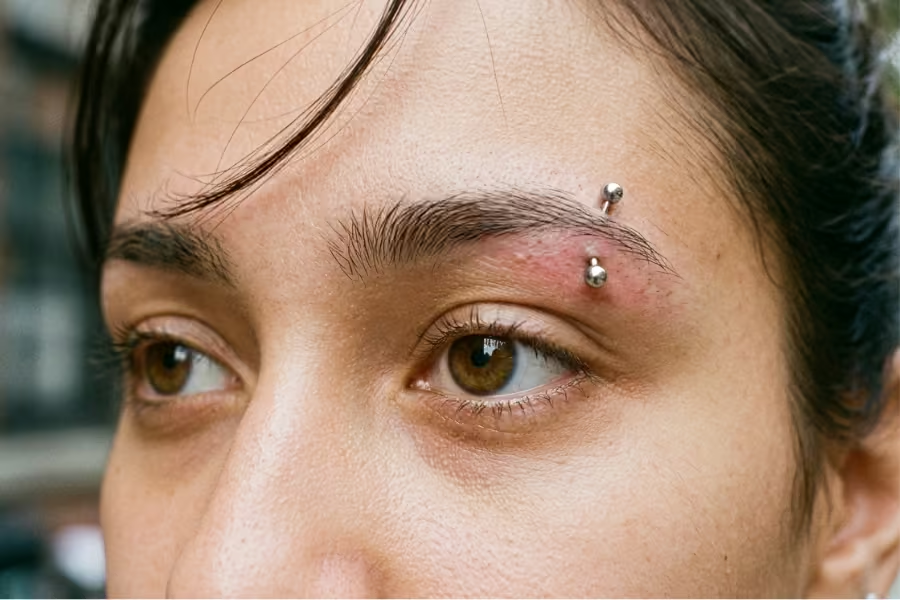
It is technically classified as a surface piercing. Unlike earlobes or nostrils, the tissue here is flat, not a distinct flap of skin. That distinction matters significantly for healing and long-term retention.
The piercing was introduced by the punk subculture in the 1970s. By the 1990s, it had crossed into mainstream fashion, favored by musicians and celebrities alike.
Anatomy: Who Can (and Cannot) Get One
Eyebrow anatomy determines whether this piercing works for you — more than personal preference does.
An ideal candidate has a protrusive brow ridge with loose, padded skin. Pinch the outer brow between your index finger and thumb. The tissue should feel thick, easy to pull away from the skull, and have clear depth. If it feels thin, tight, or nearly flat against the bone, the piercing poses a significantly higher risk of rejection.
Hormonal anatomy plays a role. People assigned male at birth often develop more protrusive brow ridges due to testosterone-driven bone development. People assigned female at birth frequently have flatter, more vertical brow ridges, which can make the piercing harder to retain and more prone to irritation.
The outer third of the brow is the standard placement zone. Moving the piercing toward the center of the brow — closer to directly above the eye — puts it near a cluster of supra-orbital nerves. Piercing too close to that area does not cause paralysis, but it can result in temporary numbness or loss of sensation in the surrounding face. The facial nerve branches responsible for motion are deeper than a surface piercing reaches.
Types of Eyebrow Piercings

Vertical Eyebrow Piercing
The standard and most common style. The needle passes vertically through the skin of the outer brow. The two ends of a curved barbell sit above and below the brow line. Placement can be anywhere along the brow from the arch outward toward the temple.
Horizontal Eyebrow Piercing
The jewelry runs horizontally along the eyebrow rather than across it. It is a true surface piercing with a higher risk of migration than the vertical style. A surface bar is typically preferred over a curved barbell for this placement.
Double (or Multiple) Eyebrow Piercings
Two or more vertical piercings placed along the same brow. Piercers generally recommend getting one at a time to simplify healing. Crowding jewelry in a small area increases the risk of irritation.
Anti-Eyebrow Piercing
Placed below the eye along the upper cheekbone, not on the eyebrow itself. It is a separate surface piercing that sits opposite where a standard eyebrow piercing would. Because it lies flat against the skin, it carries a higher rejection rate than the classic vertical placement.
Eyebrow Piercing Pain Level
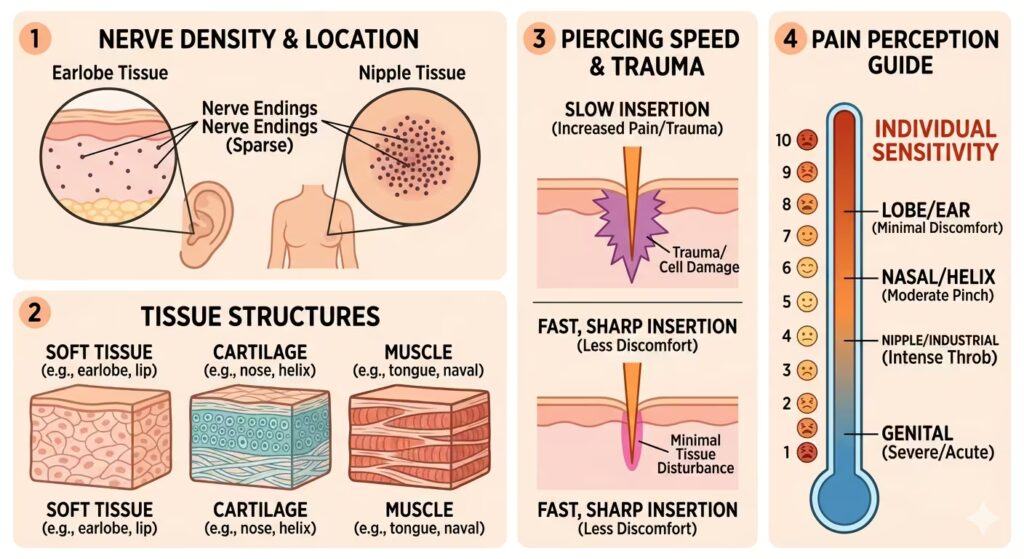
Most people rate the eyebrow piercing at a 3–4 out of 10. The needle passes through a relatively thin section of skin with modest nerve density in the outer brow area. The experience is usually a quick, sharp pinch, sometimes followed by brief pressure.
Involuntary tearing is common. The piercing’s proximity to the eye triggers a reflex tear response regardless of pain level — this is normal and not a sign of distress.
Bruising and minor swelling typically appear within 24 hours. A mild “black eye” effect is common enough that experienced piercers warn all clients in advance. It usually resolves within a few days.
Eyebrow Piercing Healing Time
Initial healing: 6–8 weeks for the wound to close around the jewelry.
Full healing: 6 months to 1 year before the jewelry can be removed for any significant period without the channel closing.
Healing is slower for side sleepers, people who wear helmets or safety headgear regularly, and anyone whose clothing or daily routine frequently catches or sags against the piercing. Irritation bumps mid-healing are common when the piercing is snagged or compressed.
Visible improvement in redness and tenderness can appear within a few weeks. That does not mean healing is complete. Maintaining aftercare through the full period matters.
Eyebrow Piercing Jewelry: What to Wear and What to Avoid
- Curved barbell is the recommended starting jewelry. Its shape follows the natural curve of the brow tissue. Straight barbells push outward against the piercing channel, creating an unnatural loop of tissue that heals poorly and looks less integrated. Most experienced piercers strongly advise against straight barbells in eyebrow piercings.
- Captive bead rings (CBR) are not suitable for initial healing. They apply uneven pressure and are difficult to keep stable during the healing phase. Wait until the piercing is fully healed — at least 6–12 months — before switching to a ring style.
- Circular barbells (horseshoe style) carry the same caveat as rings: not for healing, only for healed piercings.
- Gauge matters. Starting with a 14g or 16g curved barbell is standard. Thicker gauges (12g–14g) reduce migration risk because more tissue sits around the jewelry. Thinner gauges (18g+) are more prone to being pushed out. The body treats the jewelry like a foreign object — the thinner the piece, the easier it is to migrate toward the skin’s surface.
Initial jewelry is intentionally longer than the final fit. Swelling during healing requires that extra room. Switching to a shorter, better-fitting barbell at 2–4 weeks (with your piercer’s guidance) reduces snagging.
Eyebrow Piercing Jewelry Materials
Implant-grade materials are the only appropriate choice for a fresh piercing.
Implant-grade titanium (ASTM F136) is the top recommendation for initial jewelry. It is lightweight, fully biocompatible, and nickel-free. Available in anodized colors without compromising safety.
Implant-grade steel (ASTM F138, also listed as 316LVM or AISI 316L) is a reliable and affordable option. Avoid “surgical steel” sold without the ASTM designation — the grade matters.
14k or 18k solid gold (not gold-filled, not gold-plated) is safe for healed piercings. For initial healing, 14k implant-grade gold is acceptable. Gold-plated jewelry contains a nickel base and should be avoided entirely.
Nickel is a common allergen. Research published in Contact Dermatitis confirms that nickel sensitivity is one of the most frequent causes of allergic reactions to piercing jewelry. Reactions present as persistent redness, itching, and dry or peeling skin around the piercing site.
Avoid acrylic, mystery metals, or any jewelry sold without clear material disclosure.
Eyebrow Piercing Aftercare
Clean the piercing twice daily with a sterile saline solution (0.9% sodium chloride). NeilMed Wound Wash or an equivalent sterile saline spray is the professional-standard recommendation from the Association of Professional Piercers (APP).
Do not use:
- Alcohol or hydrogen peroxide (damages healing tissue)
- Antibacterial soap with fragrance
- Ointments like Neosporin (trap bacteria under the skin)
- Cotton balls (fibers snag on jewelry)
Pat the area dry with a clean disposable paper towel after cleaning. Cloth towels harbor bacteria.
Keep makeup, skincare products, and hair products away from the piercing during healing. The area is an open wound; any topical product that enters it introduces contamination risk.
Sleep positioning: Avoid sleeping directly on the piercing. Compression against a pillow restricts blood flow and creates constant low-level trauma that extends healing time significantly.
Avoid submerging in pools, hot tubs, lakes, or open water during the initial healing period. These environments introduce bacteria directly into an open wound.
Do not rotate or twist the jewelry. This disrupts the formation of healing tissue inside the channel and introduces bacteria from the hands.
Eyebrow Piercing Risks
Migration and Rejection
Migration is the most commonly cited concern with eyebrow piercings. The body gradually pushes the jewelry toward the surface. Rejection is the end stage — the jewelry exits the skin entirely.
Poor anatomy (flat, tight brow tissue) dramatically increases this risk. Incorrect jewelry (too thin, too short, wrong shape) accelerates it. Trauma — catching the jewelry on clothing, towels, or glasses frames — is a leading cause of mid-healing.
Signs of active migration: the jewelry appears closer to the skin surface than before; a visible outline of the bar shows through the skin; the holes enlarge or thin; and the skin around the jewelry takes on a shiny or stretched appearance.
An eyebrow piercing done on suitable anatomy with correct jewelry by an experienced piercer does not have a predetermined rejection timeline. Many people retain eyebrow piercings for years or permanently. Migration is anatomy- and care-dependent, not inevitable.
Infection
Infection presents as persistent redness, swelling, warmth, pain, and purulent (yellow or green) discharge. Discharge of white or clear fluid during early healing is normal — this is lymph fluid, not infection.
A 2001 case report published in Ophthalmologe documented a patient who developed a cherry-sized swelling of the lateral brow with facial cellulitis following an eyebrow piercing. A 2008 study in the Journal of Pediatric Ophthalmology & Strabismus reported two patients who developed orbital cellulitis (both anterior and posterior) within days of eyebrow piercings — both resolved with one week of antibiotics and cortisone.
A 2024 case report in Ophthalmic Plastic & Reconstructive Surgery described a more severe outcome: a 20-year-old developed orbital abscesses, internal jugular vein thrombosis, and Lemierre syndrome following an eyebrow piercing infection caused by MRSA, requiring orbital drainage and enucleation.
These cases represent rare outcomes. They underscore why professional placement, sterile equipment, and consistent aftercare are non-negotiable — not optional.
Do not remove jewelry from an infected piercing without consulting a professional. Removing the jewelry traps the infection inside the closed tissue.
Scarring
Eyebrow piercings that migrate out or are removed before full healing leave visible scars. Scar types include:
- Hypertrophic scars: Raised, thick tissue at the piercing site from excess collagen during healing. Usually improves over time.
- Keloids: Raised scar tissue that expands beyond the original wound. More common in those with a genetic predisposition.
- Atrophic scars: Small indentations left after the tissue heals in.
Scarring risk is highest in piercings that were placed incorrectly, healed on poor anatomy, or removed prematurely. Silicone gels, medicated creams, and laser treatment are options for managing scars after the fact.
Allergic Reactions
Nickel allergy is the primary culprit. Symptoms include persistent itching, rash, and peeling skin around the piercing. Switching to implant-grade titanium typically resolves the reaction if caught early.
Eye Proximity Risk
The eyebrow’s location directly above the eye means infections that spread can involve orbital tissue. Any increasing pain, vision changes, or orbital swelling following a new piercing warrants prompt medical evaluation — not watchful waiting.
Can You Conceal an Eyebrow Piercing?
Clear or flesh-toned retainers made of PTFE (polytetrafluoroethylene) or bioplast are available. They reduce the piercing’s visual prominence. However, during the healing period, any jewelry change — including switching to a retainer — should be done by a professional piercer to avoid trauma or misalignment.
Concealing with makeup is not advisable during the healing process. Foundation or concealer over an unhealed piercing introduces bacteria and can clog the piercing channel.
When to Change Your Jewelry
Wait until the piercing is fully healed — a minimum of 6 months, ideally closer to 9–12 months. Many people mistake the absence of pain for healed; the external appearance of a piercing heals faster than the internal tissue channel.
Have your piercer assess it before the first change. If there is any resistance when removing the initial jewelry, do not force it.
Eyebrow Piercing and Eyebrow Grooming
Waxing and threading should be avoided during the healing process. Both involve pulling at the skin immediately around the piercing. After healing is complete, routine grooming can resume — work around the jewelry carefully. The piercing passes through the skin below the hair follicles, so it does not directly prevent hair growth.
Eyebrow Piercing Frequently Asked Questions
Do eyebrow piercings cause facial paralysis?
No. The facial nerve branches closest to a standard eyebrow piercing location are responsible for sensation, not movement. Even an improperly placed piercing would cause only temporary numbness, not paralysis. Paralysis would require damage far deeper than any surface piercing reaches.
Are eyebrow piercings permanent?
Not inherently. They can last years or a lifetime on suitable anatomy with proper care. On flatter or tighter brow tissue, migration may eventually occur. There is no universal timeline.
Can I get an eyebrow piercing if I wear glasses?
Yes. A skilled piercer will mark the placement, taking into account where your frames sit. Bring your glasses to the appointment. During healing, frames pressing against the jewelry frequently cause irritation — this is one of the more common healing complications for glasses wearers.
Will an eyebrow piercing make my eyebrow hair fall out?
No. The piercing passes through the skin beneath the follicles, not through the follicles themselves.
Can I get both eyebrows pierced at once?
It is possible, but not recommended. Healing two simultaneous surface piercings doubles the aftercare demands and increases the risk that both will be disrupted. Getting them separately with a healing gap in between produces better outcomes.
What is the difference between migration and rejection?
Migration is the process by which jewelry gradually shifts from its original placement. Rejection is the outcome — the jewelry fully exits the skin. Migration is the warning sign; catching it early allows you to remove the jewelry before it leaves significant scarring.
Should I shave or trim my eyebrow before getting pierced?
Generally no. Professional piercers work around existing brow hair. If hair density genuinely obscures the marking site, your piercer will handle it.
What gauge should I start with?
14g or 16g is standard. Starting with heavier (14g or 12g) jewelry reduces the risk of the jewelry cutting through tissue over time. Going thinner than 16g for an initial eyebrow piercing increases the risk of migration.
Sources: Association of Professional Piercers (APP) aftercare guidelines; Hörle & Kuba, Ophthalmologe (2002); Brichetti et al., Journal of Pediatric Ophthalmology & Strabismus (2008); Erb et al., Ophthalmic Plastic & Reconstructive Surgery (2024); Thyssen et al., “Art of prevention: A piercing article about nickel,” Contact Dermatitis (2020); American Academy of Family Physicians, “Complications of Body Piercing,” American Family Physician (2005).