The honest material comparison every piercing owner should read
Walk into any reputable piercing studio and ask about jewellery, and the piercer will almost certainly recommend implant-grade titanium. Ask why, and many will say it is the professional standard. Ask why it is the professional standard over surgical steel, and the conversation gets more interesting.
Both materials are used professionally worldwide. Both are vastly superior to the fashion jewellery sold in most high street stores. But they are not identical, and the differences between them matter more to some people and piercings than to others.
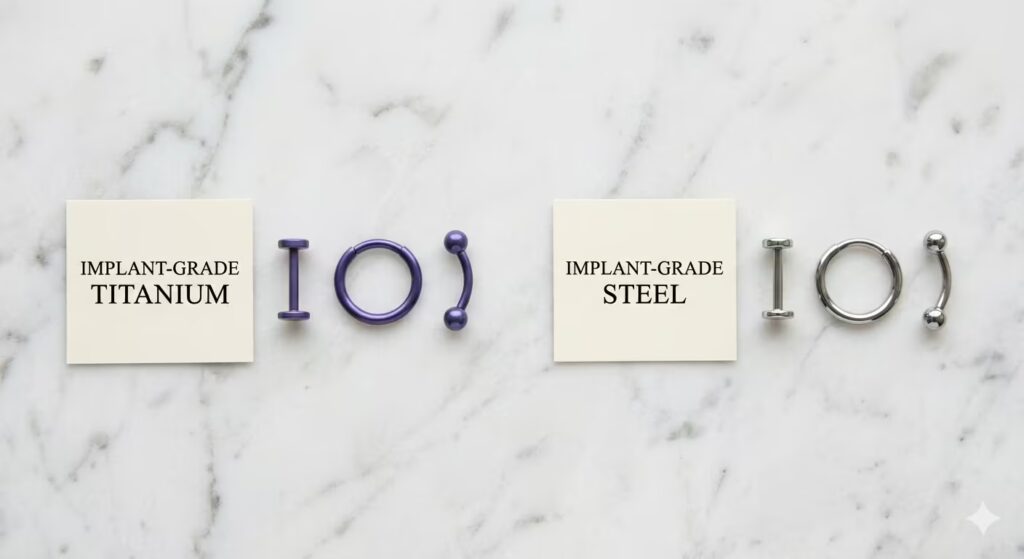
This guide covers everything: what each material actually is, how they differ chemically and physically, what those differences mean in practice for healing and long-term wear, and how to choose the right one for your specific situation.
For the broader picture of all body-safe jewellery materials and what qualifies as implant-grade, our companion article on implant-grade jewelry and why it matters covers the full material landscape.
❝ The core difference between implant-grade titanium and implant-grade steel is the presence of nickel. Titanium contains none. Steel contains 8 to 12 percent, bound within the alloy. For most people, this distinction is minor. For people with nickel sensitivity, it is everything.
What Is Implant-Grade Titanium?
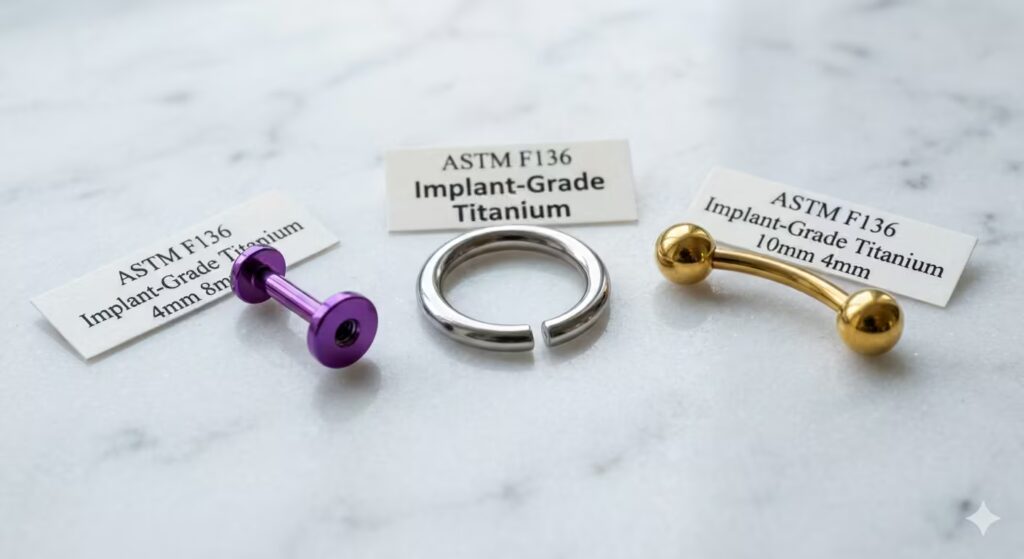
Implant-grade titanium is titanium that meets the ASTM F136 or ISO 5832-3 standard for surgical implants. These are internationally recognised standards that specify the exact alloy composition, surface finish, and biocompatibility requirements a material must meet to be considered safe for long-term contact with body tissue.
The specific alloy is Ti6Al4V ELI: titanium with 6% aluminium and 4% vanadium. ELI stands for Extra Low Interstitials, meaning the levels of oxygen, nitrogen, carbon, and hydrogen impurities are tightly controlled below threshold values. This is the same material used in hip replacement components, dental implants, bone plates, and surgical screws.
The surface of implant-grade titanium used in body jewellery is mechanically polished and often electropolished to a mirror finish. This eliminates microscopic surface irregularities that could harbour bacteria or cause friction against healing tissue. The surface finish standard is part of the implant-grade specification, not just the alloy composition.
Why titanium became the professional standard
Titanium became the default recommendation in professional piercing over the past two decades for several converging reasons. It contains no nickel, eliminating the most common source of jewellery-related irritation. It is significantly lighter than steel, reducing pressure on healing tissue, particularly in cartilage piercings. And it can be anodised to produce colour without any coatings or dyes.
The Association of Professional Piercers (APP), the primary professional body in the piercing industry, lists implant-grade titanium as an accepted material for initial piercings. Their material standards documentation specifies ASTM F136 as the required standard.
What Is Implant-Grade Steel?
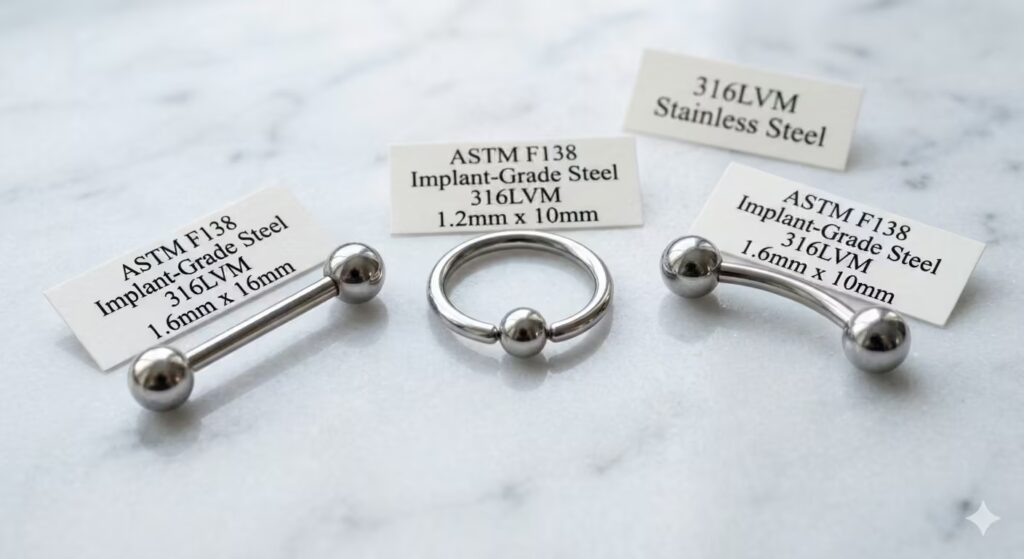
Implant-grade steel in body jewellery is ASTM F138- or ISO 5832-1-compliant 316L or 316LVM stainless steel. The LVM designation stands for vacuum-melted, a manufacturing process that reduces impurities and improves the alloy’s consistency throughout the material.
It is the same grade of steel used in surgical instruments, orthopaedic implants, and cardiovascular devices. The rigorous standards governing its composition and manufacturing make it significantly different from the generic “surgical steel” label applied to much of the fashion jewellery industry, which has no regulatory definition and can mean almost anything.
316LVM steel has excellent corrosion resistance, high durability, and a long track record of safe use in body piercing. It has been the dominant professional piercing material for several decades and remains widely used in studios worldwide, particularly in regions where titanium supply chains are less established.
The nickel question
316L steel contains nickel as an alloying element, typically eight to twelve percent by composition. In implant-grade steel, this nickel is tightly bound within the alloy matrix. The surface of properly finished implant-grade steel releases nickel ions at a very low rate, which is why it is considered safe for the general population, including most people without active nickel sensitivity.
The critical distinction is between bound nickel in a certified alloy and free nickel in a cheaper alloy. Fashion jewellery labelled “surgical steel” often uses 304 grade steel, which has a higher nickel content and significantly higher leach rates than implant-grade 316LVM. For this reason, the specific standard number matters enormously when evaluating any steel jewellery.
For people with diagnosed nickel allergies or demonstrated nickel sensitivity, even the low leach rate of implant-grade 316LVM may be sufficient to trigger a reaction over the months of healing required for a piercing. This is the clinical reason titanium is preferred for these individuals.
The Direct Comparison: Every Difference That Matters
| Property | Implant-Grade Titanium | Implant-Grade Steel |
| Standard | ASTM F136 / ISO 5832-3 | ASTM F138 / ISO 5832-1 |
| Nickel content | Zero. Completely nickel-free. | 8–12% bound in alloy. Very low leach rate. |
| Safe for nickel allergy | Yes. The safest metallic option. | Often fine. Not recommended for confirmed allergy. |
| Weight | Approx. 4.5 g/cm³. Roughly half the weight of steel. | Approx. 8.0 g/cm³. Noticeably heavier. |
| Colour options | Anodising creates structural colour. No coatings. | Silver tone only without surface coatings. |
| Biocompatibility | Excellent. Osseointegrates with bone tissue. | Excellent. Decades of safe surgical use. |
| Corrosion resistance | Exceptional. Forms a stable oxide layer. | Very good. Lower than titanium. |
| Cost per piece | Higher. Typically $15–$50. | Lower. Typically $8–$30. |
| Recommended for fresh piercings | Yes. Current APP standard. | Acceptable for non-sensitive individuals. |
| Recommended for cartilage | Yes. Lighter weight is meaningful for slow-healing cartilage. | Acceptable. Heavier weight slightly less ideal. |
| Recommended for nickel-sensitive | Yes. The correct choice. | No. Even a low leach rate can trigger a reaction. |
Weight: Why It Matters More Than It Sounds
The weight difference between titanium and steel is roughly 2:1. A piece of implant-grade steel jewellery weighs approximately twice as much as the same piece in implant-grade titanium. For lobe piercings, this difference is largely inconsequential. For cartilage piercings, it is clinically meaningful.
Cartilage has a very limited blood supply. It heals slowly and is more sensitive to mechanical disruption than soft tissue. The weight of jewellery in a healing cartilage piercing applies a small but continuous downward pressure on the piercing channel throughout the healing period. Over six to twelve months of cartilage healing, the cumulative effect of that pressure is not trivial.
Lighter jewellery means less pressure on the healing fistula, less movement of the jewellery within the channel, and, in practice, fewer irritation bumps and a more comfortable healing experience for cartilage piercings. This is one of the reasons professional piercers particularly favour titanium for helix, tragus, daith, and rook piercings.
For our detailed guidance on cartilage piercing healing, see the individual guides to what is a helix piercing and the benefits and care of a tragus piercing, both of which cover the specific role that jewellery weight plays in healing.
Anodising: The Colour Advantage of Titanium
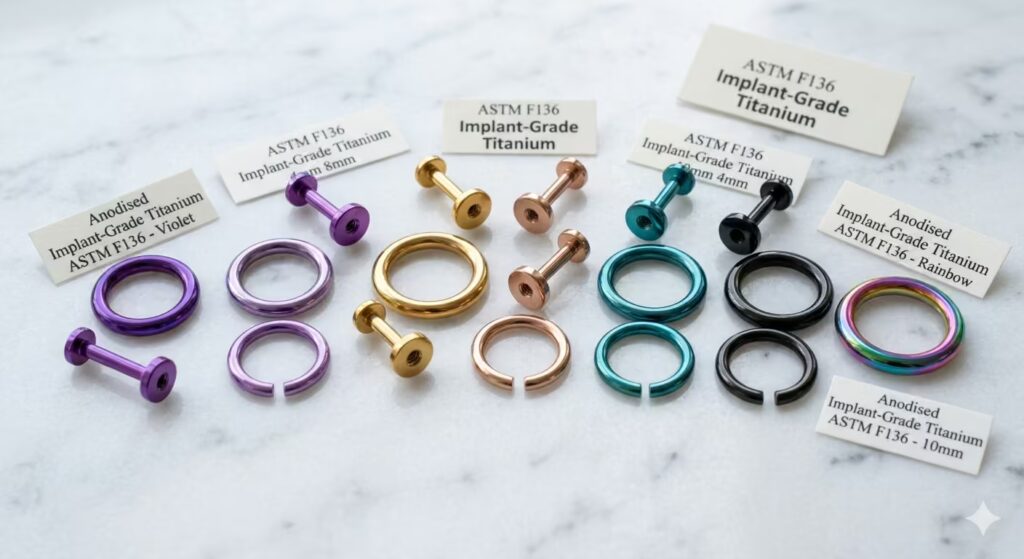
Anodising is an electrochemical surface treatment that creates a controlled oxide layer on the surface of titanium. By varying the voltage applied during the process, different oxide-layer thicknesses are produced. Different thicknesses refract light at different wavelengths, producing different colours through structural interference rather than dye or coating.
The practical result is that implant-grade titanium can be produced in violet, gold, rose, teal, blue, black, rainbow, and other colours that are completely body-safe and suitable even for fresh piercings. There is nothing to chip, flake, or leach because the colour is structural: it is the surface of the titanium itself, not something applied on top of it.
This is a genuine and significant practical advantage over steel. Steel in its natural state is a cool silver tone. Coloured steel body jewellery uses PVD (physical vapour deposition) coatings, which are durable and considered safe for healed piercings, but are technically surface coatings rather than structural colours. For fresh piercings, anodised titanium is the cleaner choice for anyone who wants colour in their initial jewellery.
The Surgical Steel Labelling Problem
One of the most important things to understand about steel jewellery is that the phrase “surgical steel” has no legal or regulatory definition in most countries. It is a marketing term that manufacturers can apply to any stainless steel alloy regardless of its nickel content, surface finish, or actual biocompatibility.
Fashion jewellery labelled “surgical steel” is frequently made from 304-grade stainless steel. Grade 304 contains a higher proportion of nickel than 316LVM and has a significantly higher nickel leach rate. Worn in a healing piercing, cheap 304 stainless steel, labelled as surgical steel, can cause the same irritation reactions as any other nickel-contaminated jewellery.
The only protection against this is asking for the specific standard number. Implant-grade steel is ASTM F138 or ISO 5832-1, and specifically 316LVM. If a studio or online retailer cannot provide a standard number for their steel jewellery, it is impossible to verify whether that jewellery is actually implant-grade or simply marketing language on a lower-grade product.
❝ When buying steel body jewellery, always ask: “Is this 316LVM to ASTM F138?” If the answer is vague or the seller does not know, the jewellery is unverified. This is the single most important question in steel jewellery sourcing.
Which Should You Choose?
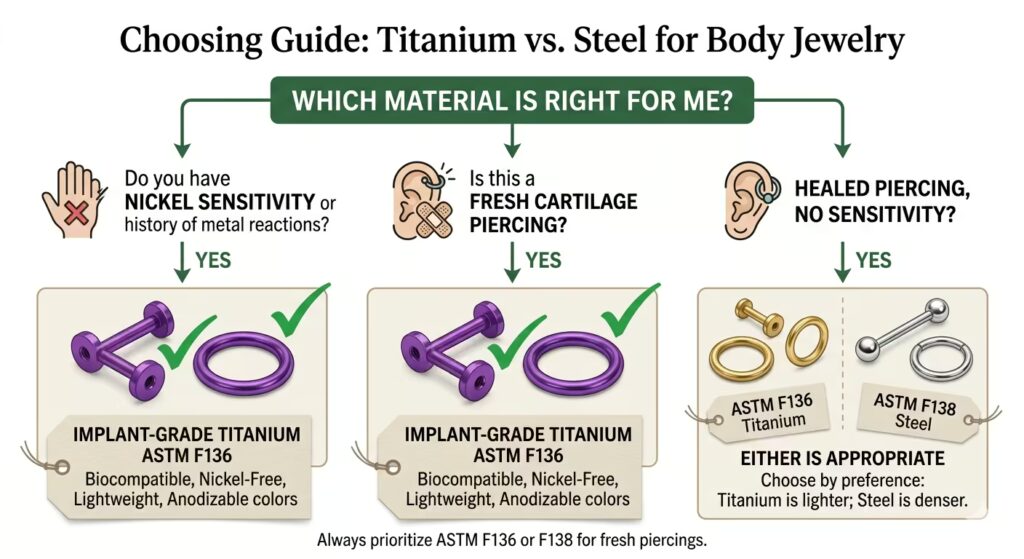
For fresh piercings in anyone: titanium
Implant-grade titanium ASTM F136 is the current consensus recommendation from professional piercers for initial jewellery. The absence of nickel eliminates the most common source of jewellery-related complications.
The lighter weight is an advantage for cartilage piercings specifically. The anodising option means you are not limited to silver during the healing process.
The slightly higher cost of titanium is the only meaningful argument against it for fresh piercings, and for most people, the price difference of $5 to $20 per piece is modest compared to the healing commitment the piercing itself requires.
For fresh piercings with known nickel sensitivity: titanium always
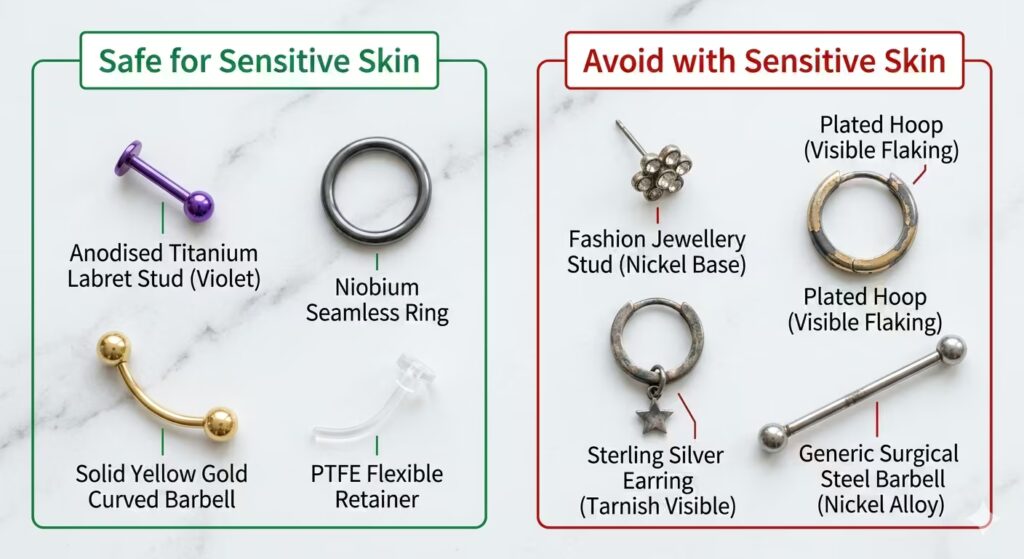
If you have ever reacted to cheap earrings, watch backs, belt buckles, or jean rivets, nickel sensitivity is the most statistically likely explanation. For you, titanium is not a preference. It is the correct clinical choice.
For detailed guidance on jewellery for sensitive skin, our article on what jewellery is safe for sensitive skin and metal allergies covers nickel allergy testing, all-nickel-free options, and what to do if an existing piercing is reacting to current jewellery.
For healed piercings without nickel sensitivity: either
A fully healed piercing in a person without metal sensitivity can wear implant-grade steel comfortably and safely. Many people wear steel in healed piercings for years without any issue whatsoever. The performance difference between titanium and implant-grade steel in a healed piercing on a non-sensitive person is minimal.
The practical argument for titanium, even in healed piercings, is its weight advantage and colour options. These are genuine benefits. But they are preferences rather than clinical necessities for non-sensitive individuals with healed piercings.
For cartilage piercings specifically: titanium
Regardless of nickel sensitivity, titanium is the better choice for cartilage piercings because of its weight. Helix, tragus, forward helix, daith, rook, conch, and industrial piercings all involve cartilage that heals slowly and reacts to mechanical disturbance. Lighter jewellery consistently produces better outcomes in these placements.
Identifying Genuine Implant-Grade Jewellery
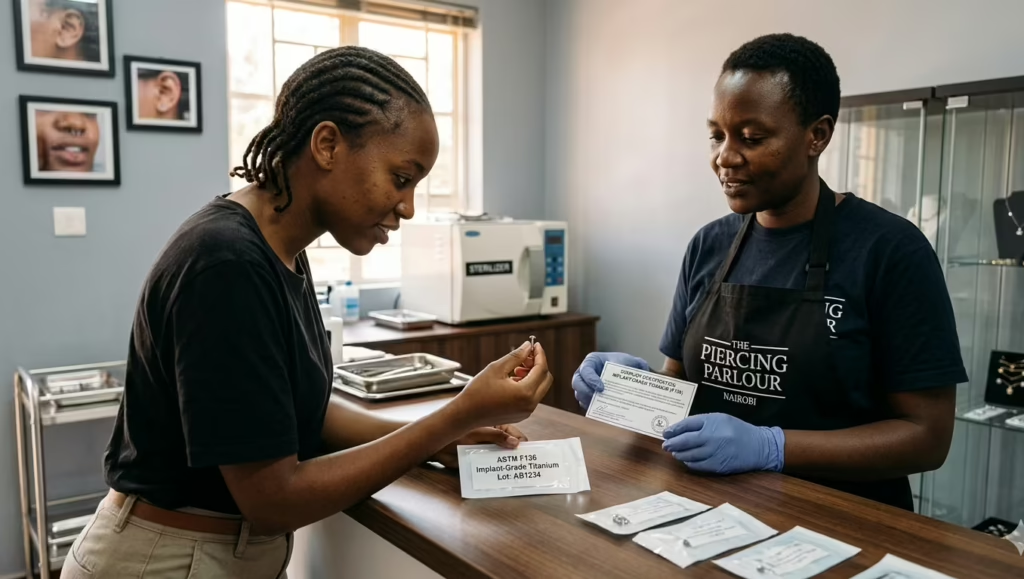
The most reliable way to verify that an item is implant-grade jewellery is to request the specific standard number and the supplier’s certification. Professional studios that source responsibly will be able to tell you exactly which standard their jewellery meets and who supplied it.
Trusted suppliers
Major implant-grade jewellery manufacturers whose material standards are well-documented include Anatometal, Neometal, Industrial Strength, BVLA (Body Vision Los Angeles), Invictus, and Junipurr Jewelry. Jewellery from these manufacturers comes with documented material certifications and is widely used in professional studios that prioritise material quality.
If a studio stocks jewellery from these suppliers, the material standards are reliable. If the studio cannot name their supplier or specify the standard of their jewellery, that is worth noting before you book.
Price as an indicator
Genuine implant-grade titanium from a certified supplier typically starts at around $15 to $20 for a basic flat-back labret stud. Implant-grade steel starts around $8 to $12. Anything significantly below these price points claiming to be implant-grade warrants scrutiny.
This does not mean expensive jewellery is always better. It means that genuine implant-grade materials have production costs that put a floor on their price. Items offered online at $2 to $5 per piece in a box of thirty are not implant-grade, regardless of what the listing says.
What About Other Materials?
Titanium and implant-grade steel are the two most widely used metallic materials in professional piercing, but they are not the only body-safe options. Solid 14k or 18k nickel-free gold is an excellent choice for healed piercings, offering premium aesthetics and strong biocompatibility. Niobium (ASTM F2384) is another nickel-free option that anodises similarly to titanium.
PTFE and medical-grade bioplast are non-metallic options used for retainers and flexible applications. Borosilicate glass is used in stretched piercings and as an inert alternative for those with extreme sensitivity. Each of these has its specific applications and advantages covered in our guide to what implant-grade jewelry is and why it matters.
What all body-safe materials have in common is a documented standard, a smooth non-porous surface, no free nickel, and a track record of safe use in tissue contact. Whatever material you choose, those four criteria are the ones that matter.
Care and Maintenance of Both Materials
Both implant-grade titanium and implant-grade steel require minimal special maintenance beyond standard piercing aftercare during healing and basic cleaning for healed piercings.
Cleaning jewellery before insertion
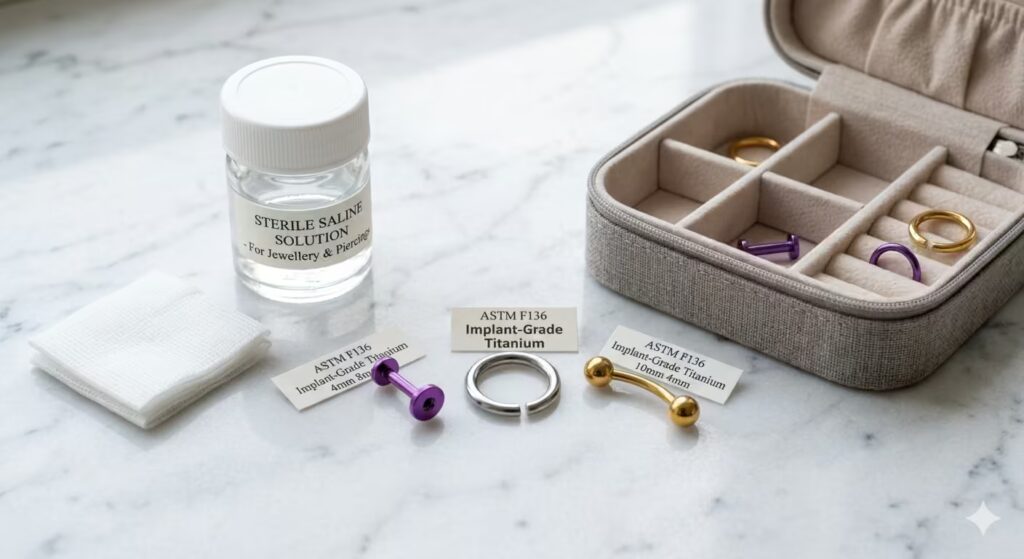
Before inserting previously worn jewellery into a healing piercing, clean it with sterile saline or soap and water and rinse thoroughly. For jewellery that has been out of the piercing for an extended period, ultrasonic cleaning or autoclave sterilisation at your piercing studio is the safest approach before reinsertion.
Titanium and anodising
Anodised titanium colour can fade slowly over the years of wear with repeated cleaning. The colour change is gradual, and the anodised surface remains body-safe throughout. Harsh chemical cleaners, bleach, and abrasive materials can accelerate colour changes in anodised titanium and should be avoided.
Steel and tarnish
Implant-grade steel does not tarnish in normal conditions. It is highly corrosion-resistant. However, prolonged contact with harsh chemicals, bleach, or salt water can affect the surface over time. Standard cleaning and storage away from corrosive substances keep implant-grade steel in good condition indefinitely.
Frequently Asked Questions
Is titanium or steel better for a helix piercing?
Titanium is the better choice for a helix piercing, specifically. Cartilage heals slowly over six to twelve months and is more sensitive to mechanical disturbance than soft tissue. The lighter weight of titanium reduces pressure on the healing cartilage fistula throughout that period. For the complete helix piercing guide, see our article on what a helix piercing is.
Can I use steel in a fresh piercing if I have never reacted to metal before?
Yes. Implant-grade steel ASTM F138 is a professionally accepted material for fresh piercings in non-sensitive individuals. Many studios use it routinely, and the majority of piercings healed in it without complication. The recommendation of titanium as the default is precautionary rather than absolute.
What about titanium that does not say implant-grade?
Not all titanium is implant-grade titanium. Titanium is a broad category of metals with many alloy compositions used across industrial, aerospace, and consumer applications. Only titanium meeting ASTM F136 or ISO 5832-3 is implant-grade. Always confirm the standard. “Titanium” without a standard number is unverified.
Is the price difference worth it?
For fresh piercings and cartilage piercings, yes. The cost difference is typically $5 to $20 per piece. The cost of a prolonged, complicated healing process from substandard jewellery, in terms of time, additional studio visits, and sometimes medical attention, is considerably higher.
For healed piercings in non-sensitive individuals, it becomes a matter of personal preference and budget. Both materials perform safely and well in that context.
Can I mix titanium and steel in different piercings?
Yes. There is no interaction between jewellery in different piercings. You can wear titanium in some placements and implant-grade steel in others without any issue. The material decision is per-piercing based on that specific piercing’s healing stage and your individual sensitivity.
My studio only stocks steel. Should I go elsewhere?
Not necessarily. ASTM F138, an implant-grade steel, is a legitimate and safe professional material. The more important question is whether their steel is actually ASTM F138 316LVM or simply labelled surgical steel without verification. Ask for the specific standard. A good studio should be able to answer that question immediately.
Making the Choice That Is Right for You
Implant-grade titanium and implant-grade steel are both genuinely safe, professionally used piercing materials when sourced to the correct standard. The choice between them is not between good and bad. It is between two good options, each with distinct advantages.
Titanium wins on nickel-free composition, weight, and colour options. It is the better default for fresh piercings, cartilage piercings, and anyone with any history of metal sensitivity. Steel wins on cost and has a longer-established track record in the industry. It is a perfectly sound choice for healed piercings in non-sensitive people.
The most important decision is not which of these two you choose. It is ensuring that whatever material you choose actually meets its stated standard. Ask the question. Get the number. That verification is what separates a body-safe choice from a marketing claim.