The complete guide to nickel-free and body-safe piercing materials
If your earlobes turn red and itchy with cheap earrings, if you react to watch backs, belt buckles, or jean rivets, you have some form of metal sensitivity. You are far from alone. Nickel allergy is the most common contact allergy worldwide, affecting an estimated 10 to 15 percent of the global population.

Metal sensitivity does not mean you cannot get pierced. It means the material you choose matters more than average. With the right material, the healing experience for someone with sensitive skin is not meaningfully different from that of anyone else.
This guide covers everything: what causes metal reactions in piercings, which materials are safe, which to avoid completely, and how to manage existing reactions.
❝ Sensitive skin is a material specification, not a barrier to piercing. The correct nickel-free material removes the primary cause of metal-related piercing reactions entirely.
What Causes Metal Reactions in Piercings?
Almost all metal allergies in piercings are caused by nickel.
Nickel is added to many metal alloys to increase hardness, create a silver-white colour, and reduce manufacturing costs. It is found in surgical steel, white gold, many silver-toned fashion alloys, and a significant proportion of mass-market jewellery.
When nickel-containing jewellery sits in a piercing, the body’s immune system identifies nickel ions leaching from the metal as a foreign substance and mounts an inflammatory response.
That response presents as redness, itching, swelling, persistent discharge, and irritation bumps around the piercing site. The reaction is not an infection. Antibiotics will not resolve it. The only effective treatment is to remove the source of the nickel by replacing the jewellery with a verified nickel-free alternative.
Contact sensitisation: how allergy develops
Nickel allergy is an acquired condition.
You are not born with it. It develops through repeated exposure to nickel. This is why some people wear nickel-containing jewellery for years without issue, only to suddenly begin reacting.
Once you develop a nickel allergy, it is typically permanent. The immune system remembers the sensitising event and reacts to subsequent exposures even in very small quantities.
A piercing accelerates sensitisation because the jewellery is in direct, continuous contact with internal tissue rather than just the skin surface. This is why piercing with nickel-containing jewellery can trigger a new allergy in people who previously had none.
How to tell if you have nickel sensitivity
You almost certainly have some degree of nickel sensitivity if you have experienced reactions to any of these: inexpensive earrings, watch metal backs, belt buckles, metal jean rivets or buttons, or coin contact with the skin.
A formal nickel patch test from a dermatologist or allergist provides a definitive answer. A small nickel patch is applied to your skin for 48 hours, and the site is assessed for reaction.
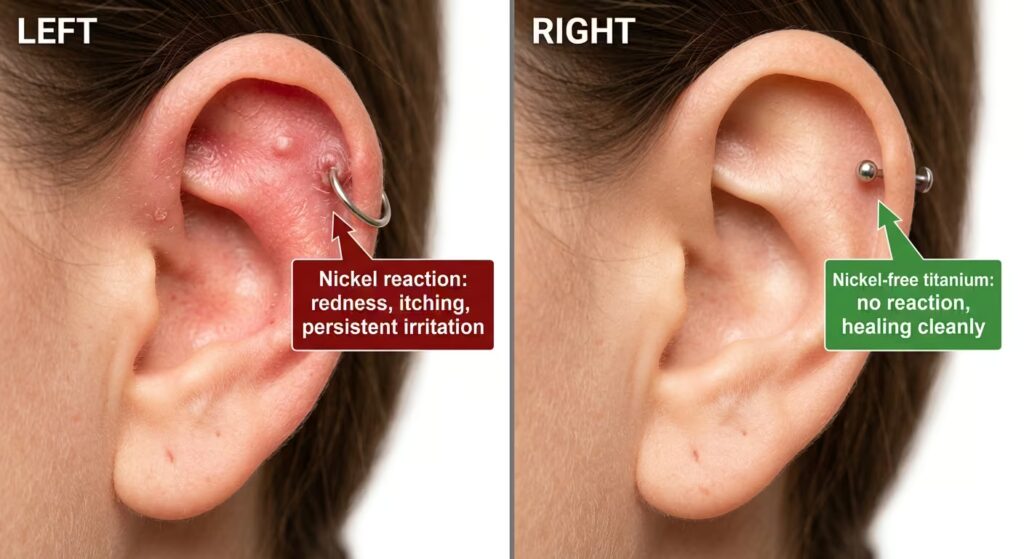
If you have experienced any of the common reactions above, treating yourself as nickel-sensitive before getting pierced is the most practical precautionary approach.
The Safest Materials for Sensitive Skin
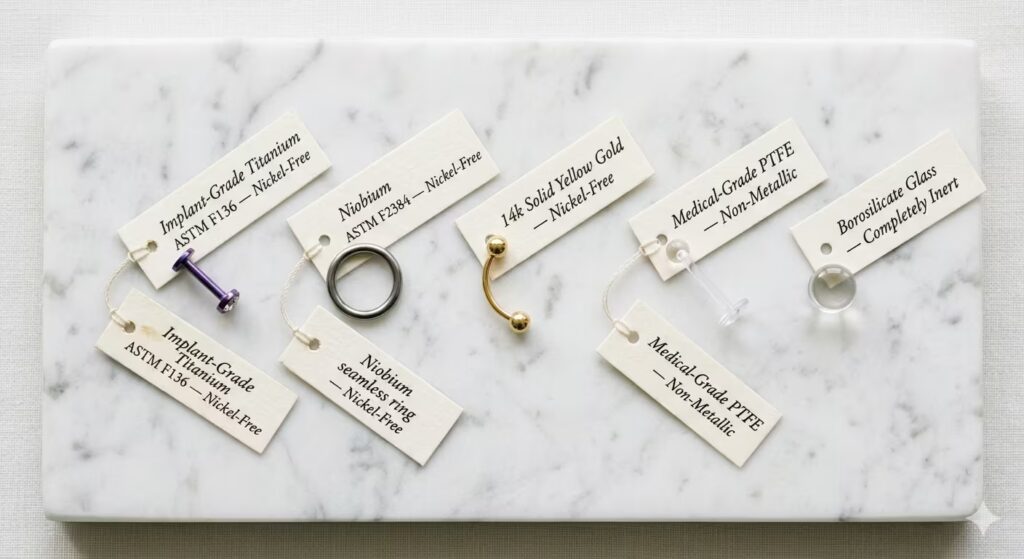
Implant-grade titanium: the best overall choice
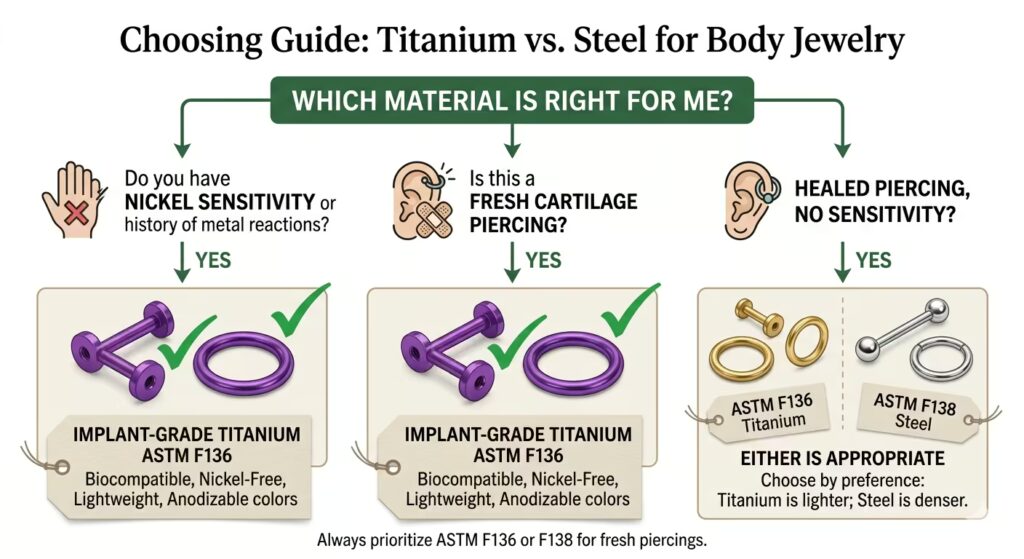
Implant-grade titanium (ASTM F136) is the unconditional recommendation for anyone with metal sensitivity.
It contains absolutely no nickel. Zero.
The ASTM F136 standard ensures that the alloy composition, surface finish, and biocompatibility all meet the requirements for long-term tissue contact. It is the same grade used in hip replacements and bone plates.

Titanium is also the lightest of the main piercing metals, which reduces pressure on healing tissue. And it can be anodised to produce a full spectrum of colours — violet, gold, rose, teal, blue, black, rainbow — without any coatings or dyes. The colour is structural, not painted on.
For anyone with nickel sensitivity, implant-grade titanium is not just a preference. It is the correct clinical choice for all piercings at all stages of healing.
Niobium: the underrated alternative
Niobium (ASTM F2384) is completely nickel-free and shares titanium’s ability to be anodised for colour.
It is slightly heavier than titanium but lighter than steel. It is more ductile than titanium, which makes it easier to work into ring shapes. This is why niobium is particularly popular for seamless rings and captive rings for sensitive skin.
Niobium is less widely available than titanium in professional studios but is fully accepted as body-safe by the Association of Professional Piercers.
If you have struggled with titanium for any reason, niobium is the closest nickel-free alternative.
Solid 14k or 18k yellow and rose gold
Yellow gold and rose gold in nickel-free alloys are excellent options for fully healed piercings in people with sensitive skin.
Traditional yellow gold alloys use copper and silver as alloying metals. Neither is nickel. Yellow gold is typically nickel-free by default at 14k and 18k.
Rose gold uses a higher copper content for its warm colour. Copper is not nickel, and nickel-free rose gold is safe for sensitive skin.
White gold is the exception. Traditional white gold uses nickel as a whitening alloy and is not suitable for sensitive skin. Only palladium white gold — specifically confirmed as nickel-free — is safe for sensitive individuals.
For the complete guide to gold in piercings, see our article on gold jewelry in a new piercing.
PTFE and medical-grade bioplast
PTFE (polytetrafluoroethylene) and medical-grade bioplast are non-metallic flexible materials with essentially zero reactivity.
They contain no metals and elicit no metal-allergic responses.
They are used primarily for retainers, pregnancy belly bars, and specialty flexible applications. They are not as durable or aesthetically varied as metals, but they are an important option when all metals are problematic.
Medical-grade PTFE is the same material used in vascular grafts and surgical tubing. Its biological inertness is well-established.
Borosilicate glass
Medical-grade borosilicate glass is completely inert, non-porous, and produces no allergic responses.
It is used primarily in stretched piercings and as an alternative to metal for healed placements in people with extreme sensitivities.
Glass is fragile compared to metal and requires careful handling. But for someone who reacts to every metallic option, borosilicate glass offers a completely inert alternative.
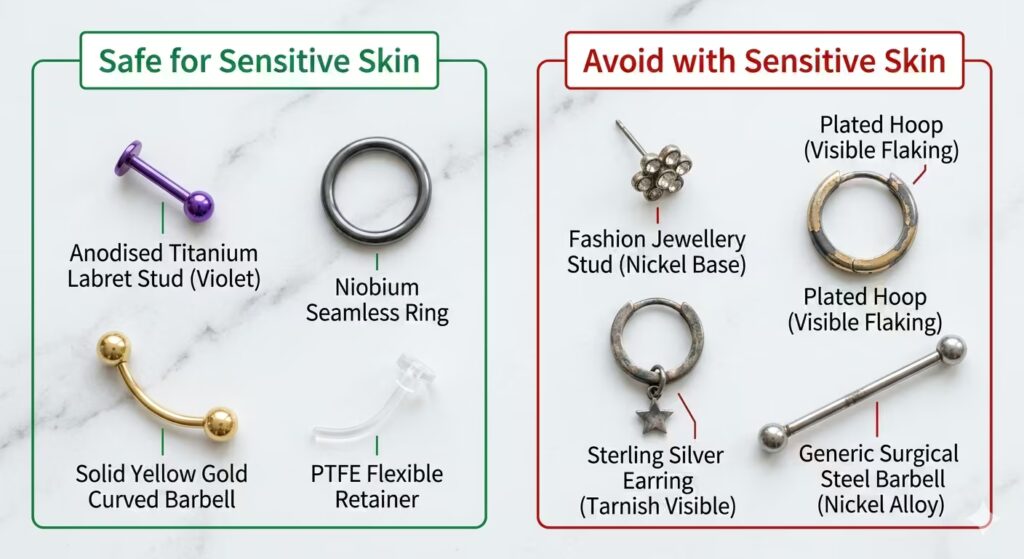
Complete Material Safety Reference for Sensitive Skin
| Material | Nickel-Free | Safe for Sensitive Skin | Notes |
| Implant-Grade Titanium (ASTM F136) | Yes | Yes | Best overall choice. Lightest, anodisable, no nickel at any level. |
| Niobium (ASTM F2384) | Yes | Yes | Excellent nickel-free alternative. Anodisable. Slightly heavier than titanium. |
| Solid 14k/18k Yellow Gold (nickel-free alloy) | Yes | Yes | Premium option for healed piercings. Not ideal for fresh cartilage (weight). |
| Solid 14k/18k Rose Gold (nickel-free alloy) | Yes | Yes | Copper alloy. Nickel-free. Rare copper sensitivity possible but uncommon. |
| Palladium White Gold | Yes | Yes | Must be confirmed as a palladium alloy specifically. Not all white gold qualifies. |
| Medical-Grade PTFE / Bioplast | N/A | Yes | Non-metallic. Completely inert. Used for retainers and flexible applications. |
| Borosilicate Glass | N/A | Yes | Completely inert. Used in stretched piercings and healed placements. |
| Implant-Grade Steel 316LVM (ASTM F138) | No (8-12% bound) | Caution | Very low nickel leach rate. Safe for most people. Not for confirmed nickel allergy. |
| Traditional Nickel White Gold | No | No | Nickel is used as a whitening alloy. Avoid entirely for sensitive skin. |
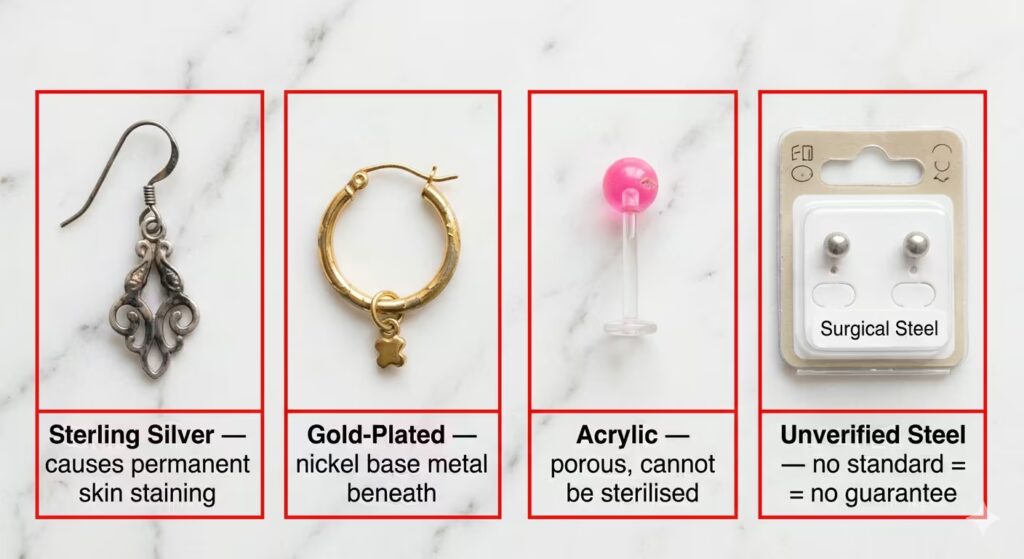
| Fashion / “Surgical Steel” (unverified) | Unknown | No | No standard number means no verification. Likely high nickel. Avoid. |
| Gold-plated / Gold-filled / Vermeil | No | No | Nickel-based metal under the surface layer. Layer wears through. Never safe for piercings. |
| Sterling Silver | No | No | Tarnishes in body tissue. Can permanently stain skin. Never a piercing material. |
| Acrylic / Generic Plastic | N/A | No | Porous. Cannot be sterilised. Releases chemical compounds. Never appropriate. |
Rows in 1-7 are safe for sensitive skin. Row 8 requires caution. Rows 9-13 should be avoided entirely.
Materials to Avoid and Why
Sterling silver
Sterling silver is one of the most persistent misconceptions in body piercing.
Silver is not a piercing material. Full stop.
Sterling silver is an alloy of 92.5 percent silver and 7.5 percent copper. In the body tissue environment, it tarnishes. The tarnish compounds deposit in the skin surrounding the piercing, a condition called argyria.
Argyria causes a permanent grey-blue discolouration of the skin around the piercing site. It does not fade when the jewellery is removed. It does not respond to treatment. It is irreversible.
Even for people without nickel sensitivity, sterling silver is a damaging material for piercings. For anyone with sensitive skin, it is doubly problematic.
❝ Sterling silver looks like a sensible choice because silver sounds pure. It is not safe for piercings at any stage. The tarnish it deposits in skin tissue can cause permanent discolouration that cannot be reversed.
Fashion jewellery and mystery metal
Any jewellery that cannot name its specific material and provide a standard number is unverified.
Fashion jewellery sold in accessories stores, marketplace platforms, and general retailers often contains high-nickel alloys regardless of what the label says. Terms like “hypoallergenic, “nickel-safe,”, and “surgical steel” have no regulatory definition and can be applied to anything.
For people without metal sensitivity, fashion jewellery in established healed piercings is a calculated risk. For people with sensitive skin, it is a near-certain trigger for a reaction.
Gold-plated jewellery
Gold-plating is a thin electrodeposited layer of gold on a base metal. The gold layer is typically less than 2.5 microns thick.
Underneath that layer is almost always a high-nickel alloy. Body fluids penetrate microscopic imperfections in the plating from the first day of wear.
In a healing piercing, this means continuous exposure to nickel by the healing tissue from day one. The plating wears through relatively quickly with regular insertion and removal, after which the nickel base is in direct contact with tissue.
Acrylic
Acrylic is porous at a microscopic level and cannot be fully sterilised by an autoclave.
It also releases small amounts of chemical compounds from its surface over time. These compounds cause contact irritation that is separate from nickel allergy but produces similar symptoms.
Acrylic should not be used in any piercing, at any healing stage, for any person.
What to Do If Your Piercing Is Already Reacting
If your piercing is currently irritated and you suspect the jewellery is the cause, many people’s first instinct is to remove it. Resist this instinct.
Removing jewellery from an irritated piercing traps the irritant inside the closing channel. If there is any active tissue reaction, closing it over makes things significantly worse.
Step 1: Visit your piercer
Your piercer can assess whether the reaction appears to be metal sensitivity or something else.
They can also replace the current jewellery with implant-grade titanium while the piercing is still open, which is the most practical first intervention.
Step 2: Switch to implant-grade titanium
If metal sensitivity is suspected, replacing the jewellery with verified implant-grade titanium (ASTM F136) is the single most effective step.
Most material-related reactions begin to reduce within one to two weeks of switching to nickel-free jewellery.
If the reaction persists after four weeks of titanium jewellery and consistent saline aftercare, the cause may not be the metal. A visit to a doctor or dermatologist is advisable.
Step 3: Restart aftercare
After changing to the new material, treat the piercing as if it were in an early healing phase.
Twice daily, sterile saline cleaning. No touching. No rotating the jewellery. No harsh products near the site.
This gives the tissue the best environment to settle after the material change.
When to see a doctor
If the reaction includes spreading redness beyond the immediate piercing site, significant swelling, throbbing pain, or yellow or green discharge, these are signs of infection rather than material reaction.
Infections require medical treatment. Do not attempt to manage a spreading infection with jewellery changes and saline alone.
See a doctor, get appropriate treatment, and keep the jewellery in unless specifically advised to remove it by the medical professional.
❝ Material reaction and infection can look similar in the early stages. The key difference: material reactions stay localised around the jewellery ends. Infections spread outward from the piercing site. When in doubt, see a doctor.
Practical Strategies for Sensitive Skin Piercing Owners
Tell your piercer before you book
Mention your metal sensitivity when booking your appointment, not on the day.
This gives the studio time to confirm they stock implant-grade titanium jewellery in the correct gauge and style for your piercing. Most professional studios will, but confirming in advance prevents arriving to find they only stock steel.
Ask for the standard number
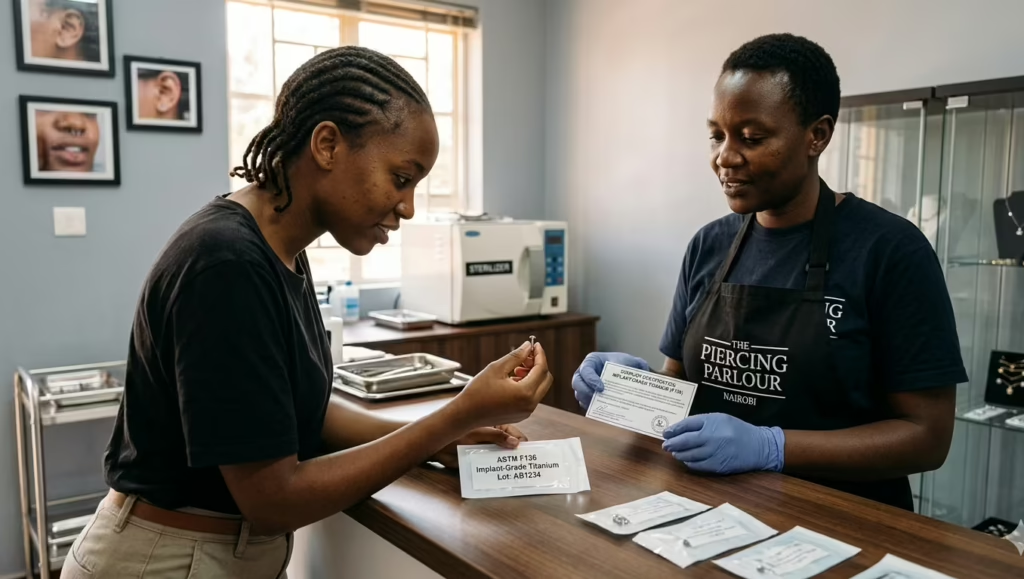
When the piercer shows you the jewellery they will use, ask: “Is this ASTM F136 titanium?”
A professional studio using genuine implant-grade titanium will answer immediately and specifically. If the answer is vague, ask to see the supplier documentation.
This is a completely normal question to ask, and any good piercer will not be offended by it.
Use threadless systems for easy swapping
A threadless titanium post paired with decorative tops is the most practical setup for sensitive skin.
The post in the piercing is always titanium. The top can be swapped for different styles without touching the post or the piercing channel.
This makes building variety in your jewellery collection both safe and economical.
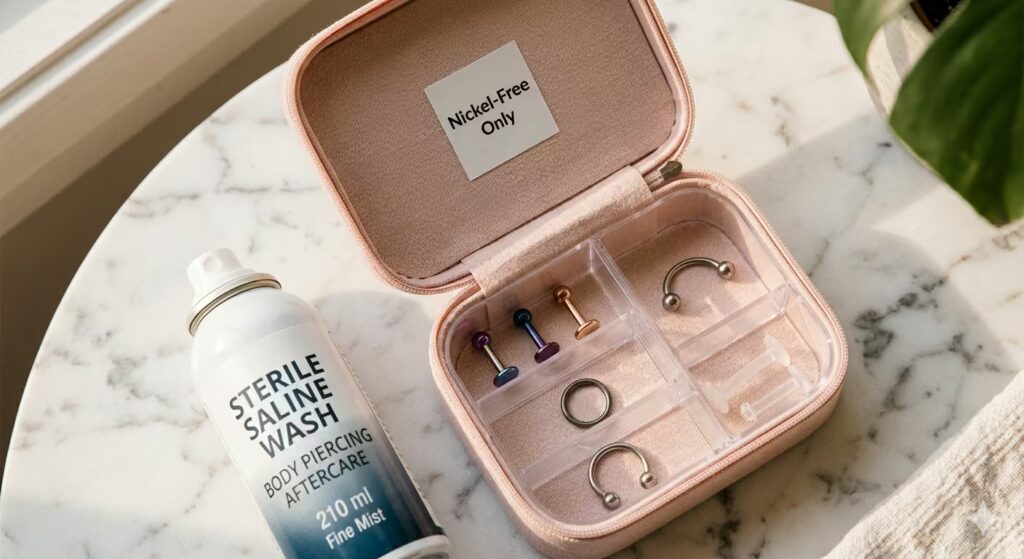
Build a nickel-free jewellery kit
Keep a small kit of verified nickel-free jewellery for times when you need to change in a hurry.
A few titanium flat-back studs in your piercing gauges, a small titanium seamless ring, and a PTFE retainer for each active piercing cover most situations.
Knowing you always have a safe option available removes the temptation to use whatever is at hand.
Special Situations for Sensitive Skin
Sensitive skin and cartilage piercings
Cartilage piercings heal slowly and are more reactive to material problems than soft tissue piercings.
For someone with nickel sensitivity, the combination of slow-healing tissue and continuous exposure to nickel from substandard jewellery creates a particularly difficult healing environment.
Implant-grade titanium is even more important for cartilage piercings in sensitive individuals than it is for lobe piercings. Do not compromise on material for any cartilage placement.
For specific cartilage piercing guides, see our articles on helix piercing and tragus piercing benefits and care.
Sensitive skin and facial piercings
Facial piercings involving labret studs, like the Medusa and labret, have an interior disc that sits against the gum tissue and teeth.
For sensitive skin, the disc material matters as much as the post material. A nickel-containing disc against gum tissue is as problematic as nickel against piercing channel tissue.
Titanium flat-back labret studs have titanium discs. If you use a bioplastic disc back for dental protection, ensure the post material remains titanium.
Sensitive skin and multiple piercings
Having multiple piercings with sensitive skin is entirely manageable. The material requirement is the same for each one: verified nickel-free.
The practical consideration is to ensure that every piece of jewellery in every active piercing meets the standard. One nickel-containing piece in a collection of nickel-free pieces will still cause a reaction in its specific piercing.
For the full picture on managing multiple piercings, our article on why people get multiple piercings covers the planning and practical management in detail.
Frequently Asked Questions
Is titanium safe for everyone?
Implant-grade titanium (ASTM F136) is the most universally tolerated metallic piercing material available.
Titanium allergy exists, but it is extremely rare. Some people have sensitivities to the aluminium or vanadium in the Ti6Al4V alloy. If you suspect a titanium reaction, niobium is the closest nickel-free alternative.
For the vast majority of people, including those with significant nickel allergy, implant-grade titanium produces no adverse reaction.
Is sterling silver ever safe in a piercing?
No, sterling silver is never a safe piercing material for anyone at any stage of healing.
The tarnishing that occurs inside body tissue deposits silver compounds into the surrounding skin, causing permanent grey-blue discolouration. This is not reversible.
The fact that silver is a precious metal does not make it biologically safe for piercings. Only materials with proven biocompatibility for tissue contact qualify.
Can I use a nickel allergy test kit on jewellery before buying?
Yes. Nickel spot test kits are available from pharmacies and online. They use dimethylglyoxime (DMG) to detect free nickel ions on a surface.
Apply a small amount of the test solution to the jewellery surface. A pink or red colour change indicates the presence of free nickel. No colour change does not guarantee zero nickel, as bound nickel in an alloy may not trigger the test at low leach rates.
A nickel spot test is a useful screening tool. Confirmed ASTM F136 titanium from a reputable supplier is the definitive solution.
My piercing healed fine for years, and now it is reacting. Why?
Nickel allergy can develop at any point after prolonged nickel exposure, even if you wore the same jewellery without issue for years.
Once sensitised, the immune response is triggered by even small exposures. A piercing that was fine with implant-grade steel for five years may begin reacting after sensitisation occurs through another route, such as a new watch or a different piece of jewellery.
The solution is the same as for any nickel reaction: switch to verified nickel-free titanium and allow the tissue to settle with consistent aftercare.
Are hypoallergenic earrings from the pharmacy safe for piercings?
Not reliably.
Hypoallergenic has no regulatory definition. Pharmacy earrings marketed as hypoallergenic often contain nickel in their alloys. Some are made from surgical steel without a specific grade number, so the nickel content is not verified.
For a healing piercing in a person with sensitive skin, only verified ASTM F136 implant-grade titanium provides the necessary certainty. Pharmacy jewellery without a specific material standard cannot provide that.
What about jewellery sold as “safe for sensitive ears”?
“Safe for sensitive ears” is a marketing phrase with no clinical or regulatory backing.
It is applied to products ranging from genuine titanium to coated fashion alloys. The phrase alone does not guarantee safety.
Ask the same question you ask for everything else: what is the specific material, and what ASTM or ISO standard does it meet? That answer is what determines safety, not the marketing language on the packaging.
Can I get any piercing with sensitive skin?
Yes. No piercing placement is off-limits for someone with metal sensitivity.
The placement does not cause a sensitivity reaction. The material does. With the correct nickel-free jewellery, every standard piercing is accessible to people with sensitive skin.
For a full overview of all piercing types and what each one involves, see our guide to types of body piercings with pictures.

Sensitive Skin, Full Possibilities
Metal sensitivity is not a reason to avoid piercing. It is a reason to be specific about materials.
Implant-grade titanium removes the primary cause of metal-related piercing reactions entirely. Niobium provides an equally nickel-free alternative. Solid yellow and rose gold offer premium options for healed piercings.
The practical steps are simple. Tell your piercer about your sensitivity before booking. Ask for ASTM F136 titanium by name. Verify the material before inserting the jewellery. Keep a kit of verified nickel-free jewellery for every active piercing.
Do those things, and your experience with sensitive skin will not be meaningfully different from anyone else’s. The piercings heal. The jewellery sits comfortably. The skin stays clear.
Sensitive skin changes the material specification. It does not change what is possible.