Rhino Piercing Quick Facts
| Detail | Info |
|---|---|
| Also Known As | Vertical tip piercing, vertical nasal tip piercing |
| Placement | Vertically through the tip of the nose |
| Pain Level | High – passes through thick cartilage |
| Healing Time | 9–12 months (sometimes longer) |
| Starting Jewelry | Curved barbell (implant-grade titanium), 14G–16G |
| Initial Barbell Length | 10mm–12mm (longer to allow for swelling) |
| Cost | $50–$100+ (jewelry additional) |
| Rejection Risk | High – visible scarring is likely if retired |
| Who It Suits | Noses with sufficient tissue at the tip |
| Not Recommended For | Beginners; thin nasal tips; chronic sinus issues |
What Is a Rhino Piercing?
The rhino piercing passes vertically through the tip of the nose. The needle enters from the underside — just above the columella — and exits at the top of the nasal tip. Both ends of the curved barbell are visible once healed: one sitting at the top of the nose tip, the other at the base.
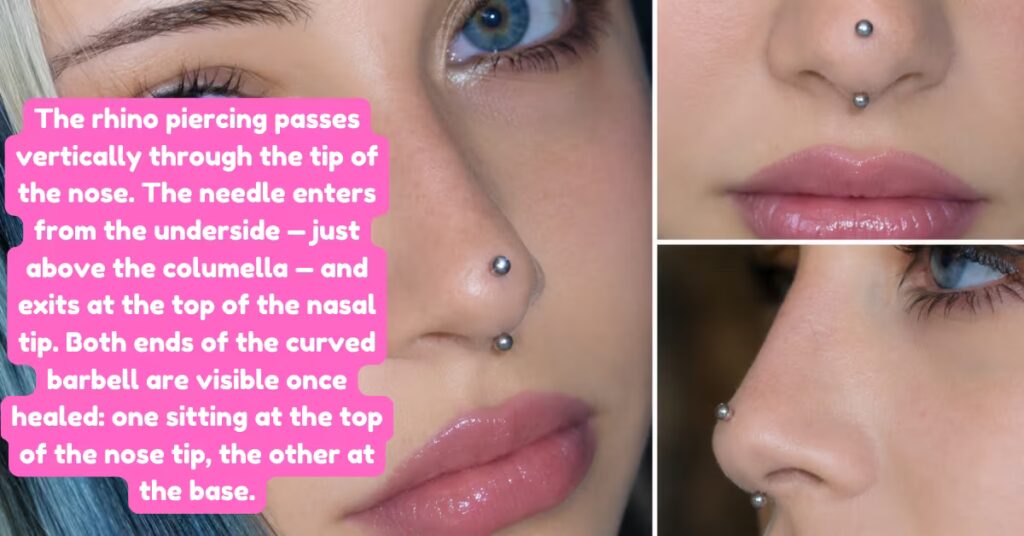
The name comes from the resemblance to a rhinoceros horn, especially when spiked ends are worn. It is also called a vertical tip piercing or vertical nasal tip piercing.
The piercing passes through the major alar cartilages — the two large curved cartilage structures that form the tip of the nose. There is a narrow strip of cartilage running through the center of the nose tip. A piercer must place the needle between these cartilage sections, slightly to one side, to avoid it.
Rhino vs. Austin Bar: Not the Same Piercing
The rhino is a vertical piercing through the nose tip. The Austin bar is a horizontal piercing through the same general area.
The Austin bar does not pass through the nasal cavity, the septum, or the columella. It goes side to side, surface-level, through the fleshy tip. It uses a straight barbell. The rhino uses a curved one.
A key practical difference: the Austin bar is better suited to noses with lateral asymmetry. If your nose curves noticeably to one side, a rhino can draw attention to that. An Austin bar, being horizontal, tends to be more forgiving of that anatomy.
Neither piercing should be confused with the nasallang, which is a three-point bar through both nostrils and the septum simultaneously.
Rhino Piercing Anatomy Suitability
Not every nose can be pierced this way. A piercer will assess whether there is enough tissue at the tip to support the jewelry long-term.
Key factors they check:
- Tissue depth at the tip — there needs to be enough to hold a barbell without it sitting shallow (which accelerates rejection)
- Cartilage position — the piercer must identify the gap between the two alar cartilage sections and confirm it’s workable
- Nose alignment — a crooked rhino is highly visible; a straight nose makes centering more predictable
- Overall tip shape — very narrow or pinched tips have less tissue and a higher rejection risk
A thorough anatomy check is not optional. This is one of the most anatomy-dependent piercings on the face.
Rhino Piercing Pain Level
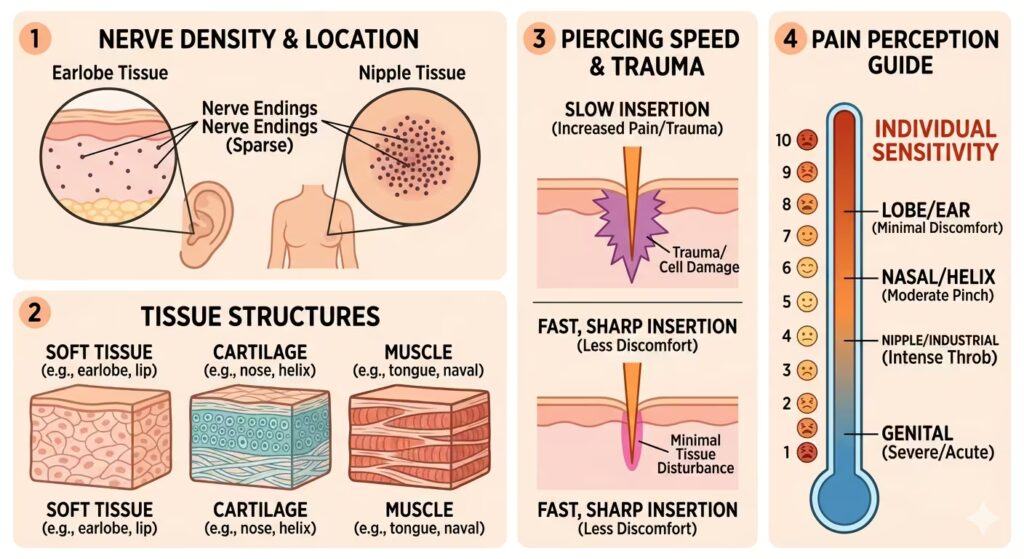
The rhino piercing is one of the more painful facial piercings. The tip of the nose has a dense concentration of nerve endings. Unlike a nostril piercing — which is quick — this one goes through significant cartilage, which slows the needle’s pass.
The longer the needle is traveling through tissue, the longer the sensation lasts. Clients consistently describe it as a sustained, intense pressure rather than a brief, sharp sting. An audible crunch as the needle passes through cartilage is normal and expected.
The area also bleeds more readily than the nostrils or septum. Post-piercing tenderness and swelling at the nose tip typically persist for several weeks.
Rhino Piercing Healing
Healing takes between 9 and 12 months, and some piercings take longer. Cartilage tissue has a significantly lower blood supply than soft tissue. This limits how quickly healing resources reach the site, which is why the timeline is so much longer than a nostril or septum piercing.
Even when the piercing feels healed externally, the internal fistula (the tissue channel through the cartilage) continues to mature. Do not assume it is fully healed just because it no longer hurts.
One critical step that many people skip: downsizing.
The initial barbell is intentionally longer — 10mm to 12mm — to accommodate post-piercing swelling. Once swelling fully subsides, usually around 4–8 weeks in, you must return to your piercer for a shorter bar. Leaving the long bar in after swelling goes down causes the excess length to catch and snag on everything, leading to irritation bumps, migration, and prolonged healing.
Rhino Piercing Aftercare
Clean the piercing twice daily using a sterile saline wound wash (0.9% sodium chloride, no additives). A pressurized can format, such as NeilMed Piercing Aftercare, delivers sterile mist directly without contaminating the solution.
Do not use:
- Alcohol or hydrogen peroxide — both damage the healing fistula
- Scented soaps, cleansers, or antiseptics
- Cotton balls — fibers catch on jewelry ends
Additional aftercare rules specific to this placement:
- Sleep on your back. This piercing is at the very front of your face; any pressure from a pillow disrupts healing.
- Be careful with face towels. The curved barbell ends catch fabric easily. Pat dry with disposable gauze or a paper towel.
- Avoid blowing your nose forcefully. The pressure and friction irritate the healing channel from the inside.
- Keep makeup, sunscreen, and face wash away from the piercing site. The nose tip makes this harder to manage than other facial placements.
- Avoid swimming in pools, lakes, or hot tubs for the entire healing period.
Rhino Piercing Jewelry
Starting Jewelry
A curved barbell (banana barbell) is the only suitable jewelry for a fresh rhino piercing. The curve follows the natural contour of the nose tip from the underside to the top.
Standard starting specs:
- Gauge: 14G (1.6mm) or 16G (1.2mm)
- Length: 10mm–12mm initially, then downsized to 8mm–10mm
- Material: Implant-grade titanium (ASTM F136) is the recommended starting material — it is nickel-free, lightweight, non-porous, and compatible with healing tissue
Do not start with surface bars. They are designed for flat-skin surface piercings and have no place in a rhino.
Healed Jewelry Options
Once fully healed, the jewelry options expand:
- Implant-grade titanium — anodized in multiple colors; remains the most reliable long-term
- 14k or 18k solid gold — appropriate only after full healing; ensure it is solid, not plated
- Implant-grade niobium — hypoallergenic, can be anodized for color
- Surgical-grade stainless steel — acceptable but contains trace nickel; not ideal for sensitive skin
Avoid plated metals, mystery alloys, and acrylic at any stage.
End Styles
The two ends of the barbell can be customized independently once healed. Popular choices include:
- Flat discs (low-profile, subtle)
- Spike ends (maximizes the rhino horn effect)
- Gemstone balls
- Opal cabochons
Rhino Piercing Variations
Standard Rhino
The most common version: enters at the underside of the nose tip, exits at the top. Placement sits between the two major alar cartilages, above the central cartilage ridge.
Deep Rhino
The exit point is positioned higher on the nasal bridge. Because the central cartilage strip prevents piercing straight up the midline, a deep rhino usually has to be placed slightly off-center. Anatomy limits how deep this can go.
Double Rhino
Two separate rhino piercings placed side by side. Requires enough tissue width at the nose tip. This dramatically increases the complexity of healing and the risk of rejection.
Septril
Often grouped with rhino variations, but it is technically a separate piercing. A septril requires a fully healed and stretched septum (stretched to 0 gauge from 14 gauge). The jewelry enters through the stretched septum fistula and exits at the base of the nose tip. Only one end is visible — as a flat stud at the bottom of the nose. This is a long-term commitment requiring months of septum stretching before the septril can even be done.
Rhino Piercing Risks
Rejection and migration are the most significant concerns with this piercing. The body can gradually push the jewelry toward the surface, especially if the tissue at the nose tip is limited. Once a rhino piercing starts migrating, it cannot be reversed — it must be retired.
Scarring is expected. Even a successfully healed rhino piercing will leave visible scarring if you eventually remove the jewelry. The nose tip is prominent. The indentation scars from the two barbell holes are noticeable and may take a long time to fade. In some cases, they do not disappear entirely.
Infection is possible, as with any piercing. Signs of infection — not to be confused with normal healing irritation — include spreading redness, hot skin, swollen lymph nodes, and yellow-green discharge that smells. Crusty white or clear discharge during healing is normal lymph fluid, not infection.
Irritation bumps (hypertrophic scarring) are common, particularly if the jewelry snags or the initial bar is not downsized. These are not permanent if caught early, and the cause is corrected.
Nerve sensitivity at the nose tip can be temporarily altered during and after healing. This usually resolves, but is worth knowing before proceeding.
Who Should Not Get a Rhino Piercing
- Piercing beginners — this is not a first-timer piercing
- Anyone with a very thin or pinched nose tip (insufficient tissue)
- Anyone with chronic sinus issues or frequent nasal congestion (constant nose-touching disrupts healing)
- Anyone not prepared for long-term visible scarring if the piercing is removed
- Anyone unable to sleep on their back consistently
Choosing a Piercer
A rhino piercing should only be performed by an experienced piercer who has done this specific procedure before — not just cartilage piercings in general. The placement precision required is significant. Ask to see photos of healed work. A reputable piercer will also turn you away if your anatomy is not suitable, which is a sign of professionalism, not failure.
Look for membership in the Association of Professional Piercers (APP), which sets standards for sterilization, single-use needles, implant-grade materials, and aftercare guidance.
Rhino Piercing Frequently Asked Questions
How long does a rhino piercing take to heal?
Expect 9 to 12 months for full healing. Some take longer. It feels better long before it is actually healed internally.
Is a rhino piercing the most painful nose piercing?
It is among the most painful. It passes through more tissue and cartilage than a septum, nostril, or bridge piercing. The sustained needle pass through thick alar cartilage is what makes it more intense than most other facial piercings.
Can I change the jewelry before the rhino piercing heals?
No — except to downsize with your piercer at 4–8 weeks once swelling subsides. Changing jewelry before full healing risks tearing the fistula and introducing bacteria.
What happens if I take it out?
The holes will begin to close, though they may remain visible for an extended period. Noticeable indentation scarring at both entry and exit points is expected. This scarring may not fully disappear.
Can a rhino piercing be hidden?
Not effectively. Both barbell ends sit on the exterior of the nose tip. There are no retainer options that make it invisible the way a septum retainer can hide a septum piercing. A flat, small-gauge disc end makes it less prominent, but not unnoticeable.
Is a rhino piercing the same as a septril?
No. A septril piercing requires a pre-stretched septum piercing and is only visible from the underside of the nose. A rhino is visible from both top and bottom and requires no prior piercing or stretching.
Why is my rhino piercing forming a bump?
Bumps during healing are usually caused by irritation — commonly from the initial barbell not being downsized after swelling, snagging on towels or clothing, or sleeping on the piercing. Return to your piercer to assess the cause before attempting to treat it yourself.
Can any nose be pierced with a rhino?
No. The piercing requires sufficient tissue depth at the nose tip and appropriate cartilage positioning. A piercer will assess your anatomy before agreeing to do the procedure. Some noses are not suitable candidates.