Forward Helix Piercing Quick Facts
| Info | Detail |
|---|---|
| Placement | Outer-facing cartilage ridge at the front of the ear, just above the tragus |
| Pain Level | 5–6 out of 10 |
| Healing Time | 6–12 months (full); 6–12 weeks to downsize |
| Initial Jewelry | Straight flat-back labret stud |
| Gauge | 16G (1.2 mm) standard; 18G also used |
| Initial Post Length | 6–8 mm, downsized to 5–6 mm after swelling |
| Best Material | Implant-grade titanium (ASTM F-136) |
| Cost (US) | $30–$70 piercing fee + jewelry |
| Anatomy-Dependent | Yes — not every ear can support it |
| Risk Level | Moderate; cartilage carries a higher infection risk than lobe tissue |
What Is a Forward Helix Piercing?
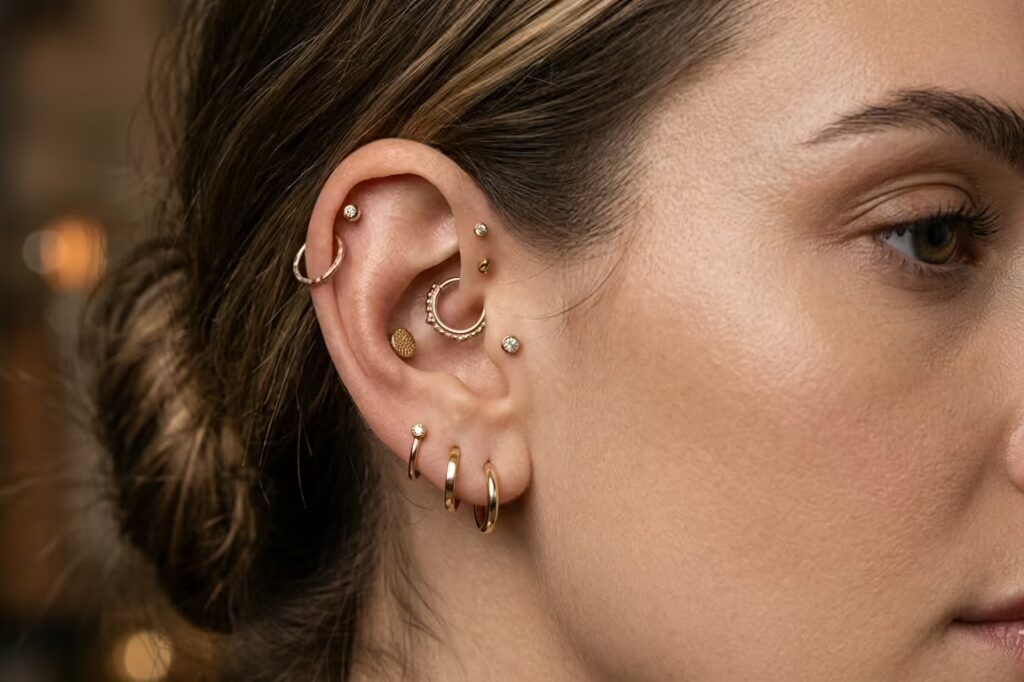
A forward helix piercing sits on the small ridge of cartilage at the very front of the ear, where the helix curves down toward the face and meets the head. It rests just above the tragus and faces forward, which is how it earns its name — both the tissue and the jewelry point forward.
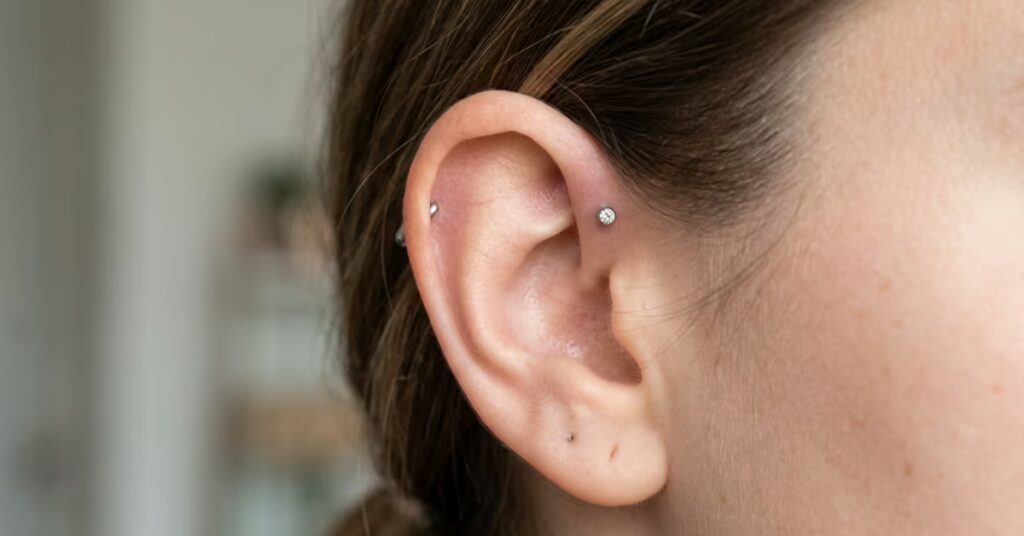
The placement became a mainstream piercing after a black-and-white photograph of a triple forward helix by piercer Christina (Chrissy) Shull at Integrity Body Piercing went viral on Pinterest in the early 2010s. Before that, it was a niche placement, mostly handled by piercing enthusiasts. By 2019, it ranked among the ten most-requested piercings worldwide.
Structurally, it differs from a standard helix in two ways. A standard helix sits on the upper outer rim of the ear and is visible from the side. A forward helix piercing sits on the front-facing portion of the same cartilage ridge and is visible from the front. It also differs from a daith, which goes through the innermost cartilage ridge deeper inside the ear.
Anatomy and Whether Your Ear Can Support One
The forward helix is one of the most anatomy-dependent piercings on the ear. Three things determine whether it can be done safely:
- A defined helix ridge with enough thickness to hold jewelry. A flat or underdeveloped ridge cannot properly anchor a piercing, leading to migration.
- Enough space behind the ridge for the back of the jewelry to sit flat. On some ears, the rook ridge crowds in close behind the forward helix, leaving no room for a flat-back disc to rest comfortably.
- Enough vertical length along the ridge for the number of piercings you want. A single fits most ears. A double needs more space. A triple needs a long, well-defined ridge — and not every ear has one.
A professional piercer will assess this in person before any markings are made. If the ridge cannot support a triple, no skilled piercer will agree to do one regardless of what the client wants. Forcing extra piercings into insufficient space leads to crowding, pressure damage, and migration.
Forward Helix Piercing Pain
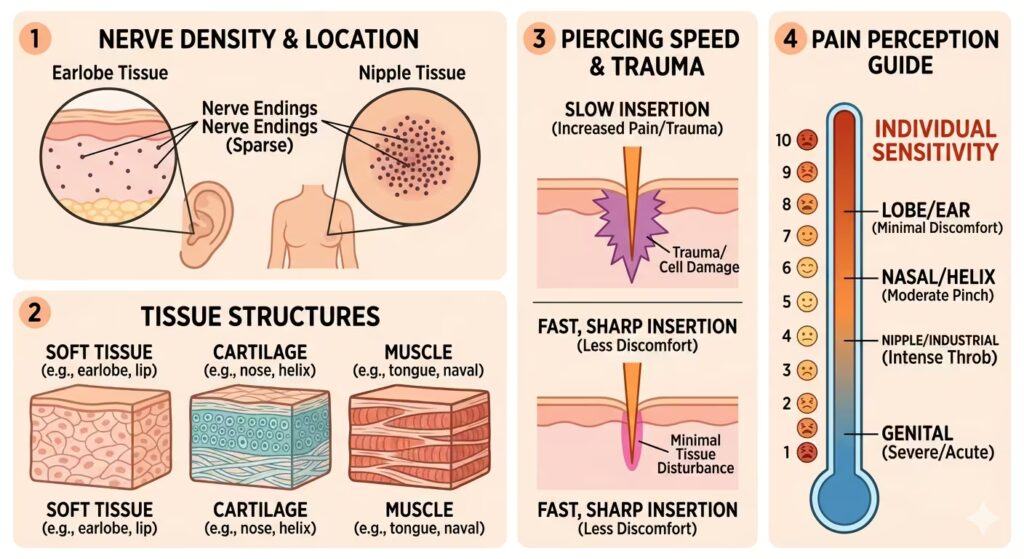
A single forward helix piercing rates around 5-6 out of 10. The piercing itself takes about a second — a sharp pinch followed by pressure, then a warm throbbing sensation that fades within minutes.
Two reasons it tends to feel sharper than a standard helix:
The cartilage at the front of the ear has more nerve endings than the upper rim. The placement sits closer to the side of the head, so pressure feels more internal.
Multiple piercings in one session amplify the discomfort. Each subsequent piercing is more intense because the surrounding tissue is already swelling. Many piercers split triples into two appointments — two piercings first, then the third once the first two have started healing — to reduce combined trauma and shorten total healing time.
Forward Helix Piercing Healing Timeline
A forward helix piercing has two distinct healing milestones.
Initial healing takes 6 to 12 weeks. Swelling subsides enough during this period that the longer initial bar can be swapped for a shorter, fitted post. This is the downsize appointment, not the all-clear.
Full healing takes 6 to 12 months, sometimes longer. Multiple forward helix piercings push the timeline toward the upper end.
The long timeline is biological. Auricular cartilage is avascular, meaning it has no direct blood supply. According to research published in Infection and Drug Resistance, the auricular cartilage depends on the surrounding perichondrium for nutrition, which is why cartilage piercings heal far more slowly than soft-tissue piercings through the lobe.
Tissue heals from the outside in. A piercing that looks healed externally is still fragile internally. WebMD notes that cartilage piercings take 4 to 12 months to fully heal, from the skin inwards, so a piercing may appear healed before it actually is.
Forward Helix Piercing Initial Jewelry
The forward helix piercing has one correct initial jewelry configuration: a straight, internally-threaded, flat-back labret stud in implant-grade titanium.
- Straight, not curved. Curved barbells are sometimes used here, almost always incorrectly. A curve does not pass perpendicularly through the cartilage, which causes the jewelry to hook above or below the rook ridge. This produces migration, angle shifts, and pressure damage to surrounding structures. Straight labrets sit perpendicular to the tissue and heal in the position the piercer placed them.
- Flat back, in most cases. A flat back sits flush against the inside of the ear, snags less on hair, and reduces pressure irritation. Some anatomies do better with a small bead back as a counterweight to a larger decorative front. The piercer judges this based on the ear in question.
- Implant-grade titanium (ASTM F-136). Cartilage is sensitive to weight and nickel exposure. Titanium is lighter than steel and contains no nickel. The Association of Professional Piercers lists implant-certified titanium, 14k or higher solid gold, niobium, and implant-grade steel as acceptable initial materials. For cartilage specifically, titanium is preferred because of its weight advantage during the long healing period.
- Internally threaded or threadless. External threading uses sharp threads to pass through the healing tract during jewelry insertion. Internal threading and threadless designs do not.
Gauge: 16G (1.2 mm) is standard. 18G (1.0 mm) is used for finer-look placements or smaller anatomy.
Length: 6–8 mm initially to accommodate swelling, then downsized to 5–6 mm.
Hoops, captive bead rings, and seamless rings are not appropriate as initial jewelry. They apply rotational pressure to a healing tract, causing irritation and bumps at this placement.
Forward Helix Piercing Aftercare
Standard cartilage aftercare applies, but the location poses specific challenges that require focused attention.
- Saline only. Clean twice daily with a sterile 0.9% sodium chloride wound-wash spray. Mayo Clinic recommends a saline solution made for wound cleaning and explicitly warns against hydrogen peroxide, iodine, and other harsh products. The Association of Professional Piercers no longer recommends home-mixed sea salt soaks because the concentration is unreliable and tends to over-dry the tissue.
- Hair management. The forward helix piercing sits exactly where the hairline meets the ear. Long hair, layers, baby hairs, and bangs wrap around jewelry and tug on the healing tract during brushing, washing, blow-drying, and sleeping. Tie hair back during early healing. Brush gently around the area.
- Glasses and masks. Glasses arms pass directly over the forward helix piercing on most frames. Bring glasses to the piercing appointment and wear them while placement is marked, so the piercer positions the jewelry where the arm will not sit on it. Ear-loop masks need the same consideration.
- Sleeping position. Side sleeping on a fresh forward helix is the leading cause of migration and angle change in this placement. Pressure during sleep shifts the jewelry’s angle over months, and once the angle changes during healing, it stays that way. Sleep on the opposite side or use a travel pillow with a hole — rest the ear in the hole so nothing presses against the piercing.
- Headphones. Over-ear headphones press directly on the forward helix piercing and routinely cause pressure-related complications during healing. In-ear earbuds like AirPods sit inside the ear canal and do not contact the piercing. Switch to earbuds for the first several months.
- Downsizing. The initial bar is intentionally long to leave room for swelling. Once swelling subsides at 6 to 12 weeks, return to the piercer for a shorter post. Leaving a long bar in a healing piercing causes the jewelry to lever back and forth with movement, which slants the angle, encourages bumps, and ruins alignment in stacked forward helix piercings.
- Water. No pools, hot tubs, lakes, oceans, or bath soaks during the healing process. Showers are fine.
- Touching and twisting. Do not touch the piercing except to clean it. Do not twist or rotate the jewelry. Both behaviors damage the forming fistula.
Forward Helix Piercing Risks and Complications
Cartilage piercing complications are well documented in medical literature, and the most serious one is auricular perichondritis — an infection of the perichondrium and underlying cartilage, most commonly caused by Pseudomonas aeruginosa. Because cartilage has no direct blood supply, these infections progress slowly, are aggressive, and are difficult to treat. Untreated, they can permanently deform the ear into a cauliflower-like appearance.
A study published in the Brazilian Journal of Otorhinolaryngology found that perichondritis following piercing occurred in up to 35% of patients and that pinna cartilage piercing carries a greater risk of infection than other piercing locations. The American Academy of Family Physicians notes that high ear piercings through cartilage are associated with more serious infections and disfigurement than lobe piercings, and that fluoroquinolone antibiotics are required for treatment because of their antipseudomonal activity.
Standard oral antibiotics like amoxicillin and cephalexin do not cover Pseudomonas. If a forward helix develops worsening pain, hot redness extending beyond the immediate piercing, deep swelling, or fever, this is not a normal healing bump. It requires a doctor who can prescribe a fluoroquinolone such as ciprofloxacin or referral to ENT.
Lower-grade complications are more common:
- Irritation bumps are small, fluid-filled or flesh-toned bumps caused by pressure (sleeping, snagging), wrong jewelry, or harsh cleaning. They resolve once the cause is removed. Never pop them.
- Migration is the slow movement of jewelry through tissue toward the surface. Causes include sleeping on the piercing, curved bars used instead of straight ones, under-gauged jewelry, and crowded placement.
- Hypertrophic scarring or keloids are raised scar tissue formations. Genetic predisposition matters. Anyone who keloids easily elsewhere should discuss this with the piercer first.
- Contact dermatitis from nickel appears as an itchy red rash around the jewelry, usually caused by low-quality “surgical steel” that is not truly nickel-free. Switching to verified implant-grade titanium resolves it.
How Long Until a Forward Helix Piercing Closes Without Jewelry
Under 6 months: closure can happen within hours to days. The fistula has not formed, and the tract is essentially still an open wound trying to seal.
6 to 12 months: the tract is more stable but fragile. Expect significant shrinkage within hours and possible closure within days to weeks if jewelry is removed.
After 12 months, and once full healing is confirmed, most forward helix piercings will not close completely but will shrink. Reinserting jewelry after even a day out can be painful or require a piercer’s help.
For temporary removal — MRI, surgery, or any situation requiring no metal — ask the piercer about a glass retainer rather than leaving the piercing empty.
Forward Helix Piercing Cost
Piercing fee in the US runs $30 to $70. Quality implant-grade titanium initial jewelry adds $20 to $60. Solid gold options run $100 or more.
Triple forward helix sessions cost more proportionally, since most studios charge per piercing rather than offering multi-piercing discounts. Each piercing represents the same time, skill, and supplies.
Avoid the cheapest options. Studios charging $15 with piercing guns use equipment that cannot be properly sterilized between clients, and the gun crushes cartilage tissue rather than cleanly perforating it. Cartilage and piercing guns are an especially poor combination because the crushing trauma dramatically increases the risk of perichondritis.
Forward Helix vs. Nearby Piercings
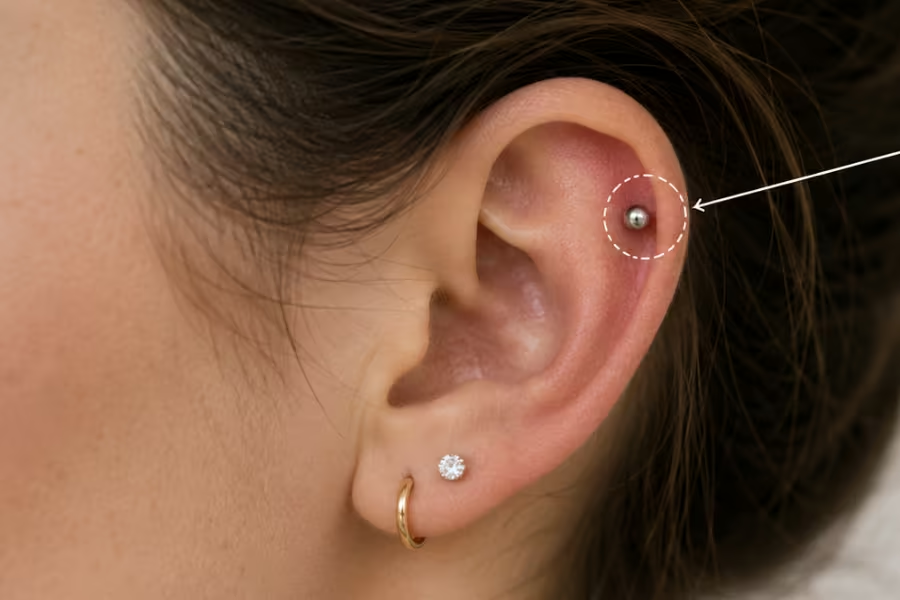
Standard helix: outer upper rim of the ear, opposite end of the same cartilage ridge. Less hair interference. Similar healing time.
Tragus: the small flap of cartilage covering the ear canal, sitting just below the forward helix. A forward helix and tragus together create a vertical line down the front of the ear.
Daith: the innermost cartilage ridge — the helix crus — deeper inside the ear. Sometimes confused with a low forward helix by inexperienced piercers. The daith sits inside the ear; the forward helix sits on the outer-facing ridge.
Rook: the inner antihelix ridge, sitting behind the forward helix. They share neighborhood anatomy, which is why a prominent rook ridge sometimes makes a forward helix impossible.
Forward Helix Piercing FAQs
How long does a forward helix piercing take to fully heal?
Six to twelve months. Initial swelling settles in 6 to 12 weeks (downsize time), but the internal tract takes far longer.
What gauge is a forward helix piercing?
16G (1.2 mm) is standard. Some piercers use 18G (1.0 mm) for finer anatomy or lighter-look jewelry. Both are acceptable.
What jewelry should the piercing start with?
A straight, internally-threaded flat-back labret stud in implant-grade titanium, typically 6 to 8 mm long initially. Hoops, curved barbells, and externally threaded jewelry are wrong choices for fresh placements.
Can I sleep on a forward helix piercing?
Not during healing. Sleep on the opposite side or use a donut-shaped travel pillow with the ear positioned in the hole. Pressure during sleep is the leading cause of migration and angle change.
Can I wear AirPods with a forward helix piercing?
After the initial swelling subsides at 2 to 4 weeks, in-ear AirPods are fine because they sit in the ear canal, below the piercing. Avoid them during early swelling. Over-ear headphones, including AirPods Max, should be avoided for the first several months.
Can I wear glasses with a forward helix piercing?
Yes. Bring glasses to the piercing appointment and wear them while placement is marked, so the piercer positions the jewelry where the arm will not press on it. After healing, lightweight frames cause no issues.
Will the piercing close if the jewelry comes out?
Yes, especially within the first year. Cartilage piercings shrink and close faster than people expect — within hours to days for a fresh piercing, days to weeks for one under a year old. Mature piercings may shrink, but not always close completely. A glass retainer keeps the channel open for temporary removal.
Can someone with a daily headset use get a forward helix piercing?
The constant pressure from over-ear headsets is one of the strongest predictors of complications. Anyone wearing a headset eight hours a day for work should consider a different cartilage placement — a standard helix, conch, or tragus — or wait until they can go several months without one.
Does the forward helix hurt more than a standard helix?
Slightly. The forward helix cartilage has more nerve endings than the upper rim, and the location closer to the side of the head makes pressure feel more pronounced. The difference is usually one point on a 10-point scale.
Can anyone get a triple forward helix?
No. The triple is the most heavily anatomy-dependent variation. It requires a long, defined ridge with enough room behind it for three jewelry backs. Many piercers recommend doing it across two appointments to reduce combined swelling.
Is the forward helix acupressure point real?
Claims that the forward helix sits on an acupressure point that helps with anxiety, headaches, or tinnitus come from auriculotherapy, a branch of traditional Chinese medicine. There is no robust scientific evidence supporting medical benefits from piercings at this location. Choose the piercing for aesthetics.
When can the jewelry be changed?
Wait at least 6 to 9 months and let the piercer perform the first change. The angle of this placement makes self-changes difficult, and forcing jewelry through a not-fully-healed tract restarts the healing process.
What’s the difference between a forward helix and a daith?
A forward helix sits on the outer-facing ridge of cartilage above the tragus. A daith sits on the innermost ridge (the helix crus), deeper inside the ear. They are entirely different piercings in different locations and are sometimes confused by inexperienced piercers — one reason to check a piercer’s portfolio before booking.