Quick Facts
- Placement: Upper labial frenulum (the webbing between the upper lip and gum)
- Common gauge: 18G (1.0mm) or 16G (1.2mm)
- Starter jewelry: Small-diameter circular barbell (horseshoe) or captive bead ring
- Healing time: 4 to 12 weeks
- Pain level: 3 to 5 out of 10 for most people
- Average cost: $30 to $90 (jewelry sometimes separate)
- Lifespan: Often 1 to 2 years before migration or rejection
- Not recommended if you have: braces, gum disease, thin or short frenulum, receding gums, enamel erosion
What is a Smiley Piercing?
The smiley piercing passes through the upper labial frenulum. That is the thin band of tissue connecting the inside of your upper lip to your gum. The jewelry stays hidden behind your lip, only flashing when you smile widely. Clinical literature also calls it the upper labial frenulum piercing or “scrumper.”
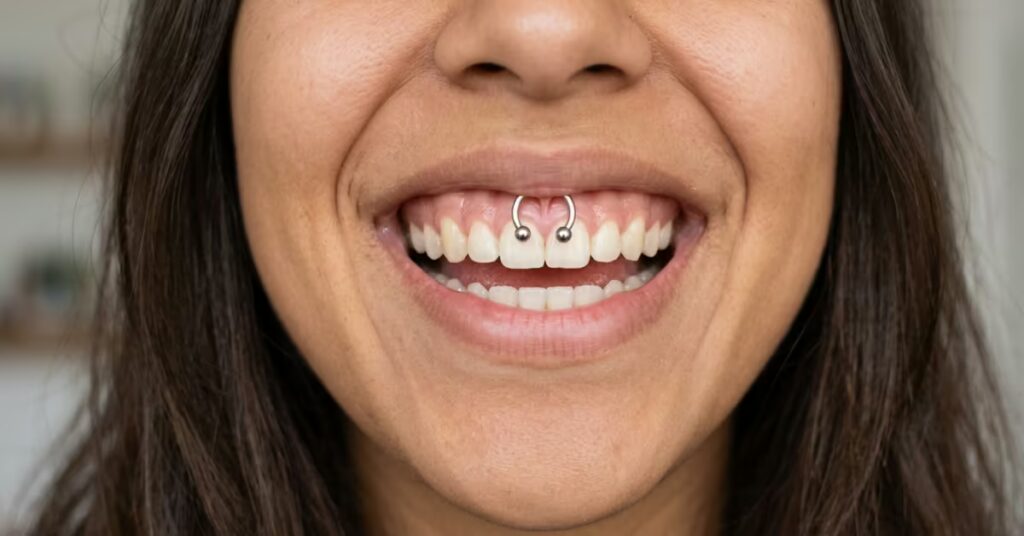
The lower-lip version goes through the frenulum between your bottom lip and lower gum. That one is called a frowny.
Anatomy You Need Before Booking for a Smiley Piercing
Not every mouth can hold this piercing. The frenulum has to be long enough and thick enough for a needle to pass through cleanly with tissue to spare on either side. A shallow attachment leaves nothing for the jewelry to hold onto, and the piercing tears or migrates out within weeks.
Two anatomical factors decide whether you are a candidate:
- Frenulum size. Lift your upper lip in front of a mirror. The vertical strip of tissue should be visibly raised and have sufficient width to accommodate a 1.2 mm post, with margins on each side. A piercer who agrees to do this on a paper-thin frenulum is taking your money and leaving you with a scar.
- Bite alignment. Your upper front teeth should come down straight when your mouth is closed. If your bite angles inward or outward, the jewelry will press against enamel every time you talk, eat, or rest your mouth. That contact is what causes the chipping and recession this piercing is known for.
A scoping review published in the International Journal of Environmental Research and Public Health lists upper labial frenulum piercings among the oral piercings with documented complications, including tooth damage and gingival recession.
Smiley Piercing Pain Level
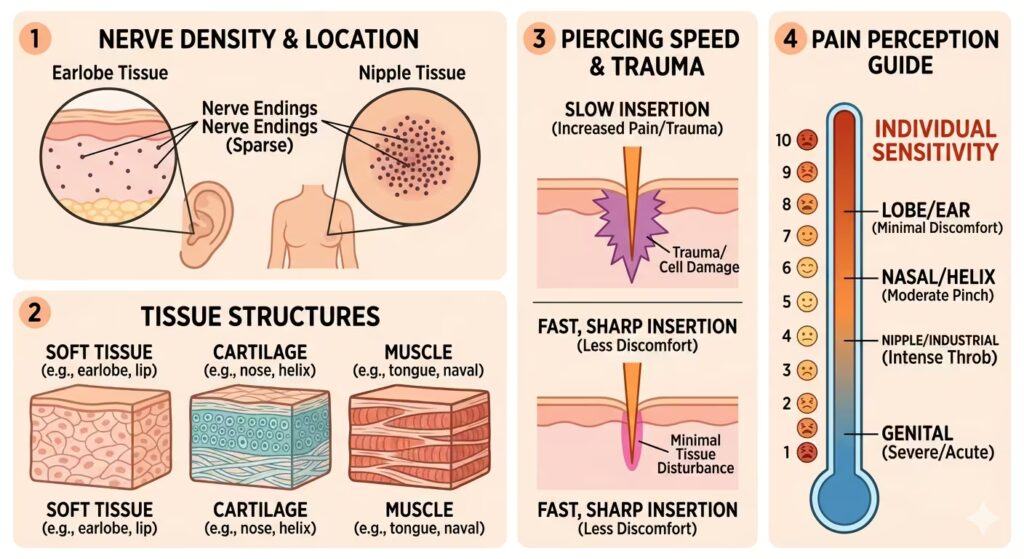
The frenulum is thin and has few nerve endings, so the needle pass is fast and the sharp pain is brief. Most people rate it 3 to 5 out of 10. It hurts less than a tongue or lip piercing but more than an earlobe.
The harder part is what comes after. The position requires you to sit with your mouth pulled open while the piercer clamps and pushes through. That awkward stretch lasts longer than the actual pierce.
Swelling peaks within the first 48 hours. Expect a tight, full feeling under your upper lip for the first three to five days.
Smiley Piercing Healing Timeline
The mouth heals quickly because of a strong blood supply, but it is also saturated with bacteria from every meal, sip, and breath. That tension is why aftercare matters more here than for most piercings.
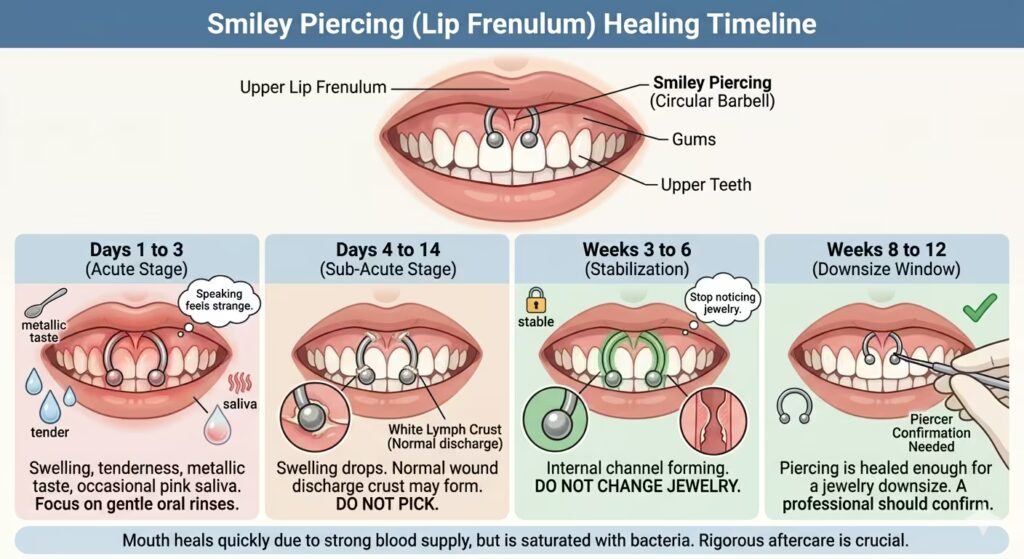
- Days 1 to 3. Swelling, tenderness, a metallic taste, and occasional pink-tinged saliva. Speaking feels strange. Eating is awkward.
- Days 4 to 14. Swelling drops. A thin, white, or clear lymph crust may form on the jewelry inside your mouth. That is normal wound discharge, not pus.
- Weeks 3 to 6. The piercing feels stable. You stop noticing the jewelry. The channel is not yet fully formed inside, so do not change the jewelry yet.
- Weeks 8 to 12. The piercing is healed enough for a jewelry downsize. A piercer should confirm before you swap anything yourself.
A 2023 systematic review on oral piercing complications found that piercings worn between 5 and 48 months on average were associated with mucosal changes from metal ion release. Healing the channel is one thing. Long-term tissue contact is a separate concern.
Smiley Piercing Aftercare
Mouth piercings need a different approach than skin piercings. You cannot do a saline soak because the site is inside your mouth. Rinsing replaces soaking.
Twice a day: Rinse with sterile saline or a sea-salt rinse (¼ teaspoon non-iodized salt in 8 oz warm distilled water). Hold and swish for 30 seconds. Spend extra time circulating the rinse over the upper lip.
After every meal: Rinse with plain water or alcohol-free mouthwash. Food trapped against the jewelry is the fastest route to infection.
Daily oral hygiene: Brush gently with a soft-bristle toothbrush. Switch to a mild-flavored, non-whitening toothpaste. Mint and whitening agents irritate the fresh wound.
Avoid for the first 6 to 8 weeks:
- Smoking (tobacco or weed) — heat and chemicals delay healing and trigger swelling
- Alcohol and alcohol-based mouthwash — dries the tissue and slows wound repair
- Kissing and oral sex — introduces foreign bacteria into an open wound
- Acidic, spicy, crunchy, sticky, or extremely hot foods
- Straws, chewing gum, biting nails, biting pens, wind instruments
- Pulling your lip down to look at the piercing in the mirror — every tug stresses the channel
- Touching or rotating the jewelry with your tongue
Alcohol exposure has been shown to slow wound healing and cause irritation at injury sites, which is why piercers and dental researchers both flag it during oral piercing recovery.
Smiley Piercing Jewelry
Initial jewelry is almost always a small-diameter circular barbell (horseshoe) or a captive bead ring. The hoop sits comfortably against the curve of the frenulum and is easy to clean around. Curved barbells are also used, making the piercing nearly invisible until you smile.
Standard gauge: 18G (1.0mm) or 16G (1.2mm). Anything thicker tears the tissue. Anything thinner risks embedding.
Standard diameter: 6mm to 8mm to start, with room for swelling. Once healed, you can downsize to 5mm or 6mm to reduce contact with the teeth.
Materials safe for an initial piercing, according to the Association of Professional Piercers’ jewelry standards, include implant-grade titanium, niobium, surgical stainless steel (316L or 316LVM), and 14-karat gold or higher (not gold-plated):
- Implant-grade titanium (ASTM F-136): Lightest, nickel-free, the safest default for oral piercings
- Niobium: Hypoallergenic, corrosion-resistant, well-tolerated inside the mouth
- Surgical stainless steel (316L / 316LVM): Generally hypoallergenic but contains nickel traces
- 14K or 18K solid gold (yellow or white): Acceptable if solid, never plated
Gold-plated, sterling silver, and costume-grade jewelry do not belong in any oral piercing. The plating wears off and the underlying alloys leach into the wound.
A 2023 review in the European Archives of Paediatric Dentistry found that oral piercings leach metal ions into surrounding tissue, contributing to local mucosal changes. Material grade is not a cosmetic detail. It is the single biggest variable in long-term tissue health.
Smiley Piercing Jewelry Variations
- Standard smiley: Single piercing through the center of the frenulum
- Double smiley: Two piercings side by side require a wider frenulum
- Side smiley: Off-center placement instead of dead-middle
- Smiley fangs: Curved barbell with cone-tipped ends that resemble small fangs when you smile
- Vampire smiley: Two pointed ends sit lower over the front teeth for a fang-style look
Smiley Piercing Cost
Expect $30 to $90 for the piercing itself in most regions. Jewelry is often charged separately and ranges from $20 for basic titanium up to $150+ for solid gold. Studios in major metro areas charge more. Studios with APP-credentialed piercers charge more, and the higher fee is worth it for a piercing this close to your teeth.
Aftercare supplies (saline spray, alcohol-free mouthwash) add another $15 to $30.
Smiley Piercing Risks
This piercing has the highest dental complication rate among decorative piercings. The American Dental Association advises against intraoral piercings, and some APP-affiliated piercers refuse to perform smileys for exactly this reason.
Gum recession
The jewelry rests against the front of your gumline every time your mouth is closed. Constant friction wears down the gum tissue, and once it recedes, it does not grow back. A systematic review in Diagnostics journal identified gingival recession as the most common complication of oral piercings, with the central mandibular incisors showing the highest incidence of periodontitis and gingivitis. Upper-arch versions cause the same pattern on the upper front teeth.
Enamel damage and tooth chipping
Metal beads contacting enamel during chewing, talking, and sleeping cause microscopic abrasion that builds over months. A 2023 systematic review found tooth chipping reported in 10 studies on oral piercings, along with documented gingival recession specifically in lip piercings.
Migration and rejection
Frenulum tissue is thin and constantly mobile. The body often treats the jewelry as a foreign object and gradually pushes it toward the surface. Signs of rejection include the jewelry sitting closer to the lip edge than originally placed, thinning tissue around the piercing, and holes that appear stretched or shallow.
Infection
The mouth carries hundreds of bacterial species. A poorly cleaned smiley can become infected within days. Signs that need a doctor or dentist, not a piercer: severe throbbing pain beyond day 3, yellow or green pus, a foul taste or smell, fever, swelling that spreads beyond the lip area, or hot skin on the face.
Bloodborne illness risk exists when needles or jewelry are not properly sterilized. NCBI’s clinical reference on needlestick injury lists hepatitis B, hepatitis C, and HIV among the pathogens transmissible through contaminated needles. Use a licensed studio that autoclaves every instrument.
Swallowing or aspiration
Loose jewelry inside the mouth can come off and be swallowed or, more dangerously, inhaled. Check the closure of your captive bead or threaded ends weekly.
Speech changes
A clicking or lisping sound during the first week is normal. It resolves as your tongue adjusts. A persistent speech change beyond two weeks indicates the jewelry is sized incorrectly.
When to Remove a Smiley Piercing
Remove the jewelry promptly if you notice:
- Visible gum line dropping below where it sat a few months earlier
- A tooth chipping, cracking, or developing a notch where the jewelry rests
- Cold or hot sensitivity in the front teeth that wasn’t there before
- The piercing is sitting visibly closer to the lip edge than at the placement
- Persistent bad breath or a sour taste that does not clear with rinsing
Tissue damage from this piercing is partially reversible only if caught early. Gum grafts and enamel restorations are the dental treatments used when removal comes too late.
Who Should Avoid a Smiley Piercing
- People with braces, retainers, dental sealants, or recent orthodontic work
- Anyone with gum disease, periodontitis, or visibly receding gums
- Anyone with chipped front teeth or known enamel erosion
- Smokers who cannot pause for at least two months
- Anyone with a frenulum too short or too thin to hold the jewelry
- People with bleeding disorders or on blood thinners (clear it with a doctor first)
- People with a history of infective endocarditis or congenital heart conditions (oral bacteremia is a documented risk)
Smiley Piercing FAQs
Does a smiley piercing damage your teeth?
Yes, often. The jewelry contacts the back of your upper front teeth thousands of times a day. Over months, this causes enamel wear, micro-chipping, and gum recession on the upper central incisors. Choosing the smallest comfortable jewelry diameter and removing it at the first sign of damage are the only ways to reduce the risk.
How long does a smiley piercing last?
One to two years is typical. Some last only a few months before rejecting. A small number lasts longer with disciplined jewelry sizing and oral hygiene. It is not considered a permanent piercing.
Can you get a smiley piercing with braces?
No. Wait until the braces are off and your teeth have settled. The jewelry snags on brackets and wires, causing constant contact that damages both your hardware and your teeth.
What gauge is a smiley piercing?
Standard sizes are 18G (1.0mm) and 16G (1.2mm). Anything outside that range is anatomically incorrect.
Does it hurt to get a smiley piercing?
The needle pass is brief and rated 3 to 5 out of 10 by most people. The frenulum is thin, so the pain is sharper but shorter than a lip or tongue piercing. Holding your mouth open during the procedure is more uncomfortable than the piercing itself.
Can you smoke or vape with a smiley piercing?
Avoid both for at least the first two months. Heat dries the tissue, smoke chemicals delay healing, and the inhalation motion pulls on the fresh wound. Vaping is not safer because the propylene glycol and flavoring agents irritate the healing channel.
Can you eat after getting a smiley piercing?
Yes, but stick to soft, cool foods for the first 48 to 72 hours. Yogurt, smoothies, mashed potatoes, scrambled eggs, and lukewarm soup are easy. Avoid anything spicy, acidic, crunchy, hot, or sticky. Rinse with water after every meal.
Can you kiss someone with a smiley piercing?
Not for the first 6 to 8 weeks. Another person’s mouth introduces unfamiliar bacteria into an open wound. Closed-mouth kissing carries less risk than open-mouth kissing, but both are best avoided during initial healing.
How do you know if your smiley piercing is rejecting?
The jewelry sits closer to the edge of your lip than it did at placement. The tissue holding it looks thinner, stretched, or shiny. The entry and exit holes appear larger or closer together. Remove the jewelry as soon as these signs appear to limit scarring.
How do you clean a smiley piercing?
Rinse with sterile saline or a sea-salt solution twice daily, and use a water- or alcohol-free mouthwash rinse after every meal. Do not scrub the jewelry with a toothbrush. Do not pull your lip back to inspect or wipe at the piercing.
Can a smiley piercing close up?
Yes, quickly. Within hours of the removal of a fresh piercing. Within days, even in a healed one. The frenulum is fast-healing tissue. If you take the jewelry out for more than a few hours during the healing process, the hole will likely close.
How old do you have to be to get a smiley piercing?
Most studios require 18 with a valid ID. Some accept 16 or 17 with a parent or legal guardian present and written consent. Local laws vary.
Can you hide a smiley piercing?
Yes, naturally. It is invisible until you smile widely or pull your lip up. Curved barbells hide it even more effectively than hoops.
Does a smiley piercing leave a scar?
If it rejects or you remove it after wearing it for over a year, a small vertical line of scar tissue often remains on the frenulum. It is rarely visible to anyone but you.
Can you re-pierce a smiley after rejection?
Most piercers will refuse. The scar tissue from a rejected smiley is fragile and will not reliably hold a new piercing. A second attempt almost always rejects faster than the first.