Earlobe Piercing Quick Facts
| Detail | Information |
|---|---|
| Placement | Soft, fleshy lower portion of the ear |
| Pain level | 1–2 out of 10 |
| Healing time | 6–8 weeks externally; up to 6 months internally |
| Standard gauge | 20G (0.8 mm) to 18G (1.0 mm) |
| Average cost (US) | $25–$80 per lobe |
| Best starter jewelry | Implant-grade titanium flat-back stud |
| Aftercare | Sterile saline twice daily |
What Is an Earlobe Piercing?
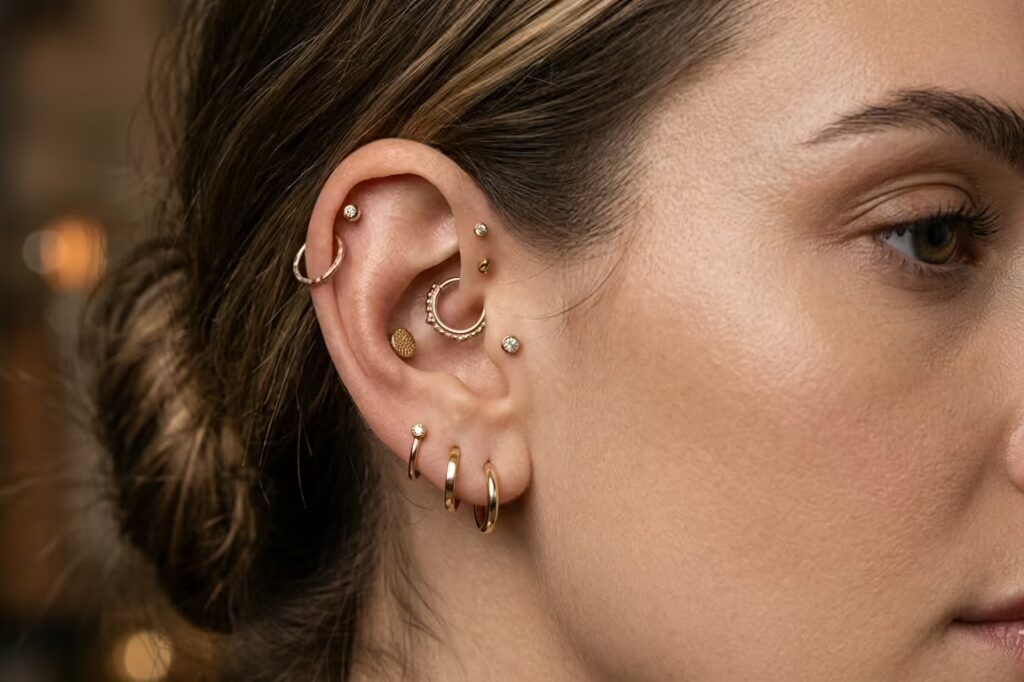
An earlobe piercing is a hole made through the soft, fatty tissue at the bottom of the ear. The lobe contains no cartilage, only skin, fat, and connective tissue. This is why it heals faster and hurts less than any other ear placement.

The earlobe is the oldest and most common piercing site in human history, with archaeological evidence dating back over 5,000 years. Earlobes are the most pierced body part in the United States — 84% of women and 64% of men in the U.S. rock pierced lobes. The piercing typically sits in the center of the lobe, though placement varies for stacked, transverse, and high-lobe styles.
Types of Earlobe Piercings
Standard Lobe
A single piercing through the center of the fleshy lobe. It accepts almost any earring style and remains the most common ear piercing worldwide.
Second and Third Lobe
These sit slightly above the standard hole. Each new hole stacks vertically, with roughly 1.5-2 mm of spacing for jewelry layering.
Upper Lobe (High Lobe)
This placement sits at the very top of the fleshy lobe, just before the cartilage begins. It still heals on lobe timelines because the tissue is soft.
Transverse Lobe
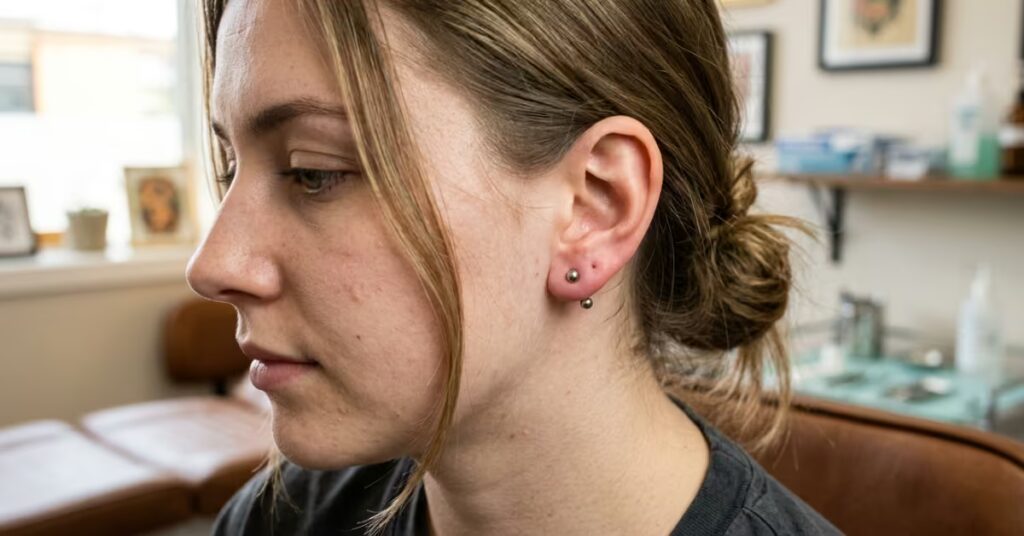
A horizontal piercing that travels through the lobe sideways, capped by a barbell on each end. It passes through more tissue than a vertical lobe, so healing runs 8 to 10 weeks. Migration and rejection are slightly more common than with standard lobes.
Orbital Lobe
Two separate piercings connected by a single ring or curved barbell. The ring orbits a small section of the lobe, creating a hoop-through-flesh effect.
Stacked Lobe
Multiple holes placed tightly together, often less than 2 mm apart. The arrangement lets tiny studs sit shoulder to shoulder for a clustered look.
Constellation Lobe
A curated set of three or more piercings placed in an asymmetrical pattern. Placement is mapped out before piercing so jewelry mimics a star pattern.
Stretched Lobe
A standard lobe gradually widened over months using tapers and plugs. Stretching past 0–2 gauge (around 8–10 mm) often prevents the lobe from returning to its original size without surgery.
How Much Does an Earlobe Piercing Hurt?
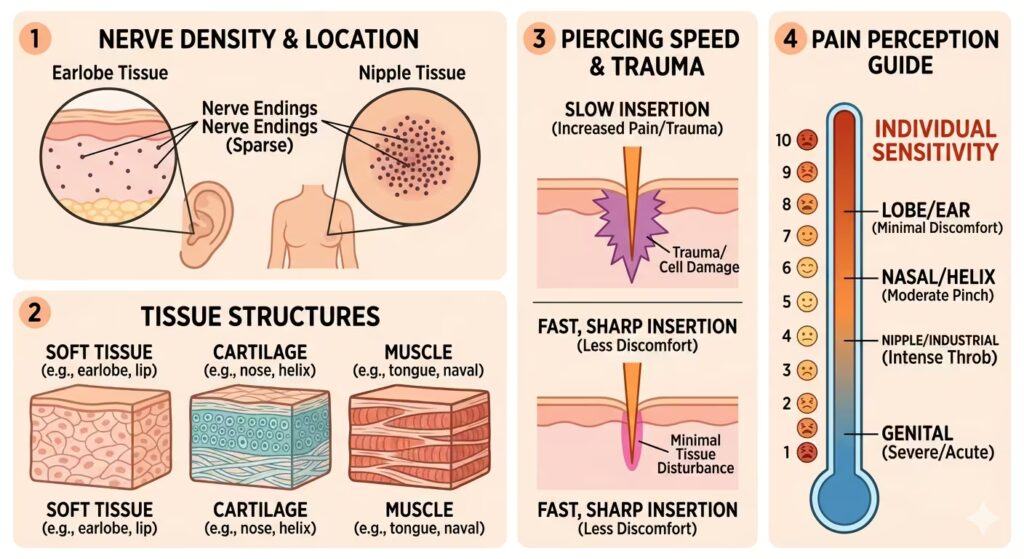
Most people rate the pain at 1–2 out of 10. The lobe is fatty tissue with few nerve endings, so the sensation is brief.
Earlobes are fatty tissue, so they don’t have many nerves in them. They hurt the least. Expect a sharp pinch lasting under a second. A throbbing or warm sensation may follow for a few hours.
Pain varies based on piercer skill, needle gauge, and individual tolerance. Numbing cream is rarely needed and is not used in most reputable studios.
Earlobe Piercing Healing Timeline
External healing takes 6 to 8 weeks. Full healing means the tissue has strengthened and is less likely to become irritated or infected, and that takes 3 to 6 months.
- Week 1: Redness, mild swelling, tenderness, and clear or pale yellow fluid forming light crusts.
- Weeks 2–4: Tenderness fades. Crusting decreases. The piercing still feels firm to the touch.
- Weeks 5–8: External skin appears healed. The fistula (internal channel) is still forming and remains fragile.
- Months 3–6: The channel hardens. Jewelry can be changed safely once it moves without resistance or pain.
Removing the starter earring before 6 weeks risks the hole closing. The American Academy of Dermatology advises keeping jewelry in a new piercing for at least 6 weeks, even at night.
Earlobe Piercing Aftercare
Clean the piercing twice daily with sterile saline solution (0.9% sodium chloride). Avoid alcohol, hydrogen peroxide, tea tree oil, and antibacterial ointments. They dry the skin and slow healing.
Do not rotate or twist the jewelry. Rotation drags crust and bacteria into the channel and tears new tissue.
Sleep on the opposite side. Pressure on a fresh piercing causes the most common complication piercers see: irritation bumps on the back of the lobe.
Keep shampoo, conditioner, hairspray, and makeup off the area. Rinse the lobe at the end of every shower with plain water.
Skip pools, hot tubs, lakes, and the ocean for at least the first 4 to 6 weeks. Standing water carries bacteria that thrive in open piercings.
Best Jewelry for a Fresh Earlobe Piercing
Starter jewelry should be implant-grade titanium (ASTM F-136), implant-grade steel (ASTM F-138), 14k or 18k solid gold (nickel-free), or medical-grade niobium. These materials carry the lowest risk of reaction.
Flat-back labret studs are the gold standard. The smooth disc sits behind the ear and does not dig into the neck during sleep.
Butterfly backs are the traditional option but trap moisture and hair behind the lobe. Many professional piercers have moved away from them for fresh piercings.
Avoid hoops, dangles, and heavy earrings until full internal healing. Their weight pulls on the channel, stretching the hole sideways.
Earlobe Piercing Risks and Complications
Infection
Localized infection is the most common complication. Signs include spreading redness, hot skin, thick yellow or green discharge with odor, and increasing pain after the first week.
A study of pierced ears found that as many as 35% of people with pierced ears had one or more of the following complications: minor infection (77%). Allergic reaction: 43%. Scar tissue (keloid) formation: 2.5%. Traumatic tearing: 2.5%.
Research on females aged 18 to 28 found the prevalence of probable ear piercing-related infection was significantly higher for cartilage piercings than earlobe piercings (41.4% vs. 29.6%). Lobe infections are usually mild and respond to saline cleaning. Persistent or worsening symptoms warrant a doctor visit.
Nickel Allergy
Nickel is the leading cause of allergic contact dermatitis worldwide. A 2025 systematic review and meta-analysis in Contact Dermatitis found nickel allergy was significantly associated with piercings in the general population (OR 5.9).
The same review found critical nickel release in 11.3% of European earrings, 31.1% of North American earrings, and 34.5% of Asian earrings. The risk is highest at the time of piercing, when raw tissue is exposed. The risk of getting nickel allergy when pierced was 4.6 (95% CI: 3.3–6.4) for women and 2.8 for men.
Implant-grade titanium or solid gold for the initial piercing is the single best way to prevent lifelong nickel sensitivity.
Keloids
Keloids are raised, firm scars that grow beyond the original wound. A multi-ancestry meta-analysis found that in the US, keloids occur in about 1 in 30 Black individuals, roughly a 20-fold increase in risk compared to White individuals.
Genetic predisposition is the strongest risk factor. Heritability estimates were 6% for European ancestry, 21% for East Asian ancestry, and 34% for African ancestry. Anyone with a personal or family history of keloids should consult a dermatologist before piercing.
Embedded Earring
Tight butterfly backs can press the post into the lobe until skin grows over the front or back. A retrospective review from Cincinnati Children’s Hospital reported an incidence rate of 25 per 100,000 patient visits, with 60% of cases in children under 10.
The earrings are embedded in the earlobe in 87% of cases. This is far more common in young children with thick, fleshy lobes pierced with spring-loaded guns. Flat-back jewelry with longer posts almost eliminates this risk.
Tearing and Splitting
Heavy or dangling earrings can stretch or tear the lobe over time. A snagged hoop can split the lobe in a single accident. Surgical repair is straightforward but leaves a scar and usually means re-piercing in a new spot.
Needle vs. Piercing Gun
Needles are sharper, sterile, and single-use, and they cleanly remove a tiny core of tissue. Guns force a blunt earring stud through the lobe by impact and cannot be fully sterilized between clients.
The research on this gap is clear. The prevalence of ear piercing complications among participants who used piercing needles was lower for both earlobe piercings and ear cartilage piercings (3.65%, 8.75%) than among those who used piercing guns (37.9%, 43.4%).
The Association of Professional Piercers and the American Academy of Pediatrics both discourage the use of piercing guns. Choose a piercer who uses single-use needles.
Earlobe Piercing Cost in the United States
One lobe piercing typically runs $25 to $55. Both lobes together run $50 to $150 in most studios.
Reputable studios charge a separate fee for jewelry. Implant-grade titanium starter studs run $25 to $80, depending on gem size. Solid 14k gold studs run $80 to $250.
Mall kiosks and jewelry-store piercings appear cheaper but use guns. Factoring in possible complications, a professional studio is the better value.
Piercing Children’s Earlobes
The American Academy of Pediatrics recommends postponing piercing decisions until children are mature enough to care for the pierced sites themselves. Pediatricians often suggest waiting until the infant is at least 2 to 3 months old, after the first round of vaccinations, if parents choose infant piercing.
Children under 10 are the largest group affected by embedded earrings, almost always from gun piercings with tight butterfly backs. A pediatric medical piercing or a needle piercing at a professional studio is safer than a mall kiosk.
When to See a Doctor
Seek medical attention if any of the following appear:
- Spreading redness that extends beyond the piercing
- Pain that worsens after day 3 instead of improving
- Thick yellow or green discharge with odor
- Fever, chills, or swollen lymph nodes near the jaw or neck
- A hard, growing lump that extends past the piercing hole
- The earring back becomes buried in the skin
Do not remove the jewelry without medical advice if there is a suspected infection. Removing it can trap bacteria inside a wound that is closing.
Earlobe Piercing FAQs
How long until I can change my earring?
Wait at least 6 to 8 weeks for the first change. The hole stays fragile internally for up to 6 months, so use the same gauge and avoid heavy styles early on.
Can I sleep on a new earlobe piercing?
No. Pressure causes irritation, bumps, and migration to the pillow side. Sleep on the opposite side or on your back until full healing.
Will my earlobe piercing close if I take the earring out?
Yes, especially in the first year. A hole under 6 months old can close within hours. A hole over a year old may stay open for days, but it can still shrink.
Can I get my lobes pierced if I’m pregnant or breastfeeding?
Most professional piercers will decline. Hormonal changes affect healing and immune response, and any infection during pregnancy carries higher stakes.
Is it safe to pierce with a gun at a mall or jewelry store?
No. Guns cannot be sterilized to the same standard as autoclaved needles, and the blunt-force technique causes more tissue trauma. Needle piercings have a roughly one-tenth lower complication rate.
Can I swim during healing?
Avoid pools, hot tubs, lakes, oceans, and bathtubs for 4 to 6 weeks. Showers are fine. Rinse the lobes with plain water at the end.
What gauge is used for an earlobe piercing?
Most piercers use 18G (1.0 mm) or 20G (0.8 mm). A slightly thicker gauge heals more reliably than a thin one and prevents the post from cutting into the channel.
My earlobe piercing has a small bump behind it. Is that a keloid?
Probably not. Most bumps behind a healing lobe are irritation bumps caused by pressure, moisture, or a tight earring back. True keloids grow over months and extend beyond the piercing site. Persistent or growing bumps should be checked by a dermatologist.
Can I use rubbing alcohol or hydrogen peroxide to clean it?
No. Both damage healing tissue and prolong recovery. Sterile saline is the only product needed for daily cleaning.
How fast does an earlobe piercing close after years of wearing earrings?
Older piercings often stay open for days or weeks without an earring, but the hole gradually shrinks. Some piercings remain functional decades after the last earring; others close within a month.
Can I get a sinus or inner ear infection from an earlobe piercing?
No. The lobe is anatomically separate from the ear canal and sinuses, so a piercing infection does not spread into them. Cartilage piercings carry that risk; lobes do not.
Why is my earlobe piercing crusty?
Clear or pale-yellow lymph fluid dries on the jewelry during healing. Light crusting is normal for the first 2 to 4 weeks. Soak it off with saline rather than picking it.
Can I get both ears pierced at the same time?
Yes. Most piercers offer it, often with two professionals working simultaneously for symmetry. Sleep will be harder for the first 2 to 3 weeks, as neither side is unaffected.
Does the season I get pierced matter?
Summer brings sweat, sunscreen, pools, and sand into contact with healing skin. Cooler months reduce these exposures and tend to make aftercare easier.