Orbital Piercing Quick Facts
| Info | Details |
|---|---|
| Piercing type | Two connected piercings sharing one ring |
| Placement | Lobe, helix, conch, flat, or cross-region cartilage |
| Pain level | 2–3/10 (lobe), 4–6/10 (cartilage) |
| Healing time | 6–10 weeks (lobe), 6–12 months (cartilage) |
| Jewelry gauge | 18G (lobe), 16G or 14G (cartilage) |
| Starter jewelry | Captive bead ring or circular barbell |
| Cost | $50–$100 for service, jewelry priced separately |
| Aftercare solution | Sterile saline spray (0.9% sodium chloride) |
What Is an Orbital Piercing?
An orbital piercing is two separate piercings linked by one continuous ring. The jewelry “orbits” the strip of tissue between the two holes, which is where the name comes from. It is a style category rather than a fixed location on the ear.
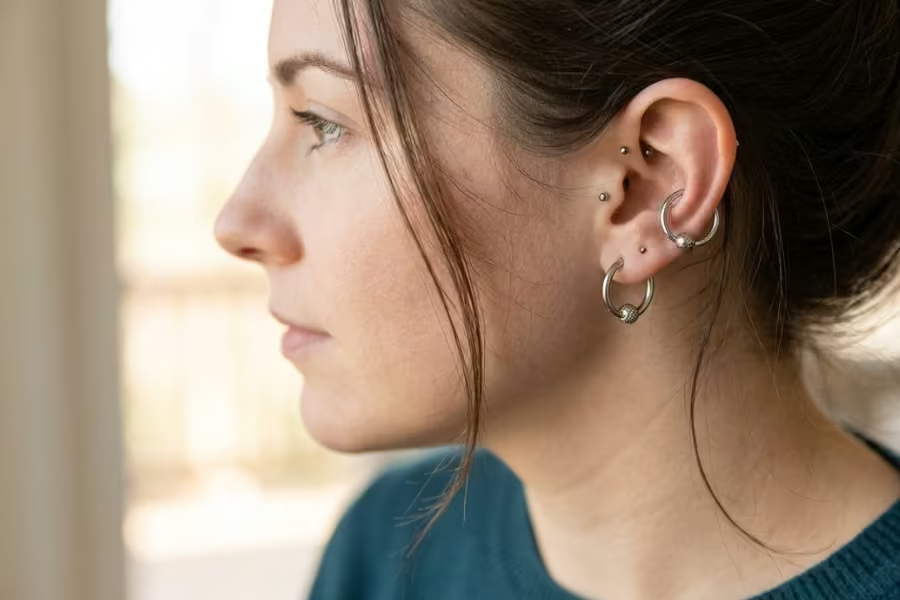
The piercing can sit in the lobe, helix, conch, flat, or across two regions of cartilage. Both channels must be placed at precise angles so the ring passes through without compressing or pulling tissue. Two healed but unrelated piercings cannot always be turned into an orbital, since the angles are usually wrong.
How Orbital Piercing Differs From Similar Piercings
An orbital piercing needs two healed channels at precise angles so a single hoop can pass through both without pulling tissue. Force the wrong angle and the piercing will not settle. This is why it cannot be improvised from two unrelated existing piercings without expert assessment.
It is often confused with two other piercings:
- Industrial: also connects two holes, but with a straight barbell across the upper cartilage.
- Conch with a hoop: a single conch piercing wearing a large ring that wraps the ear rim. Only one channel exists, so it is not an orbital.
A true orbital piercing always has two fistulas sharing one ring.
Orbital Piercing Placement Options
- The orbital lobe sits in soft tissue and is the easiest to access. It heals fastest and hurts least.
- The Helix orbital uses two closely spaced holes on the outer upper rim of the ear. The cartilage there is thin but firm.
- The conch orbital has two perforations within the bowl of the ear, connected by a ring. The cartilage is thicker, so healing takes longer.
- Flat orbital runs across the flat cartilage between the helix and antihelix.
- Cross-region orbitals connect different parts of the ear, such as a rook to a forward helix or a conch to a helix. These require expert anatomy assessment.
Orbital Piercing Pain Level
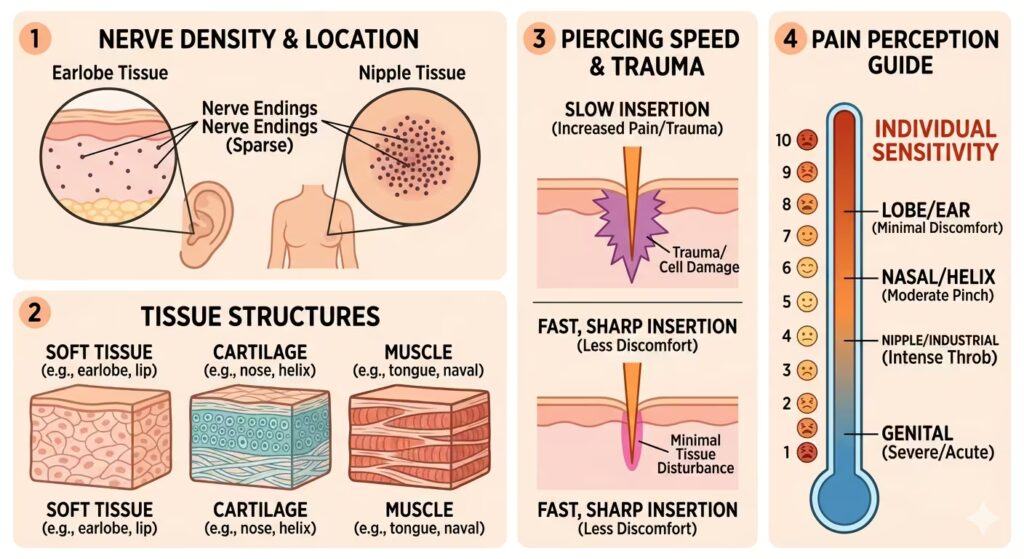
Most people rate a lobe orbital at 2–3 out of 10. A cartilage orbital sits closer to 4–6 out of 10. The needle passes twice, and the second pass usually feels sharper because the ear is already sensitized.
Cartilage hurts more than the lobe because it is dense and slower to compress around the needle. The piercer also has less room to maneuver when inserting the ring through two fresh holes. This adds brief pressure during jewelry insertion.
Orbital Piercing Healing Time
An orbital lobe heals in 6 to 10 weeks. A cartilage orbital takes 6 to 12 months, and sometimes up to two years for full internal healing.
Cartilage has a poor blood supply, so cellular repair runs more slowly than in lobular tissue. The orbital style also doubles the number of wounds in one ear, increasing the risk of irritation during healing.
A study published in The Laryngoscope found that cartilage piercings have 2.2 times the odds of complications compared with lobe piercings, with infection rates of 30.3% versus 23.8%. A separate study in the Journal of Nature and Science of Medicine reported a probable infection prevalence of 41.4% among cartilage piercings, compared with 29.6% among earlobe piercings.
Orbital Piercing Jewelry: Gauge, Diameter, and Material
Orbital piercing is defined by its ring, so jewelry choice matters more than for single-channel piercings.
- Gauge. A lobe orbital uses 18G (1.0 mm). An orbital cartilage uses 16G (1.2 mm), occasionally 14G (1.6 mm).
- Diameter. Measure the center-to-center distance between the two holes. Add roughly 2 mm for room swelling during healing. An orbital cartilage often starts at an internal diameter of 10–12 mm.
- Starter jewelry. A captive bead ring or a circular barbell is standard. Both allow swelling, and the captive bead can be removed without forcing the ring through the channels. Hinged segment clickers should be avoided in fresh piercings, since the seam can trap bacteria.
- Material. The Association of Professional Piercers recommends implant-grade titanium (ASTM F-136), solid 14k or 18k nickel-free gold, or niobium for fresh piercings. Surgical stainless steel can contain nickel and is not appropriate during healing.
Orbital Piercing Cost
Expect $50 to $100 for the piercing service. Jewelry is priced separately. Implant-grade titanium rings typically run $20 to $40, while solid gold runs higher.
Two needle passes, and the technical difficulty of aligning the ring mean orbitals costs more than a single piercing. Tipping the piercer 15–20% is customary in the United States.
Orbital Piercing Aftercare
Spray sterile saline (0.9% sodium chloride) on the piercing twice a day. Soften any crust with the spray, then gently wipe with sterile gauze. Do not pick at the area.
Do not rotate, twist, or move the jewelry. Keep shampoo, conditioner, makeup, and styling products away from the piercing. Avoid pools, hot tubs, lakes, and the sea until fully healed.
Sleep off the piercing. A U-shaped travel pillow lets side sleepers rest their ear inside the hole. Do not change the ring until a piercer confirms the channels are settled.
Skip alcohol, hydrogen peroxide, tea tree oil, homemade salt mixes, antibacterial soap, and ointments. These either damage healing cells or trap moisture against the wound.
Orbital Piercing Risks Specific to Orbital Piercings
- Perichondritis is an infection of the cartilage’s covering layer. A 2025 study in The Laryngoscope, tracking 217 patients, found that piercing-induced auricular perichondritis affected a younger group with fewer comorbidities than in non-piercing cases. Cartilage orbitals carry double the puncture count, which widens the risk window.
- Warning signs include red, hot, shiny skin spreading beyond the piercing; severe pain; swelling that distorts the ear shape; and fever. Treat these as urgent and see a doctor.
- Pseudomonas aeruginosa infection is a serious bacterial infection linked to contaminated water and aftercare products. An outbreak documented in JAMA traced cases to commercial piercing studios that used a contaminated aftercare solution. Use single-use sterile saline and never refill bottles.
- Hypertrophic bumps are small, firm bumps next to the piercing caused by irritation, snagging, pressure, or a ring that pulls tissue. They are not infections. They usually resolve once the source of pressure is removed.
- Migration and rejection occur when the ring applies uneven tension to the two channels. This is more common when an orbital is forced from two pre-existing piercings that were not placed with an orbital in mind.
- Keloids are raised, hypertrophic scars that extend beyond the piercing site. Genetic predisposition matters. Anyone with a family history of keloids should discuss the risk before piercing cartilage.
Changing the Jewelry
Wait until a piercer confirms full healing. For a lobe orbital, this is usually around 10 weeks. For cartilage, it is a minimum of 6–12 months, even when the surface looks healed.
The internal channel lags behind the external skin. Changing too early can collapse the fistula or introduce infection.
Once healed, a seamless ring or hinged clicker becomes safe to wear. A clicker is easier to insert because it opens at a hinge, rather than needing the ring to be pried apart.
When an Orbital Is Not Possible
A piercer may decline if the cartilage is too thin or too curved to support two close-set holes. Existing piercings that sit at the wrong angle, or scar tissue from past piercings, can also rule it out.
If the required ring diameter would be uncomfortably large for the chosen area, an alternative style is recommended. Two separate cartilage piercings with matching studs, or a single conch with a hoop, can mimic the look without the doubled risk of healing.
Orbital Piercing FAQs
Can an orbital be made from two existing piercings?
Sometimes. Lobe piercings are flexible enough to accept a ring if the spacing is right. Cartilage piercings rarely align correctly unless they were placed with an orbital in mind. A piercer must check angles before inserting any ring.
Does an orbital scar, if removed?
Two small dots remain after the channels close, similar to any healed piercing. Cartilage holes often stay partially open even after years without jewelry.
Can headphones be worn?
Earbuds press directly on cartilage and should be avoided during healing. Over-ear headphones are usually fine once the piercing is settled, provided the cushions do not pinch the ring.
Can an orbital be placed on the navel or other body parts?
Yes, though it is rare. The ear is where the anatomy lends itself most easily.
What if one hole heals faster than the other?
This is common. Treat both as unhealed until the slower one catches up. Do not change the jewelry early.
Does the ring need to come out for an MRI?
Implant-grade titanium and 14k+ gold are MRI-safe. Confirm with the radiology team before scanning. If the material is unknown, the ring should be removed.
How is sleep managed during months of cartilage healing?
A travel pillow or piercing pillow with a hollow center keeps pressure off the ear. Sleeping on the opposite side helps, but most side sleepers shift during the night without realizing.
Can the two holes be pierced on separate visits?
This is not recommended. Healing the channels separately, then forcing a ring through them, puts strain on the tissue and often causes hypertrophic scarring. Both holes should be done in the same sitting, with the final jewelry in mind.