Auricle Piercing Quick Facts
| Info | Detail |
|---|---|
| Placement | Outer rim of the ear, midway between the helix and the earlobe |
| Also called | Mid-helix, midi-helix, midi |
| Piercing type | Cartilage |
| Pain level | 3 to 5 out of 10 |
| Healing time | 6 to 12 months |
| Standard gauge | 16G (1.2 mm), sometimes 14G |
| Best initial jewelry | Implant-grade titanium flat-back stud |
| Average cost | $30 to $75 (procedure), $20+ (jewelry) |
| Tool | Sterile single-use needle (never a gun) |
What Is an Auricle Piercing?
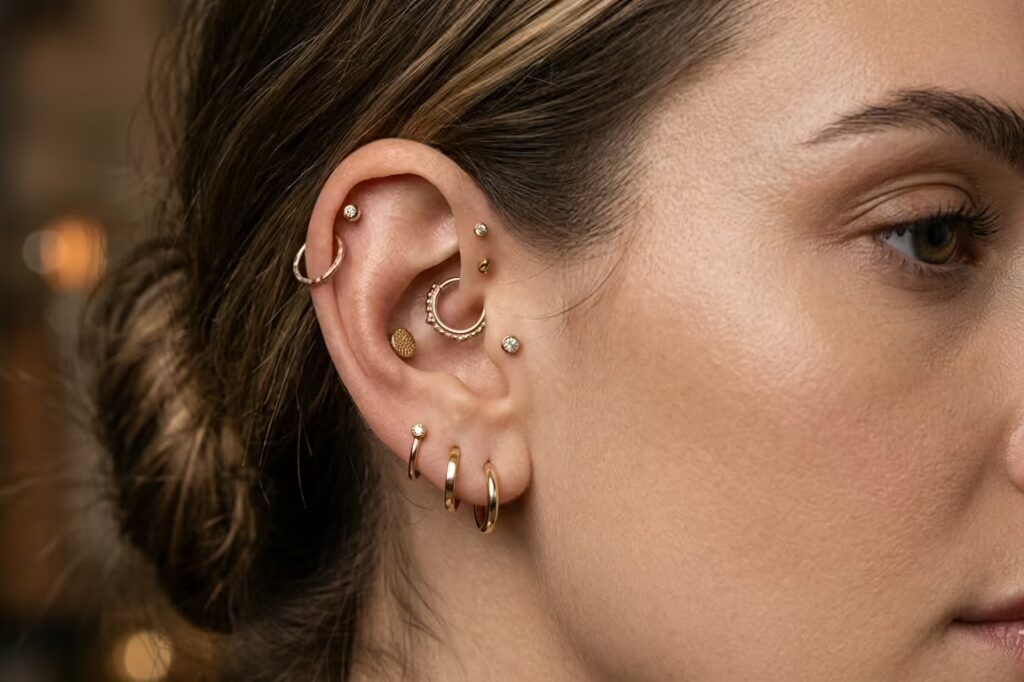
An auricle piercing sits on the outer rim of the ear, midway between the helix above and the earlobe below. It passes through cartilage, but cartilage that is noticeably thinner than at the helix, rook, or daith.
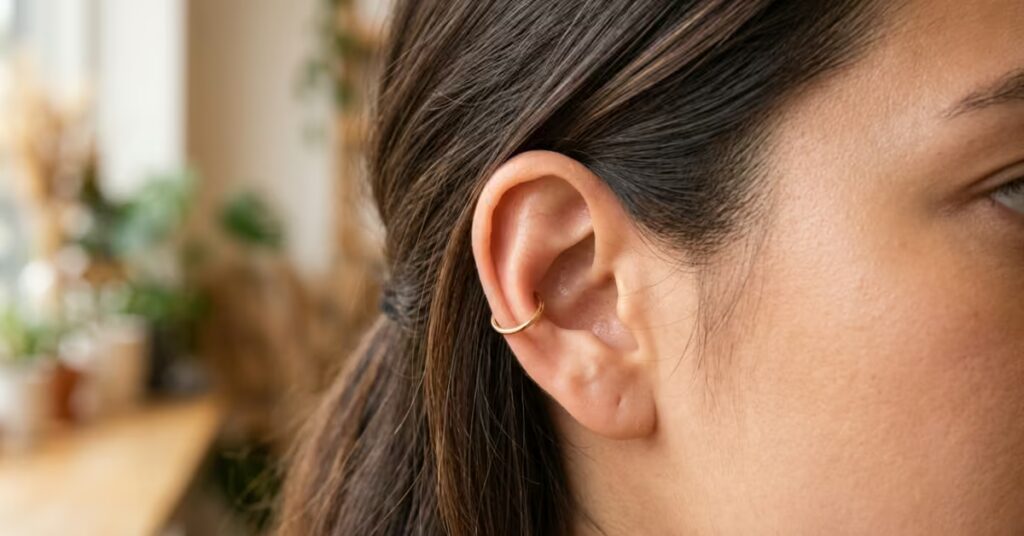
The name comes from the anatomical term auricle, the medical word for the visible outer ear. Piercers often call the same spot a mid-helix or midi because it sits in the middle of the helix curve, usually level with the tragus.
The piercing rose in popularity through the “earscaping” trend of the late 2010s. It sits roughly at the 3 o’clock position on the right ear and at the 9 o’clock position on the left ear. Its main appeal is flexibility — it anchors a curated ear stack without sitting at the painful upper helix.
Auricle Piercing Placement and Anatomy
The cartilage at the mid-rim is among the thinnest on the outer ear. That single fact shapes the pain, the needle size, and the healing timeline.
Not every ear suits this piercing. A tightly rolled helix or a very flat rim leaves too little tissue to safely hold jewelry. A piercer should assess the anatomy in person before booking.
Auricle Piercing Pain Level
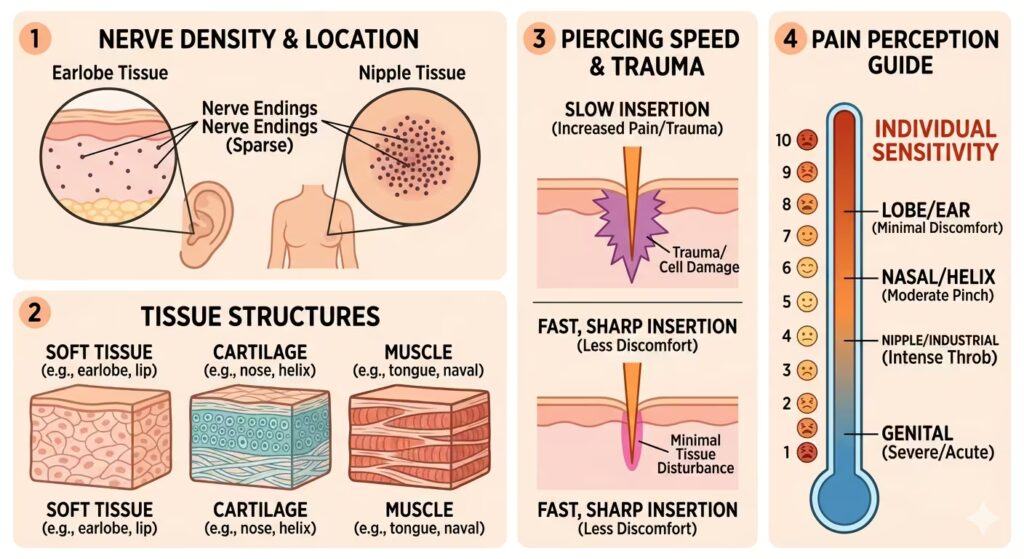
The auricle ranks lower on the cartilage pain scale than the helix, rook, or daith. Most clients describe a brief, sharp pinch and a few seconds of pressure.
Thinner cartilage means less drag on the needle. Pain after the appointment matters more than pain during it. Expect dull throbbing for two to three weeks, then intermittent soreness for several months.
Auricle Piercing Healing Time
The auricle takes 6 to 12 months to fully heal. Most piercers quote an average of 6 to 9 months for cooperative anatomy.
Surface skin closes within the first 8 to 12 weeks. The deeper cartilage tract continues to remodel throughout the full healing window. Changing jewelry too early is the most common cause of complications at this site.
Cartilage heals slowly for a structural reason. It has no direct blood supply. Nutrients reach it by diffusion through the perichondrium, the membrane wrapping the cartilage.
Auricle Piercing Infection Risk
Cartilage piercings carry a higher infection rate than lobe piercings. According to a 2026 cohort study published in The Laryngoscope, infection rates were significantly more common in the cartilage group at 30.3 percent compared with 23.8 percent in the lobule group.
A 1998 study by Simplot and Hoffman in the American Journal of Otolaryngology reported a similar pattern. Minor infection was more prevalent among cartilage piercings at 30 percent, compared with 21 percent in soft tissue.
The bacteria involved differ from lobe infections. Lobe infections are usually caused by Staphylococcus aureus or Streptococcus. Cartilage ear infections frequently involve Pseudomonas aeruginosa, a waterborne organism.
According to the StatPearls chapter on Body Piercing Infections (NCBI Bookshelf, NIH), there is a higher rate of Pseudomonas infections involving the cartilaginous ear and nasal structures.
Pseudomonas matters because it can progress to auricular chondritis, infection of the cartilage itself. Untreated chondritis can destroy cartilage and permanently deform the ear.
An investigation published in the American Journal of Preventive Medicine found 15 confirmed cases of chondritis linked to ear piercing. Nine were hospitalized for a median of 4.4 days. Cases required intravenous antibiotics, surgical treatment, and multiple drug regimens.
Two risk factors drove most of those cases: piercing with a gun and a contaminated aftercare solution shared between clients.
Needle vs Gun
Auricle piercings should be done with a sterile single-use needle. Piercing guns are inappropriate for any cartilage site.
A gun delivers blunt force. The stud is driven through the tissue rather than cut through cleanly. In cartilage, this crushing action raises the risk of fragmenting the tissue and embedding the earring back.
The Association of Professional Piercers recommends needle piercing for all cartilage sites without exception. UKAPP gives the same guidance.
Auricle Piercing Jewelry: What Actually Goes In
Initial jewelry should be implant-grade. The APP recognizes specific material standards, not vague labels like “surgical” or “hypoallergenic.”
According to the Association of Professional Piercers, acceptable titanium for initial piercings includes implant-certified Ti6Al4V ELI compliant with ASTM F-136, ASTM F1295, or ISO 5832-3. Commercially pure titanium compliant with ASTM F-67 is also accepted.
For steel, the standard is ASTM F-138 or ISO 5832-1 — specifically 316LVM. Solid 14k or 18k gold is acceptable if it is nickel-free and cadmium-free.
Plated, filled, or vermeil jewelry is not appropriate for fresh piercings. The gold layer is measured in millionths of an inch and wears off.
Standard initial jewelry is a flat-back labret stud at 16-gauge. Post length is usually 6 mm or 8 mm to allow for swelling. After full healing, the piercer should downsize the post to fit the settled anatomy.
Hoops are not recommended as starter jewelry. They move more, irritate the channel, and the diameter needed for healing swelling is rarely the diameter wanted long-term.
After full healing, jewelry options expand:
- Flat-back studs (lowest profile, least snagging)
- Seamless rings
- Hinged clicker rings
- Captive bead rings
- Small huggie hoops
- Chained pairs across double piercings
Auricle Piercing Aftercare
Twice-daily saline rinses are the standard. Sterile saline (0.9 percent sodium chloride) sold as a wound wash spray is what most professional piercers recommend.
Avoid alcohol, hydrogen peroxide, tea tree oil, and antibacterial soap on a healing auricle. Each of these kills new tissue along with bacteria and delays healing.
Pat the area dry with clean, disposable paper towels. Cloth towels carry bacteria and snag on jewelry.
Avoid the following for the first three months at a minimum:
- Sleeping directly on the piercing
- Submerging in pools, hot tubs, lakes, oceans, or baths
- Pulling clothing roughly over the ear
- Pressing phones or over-ear headphones against the piercing
- Hair products, dry shampoo, or hair dye near the site
Sleeping on the opposite side is the simplest preventive habit. A travel pillow with a center hole accommodates the ear when side-switching is unavoidable.
Auricle Piercing Cost
Studio fees run roughly $30 to $75 in the United States. Jewelry is usually priced separately and starts around $20 for basic implant-grade titanium.
Solid-gold pieces start at around $55 and run into the hundreds for gem-set work. Studios quoting a single flat fee inclusive of jewelry often use lower-grade pieces.
Reputable studios stock implant-grade jewelry from manufacturers like Anatometal, NeoMetal, Industrial Strength, and BVLA. A studio that cannot name its supplier or specify ASTM standards is a warning sign.
Bumps and Keloids
Two different problems get confused at this site: piercing bumps and keloid scars.
A piercing bump is a localized swelling from friction, pressure, or low-grade irritation. It sits directly at the piercing hole, often pink or skin-coloured, and resolves once the irritation stops. Bumps can persist for several months.
A keloid is a different scar process. According to the Cleveland Clinic, ear keloids develop slowly and may take three to 12 months to become noticeable. They will eventually stop growing, but they will not go away without treatment.
Keloids extend beyond the original wound. Family history is the strongest predictor.
The American Academy of Dermatology states that if you or blood relatives have had a keloid, you may develop one after piercing any part of your ear. Their guidance is to skip ear piercings entirely if you have a history of that.
Treatment options for true keloids include pressure earrings, intralesional steroid injections, silicone gel, surgical excision, and occasionally radiation. Surgery alone has a high recurrence rate.
Double and Triple Auricle Piercings
The auricle rim has enough vertical space to accommodate two or three stacked piercings. Both can be done in one session if the anatomy supports it.
Pacing the piercings one at a time is usually easier. Each one heals without competing for blood supply. It also leaves one side of the head free to sleep on.
Triple auricle setups often work better with a slight angle variation along the rim. Following the natural curve looks more balanced than a strict vertical line.
Who Should Not Get an Auricle Piercing
Some anatomy and some medical situations make this piercing a poor choice:
- A thin, rolled helix with no flat rim area
- Active eczema, psoriasis, or dermatitis on the ear
- A personal or family history of keloids
- Bleeding disorders or current anticoagulant use without medical clearance
- Active acne on the ear that has not been controlled
- Pregnancy, due to unpredictable healing and overlap with the postpartum period
A piercer who declines based on anatomy is doing the job correctly.
Auricle Piercing FAQs
Is an auricle piercing the same as a helix piercing?
No. The auricle sits at the mid-rim, level with or just above the tragus. The helix is higher, around the 12 to 2 o’clock position. Some piercers call the auricle a mid-helix or midi-helix.
Does the auricle piercing hurt more than the lobe?
Yes, but not by much. The auricle is cartilage, which heals more slowly and offers more resistance to the needle than soft lobe tissue. Most clients rate the pain 3 to 5 out of 10.
How long before I can change the jewelry?
Wait until the full healing window has passed. Six months is the earliest, and longer for slower healers. The piercer should perform the first change to confirm the channel is ready.
Can I sleep on an auricle piercing?
Not during healing. Pressure causes irritation, prolonged swelling, and bumps. Sleeping on the opposite side for the first six months is the simplest fix.
Can I wear headphones with an auricle piercing?
Over-ear headphones press directly on a healing auricle and should be avoided for the first three months. Earbuds that sit in the canal do not touch the auricle and are fine. Bone-conduction headphones are another option.
What does an infected auricle piercing look like?
Watch for spreading redness, yellow or green discharge, growing swelling, increasing pain after the first week, warmth, and fever. A clear or pale yellow crust around the jewelry is normal and not an infection.
Can the piercing close?
Yes. During the first year, removing the jewelry for even a few hours can let the channel close. After full healing, the channel is more stable but can still shrink over several days without jewelry.
How much does an auricle piercing cost?
Studio fees run from $30 to $75 in the United States. Jewelry is priced separately. Implant-grade titanium starts at $20, and solid gold starts around $55.
What gauge is an auricle piercing?
16-gauge (1.2 mm) is standard. Some piercers use 14-gauge (1.6 mm) for thicker rim cartilage or heavier long-term jewelry.
Can I get an auricle piercing if I’m prone to keloids?
The dermatological consensus is to avoid ear piercings altogether in individuals with a personal or family history of keloids. The risk applies to any ear location, including the auricle.
Will the piercing leave a scar if I take it out?
Usually yes. Cartilage does not fully close back to invisible. A small indentation or dimple often remains permanently.
Can I get pregnant with a healing auricle piercing?
Pregnancy itself is not a problem, but healing during pregnancy is unpredictable. Most piercers recommend waiting until after the postpartum period to start a new cartilage piercing.
Is needle piercing more painful than a gun?
No. A needle cuts cleanly through tissue, while a gun pushes a blunt stud through with force. Most clients report less pain and faster healing with a needle.