
Anti-Tragus Piercing Quick Facts
| Detail | Information |
|---|---|
| Placement | Cartilage ridge above the earlobe, opposite the tragus |
| Pain level | 6 to 7 out of 10 |
| Healing time | 6 to 12 months |
| Initial gauge | 16G (1.2mm), occasionally 14G |
| Starter jewelry | Curved barbell, labret stud, or small captive ring |
| Cost | $30–$100 (US); £30–£50 (UK) |
| Best metals | Implant-grade titanium (ASTM F136), solid 14k+ gold, niobium |
| Aftercare solution | Sterile saline (0.9% sodium chloride) only |
What Is an Anti-Tragus Piercing?
The anti-tragus piercing is the small ridge of cartilage that sits directly above the earlobe. It faces the tragus across the ear canal and forms the lower tip of the antihelix. The anti-tragus piercing passes horizontally through this small flap.
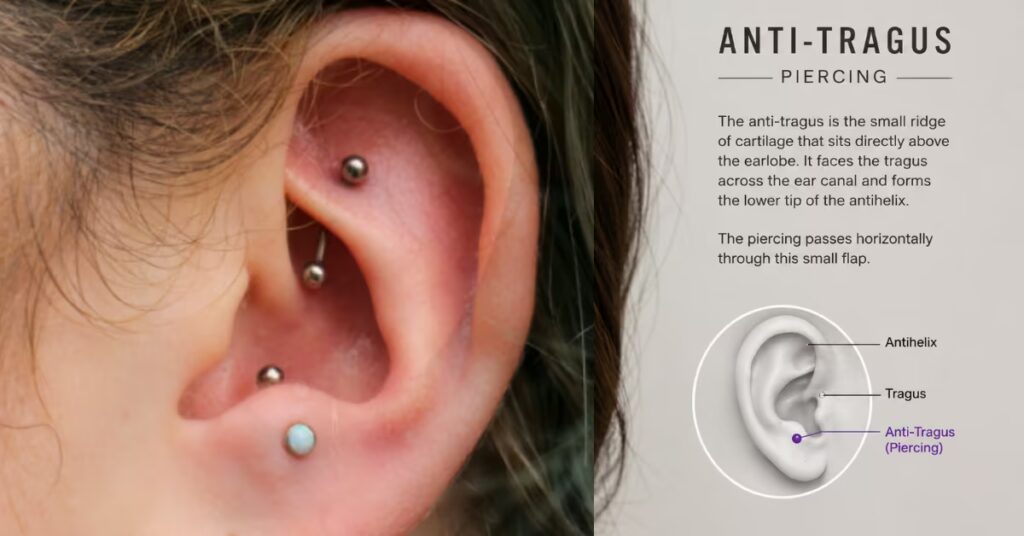
The name comes from Greek anatomical terminology, where “anti” means “opposite.” The anti-tragus piercing sits opposite the tragus across the intertragic notch. It became a recognized piercing in the modern Western body modification scene during the 1990s, alongside the rise of other cartilage placements like the rook and daith.
Cartilage thickness and projection here vary widely between people. Some ears show a prominent, well-defined ridge; others have only a flat lip of tissue.
Anatomy Decides Whether You Can Get One
Not every ear has an anti-tragus large enough to pierce. The cartilage needs enough depth and projection for the needle to enter and exit cleanly with tissue on both sides. An anti-tragus piercing forced into flat or shallow anatomy will migrate, reject, or sit at an awkward angle.
A reputable piercer will turn you away if your anatomy doesn’t support the piercing. Roughly one in five candidates is declined for this reason. This is the single most important reason to book a consultation rather than walking in.
If your anti-tragus is too small, two alternatives give a similar visual effect. A high lobe piercing at the top edge of the earlobe sits in roughly the same spot. A vertical anti-tragus that goes up through the ridge sometimes works on borderline anatomy.
Anti-Tragus Piercing Pain Level
Cartilage is denser and less vascular than the earlobe, so it hurts more. The anti-tragus piercing sits at the higher end of cartilage pain ratings, often described as 6 to 7 out of 10. The cartilage here is thicker than that of the tragus despite its smaller surface area.
The sharp pain lasts only one or two seconds during the needle pass. Pressure and a throbbing ache follow for several minutes afterward. Sleeping on that side or bumping the area causes a duller soreness for the first few weeks.
A 2008 histologic study in the Journal of Plastic, Reconstructive & Aesthetic Surgery found that all piercing methods cause the same extent of cartilage and perichondrium damage. Needle versus piercing gun makes no difference to tissue trauma. Pain comes down to cartilage density, your tolerance, and the piercer’s speed.
Lidocaine-based numbing creams like EMLA can be applied 30 to 45 minutes before the appointment. Not every piercer allows them, since they can slightly firm the tissue. Ask in advance rather than showing up with cream already applied.
Anti-Tragus Piercing Healing Time
Full healing runs 6 to 12 months. The piercing closes externally within a few weeks, but the deeper channel continues to remodel for nearly a year. Changing jewelry too early collapses the tunnel and restarts inflammation.
Cartilage heals slowly because it has no direct blood supply. Nutrients diffuse into the tissue from the surrounding tissue. Research published by the National Library of Medicine notes that cartilage piercings have a poorer healing profile than the earlobe, which contains no cartilage.
Expect the anti-tragus piercing to look fully healed long before it actually is. Mild crusting, occasional pale discharge, and slight tenderness can continue for several months. None of these signals infection on its own.
Anti-Tragus Piercing Aftercare
Clean the anti-tragus piercing twice a day with sterile saline (0.9% sodium chloride) for the full healing window. Spray it on, let it sit for 30 seconds, then pat dry with a clean paper towel. Cloth towels harbor bacteria and snag jewelry.
Skip alcohol, hydrogen peroxide, tea tree oil, and “piercing solutions” containing benzalkonium chloride. These dry the cartilage, kill healthy tissue, and slow healing. The Association of Professional Piercers recommends saline only.
Sleep on the opposite side for at least three months. A travel pillow with a center cutout lets you rest your ear in an open space. Change pillowcases two to three times a week.
Avoid swimming pools, hot tubs, lakes, and the ocean for at least 8 weeks. Research on pinna perichondritis shows that exposing a fresh cartilage wound to freshwater or hot tubs significantly increases the risk of infection. Pseudomonas aeruginosa, the bacteria most often responsible for serious cartilage infections, thrives in standing water.
The Headphones Problem
The anti-tragus sits exactly where earbuds and over-ear headphone cushions press against the ear. Earbuds push directly on the back of the jewelry. Over-ear pads press the front. Both cause pressure bumps and prolonged healing.
For the first 3 to 6 months, switch to bone-conduction headphones or use a single earbud in the unpierced ear. Deep-cushioned, open-back over-ear models sometimes clear the area, but check before relying on them. Speakerphone works for calls.
Anti-Tragus Piercing Risks
Perichondritis. This is an infection of the cartilage and its surrounding membrane. The classic sign is redness of the pinna that spares the earlobe, often accompanied by intense pain and possible fever. Left untreated, it can lead to abscess formation and cartilage death.
The most commonly responsible bacterium is Pseudomonas aeruginosa. A clinical case report in the NIH library explains that auricular perichondritis usually requires anti-pseudomonal therapy such as a fluoroquinolone. Standard skin-infection antibiotics like cephalexin often fail. This is why cartilage infections require a doctor’s visit, not home treatment.
A 2025 study in The Laryngoscope analyzed 217 cases of perichondritis. Piercing-induced cases accounted for 55.3% of patients and showed significantly higher rates of abscess formation and Pseudomonas colonization than non-piercing cases. Catching an infection within 48 hours prevents cartilage necrosis.
Cauliflower ear. Untreated cartilage infection or repeated trauma can cause permanent deformity. The risk is small with proper aftercare but real with neglected infection.
Keloid and hypertrophic scarring. Cartilage piercings produce raised scars more often than lobe piercings. Ask family members about scarring history before deciding.
Embedding. Swelling can pull the jewelry’s disc or ball into the cartilage. Starter jewelry should be sized with extra length for the first 4 to 6 weeks.
Migration and rejection. Cartilage that is too thin for safe placement may push the jewelry out over weeks or months. Correct anatomy assessment upfront prevents this.
Allergic contact dermatitis. Itching, redness, and weeping around the jewelry rather than at the holes suggest a metal allergy. Nickel is the usual culprit. Implant-grade titanium and high-karat solid gold prevent most reactions.
When to See a Doctor
Mild swelling, pale crust, and tenderness are normal during healing. Get medical attention if you notice:
- Green, thick, or foul-smelling discharge
- Spreading redness past the immediate piercing site
- Heat radiating from the ear
- Fever
- Severe throbbing pain that worsens after the first week
- A growing or fluid-filled lump (possible abscess)
Do not remove the jewelry yourself if you suspect an infection. The hole can close around the bacteria, trapping the infection inside the cartilage. A piercer or doctor should assess first.
Anti-Tragus Piercing Jewelry Sizes, Shapes, and Materials
Gauge: 16G (1.2mm) is standard. Some piercers use 14G (1.6mm) on thicker anatomy.
Length or diameter: 6mm or 8mm starter posts. 6mm or 7mm internal diameter for rings. Initial jewelry is sized long to allow for swelling, then downsized at 8 to 12 weeks.
Shapes that work:
- Curved barbell. Most common choice. Follows the natural curve of the cartilage and reduces pressure on healing tissue.
- Labret stud with flat back. Sits flush against the inner ear. Best for a clean look and a more restful sleep.
- Captive bead ring or seamless hoop. Best after full healing. Constant micro-movement during healing causes irritation.
- Circular barbell (horseshoe). Works on more pronounced anti-tragus anatomy.
Materials to choose:
- Implant-grade titanium (ASTM F136 or F1295)
- Solid 14k, 18k, or higher gold (nickel-free)
- Niobium
- Implant-grade surgical steel (ASTM F138) — contains trace nickel; avoid if sensitive
Materials to avoid as starter jewelry: Sterling silver tarnishes and oxidizes in healing tissue. Gold-plated and gold-filled pieces wear through, exposing the base metal. Externally threaded jewelry drags threads through the fresh wound during insertion. Always request internally threaded or threadless pieces.
Anti-Tragus Piercing Cost
US: $30 to $100, depending on the studio and starter jewelry included. UK: £30 to £50. Australia: AUD$60 to $120.
Studios at the low end usually charge separately for jewelry. A reputable piercer using implant-grade titanium often charges more upfront but provides jewelry that won’t need replacing in six weeks. Cheap jewelry is the most common cause of healing complications.
When to Change the Jewelry
Wait at least 3 months, preferably 6, before the first change. Have the piercer do it — not yourself. The channel is fragile, and a missed re-insertion can tear the tissue and restart healing from zero.
Switching to a hoop or seamless ring should wait until the piercing is fully settled, typically 6 to 9 months in. Hoops move more than studs and need a stable channel underneath.
Styling
The anti-tragus piercing pairs well with stacked lobes, a tragus, a conch, or a daith for a curated ear look. Symmetry isn’t required. Many people pierce only one anti-tragus and balance the look by placing it differently on the other side.
Tiny solitaire studs, threaded crystal ends, small huggies, and beaded curved barbells are the most popular jewelry choices once healed. The small canvas suits dainty pieces. Oversized jewelry can pull on the cartilage and cause sagging or migration over time.
Anti-Tragus Piercing FAQs
Can anyone get an anti-tragus piercing?
No. The cartilage ridge must be prominent enough to safely hold jewelry. Roughly one in five people are turned away because the anatomy is too flat or small.
Does it hurt more than a tragus piercing?
For most people, yes. The cartilage is thicker and the area smaller, so the needle encounters more resistance.
How long until I can sleep on it?
Three to six months for short periods. Some people need closer to a year before sleeping on that side is fully comfortable.
Can I wear earbuds during healing?
Not for at least 3 months. Earbuds press directly against the jewelry, causing irritation, bumps, migration, and prolonged healing.
What’s the difference between an anti-tragus and a snug piercing?
The snug sits on the antihelix ridge, which runs up the outer ear. The anti-tragus is the small cartilage flap right above the earlobe. They look similar in photos but pierce different anatomy.
Can I get a double anti-tragus piercing?
Only if the cartilage is large enough to support two piercings with safe spacing between them. This is rare.
Will it close up if I take the jewelry out?
Yes, often within hours during the first year. Even fully healed cartilage piercings can shrink within weeks of leaving jewelry out.
Is it safe to pierce at home?
No. Cartilage piercing requires sterile technique, accurate anatomical assessment, and the correct angle to avoid splitting the cartilage. Home piercing is the leading cause of perichondritis.
Can the piercing trigger an allergic reaction?
Yes, mainly to nickel in low-grade steel or plated jewelry. Implant-grade titanium and solid high-karat gold prevent most reactions.
Does an anti-tragus piercing have acupressure benefits?
Anecdotal claims connect it to migraine, anxiety, or motion sickness relief. No peer-reviewed studies support these claims for the anti-tragus specifically.
What if my anti-tragus is too small?
A high lobe piercing or a vertical anti-tragus may give a similar look. A consultation with a reputable piercer determines what’s possible for your anatomy.
Can I take anti-tragus out if I no longer want it?
Yes, at any point. Removing it after full healing usually leaves a small pinhole scar that fades over time.