Hip Piercing Quick Facts
| Info | Details |
|---|---|
| Piercing Types | Surface, Dermal (anchor), Microdermal |
| Pain Level | 5–8/10 (varies by type and anatomy) |
| Healing Time | 6–12 months (surface); 3–6 months (dermal) |
| Jewelry Types | Surface barbell, curved barbell, dermal anchor |
| Best Materials | Implant-grade titanium (ASTM F136), niobium |
| Cost | $50–$100+ (jewelry not always included) |
| Rejection Risk | High (one of the most rejection-prone piercings) |
| Placement | On or just above the hip bone, one or both sides |
What Is a Hip Piercing?
A hip piercing is a surface or dermal piercing placed on the skin over or just beside the hip bone. It does not pass through the bone — the jewelry sits within the layers of skin in the pelvic area.
Hip piercings are typically done as a pair, one on each side, though a single placement is equally common. They sit along the natural line of the hip and are most visible with low-rise clothing, swimwear, and crop tops.
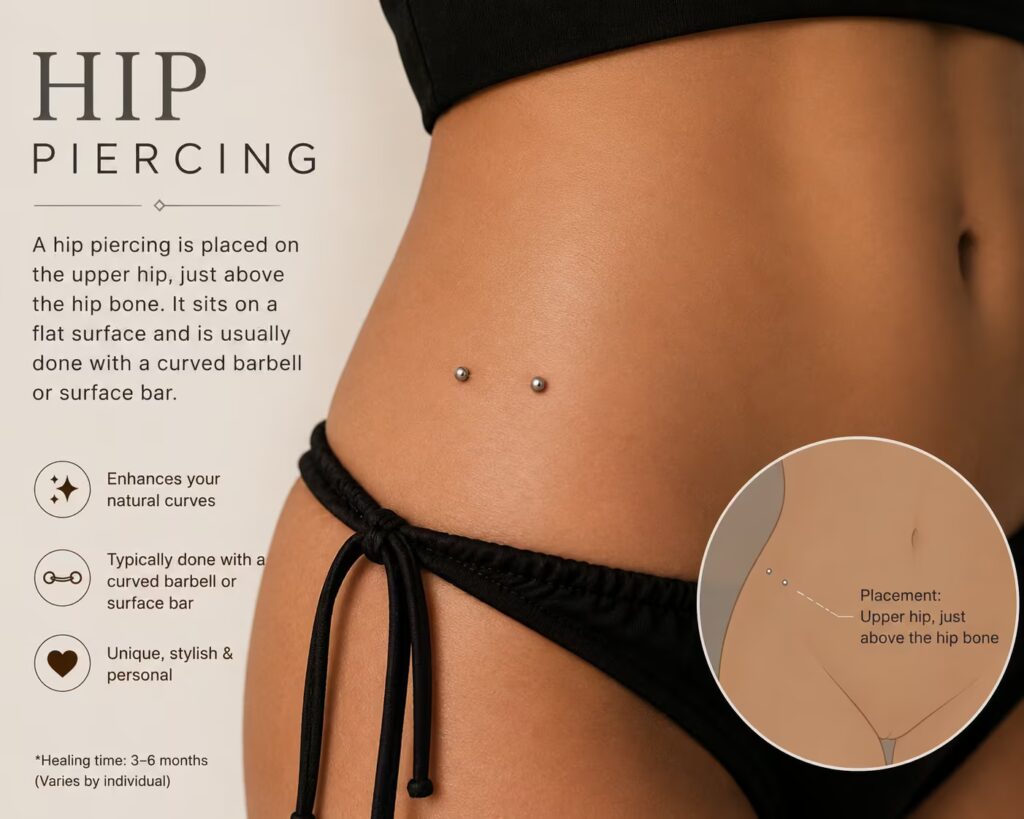
Unlike standard piercings that pass through a fold of tissue, hip piercings are placed on flat skin. This is what makes them both visually distinctive and more technically demanding to heal in the long term.
Types of Hip Piercings
There are three distinct types of hip piercings, and they differ significantly in placement, technique, and longevity.
Surface Hip Piercing
A surface barbell enters and exits through the skin on a flat plane. Both decorative ends are visible on top, with a staple-shaped bar running underneath.
The piercer creates a shallow tunnel beneath the skin surface using a needle or scalpel. The scalpel method produces a more precise tissue pocket, which lowers the rejection rate compared to the needle-only approach.
Surface hip piercings carry a higher long-term risk of rejection than dermal types. The constant movement and friction at the hip make them particularly vulnerable.
Dermal Hip Piercing
A dermal piercing — also called a single-point or anchor piercing — uses a flat-base anchor inserted beneath the skin. Only one decorative top is visible on the surface.
The piercer creates a small pocket using either a needle (in an L-shaped puncture) or a dermal punch. The punch removes a tiny cylinder of tissue to seat the anchor, which tends to be more stable.
Dermal anchors sit flush against the skin and have a slightly lower rejection rate than surface bars. They are also harder to snag on clothing.
Microdermal Hip Piercing
Microdermals use a small anchor base with perforations, allowing tissue to grow through and hold the jewelry in place. A single decorative top screws onto the base.
Unlike dermal anchors, microdermal tops can be changed once the piercing is healed — typically after two to three months. Removal, when needed, usually does not require cutting.
Hip Piercing Pain Level
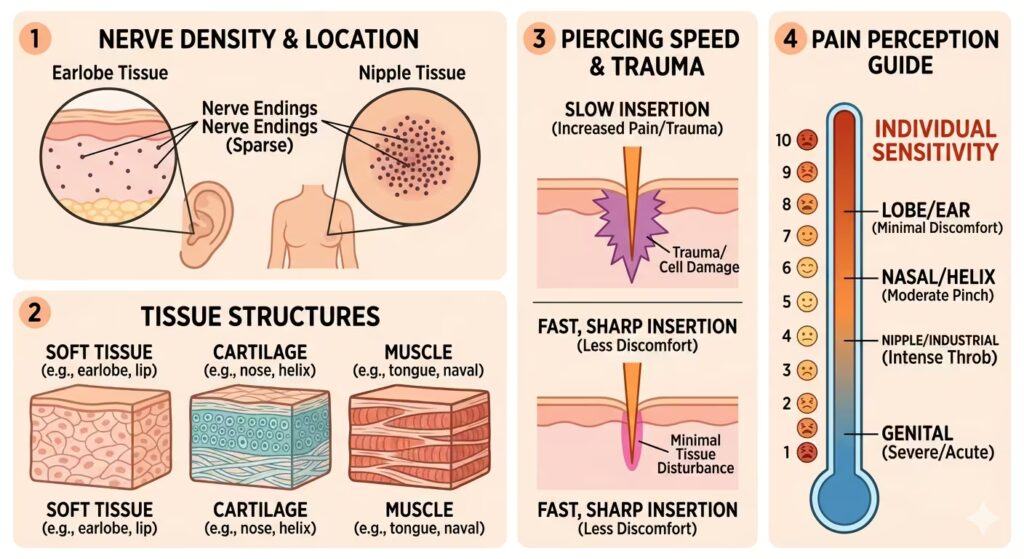
Hip piercings generally rate between 5 and 8 on a 10-point pain scale. Dermal placements tend to hurt less than surface piercings because less tissue manipulation is involved.
Individuals with very little body fat over the hip bone often report sharper pain, as there is less cushioning between the needle and bone. Bony anatomy also increases the risk of complications.
The sensation is typically a sharp pinch followed by pressure. The dermal punch method is often described as quicker and less uncomfortable than a needle.
Anatomy and Who Can Get This Piercing
Not everyone is a good candidate, and a professional piercer should assess your anatomy before proceeding.
Too little tissue: Very bony hips lack the skin depth required for a stable piercing. Placement that is too shallow inevitably leads to rejection or migration.
Weight fluctuations: Significant weight changes stretch the skin around the piercing. This puts pressure on the jewelry and substantially increases the risk of rejection.
Previous rejection history: If you have lost multiple surface piercings from different piercers, hip surface piercings carry a high likelihood of the same outcome.
If your anatomy does not support a surface piercing, a dermal or microdermal placement may still be viable. Your piercer can advise based on the actual tissue available.
Hip Piercing Jewelry
Types
Surface barbells are the standard for surface hip piercings. They are shaped like a staple, with two 90-degree bends that allow the bar to sit parallel to the skin. The flat footplate design minimizes pressure on surrounding tissue.
Curved barbells are used when the natural contour of the hip suits a gentle arc rather than a flat bar.
Dermal anchors and microdermal bases are single-point options. The anchor holds beneath the skin, and the top screws or presses in place.
Materials
Implant-grade titanium meeting the ASTM F136 standard is the recommended material for all hip piercings, especially during initial healing. It is completely nickel-free, lightweight, and biocompatible — the same specification used in surgical implants and bone screws.
Surgical steel (316L, ASTM F138) contains 10–14% nickel. It is acceptable for healed piercings but should not be used for fresh ones, particularly in people with sensitive skin or known nickel sensitivity. Approximately 10–20% of the population has a nickel allergy.
Niobium is another safe, nickel-free alternative and is available in anodized colors.
Avoid acrylic, plated metals, and unknown alloys. These degrade over time inside the body and significantly raise the risk of infection and rejection.
Some piercers use Tygon (PTFE), a medical-grade flexible plastic. Its flexibility reduces stress on the piercing channel, potentially extending longevity in high-movement placements like the hip.
Jewelry Size
The gauge and bar length matter as much as the material. Jewelry that is too short creates pressure; jewelry that is too long catches on clothing and bedding. Your piercer should fit the jewelry to your specific anatomy at the time of piercing.
Hip Piercing Healing Time
| Type | Initial Healing | Full Healing |
|---|---|---|
| Surface hip piercing | 3 months | 6–12 months |
| Dermal hip piercing | 6–8 weeks | 3–6 months |
| Microdermal | 6–8 weeks | 2–3 months |
A piercing can feel healed on the surface while still being fragile internally. Tissue heals from the outside in. Stopping aftercare prematurely is one of the most common reasons for healing complications.
Hip Piercing Aftercare
The Association of Professional Piercers (APP) recommends sterile saline wound wash (0.9% sodium chloride, no additives) as the primary cleaning agent for healing piercings.
Twice daily: Spray sterile saline directly onto the piercing. Let it sit briefly, then gently pat dry with disposable gauze or a clean paper towel.
Never use: hydrogen peroxide, rubbing alcohol, iodine, tea tree oil, or antibacterial soap. These over-dry the tissue and slow healing.
Do not rotate the jewelry. Rotating was once a common recommendation; it is now understood to irritate the healing fistula rather than help it.
Because of the hip’s location, saline soaks can be awkward. Soaking a clean paper towel in saline and pressing it against the piercing for 3–5 minutes is an effective alternative to submersion.
Clothing matters. Waistbands, tight jeans, and underwear waistlines sit directly on the hip piercing during healing. Loose, low-rise clothing or high-waisted options that clear the jewelry entirely are necessary for the first several months. A breathable bandage over the jewelry while sleeping or changing clothes reduces snagging.
Avoid submerging the piercing in pools, oceans, hot tubs, or baths until fully healed. These environments introduce bacteria to a healing wound.
Hip Piercing Rejection and Migration
Hip piercings are among the body modifications most prone to rejection. The hips are a high-movement, high-contact area, and the body naturally attempts to push foreign objects toward the skin surface.
Rejection occurs when the immune system identifies the jewelry as a threat and begins moving it outward through the skin. Migration is the process by which the jewelry shifts position, which may or may not lead to full rejection.
Early warning signs:
- The jewelry has visibly moved from its original placement
- The skin between the entry and exit holes looks thinner or shinier
- You can see the bar or anchor more clearly through the skin than before
- Persistent redness, itching, or tenderness that does not improve
If any signs of rejection appear, remove the jewelry promptly. Leaving a rejected piercing in place allows it to tear through the skin entirely, causing a more significant scar.
What increases rejection risk at the hip:
- Shallow placement
- Low-quality jewelry or incorrect gauge
- Waistbands, seatbelts, and clothing apply constant friction
- Sleeping directly on the piercing
- Weight fluctuations that change the skin’s tension
- Immune suppression or high physical/emotional stress
Dermal anchors and microdermals tend to have better longevity than surface bars at this location, but neither type is immune to rejection.
Hip Piercing Risks
- Infection: Bacteria can enter the wound if aftercare is inadequate or equipment was not properly sterilized. Signs of infection include yellow or green discharge, significant warmth, worsening rather than improving swelling, and fever. The Mayo Clinic advises seeking medical attention if redness, swelling, and bleeding extend beyond a few days post-piercing.
- Embedding: If a surface piercing is placed too deeply or the jewelry shifts inward, the skin layers can grow over the jewelry. This requires professional removal.
- Nerve and tissue damage: Improper depth can damage blood vessels or nerves in the dermis. This risk is substantially higher when the procedure is performed by an untrained piercer.
- Scarring: All hip piercings carry a risk of leaving two small marks. Surface piercings that are rejected through the skin rather than removed early tend to leave a more pronounced scar. Dermals typically leave a smaller mark after removal.
- Keloid formation: Individuals prone to keloids should discuss this with a dermatologist before getting any surface or dermal piercing.
How Long Do Hip Piercings Last?
Surface hip piercings are often considered semi-permanent. Even with excellent aftercare and ideal anatomy, many surface hip piercings eventually reject — some after a few months, others after several years.
Dermal and microdermal placements tend to last longer, with some people keeping them for five to ten years or more. Lifestyle, clothing habits, and jewelry quality all influence longevity.
Hip Piercing FAQs
Does a hip piercing go through the bone?
No. Hip piercings pass through the skin over or beside the hip bone, not through the bone itself.
Can I get a hip piercing if I have more body fat in that area?
It depends on the specific anatomy. Some amount of soft tissue is actually helpful, as it provides depth for the jewelry. Very pronounced fatty tissue that shifts significantly with movement can make healing difficult and increase the risk of rejection. A piercer needs to assess your individual anatomy in person.
Can I get re-pierced after rejection?
In most cases, yes — but only after the area has fully healed and any scar tissue has settled. This typically means waiting at least one year. The new piercing is usually placed slightly behind or away from scar tissue. Scar tissue is less pliable than normal skin and does not support jewelry as reliably.
Will hip piercings leave a scar?
All hip piercings carry some risk of scarring. Surface piercings that reject completely leave a more visible line scar. Dermals and microdermals, when removed by a professional early, typically leave minimal marks.
Can I get a hip piercing on both sides at once?
Yes. Paired hip piercings are common. The healing demands are simply doubled — both sides require consistent aftercare, and both are vulnerable to the same friction and clothing issues.
What should I wear after getting a hip piercing?
Loose-fitting clothing that does not press against the piercing is essential. High-waisted bottoms that fully clear the jewelry, or very low-rise pieces that sit below it, work best. Avoid tight waistbands, athletic wear with elastic at the hip, and anything that rubs during movement.
Can I exercise with a hip piercing?
Light activity is generally fine once initial swelling subsides, usually after one to two weeks. Direct pressure, contact sports, and exercises involving core rotation that create friction at the hip should be avoided until healing is complete. After exercise, rinse the area with saline and pat dry.
Can hip piercings be removed and re-inserted?
Jewelry changes during healing should be done by a professional piercer using appropriate tools. Attempting to change a surface barbell or dermal anchor yourself during healing risks tearing the fistula and triggering rejection. Once fully healed, a piercer can safely swap the jewelry.