Tongue Web Piercing Quick Facts
| Also Known As | Lingual frenulum piercing, tongue frenulum piercing, Marley |
|---|---|
| Placement | The frenulum linguae — thin tissue connecting the underside of the tongue to the floor of the mouth |
| Pain Level | Low — approximately 3/10 |
| Healing Time | 4–8 weeks |
| Best Jewelry | Curved barbell (16g or 14g) |
| Average Cost | $30–$60 |
| Rejection Risk | High — behaves like a surface piercing |
| Anatomy Dependent | Yes — not everyone qualifies |
What Is a Tongue Web Piercing?
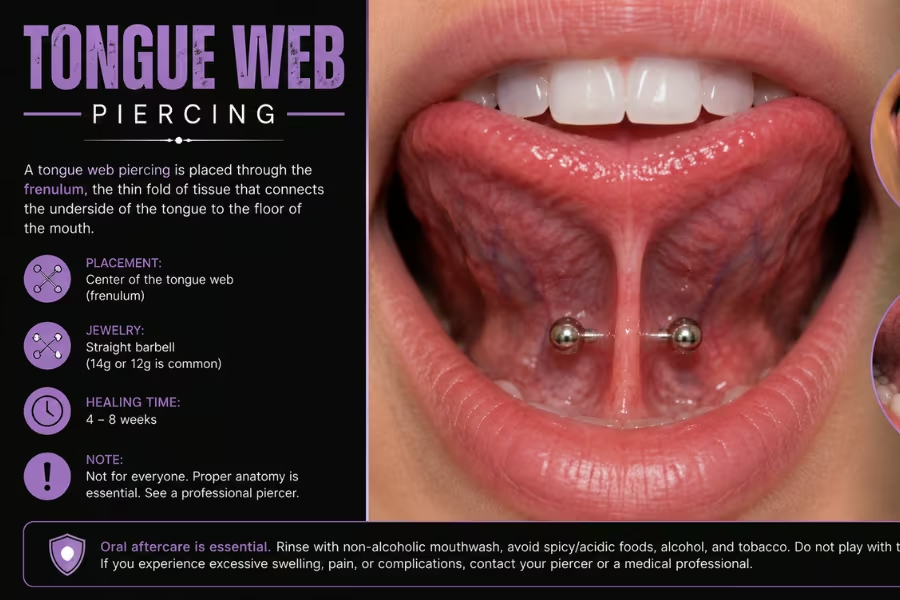
A tongue web piercing passes through the frenulum linguae — the thin membrane that runs from the floor of the mouth to the midline of the tongue’s underside. It stays completely hidden unless you deliberately lift your tongue to show it.
Unlike a standard tongue piercing, which goes through the tongue muscle, this one only penetrates a thin fold of connective tissue with minimal nerve supply and very few blood vessels.
Not Everyone Can Get Tongue Web Piercing
The frenulum linguae varies significantly between individuals. A very thin, short, or tight frenulum may not hold jewelry safely. Piercers assess tissue thickness before agreeing to proceed — if the web is too narrow, the needle can tear it rather than pass cleanly through.
People with ankyloglossia (tongue-tie) also face limitations. A proper anatomy assessment evaluates frenulum length, elasticity, and tissue depth. A reputable piercer will decline the procedure rather than risk a tear or immediate rejection. Multiple refusals from different piercers is a strong signal that the anatomy is unsuitable.
Tongue Web Piercing Pain Level
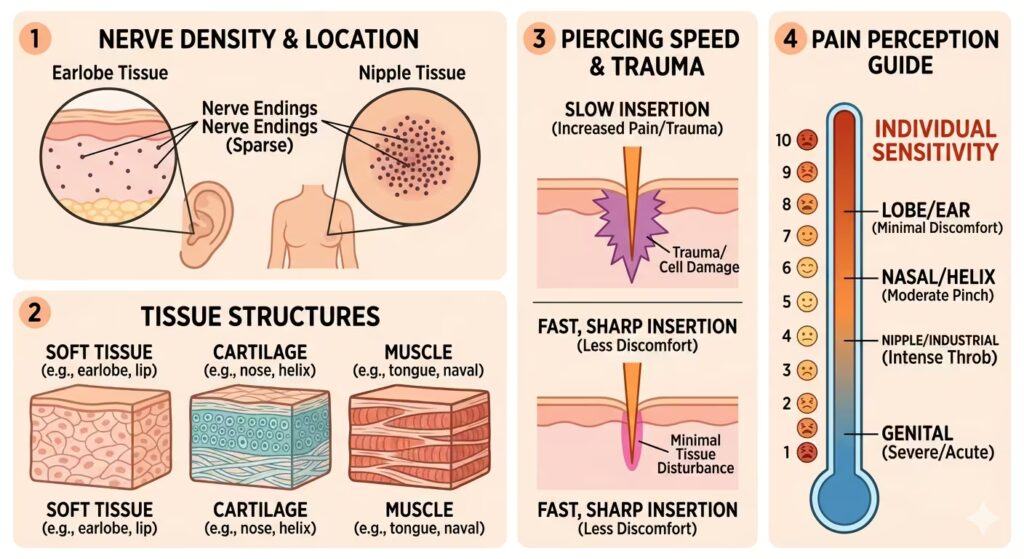
The tongue web registers around 3/10 on the pain scale. The frenulum has a low concentration of nerve endings, which keeps the sensation mild compared to cartilage or dermal placements. Most people describe it as a dull pressure rather than a sharp sting.
The clamp used to stabilize the tissue is often reported as more uncomfortable than the needle itself. Swelling sets in within 24–48 hours and is the more noticeable source of discomfort during the initial days.
Tongue Web Piercing Healing Time
Tongue web piercings typically heal within 4–8 weeks. According to the journal of Registered Dental Hygienists, healing time for the lingual frenulum piercing is approximately four weeks under proper conditions. Oral tissue heals faster than skin due to higher vascularity and enzyme-rich saliva.
Initial jewelry is fitted longer to accommodate swelling. Once swelling subsides — usually within 2–3 weeks — the piercer downsizes to a shorter barbell. Wearing oversized jewelry longer than necessary increases friction and slows healing.
A whitish discharge during the first few weeks is normal lymph fluid, not infection, and is part of routine healing.
Tongue Web Piercing Jewelry Options
A curved barbell is the standard choice for initial healing. It follows the natural contour of the frenulum, reduces movement, and is easier to keep clean than a ring during the healing phase. Captive bead rings are viable post-healing but tend to contact the teeth and gums more frequently.
Starting gauge is typically 16g, though 14g is used when the tissue is substantial enough. Heavier gauge jewelry migrates more slowly, so choosing the largest gauge the anatomy supports reduces long-term rejection risk.
Implant-grade titanium (ASTM F136) or implant-grade steel (316LVM) are the appropriate starting materials. Both are autoclave-sterilizable and biocompatible. Acrylic, low-grade steel, and unspecified alloys are unsuitable for healing oral piercings.
Tongue Web Piercing Risks
Migration and Rejection
The tongue web piercing behaves like a surface piercing. The lingual frenulum is easily rejected by the body — a known risk documented in dental hygiene literature. Constant mechanical stress from tongue movement during speaking and eating accelerates migration outward over time.
Placing the piercing as far back on the frenulum as anatomy allows reduces migration risk. Playing with the jewelry — a strong temptation given its location — is the primary behavioral factor that speeds up rejection.
Gum Recession and Enamel Wear
A 2025 narrative literature review published in Clinics and Practice (MDPI), covering peer-reviewed studies from 1990 to 2025, documented gingival recession, enamel wear, and dental fractures as consistent complications of oral piercings. The jewelry’s proximity to the lower front teeth means even minor habitual contact causes cumulative enamel damage.
Switching to a shorter barbell after healing significantly reduces this risk. Wearing the initial long starter bar indefinitely is one of the primary contributors to long-term dental damage.
Sublingual Gland Risk
The sublingual salivary glands sit directly beneath the lingual frenulum, producing approximately 5% of total saliva. An inexperienced piercer can damage these glands during the procedure. Only a qualified professional with specific experience in this piercing should perform it — not a general studio unfamiliar with sublingual anatomy.
Frenulum Tearing
If pierced too close to the edge of the frenulum, or if the jewelry migrates significantly outward, the tissue can tear through permanently. This is a primary reason experienced piercers refuse unsuitable anatomy rather than attempting the procedure anyway.
Infection
The oral environment carries a high bacterial load. Food debris accumulates around jewelry after every meal. Bacteria trapped around oral jewelry can lead to localized abscesses. Signs of infection — increasing swelling, heat, green or yellow discharge, and fever — require prompt professional evaluation rather than self-treatment.
Tongue Web Piercing Aftercare
- Rinse with sterile saline solution (1/4 tsp non-iodized sea salt dissolved in 8 oz distilled water) twice daily.
- Rinse with an alcohol-free, pH-balanced mouthwash after every meal and drink.
- Avoid alcohol-based mouthwashes — they irritate healing oral tissue and disrupt the oral microbiome.
- Eat soft, non-spicy foods for the first two weeks.
- Avoid smoking, alcohol, and oral contact (kissing, oral sex) until fully healed.
- Always wash hands before touching the piercing.
- Do not play with or twist the jewelry — this is the most common reason tongue web piercings fail or migrate.
- Return to your piercer at 2–3 weeks for a downsize to shorter, appropriately fitted jewelry.
Excess mouthwash use can cause white discoloration around the piercing site. If this appears, reduce rinsing frequency — over-rinsing is as problematic as under-rinsing.
Tongue Web Piercing Signs of Rejection
Rejection happens gradually. Early signs include the jewelry visibly moving toward the tissue’s edge, the skin around the entry and exit points thinning, persistent redness, and increased sensitivity. If the jewelry appears closer to the edge of the frenulum than it was at placement, migration is underway.
Removing jewelry at the first signs of rejection prevents a full tear. A scar left by early removal is far less significant than one caused by the jewelry tearing completely through the frenulum.
Effect on Speech
The tongue web piercing has minimal impact on speech compared to a standard tongue piercing. Oversized starter jewelry can temporarily cause a slight lisp or altered articulation during the swelling phase. This resolves once the piercing heals and is downsized to properly fitted jewelry.
A standard tongue piercing disrupts the tongue muscle directly and carries a higher speech impact. The web piercing avoids the tongue muscle entirely, which is why speech disruption is significantly lower and typically temporary.
Visibility and Concealment
The tongue web piercing is invisible in normal interaction. The jewelry only becomes visible when the tongue is deliberately lifted and turned outward. It is one of the most concealable oral piercings available — more so than the smiley, frowny, or standard tongue piercing.
A curved barbell keeps the piercing hidden even in close proximity. A captive ring may become partially visible during animated speech or laughter depending on its diameter and position.
Tongue Web Piercing FAQs
Does a tongue web piercing hurt?
Pain is generally rated around 3/10. The frenulum has few nerve endings, so the needle passes through with minimal sensation. The clamp used to stabilize the tissue is often described as more uncomfortable than the needle itself.
How long does a tongue web piercing take to heal?
Most heal within 4–8 weeks. Oral tissue regenerates faster than skin, but healing depends heavily on aftercare and how often the jewelry is disturbed by tongue movement or touching.
Can everyone get a tongue web piercing?
No. A very thin, short, or overly tight frenulum may not have sufficient tissue for a safe piercing. A piercer will assess the anatomy beforehand and may decline the procedure if the tearing or rejection risk is too high.
Why do tongue web piercings reject so easily?
The frenulum is thin connective tissue with no deep muscle anchor beneath it. Like all surface piercings, the body continuously attempts to push foreign objects out. Constant tongue movement during eating and speaking accelerates this process.
What jewelry is used for a tongue web piercing?
A curved barbell in 16g or 14g is standard for initial piercing. Implant-grade titanium or 316LVM steel are the appropriate materials. Captive bead rings are an option after full healing.
Can a tongue web piercing damage your teeth?
Yes, with prolonged wear and habitual jewelry-to-tooth contact. Enamel wear and chipping are documented outcomes of oral jewelry rubbing against lower front teeth over time. Downsizing to shorter jewelry after healing significantly reduces this risk.
How do you clean a tongue web piercing?
Rinse twice daily with sterile saline solution and after every meal with an alcohol-free mouthwash. Avoid alcohol-based rinses. Always wash hands before touching the jewelry.
How fast does a tongue web piercing close after removal?
Oral piercings close quickly without jewelry in place — often within days to weeks, even after full healing. Unlike some long-healed piercings, the tongue web fistula does not tend to remain permanently open.
Can you get a tongue web piercing if you have tongue-tie?
Ankyloglossia complicates this piercing significantly. The frenulum may be positioned or structured in a way that makes safe placement impossible. A frenuloplasty (surgical frenulum release) performed by a dentist or ENT can sometimes create viable anatomy, but both a clinician and an experienced piercer should assess this independently before proceeding.