Austin Bar Piercing Quick Facts
| Placement | Horizontally through the tip of the nose (nasal cap) |
| Piercing Type | Surface piercing |
| Needle Gauge | 14G (1.6mm) or 16G (1.2mm) |
| Jewelry | Straight barbell |
| Pain Level | 6–7 out of 10 |
| Healing Time | 2–3 months |
| Cost | $25–$100 (jewelry sold separately) |
| Risks | Migration, rejection, infection, snagging |
| Not Suitable For | First-time piercees, keloid-prone skin |
What Is an Austin Bar Piercing?
The Austin bar piercing is a horizontal piercing that passes through the fleshy tip of the nose, the nasal cap. It does not enter the nostrils, touch the septum, or pass through cartilage. The result is a small barbell with two visible beads sitting on either side of the nose tip.

Because it only passes through soft tissue, it is technically classified as a surface piercing. Surface piercings carry a higher baseline risk of migration and rejection than piercings anchored by cartilage or bone.
The piercing is named after the first known person to have it done. London-based piercer Patrick Bartholomew performed it, and the name stuck.
Austin Bar vs. Nasallang vs. Mantis: How They Differ
These three piercings are frequently confused because they all result in visible dots near the tip of the nose.
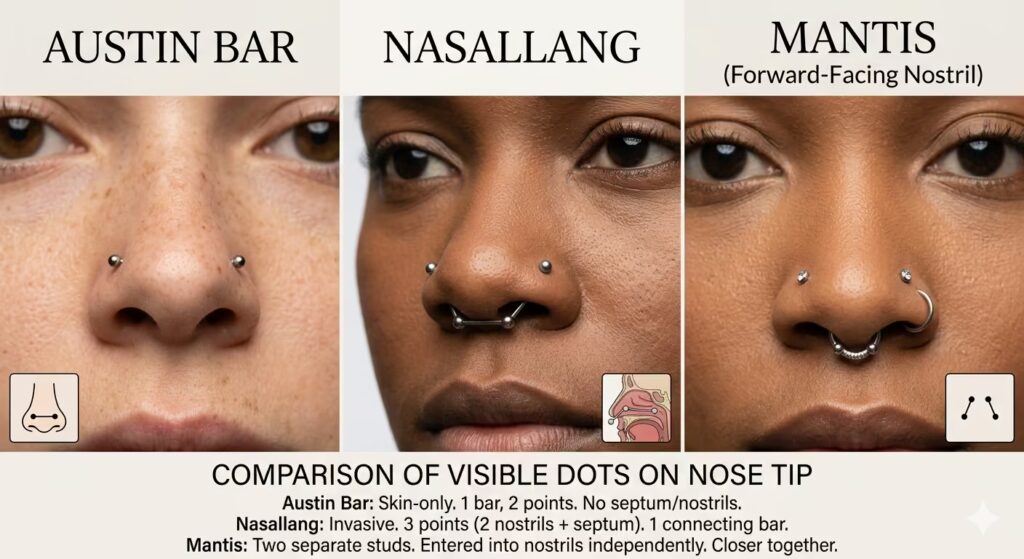
Austin bar passes through the soft tip of the nose only. One barbell, two entry/exit points — no septum involvement, no nostrils.
Nasallang is far more invasive. It goes through both nostrils and the septum in a single pass, requiring three punctures connected by one piece of jewelry. Pain and healing time are significantly higher.
Mantis piercing (also called forward-facing nostril piercing) uses two separate studs. Each one goes into a nostril independently, placing them slightly lower and closer together than an Austin bar. There is no single connecting bar.
From a distance, the Austin bar and mantis piercing can look nearly identical. The differences are in placement (Austin sits higher on the nose tip), anatomy (Austin bar doesn’t enter the nostrils), and jewelry (one barbell vs. two studs).
Austin Bar Piercing Pain Level
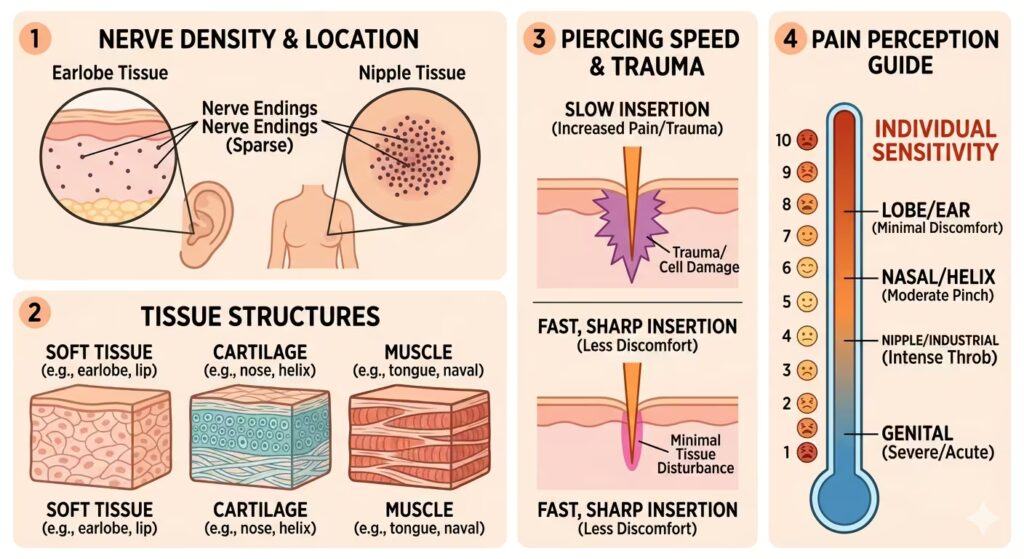
The Austin bar sits in the 6–7 range on a 1–10 pain scale. The nose tip is dense with nerve endings, and the piercing passes through a thicker section of tissue than a standard nostril piercing.
Pain is sharp and immediate during the needle pass, then settles into a dull ache during the first few days of healing. Individual pain tolerance varies considerably.
The Austin bar piercing is not recommended as a first piercing. Building experience with less complex piercings first is advisable.
Austin Bar Piercing Gauge and Jewelry Sizing
Most piercers use a 14G (1.6mm) or 16G (1.2mm) needle for an Austin bar. The wider gauge helps resist migration — thinner jewelry cuts through tissue more easily over time.
Initial jewelry is always a straight barbell, sized longer than the final width to allow for swelling during healing. Once healed (typically after 2–3 months), your piercer can downsize the bar to a shorter length that fits flush.
Some people opt to add a thin chain connecting the two ends across the bridge of the nose. This is a jewelry-on accessory, not a separate piercing.
Curved barbells are occasionally used depending on anatomy, but straight barbells are the standard choice for this placement.
Austin Bar Piercing Jewelry Materials
Choosing the right material matters most during the healing phase. According to the Association of Professional Piercers (APP), only implant-grade materials should be used in fresh piercings.
- Implant-grade titanium (ASTM F136) is the top recommendation. It is biocompatible, lightweight, corrosion-resistant, and hypoallergenic. It can be anodized in multiple colors without coating.
- 14k or 18k solid gold is a safe option. Avoid gold-plated or gold-filled jewelry — coatings can flake and cause irritation.
- Implant-grade surgical steel (316L or 316LVM) is budget-friendly and durable, but contains nickel. If you have a nickel sensitivity, avoid it.
- Niobium is another hypoallergenic option. Like titanium, it is nickel-free and can be anodized.
Avoid acrylic, mystery metals, or anything labeled “surgical steel” without implant-grade certification during healing.
Austin Bar Piercing Aftercare
Proper aftercare is the biggest factor in a successful Austin bar piercing. A 2012 review in the American Journal of Clinical Dermatology (Holbrook et al.) confirmed that complications from body piercings — including infection and rejection — vary significantly with the quality of aftercare and the practitioner’s hygiene.
Do this twice daily: Clean the piercing with a sterile saline solution (0.9% sodium chloride, no additives). Spray directly onto the site or soak with gauze for 30–60 seconds. Pat dry with clean, disposable paper (not a cloth towel — fibers snag).
Avoid these throughout healing:
- Touching the piercing with unwashed hands
- Rotating or twisting the jewelry — this disrupts tissue formation
- Alcohol, hydrogen peroxide, or harsh soaps near the site
- Swimming pools, lakes, or hot tubs
- Makeup, sunscreen, or sprays near the piercing
- Alcohol consumption and smoking — both impair wound healing, as documented in research on factors affecting wound repair (Guo & DiPietro, Journal of Dental Research, 2010)
Blowing your nose is unavoidable, but be as gentle as possible. Colds and allergies are a genuine complication for this placement. Pat, don’t rub the area when drying it.
Austin Bar Piercing Healing Timeline
| Phase | Timeframe | What to Expect |
|---|---|---|
| Initial | Days 1–7 | Swelling, redness, tenderness |
| Early healing | Weeks 2–6 | Discharge (lymph fluid), some crustiness |
| Intermediate | Weeks 6–10 | Sensitivity decreases, tissue consolidating |
| Healed | 2–3 months | Swelling gone, no discharge, jewelry moves freely |
Do not assume an Austin bar piercing is healed because it feels fine. The tissue inside heals more slowly than the surface. Changing jewelry too early is one of the most common causes of setbacks and infection.
Austin Bar Piercing Risks and Complications
Migration and Rejection
Because the Austin bar is a surface piercing, migration and rejection are the most significant long-term risks. The body may treat the jewelry as a foreign object and gradually push it toward the skin surface.
Early signs of migration include the jewelry appearing closer to the skin’s surface, visible thinning of the tissue around the entry/exit points, and a change in placement compared to when it was first done. If you notice these signs, see your piercer promptly. Removal before rejection completes will reduce scarring.
Per a review published in American Family Physician (Meltzer, 2005), foreign-body rejection is a recognized complication of body piercing. Surface placements are the most susceptible.
Infection
Localized cellulitis is the most common infectious complication from body piercings, according to StatPearls (Preslar & Borger, NCBI Bookshelf, updated 2023). Signs include increasing redness, warmth, swelling, pain, and purulent discharge (yellow or green, distinct from the clear-to-white lymph fluid normal during healing).
If you suspect infection, do not remove the jewelry — this can trap bacteria inside. See a doctor. A piercer can advise on whether the healing process has gone wrong, but only a medical professional can prescribe antibiotics.
Snagging
The barbell ends protrude from the nose tip, making snagging on towels, clothing, and bedding a real hazard. A snag on a fresh piercing is painful and can cause tearing or delayed healing. Tuck towel edges away from your face when drying, and be deliberate when pulling clothes over your head.
Keloid Risk
People prone to keloid scarring should not get this piercing. The nose tip is a common keloid site, and the risk of excessive scarring — particularly if the piercing is irritated or removed during healing — is significant.
Allergic Reactions
Nickel allergies are the most common cause of jewelry-related contact dermatitis. Redness, itching, and fluid-filled bumps around the jewelry suggest an allergic response. Switching to implant-grade titanium or niobium resolves most cases.
Who Should Avoid the Austin Bar Piercing
- People getting their first piercing
- Anyone prone to keloids
- People with active skin infections or compromised immune function
- Those whose jobs or sports require frequent jewelry removal
- Pregnant individuals (healing and infection risk both increase)
- Anyone currently taking anticoagulants (increased bleeding risk, per AAFP guidelines on body piercing complications)
Austin Bar Piercing Cost
Expect to pay $25–$100 for the piercing service itself, depending on the studio’s location and the piercer’s experience level. Jewelry is typically priced separately.
A straight barbell in implant-grade titanium adds roughly $20–$50. High-quality gold options run higher. Choosing the cheapest jewelry to save money during healing is a false economy — poor-quality metal is the most preventable source of complications.
Austin Bar Piercing Frequently Asked Questions
Does an Austin bar piercing go through cartilage?
No. It passes through the soft tissue of the nose tip only, not through cartilage or the septum.
How long does an Austin bar piercing take to heal?
2–3 months with consistent aftercare. Some people heal closer to the shorter end; others take the full three months or slightly beyond.
Can I change my Austin bar jewelry during healing?
No. Changing jewelry before the piercing is fully healed disrupts tissue formation and significantly increases the risk of infection. Wait for the full healing period and have your piercer confirm before swapping.
Will I be able to see the bar when looking in the mirror?
The two bead ends are visible on either side of the nose tip. The bar itself sits inside the tissue and is not visible.
Is the Austin bar a permanent piercing?
No piercing is technically permanent. If you remove the jewelry after full healing, the holes will eventually close. If removed during healing, they will close quickly. Scarring from migration or rejection may leave marks at the entry/exit points.
How do I know if my Austin bar is rejecting?
The jewelry will appear to sit closer to the skin surface than before. The tissue around the exit/entry points may look thin or see-through. The jewelry may visibly shift position. See your piercer immediately if you notice these signs.
Can I blow my nose with an Austin bar piercing?
Yes, but gently. The nose tip is close to the nostrils, and forceful blowing or wiping can irritate a healing piercing. Use gentle pressure and pat dry afterward.