Every Ear Piercing Pain Placement Ranked, Explained, and Compared
The ear is one of the most pierced parts of the human body, and it offers more distinct placement options than almost anywhere else. From the soft, quick-healing earlobe to the dense, slow-healing inner cartilage folds, every placement has its own character, pain level, healing timeline, and aesthetic personality.
Whether you are planning your very first ear piercing or mapping out an ambitious curated ear, understanding the full landscape of ear piercing options before you book is genuinely useful. This guide covers all the types of ear piercings with honest, consistent information so you can make an informed decision rather than guessing from partial information across multiple articles.
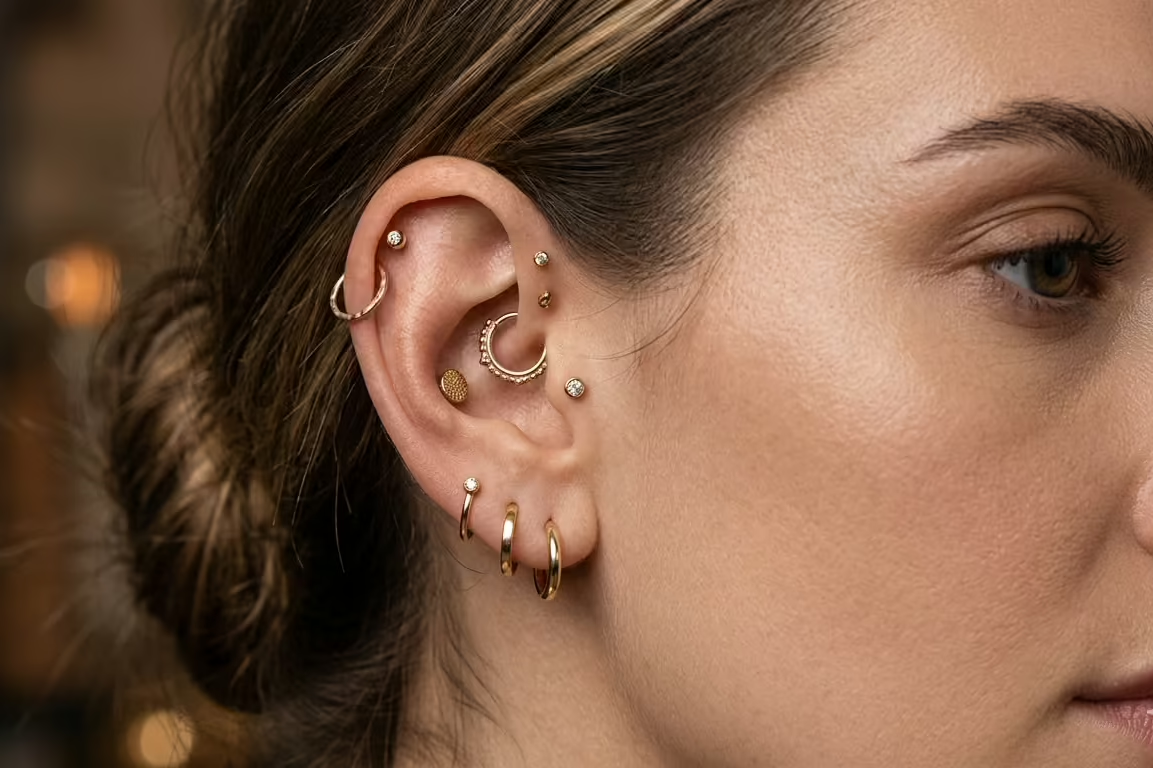
The ear-piercing tradition itself dates back thousands of years across every culture and continent. For the full historical picture from ancient Egypt to modern curated ears, our article on the evolution of ear piercings: from ancient Egypt to modern trends is a fascinating companion to this practical guide.
❝ Ear piercings fall into two fundamental categories: lobe piercings through soft tissue, and cartilage piercings through firm, slow-healing cartilage. This distinction matters more than any other single factor when it comes to pain and healing expectations.
The Complete Ear Piercing Reference Table
Every common ear piercing type in one place, with consistent pain ratings and honest healing timelines.
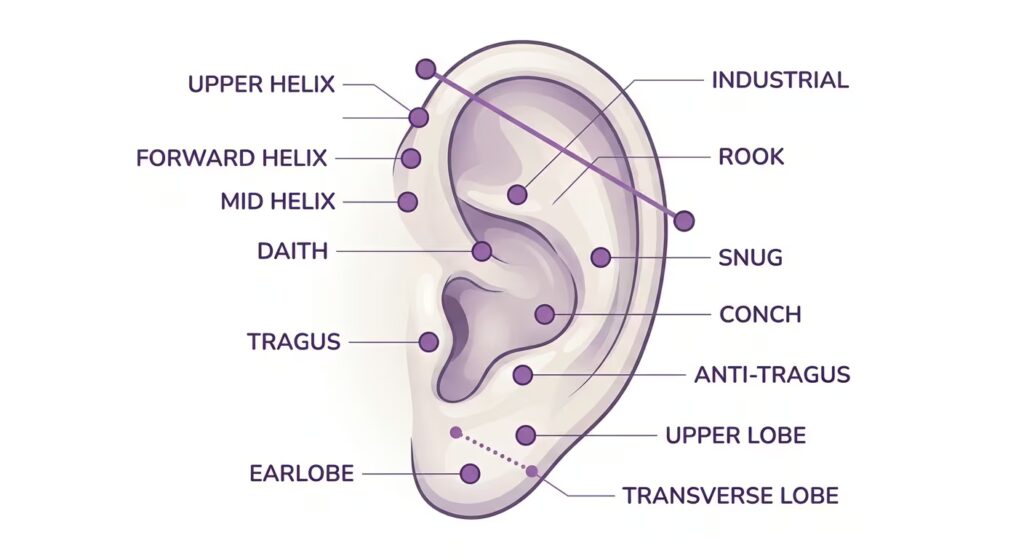
| Piercing | Location | Pain (1-10) | Heal Time | What It Feels Like |
| Earlobe | Soft lobe | 1–2 | 6–8 wks | Quick pinch. Fades almost immediately. The gentlest option. |
| Upper Lobe | Upper soft lobe | 2–3 | 8–10 wks | Slightly sharper pinch. Still very manageable soft tissue. |
| Transverse Lobe | Horizontal through lobe | 3–5 | 8–10 wks | Longer needle pass. Mild to moderate pressure throughout. |
| Helix | Outer upper rim | 4–6 | 6–12 mths | Sharp cartilage pressure. Soreness lingers a few days. |
| Forward Helix | Front rim near face | 5–7 | 9–12 mths | Denser cartilage. Sharper than standard helix. Visible from front. |
| Tragus | Flap over ear canal | 5–7 | 6–12 mths | Dense cartilage. Audible crunch. Deep ache fades over an hour. |
| Anti-Tragus | Ridge above lobe, across from tragus | 6–7 | 6–12 mths | Thick small cartilage bump. Less common and more intense. |
| Conch | Bowl of inner ear | 6–7 | 9–12 mths | Thick flat cartilage. Strong pressure, deep ache lasting days. |
| Orbital | Two holes connected by one ring | 4–6 each | 6–12 mths | Two standard helix-style piercings. Ring connects them visually. |
| Daith | Inner cartilage fold over ear canal | 6–8 | 6–12 mths | Dense inner fold. Deep pinch with significant throbbing after. |
| Rook | Upper inner cartilage fold | 7–8 | 12–18 mths | Very thick cartilage fold. Intense push. Significant ache hours after. |
| Snug | Horizontal inner rim (antihelix) | 7–9 | 12–18 mths | One of the most painful ear piercings. Very thick dense cartilage. |
| Industrial | Two cartilage holes, one bar | 6–8 | 12–18 mths | Two sharp passes. Lingering soreness. Long complex healing. |
Rows 1-3 are cartilage placements. Rows 4-10 are lobe placements. Pain ratings assume an experienced piercer with a sharp single-use needle.
Lobe Piercings
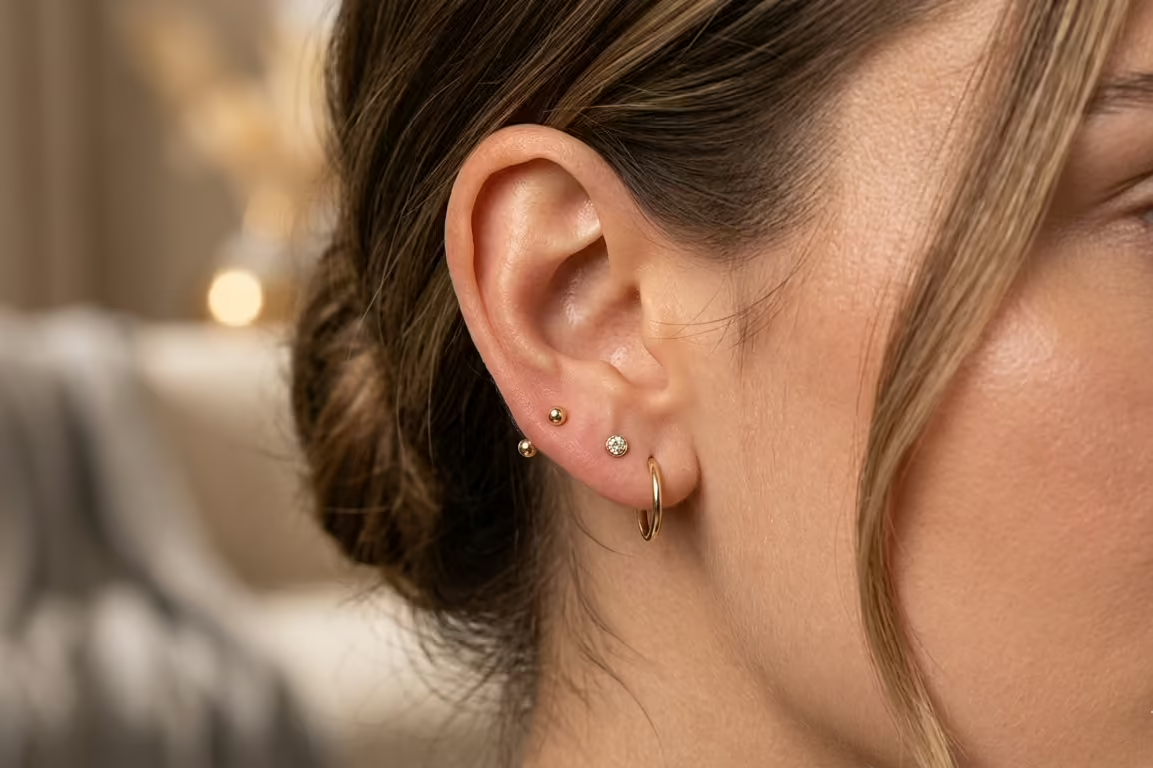
Lobe piercings pass through the soft, fleshy tissue at the bottom of the ear. They have excellent blood supply, heal relatively quickly, and are significantly less painful than cartilage piercings. They are the ideal starting point for any ear piercing journey.
Standard earlobe: 1 to 2 out of 10
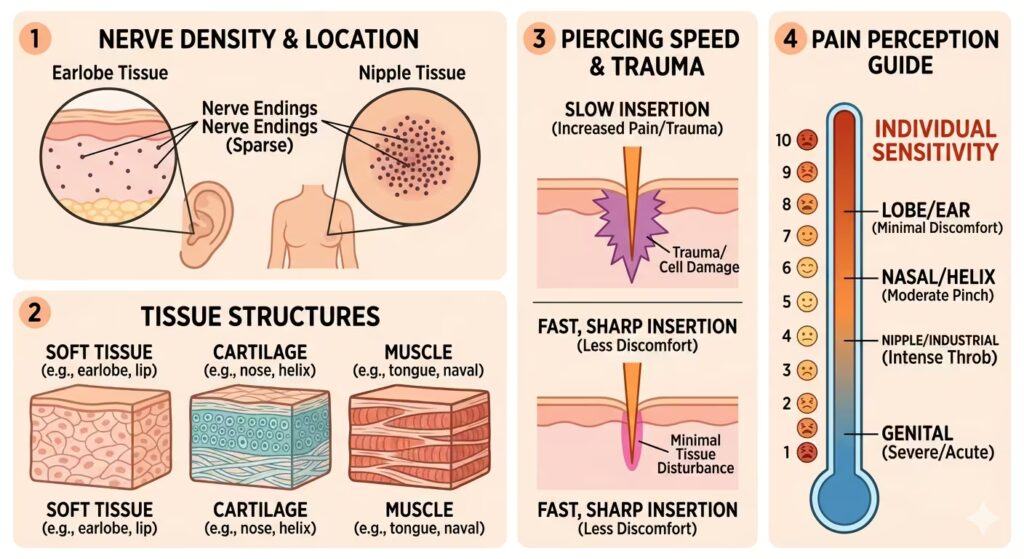
The standard earlobe is the universal starting point for ear piercing worldwide. The soft tissue offers minimal resistance and has fewer concentrated nerve endings than cartilage. The sensation is a quick pinch that most people describe as less painful than anticipated.
Healing takes six to eight weeks, making it the fastest healing of all ear piercings. Multiple lobe piercings are easy to accumulate over time, which is why the lobe is the foundation of most curated ear arrangements. A fully developed lobe with two or three piercings at graduated positions creates a clean, classic look that works with every style.
Upper lobe: 2 to 3 out of 10
The upper lobe sits higher on the earlobe, still in soft tissue but approaching the point where the lobe begins to meet the cartilage. The tissue is slightly firmer than the standard lobe position. The healing timeline is a little longer at eight to ten weeks but still well within the fast-healing category.
Transverse lobe: 3 to 5 out of 10
The transverse lobe piercing is a surface barbell that runs horizontally through the earlobe rather than straight through front to back. The visual effect is striking because the barbell ends are visible on the sides of the lobe rather than the front and back.
It is technically a surface piercing, which means it carries a higher rejection risk than a standard lobe. Placement needs to be precise and the jewellery needs to sit with minimal pressure on the surrounding tissue. An experienced piercer is important for this one.
Outer Cartilage Piercings
Outer cartilage piercings are placed in the visible outer rim and outer structures of the ear. They are more visible than inner cartilage piercings and are the most popular cartilage category for curated ear building.
Helix: 4 to 6 out of 10
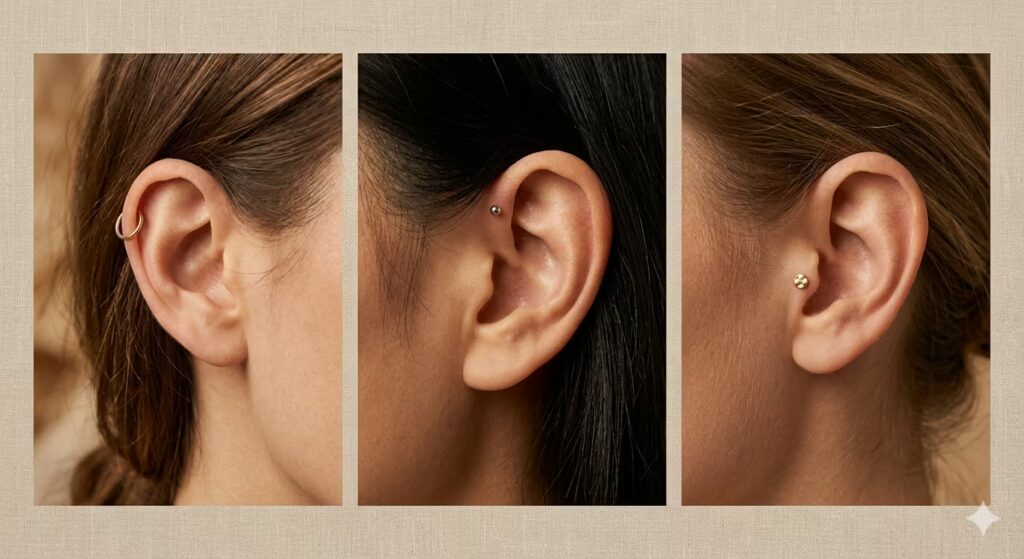
The helix is the outer rim of the upper ear. It is the most popular cartilage piercing in the world and the most common starting point for curated ear building. The helix accepts the widest range of jewellery of any cartilage piercing, from flat-back studs to hoops, rings, and decorative clickers.
Healing takes 6 to 12 months. Initial surface healing looks complete much earlier, but the cartilage beneath takes the full timeline to stabilise. Our dedicated article on helix piercing guide covers everything about this placement in full detail. And for specific cost information, our helix piercing cost guide has full pricing across multiple countries.
Forward helix: 5 to 7 out of 10
The forward helix sits at the front of the ear where the rim curves inward toward the head. It is visible from the front of the face in a way that a standard helix is not, which makes it a popular choice for people who want their cartilage piercing to be seen in face-on interactions as well as profile views.
The cartilage at the forward helix is denser and firmer than the standard outer rim. This makes the procedure sharper and the healing timeline slightly longer at nine to twelve months. One to three forward helix piercings stacked vertically is a very popular styling choice.
Tragus: 5 to 7 out of 10
The tragus is the small triangular flap of cartilage that sits directly in front of the ear canal opening. It creates a delicate, precise-looking piercing in a less common location that many people find particularly elegant.
The proximity to the ear canal creates specific aftercare considerations around earbuds and phone calls that other ear piercings do not share. Our full tragus piercing benefits guide covers the complete picture, including the claimed health benefits, their evidence base, and the practical daily management.
Anti-tragus: 6 to 7 out of 10
The anti-tragus sits on the small raised ridge of cartilage on the inner edge of the ear, directly across from the tragus. It is less commonly pierced than the tragus and is not present as a pierceable structure in all ear anatomies. Your piercer will assess whether your anti-tragus is suitable during consultation.
Orbital: 4 to 6 out of 10 per piercing
An orbital is not a distinct anatomical placement but a jewellery configuration. Two piercing holes are placed close enough together that a single ring passes through both, creating an orbital loop visible on the outer rim. The individual piercings rate similarly to standard helix piercings. The visual effect is distinctive and eye-catching.
Inner Cartilage Piercings
Inner cartilage piercings sit in the structures of the inner ear, away from the outer rim. They tend to be more painful, take longer to heal, and are more technically demanding than outer cartilage piercings. They also create a more intimate, detailed look in the ear, which has made them increasingly sought after for complex, curated ear arrangements.
Conch: 6 to 7 out of 10
The conch is the large, flat cartilage bowl in the centre of the inner ear. It comes in two varieties: the inner conch, which is the main flat bowl area, and the outer conch, which sits closer to the helix rim.
The conch is a thick, flat cartilage that requires considerable force to pierce. The sensation is a strong sustained pressure followed by a deep ache that can last several days. Healing takes nine to twelve months for most people.
The conch accepts both studs and rings. A conch ring that passes through the bowl of the ear and sits against the inner cartilage wall is one of the most visually dramatic ear piercing options available.
Daith: 6 to 8 out of 10
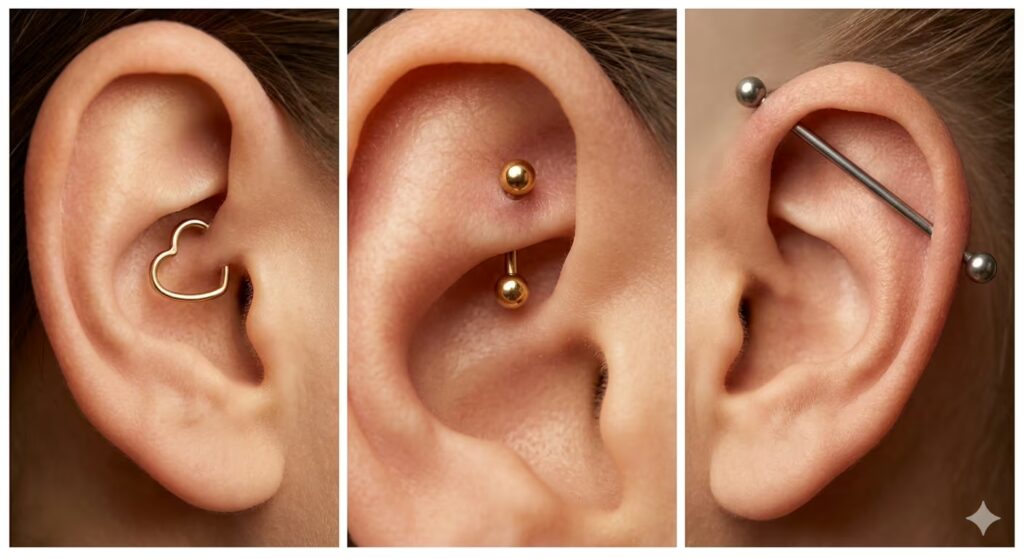
The daith is the small, crescent-shaped fold of cartilage above the opening of the ear canal. It is one of the more technically challenging inner ear piercings because the piercer must navigate through the fold at exactly the right angle to create a channel that will sit and heal correctly.
The daith is most commonly jewelled with a seamless ring, clicker ring, or heart-shaped clicker that sits in the fold. The visual effect is subtle from most angles but striking when viewed close up.
The daith shares the tragus’s association with claimed migraine relief through acupressure. The evidence is similarly anecdotal rather than clinical. For an honest treatment of these claims, see our tragus piercing benefits guide which covers the same pressure point claims with balanced detail.
Rook: 7 to 8 out of 10
The rook is the prominent fold of cartilage that runs across the upper inner ear, above the daith. It is one of the thicker cartilage structures in the ear and piercing through it requires more force and pressure than most ear piercings.
The rook is pierced with a curved barbell that sits in and through the cartilage fold, with both ball ends visible. The healing timeline is long at twelve to eighteen months. The rook rewards patience with a unique, striking placement that relatively few people have.
Snug: 7 to 9 out of 10
The snug sits on the inner cartilage ridge that runs along the inner edge of the outer ear, technically called the antihelix. It is a horizontal piercing that passes through this dense ridge. It is widely considered one of the most painful ear piercings due to the thickness and density of the cartilage involved.
Not everyone has an antihelix that is suitable for a snug piercing. The structure needs to be prominent enough to pierce safely. Your piercer will assess this during consultation. The healing timeline is twelve to eighteen months and the snug has a reputation for being one of the more demanding cartilage piercings to heal successfully.
Industrial: 6 to 8 out of 10
The industrial is a bar that connects two cartilage piercings on the upper ear, typically a forward helix and a standard helix, creating a single diagonal bar across the upper ear. It is two separate piercings connected by one piece of jewellery.
Because both piercings are connected by the bar, any movement of the ear, including sleeping, wearing headphones, or anything that touches the bar, affects both healing channels simultaneously. This makes the industrial one of the most demanding ear piercings to heal. Our full industrial piercing cost guide covers the complete picture including placement, healing, and jewellery.
Choosing Your First Cartilage Piercing
If you are moving beyond lobe piercings for the first time, the choice of which cartilage piercing to start with has real implications for your experience.
Best first cartilage piercings
The standard helix is the consensus recommendation for a first cartilage piercing. It sits in the lowest pain range for cartilage piercings, it has the widest jewellery options, the most available research on healing outcomes, and the most piercers experienced with it.
The forward helix and tragus are good second choices for someone who wants something slightly less common from the start. Both are manageable for first-time cartilage piercing owners who are prepared for the healing commitment.
Piercings to work up to
The rook, snug, and industrial are best approached after you have healed at least one cartilage piercing successfully. The healing demands and pain levels of these three make the experience significantly better for people who already understand what cartilage healing involves.
The daith and conch sit in the middle. Both are popular first inner cartilage piercings for adventurous starters, but understanding the full healing timeline before you commit is important.
❝ The most common mistake people make with ear piercings is underestimating how long cartilage takes to heal. If you go in knowing a helix takes 6 to 12 months rather than 6 to 8 weeks, the whole experience is smoother and less frustrating.
Planning a Curated Ear
A curated ear is a deliberately designed arrangement of multiple ear piercings that work together as a visual composition. It has become one of the dominant trends in ear jewellery, driven by the combination of high-quality implant-grade jewellery options and social media’s emphasis on photographable personal style.
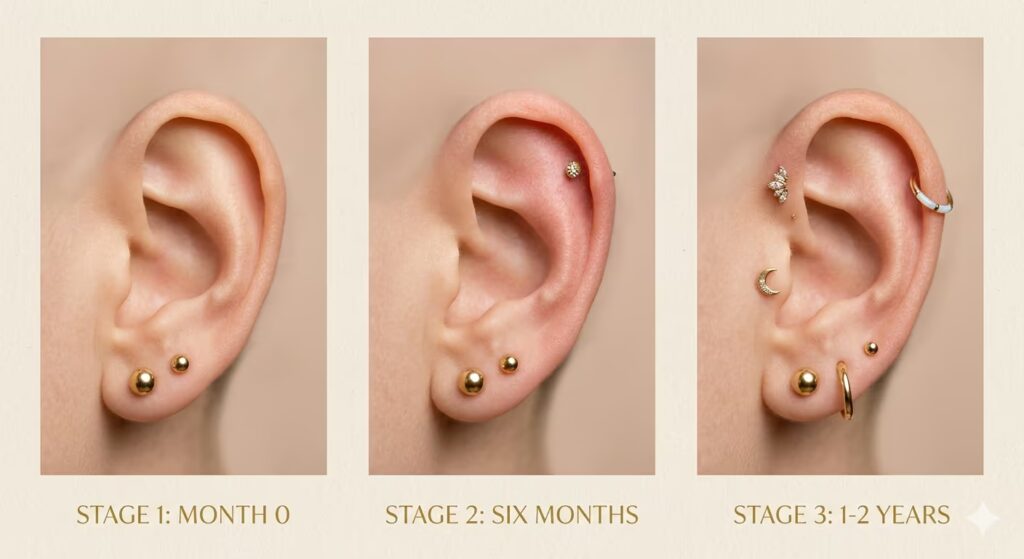
The key principle is that a curated ear is built over time. Each piercing heals before the next is added. The vision is planned in advance so that placements work harmoniously together from the start rather than creating crowding or conflict.
For specific guidance on when it is safe to change jewellery or add new piercings during the healing process, our guide to when can I change my ear piercing covers the full healing timeline breakdown for every placement type.
A typical curated ear progression
Most curated ears start with two or three lobe piercings in the first year. The lobes heal quickly and create the foundation. A helix is typically added first in the cartilage. Then, depending on preference, a tragus, forward helix, daith, or conch is added as each previous piercing heals.
The process takes two to four years to build a complete curated ear with multiple cartilage placements. That timeline feels long before you start and surprisingly fast once you are in it. Each new addition is its own milestone.
Jewellery Overview for Ear Piercings
The right jewellery for each ear piercing type depends on the stage of healing and the specific anatomy of the placement.
| Piercing | Initial Jewellery | After Healing | Avoid |
| Earlobe | Flat-back stud or simple push-fit earring | Any style: hoops, drops, studs, clusters | Very heavy or dangling until lobe is established |
| Helix | Flat-back titanium labret stud | Hoops, rings, clickers, decorative studs | Hoops and rings during healing |
| Forward Helix | Flat-back titanium labret stud | Small studs and tiny hoops | Oversized jewellery in this tight space |
| Tragus | Flat-back titanium labret stud | Small hoops (6–8mm), small studs | Heavy earrings, oversized rings |
| Daith | Seamless ring or simple clicker | Decorative clickers, heart rings, hoops | Studs (wrong shape for this placement) |
| Rook | Curved barbell (titanium) | Decorative curved barbells | Rings, straight bars |
| Conch | Flat-back labret stud | Large conch rings, studs | Anything that presses on the inner ear wall during healing |
| Industrial | Straight barbell (correct gauge) | Decorative industrial bars | Rings or hoops, wrong-length bars |
Frequently Asked Questions
Which ear piercing hurts the least?
The standard earlobe is consistently the least painful ear piercing, rating 1 to 2 out of 10. The upper lobe is the second gentlest at 2 to 3. Both are soft tissue piercings that yield easily to the needle and heal quickly.
Which ear piercing hurts the most?
The snug is widely considered the most painful ear piercing due to the thickness of the antihelix cartilage it passes through, rating 7 to 9 out of 10. The rook and industrial are close behind. For a full ranked list see our most painful piercings guide and our dedicated most painful ear piercings ranked article.
How many ear piercings can I get at once?
For lobe piercings, two at once is very manageable. For cartilage piercings, most professional piercers recommend one or at most two at a time. Getting more than two cartilage piercings simultaneously significantly increases healing demands and the risk that one or more will develop complications.
Which ear piercing heals the fastest?
The standard earlobe heals fastest at six to eight weeks. Upper lobe piercings follow at eight to ten weeks. All cartilage piercings require a minimum of six months and some take twelve to eighteen months. The tissue type difference between lobe and cartilage is the primary driver of this gap.
Can I mix metals in a curated ear?
Yes, intentionally mixing metal tones is a core part of the curated ear aesthetic. The most popular combinations are gold and rose gold, or yellow gold and silver-toned titanium. The key is keeping a few pieces in the same metal tone as anchors rather than having every piece in a different finish, which creates visual chaos rather than intentional variety.
Do cartilage piercings ever fully heal?
Yes, fully. A well-healed cartilage piercing with quality jewellery, left undisturbed, becomes stable tissue that is no different from any other established part of the ear. The fistula, the tube of skin that forms around the jewellery, matures into permanent tissue over time.
The key phrase is well-healed. Cartilage piercings that were repeatedly disturbed, had jewellery changed too early, or used low-quality materials may never fully stabilise and remain reactive long-term. The quality of healing matters as much as the passage of time.
Build Your Ear With Intention
Every ear piercing on this page, from the gentlest lobe to the most demanding snug, is chosen by millions of people every year who are happy with the result. The difference between a great experience and a frustrating one comes down almost entirely to preparation: choosing the right placement for your current tolerance and lifestyle, finding an experienced piercer, using quality jewellery, and respecting the healing timeline.
Start where you are comfortable. Build at your own pace. Every piercing you add is an investment in something that you will wear for years. Getting each one right is worth the patience.
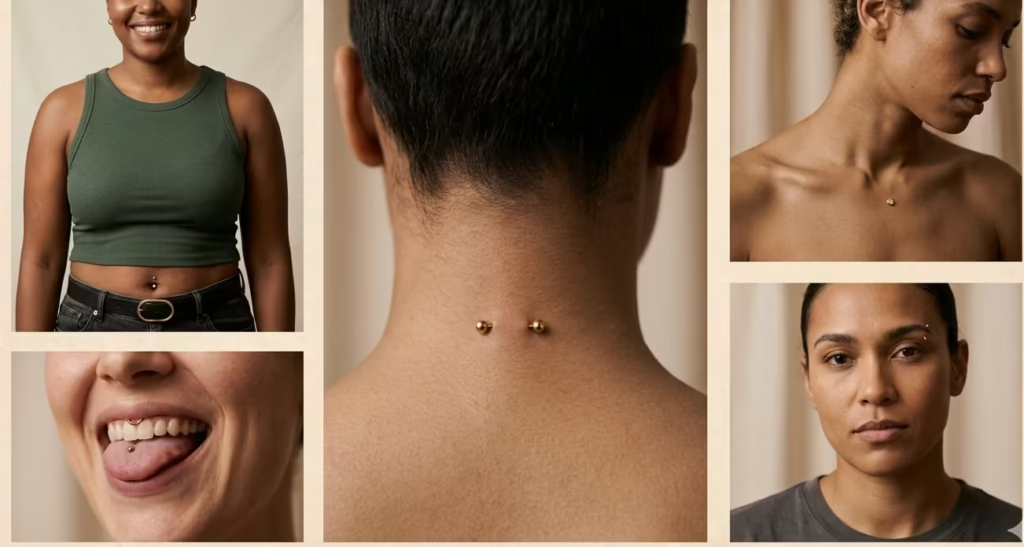
For individual deep dives on specific piercings, our guides cover the helix, tragus, industrial, septum, nipple, belly button, eyebrow, and many more in full detail. The types of body piercings with pictures article extends the picture beyond the ear to every major body piercing placement available.