There is something instantly striking about a nose piercing. Whether it is a tiny diamond stud catching the light or an elaborate gold ring adorned with dangling chains, a nose piercing draws the eye and tells a story. But for millions of people across India, Pakistan, Bangladesh, Nepal, and the Middle East, a nose piercing is far more than a fashion choice.
It is a tradition woven into weddings, religious rites, medical beliefs, and family identity. It carries the weight of centuries. It speaks of womanhood, devotion, beauty, and belonging in ways that go far deeper than any trend ever could.
In this article, we are going deep into the history, meaning, and cultural significance of nose piercings in Indian and Middle Eastern traditions. We will look at where the practice began, how it traveled, what it means spiritually and socially, and how it continues to evolve in the modern world.
If you have been following our piercing history series, you will remember that our first article — The Evolution of Ear Piercings: From Ancient Egypt to Modern Trends — traced the evolution of ear adornment, which has been a human constant for at least five thousand years. Nose piercings have their own equally rich story, and it starts in South Asia.
❝ In many South Asian cultures, a nose piercing is not just jewellery. It is a rite of passage, a spiritual marker, and a declaration of womanhood all at once.
The Ancient Roots: Where Did Nose Piercing Begin?
The oldest written reference to nose piercing comes from the Middle East. The Book of Genesis in the Hebrew Bible describes a gold nose ring — a “shanf” — being given to Rebekah as a bridal gift. Scholars date this text to roughly the second millennium BCE, making nose jewelry at least 3,000 to 4,000 years old.
From the Middle East, nose piercing spread along ancient trade and migration routes into South Asia. By the time nose piercing is mentioned in the ancient Indian text Sushruta Samhita — an Ayurvedic medical text from around 600 BCE — it was already established enough to warrant medical discussion. The text describes the left nostril as being connected to the female reproductive system and recommends piercing it to ease menstrual pain and childbirth.
This Ayurvedic reasoning is significant. It gave nose piercing medical legitimacy, making it more than just a cosmetic procedure. Piercing the left nostril was not vanity. It was healthcare, grounded in the ancient Indian understanding of how the body’s energy channels, or nadis, function. The left nostril connects to the ida nadi, associated with feminine energy, lunar cycles, and reproductive health.
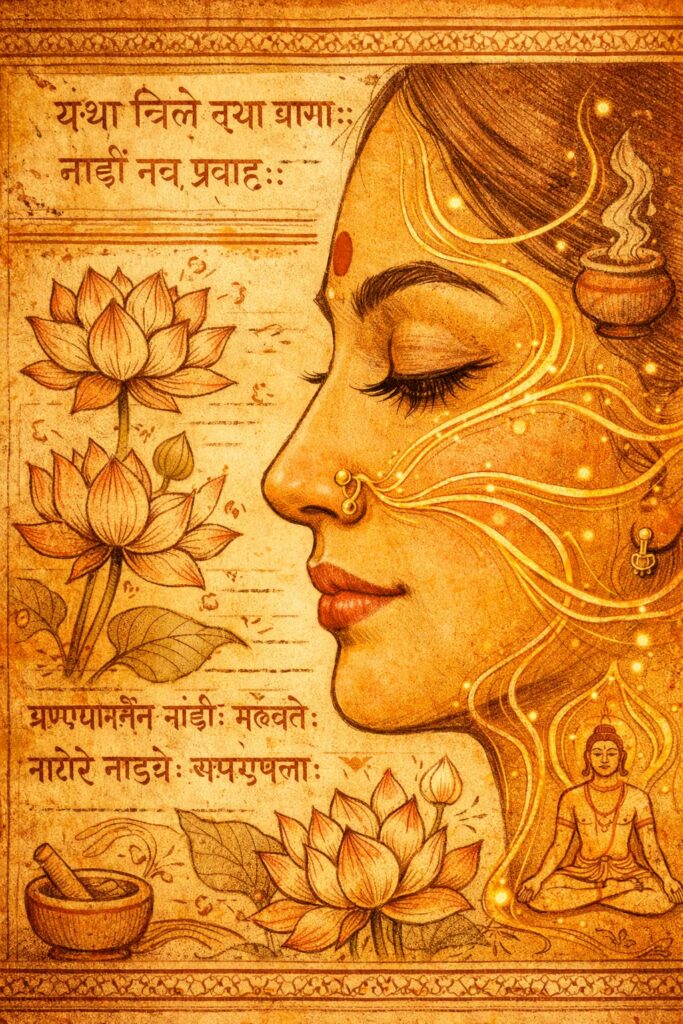
What is particularly interesting is that this same medical logic appears independently in acupuncture traditions in China and in acupressure practices across Asia. The idea that specific points on the nose and ears connect to internal organs is ancient, widespread, and remarkably consistent across cultures with limited contact. Whether or not the science holds up by modern standards, it speaks to a deeply intuitive human understanding of the body.
Nose Piercings in Hindu Tradition: Marriage, Devotion, and the Goddess
In Hindu tradition, nose piercing carries a layered significance that is simultaneously spiritual, social, and aesthetic. The practice is most strongly associated with women, and particularly with marriage. In many parts of India, a woman’s nose piercing is as central to her wedding day as her mangalsutra (sacred marriage necklace) or her sindoor (vermillion powder placed in the hair parting).
The nose ring worn at marriage is called a nath. It varies dramatically by region. In Maharashtra, a large decorative nath, connected to the hair by a chain, is traditional. In Rajasthan, enormous oversized rings that sweep across the cheek are worn. In Karnataka and Tamil Nadu, smaller, elegant rings or studs are more typical. In Bengal, a delicate gold ring called a nolak is traditional. Each style tells you exactly where a woman comes from — her nath is a regional identity statement as much as a personal one.
❝ The nath is one of the sixteen traditional adornments — or solah shringar — that a Hindu bride is expected to wear on her wedding day. Each one carries a specific spiritual meaning.
The nath is one of the solah shringar — the sixteen adornments a Hindu bride traditionally wears. These sixteen adornments are not merely decorative. They are considered offerings to the goddess Parvati, wife of Lord Shiva, and wearing them is an act of devotion as much as beauty. A bride adorning herself for her wedding is, in this tradition, participating in a divine ritual that connects her to thousands of years of feminine spiritual practice.
Beyond marriage, nose rings in Hindu tradition are associated with Lakshmi, the goddess of wealth and prosperity. Wearing a nose ring is seen as an invitation to her blessings. In some communities, girls have their noses pierced in a dedicated ceremony before puberty, as a way of invoking divine protection and preparing them spiritually for womanhood.
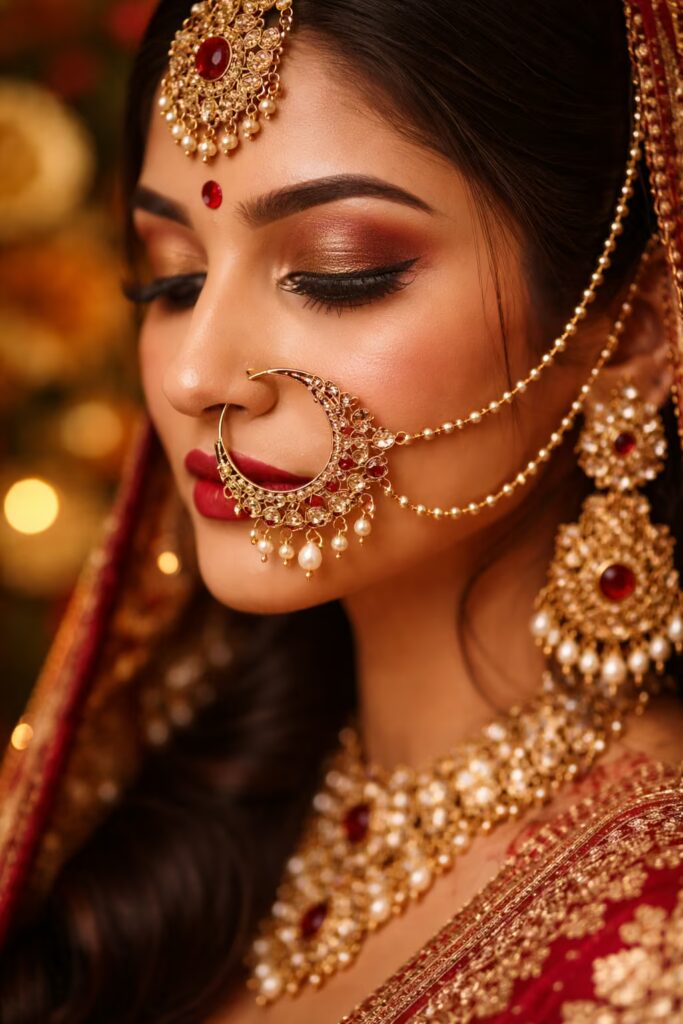
It is also worth noting that in some Hindu communities, widows traditionally remove their nose ring along with other marriage ornaments. This practice underscores just how deeply the nose ring is tied to marital identity — it is not merely worn at the wedding but remains a lifelong marker of a woman’s status as a wife.
Regional Variations Across South Asia: One Tradition, Many Expressions
Nose piercing across South Asia is not a single uniform tradition. It is a rich tapestry of regional variations, each with its own aesthetic language, symbolic meanings, and social significance.
In North India, nose rings tend to be more elaborate and statement-making. The large ring worn by Rajasthani brides, which sweeps dramatically across the face, is one of the most visually striking examples of bridal jewelry in the world. These pieces are works of art—handcrafted by goldsmiths using centuries-old techniques, often set with precious and semiprecious stones, and passed down through generations as family heirlooms.
In South India, the aesthetic is typically more refined and delicate. The mukhuthi — a small gold stud worn in the left nostril — is common across Tamil Nadu and Kerala. In Andhra Pradesh and Telangana, ornate gold studs featuring intricate temple jewelry motifs are popular. South Indian nose jewelry is often designed as part of a complete set that includes earrings, necklaces, and hair ornaments, all sharing the same motifs and craftsmanship.
In Pakistan and Bangladesh, nose jewelry carries cultural weight similar to that in India, with regional variations reflecting local artistic traditions. Pakistani bridal nose rings often feature elaborate kundan work — a technique of setting gemstones in pure gold using lac as a base — that results in jewellery of extraordinary beauty and intricacy.
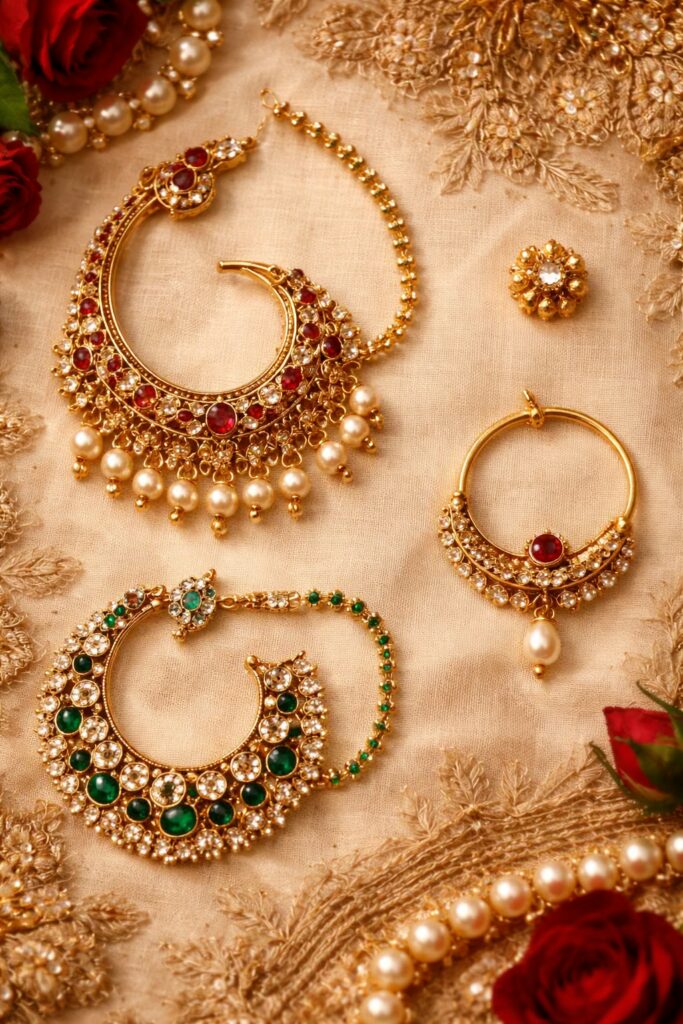
Nepal presents its own fascinating tradition. Newar women in the Kathmandu Valley traditionally wear a large nose ring called a bulaki that hangs below the nose and connects the septum. This is distinct from the nostril piercings more common in India, and it has its own set of spiritual and social associations within Newar culture. The bulaki is often worn alongside elaborate gold earrings and necklaces as part of a complete ceremonial adornment.
What unites all these variations is the core understanding that a woman’s nose piercing is meaningful. Across South Asia, it communicates important aspects of who she is, where she comes from, what stage of life she is in, and the traditions she honors. It is never just decoration.
Nose Piercings in Islam and Middle Eastern Culture
The relationship between nose piercing and Islamic culture is nuanced and fascinating. The practice predates Islam — as we noted, nose rings appear in the Hebrew Bible — but Islam’s spread across the Middle East, North Africa, and South Asia significantly shaped how nose piercing was practiced and understood in those regions.
In classical Islamic scholarship, the question of whether nose piercing is permissible has been debated for centuries. The majority view among scholars is that it is permissible for women, classified under the general permission for women to adorn themselves. The Hadith literature mentions nose rings among women’s ornaments. In many Islamic cultures, nose jewelry became associated with femininity, beauty, and bridal adornment in ways that parallel Hindu traditions — even as the religious frameworks differ entirely.
In the Arabian Peninsula, particularly in Yemen and Oman, nose piercing has long been practiced among women as a marker of beauty and social status. Yemeni silver nose rings — often featuring intricate filigree work and dangling chains — are remarkable examples of traditional craft that have been made and worn for centuries. These pieces are recognizably distinct from Indian nose jewelry but share the same underlying idea: a nose ring communicates something meaningful about the woman wearing it.
❝ Across the Middle East, nose jewelry craftsmanship developed independently but often arrived at remarkably similar conclusions about beauty, status, and femininity.
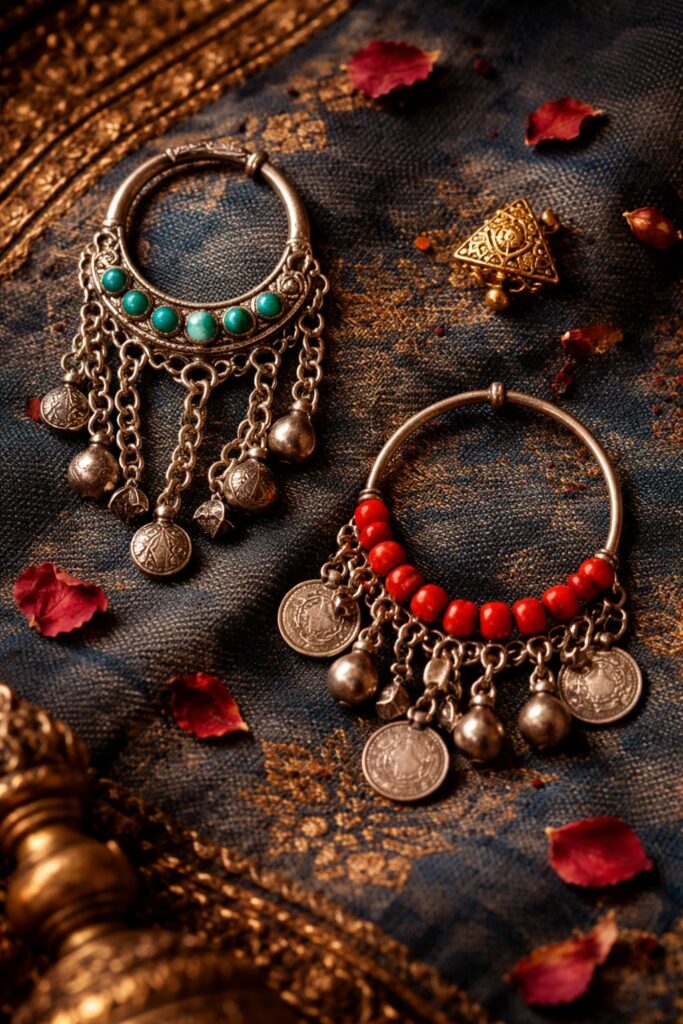
Among Bedouin communities across the Arabian Peninsula, Egypt, and the Levant, nose rings have historically been worn as both ornaments and portable wealth. In nomadic cultures, jewelry served as a form of stored value that traveled with the family. A woman’s nose ring could represent significant financial value, serving as both an adornment and a form of insurance. This practical dimension added another layer of meaning to what was already a culturally loaded object.
In Egypt, nose piercing has ancient roots — the earliest documented examples from the region date to the pre-Islamic period — and the practice continued through the Islamic era. Modern Egyptian attitudes toward nose piercing have shifted over time and vary significantly across urban and rural communities, more conservative and more liberal social circles, and generations.
Iran presents a particularly interesting case. Pre-Islamic Persian culture had its own traditions of nose adornment, and after the Islamic conquest of the 7th century CE, those traditions intertwined with Islamic aesthetics and values in complex ways. Today in Iran, nose piercing occupies an interesting cultural space — traditional among some rural and tribal communities, fashionable and sometimes countercultural among urban young women.
The Mughal Influence: When Two Traditions Met
One of the most significant moments in the history of nose piercing in South Asia came with the arrival of the Mughal Empire in the 16th century. The Mughals brought with them the Persian and Central Asian aesthetic traditions of the Islamic world, and these fused with existing Hindu piercing traditions, permanently transforming Indian jewelry design.
Mughal nose jewelry is among the most spectacular ever created. The Mughal emperors and their courts were legendary patrons of the arts, and jewelry-making flourished under their rule. Craftsmen from across the empire — Hindus, Muslims, Persians, and Central Asians — worked together to create pieces of extraordinary technical sophistication and artistic beauty.
The nath as we know it today — elaborate, often incorporating pearls and precious gems, sometimes connected by a chain to a hair ornament — owes a great deal to Mughal aesthetics. The Mughal love of pearl jewelry, intricate goldwork, and jeweled ornamentation merged with existing Hindu bridal traditions to produce the rich tradition of Indian bridal nose jewelry that continues to this day.
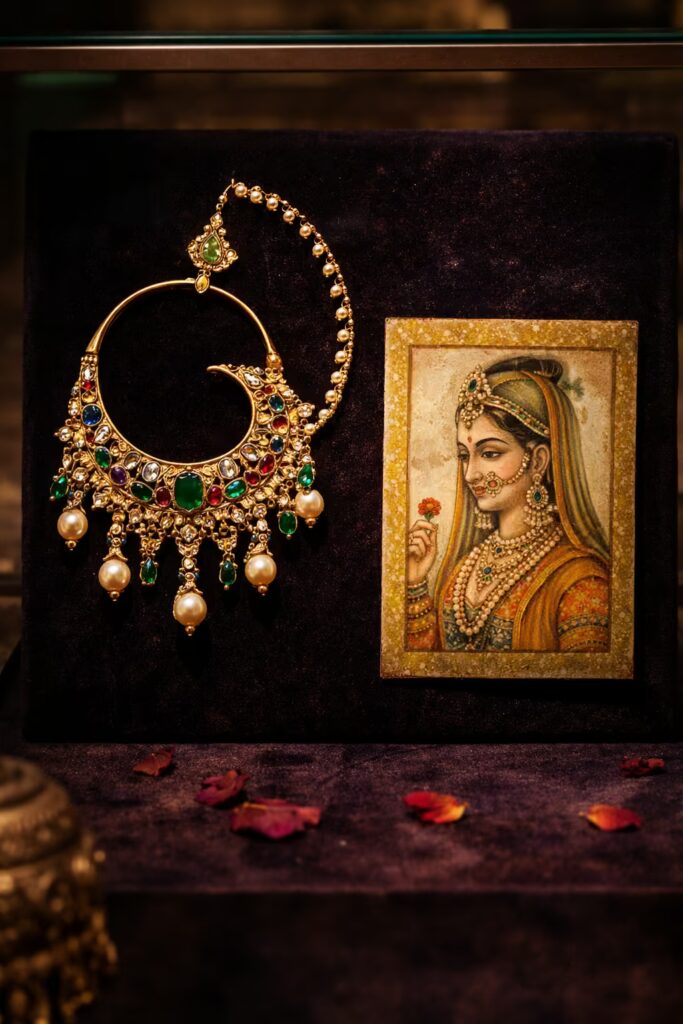
The Mughal period also saw nose piercing become more common across social classes in India. Previously, elaborate nose jewelry had been primarily a marker of high status — only the wealthy could afford elaborate gold pieces. As the Mughal economy flourished and metalworking traditions spread, nose jewelry became accessible to a wider range of women, and the tradition deepened its roots across Indian society.
Nose Piercing as a Coming-of-Age Ceremony
Across Indian and Middle Eastern cultures, nose piercing is often associated with specific life stages and transitions rather than being a casual decision. Understanding when and how a nose piercing is traditionally done reveals a great deal about what it means.
In many Indian communities, a girl’s nose is pierced in a dedicated ceremony during childhood or early adolescence. This is not merely a practical matter of getting the piercing done. It is a family event marked by prayers, gift-giving, and the involvement of extended family members. The goldsmith who performs the piercing may be a trusted family artisan whose family has served the community for generations.
In some communities, the timing of the nose-piercing ceremony is determined by an astrologer, who identifies an auspicious date and time based on the child’s birth chart. This places nose piercing within the same sacred calendar that governs weddings, religious observances, and other major life events. It is not something done casually on a Tuesday afternoon. It is a moment of spiritual and social significance.
❝ In communities where nose piercing is a rite of passage, the ceremony itself matters as much as the piercing. The gathering of family, the prayers, the chosen jewellery — all of it carries meaning.
In some tribal and rural communities across Rajasthan, Gujarat, and the Deccan plateau, the nose piercing ceremony for young women is accompanied by songs specific to that rite of passage. These songs — passed down orally through generations — describe the significance of the nose ring, invoke blessings from goddesses, and celebrate the young woman’s transition. They are a form of living cultural memory.
Among certain Bedouin communities in the Middle East, nose piercing was historically performed as part of a young woman’s preparation for marriage. The specific nose ring she received would be chosen or commissioned by her family as a demonstration of their wealth and their care for her. The quality of the jewelry was a statement about the family’s standing in the community.
Materials and Craftsmanship: The Art Behind the Jewellery
The nose jewelry worn across India and the Middle East represents some of the most sophisticated metalworking traditions in human history. Understanding the materials and techniques involved adds another dimension to appreciating what these pieces mean.
In India, gold is by far the preferred material for nose jewelry, and this preference is both aesthetic and symbolic. In Indian culture, gold is not merely valuable — it is auspicious. It is associated with Lakshmi, the goddess of wealth, and with divine light and purity. Wearing gold is considered spiritually beneficial, and in many communities, a bride wearing anything less than gold on her wedding day is considered inauspicious.
The techniques used to make Indian nose jewelry are extraordinary. Filigree — the art of creating delicate patterns from twisted gold wire — produces nose rings of astonishing delicacy and intricacy. The Kundan setting, in which pure gold is shaped around gemstones without solder or heat, produces pieces of remarkable brilliance. Meenakari — enamel work in vibrant jewel colours — adds a palette of reds, greens, and blues to gold jewelry, making Indian pieces instantly recognizable.
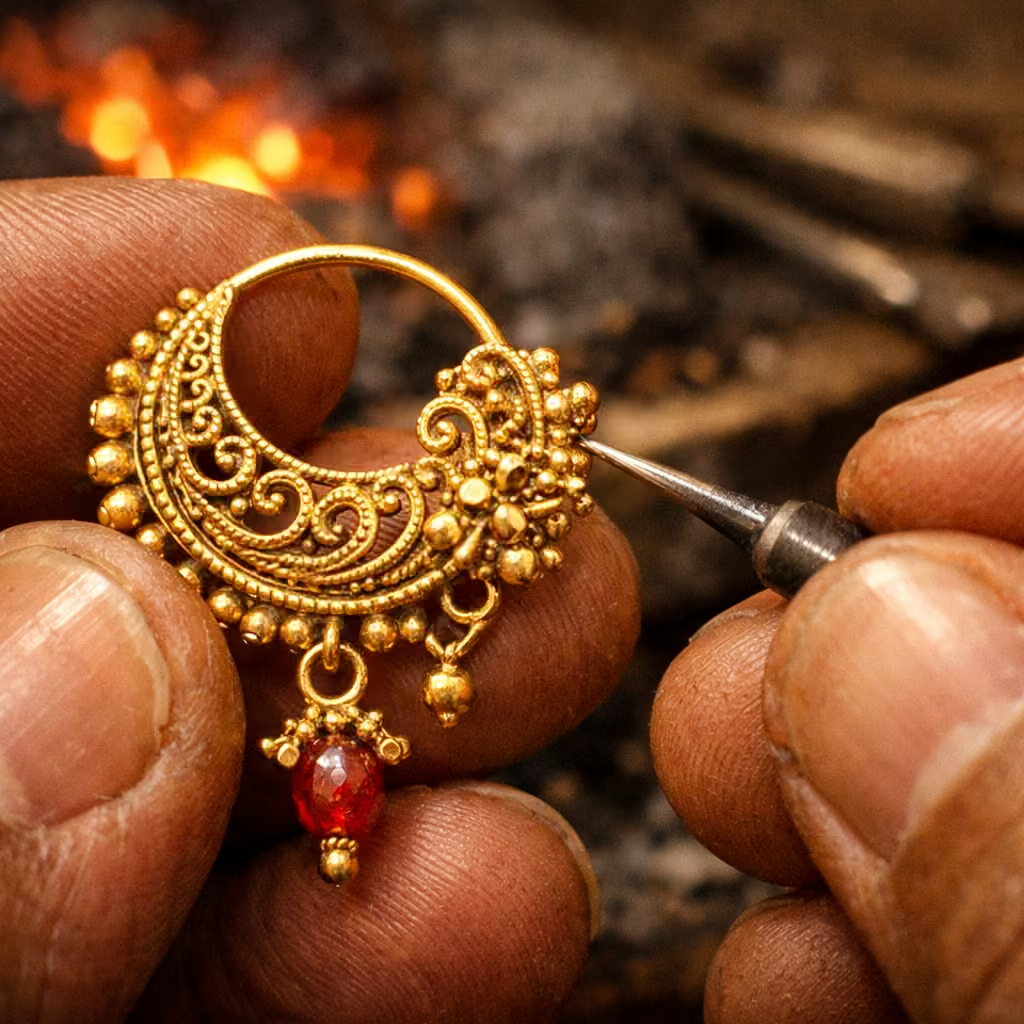
In the Middle East, silver has historically been as important as gold — particularly in Yemeni, Omani, and Bedouin jewelry traditions. Middle Eastern silver jewelry is often characterized by granulation (tiny balls of silver fused to a surface), niello work (black metallic inlay in engraved patterns), and the incorporation of coral, turquoise, and carnelian. These stones carried protective significance — turquoise, in particular, was believed to ward off the evil eye across both Middle Eastern and South Asian cultures.
The craftsmanship behind traditional nose jewelry in both regions is increasingly endangered. As mass-produced jewelry floods the market, the artisanal goldsmiths and silversmiths who carry these techniques are dwindling. Efforts to preserve and document these traditions are ongoing. Still, there is a genuine risk that some of the most sophisticated knowledge of jewelry-making in human history could be lost within a generation or two.
Nose Piercings in the Diaspora: Tradition Meets New Contexts
As South Asian and Middle Eastern communities have migrated around the world over the past century, they have taken their nose-piercing traditions with them — and in new environments, those traditions have encountered new contexts, pressures, and possibilities.
For South Asian women in the UK, USA, Canada, and Australia, nose piercings often carry a dual significance. On the one hand, they are a connection to heritage — a visible marker of cultural identity that speaks to where a woman comes from and what she values. On the other hand, they exist in a Western context where nose piercings are also a mainstream fashion choice made for entirely different reasons.
This creates interesting tensions and conversations. A South Asian woman wearing a gold nose stud in London or Toronto may be seen by some observers as a fashion statement and by others as a cultural marker. The same piece of jewelry means completely different things depending on who is looking at it and what context they bring.
There are also generational conversations happening within diaspora communities about when and whether daughters should be pierced traditionally. Some families maintain the ceremony and the tradition in full, recreating it as faithfully as possible in their new home. Others adapt it, keeping the nose ring but letting go of the formal ceremony. Others still leave the decision entirely to the child when the child is old enough to choose.
❝ For many women in the South Asian diaspora, a nose ring is a quiet but powerful act of cultural reclamation — a way of wearing their heritage in a world that often asks them to set it aside.

The Modern Nose Piercing: Fashion, Identity, and Cultural Conversation
Nose piercings today occupy a fascinating position at the intersection of deep tradition and global contemporary fashion. The small nose stud has become one of the most popular piercings worldwide — worn by people from every background, culture, and context.
This mainstreaming raises genuine questions about cultural exchange and appropriation. When the nose stud became a global fashion item in the 1990s and 2000s, it did so largely through the influence of South Asian aesthetics on Western fashion — filtered through pop culture, the global music industry, and the growing visibility of South Asian communities in Western countries. The question of whether non-South Asian people wearing nose studs constitutes cultural appropriation generates real and reasonable debate.
Most thoughtful voices in this conversation distinguish between wearing a nose stud as personal style and actively claiming or commercializing the specific cultural meanings attached to it. Wearing a nose ring because you like how it looks is different from marketing it as “exotic” or wearing it to a cultural-themed event as a costume. The jewelry itself is not off-limits — the disrespect lies in reducing a tradition to an aesthetic trend without acknowledging its depth.
What is encouraging is that the global popularity of nose piercings has, in many ways, increased interest in and respect for the traditions that gave the practice much of its modern visibility. South Asian jewelry designers are thriving in global markets. Indian bridal jewelry has become internationally celebrated. Young women of South Asian heritage are embracing their nose-piercing traditions with pride and confidence, framing them explicitly as cultural heritage rather than feeling pressured to downplay them in Western contexts.
The nose piercing community today — from traditional craftsmen in Jaipur to professional piercers in New York, from Indian brides to fashion-forward teenagers — is a genuinely global conversation about beauty, identity, and what we choose to carry with us.
What Nose Piercings Tell Us About Culture and Connection
Step back from all the specific details — the Ayurvedic theory, the Mughal aesthetics, the Bedouin silverwork, the diaspora conversations — and the nose-piercing tradition tells a story about something fundamental in human experience.
It tells us that the body is always more than just a body. It is a site of meaning. What we put on it, in it, and through it communicates things about who we are, where we belong, what we believe, and what stage of life we are in. A nose ring in Rajasthan, a nose ring in Oman, and a nose ring in London occupy different cultural positions — yet they are also connected across time, trade routes, and the shared human desire to visibly mark significant moments of life on the body.
The tradition of nose piercing in Indian and Middle Eastern cultures is one of the most richly documented and deeply meaningful body modification traditions in the world. It has survived conquests, migrations, colonial pressures, and globalization. It has adapted without losing its core meaning. It continues to evolve while honoring its roots.
That resilience is worth celebrating — not just as a cultural curiosity, but as evidence of the remarkable tenacity of human traditions when they are tied to genuine meaning.
❝ The nose ring has traveled thousands of miles and thousands of years. It has meant different things to different people in different times — and it is still going strong.
Final Thoughts
Whether you are drawn to nose piercings for their beauty, cultural heritage, spiritual significance, or simply because you love how they look, understanding their history enhances the experience. A nose stud is not just metal through flesh. In its full historical context, it is a thread connecting you to one of the world’s oldest and richest traditions of human adornment.
The story does not end here, either. Across cultures worldwide, piercings of all kinds carry the same kind of layered significance we have explored in this article. If you want to keep exploring, these articles go deeper into the traditions that intersect with the nose piercing story:
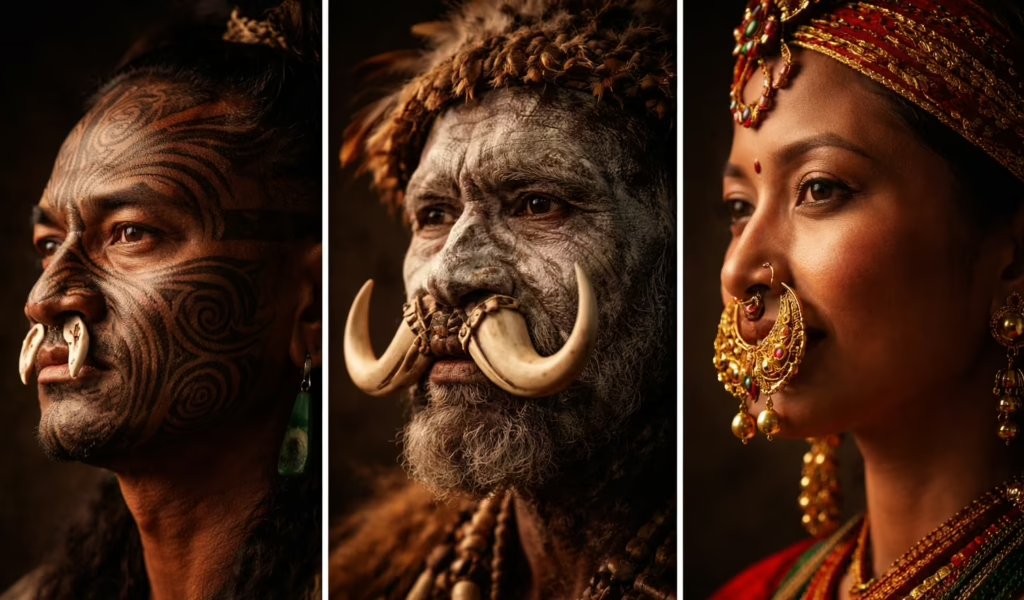
→ Tribal Septum Piercings: Symbols and Rituals Worldwide
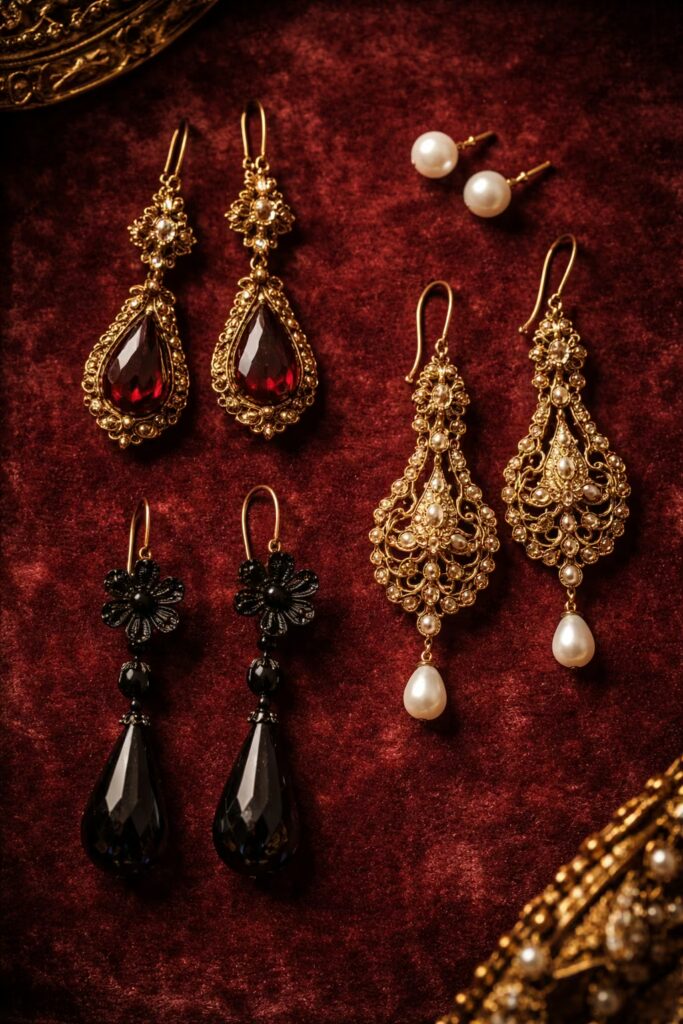
→ Victorian-Era Piercings and Their Social Meanings
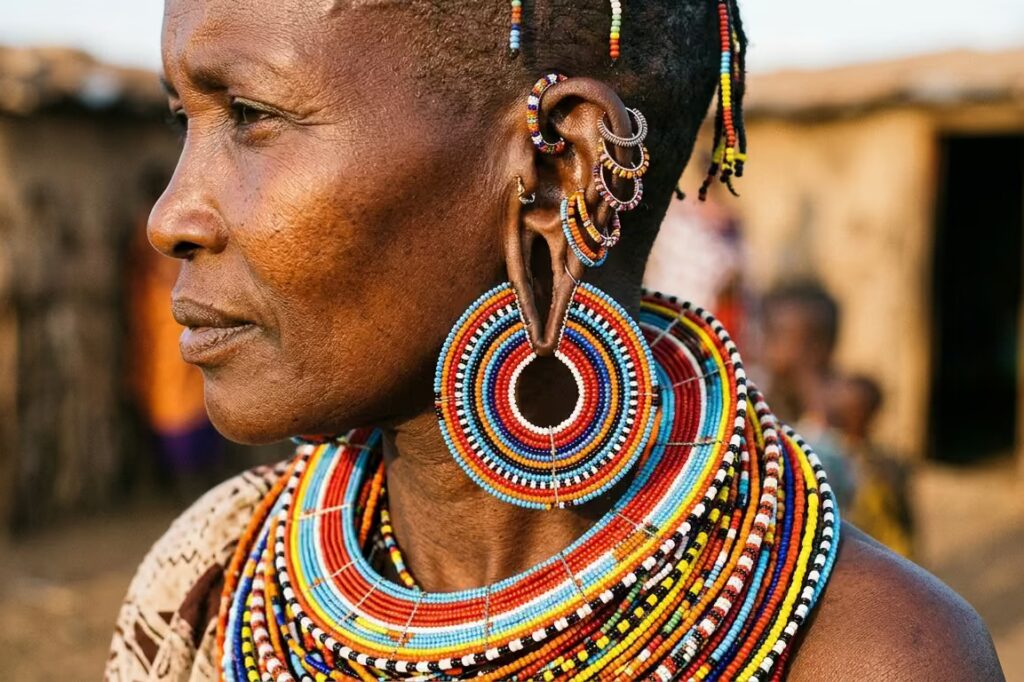
→ Piercing Jewelry in African Cultures: Materials and Heritage