Stretched Earlobes Quick Facts
| Info | Detail |
|---|---|
| Also Known As | Ear gauging, lobe stretching |
| Location | Healed earlobe piercing |
| Starting Gauge | 18g or 20g (existing piercing) |
| Common Goal Sizes | 0g, 00g, 1/2 inch, 1 inch |
| Time Between Stretches | 6–8 weeks minimum (small sizes); 3–6 months (larger) |
| Pain Level | Mild tightness; should not be painful |
| Point of No Return | Roughly 0g to 4g (varies by person) |
| Reversible | Yes, if stopped before 2g; surgery needed past that |
| Best Starter Jewelry | Single-flare steel, titanium, or glass plugs |
| Lubricants | Jojoba oil, vitamin E oil, and stretching balm |
| Avoid | Acrylic tapers, Vaseline, Neosporin, piercing guns |
| Cost | $10–$40 per stretching kit; $50–$200+ per professional stretch |
What Is Ear Stretching?
Ear stretching is the gradual enlargement of a healed earlobe piercing to hold larger jewelry. The process uses tapers, taping, or weights to expand the fistula over months and years. “Gauging” is a common slang term, though gauge technically refers to the jewelry size, not the act.
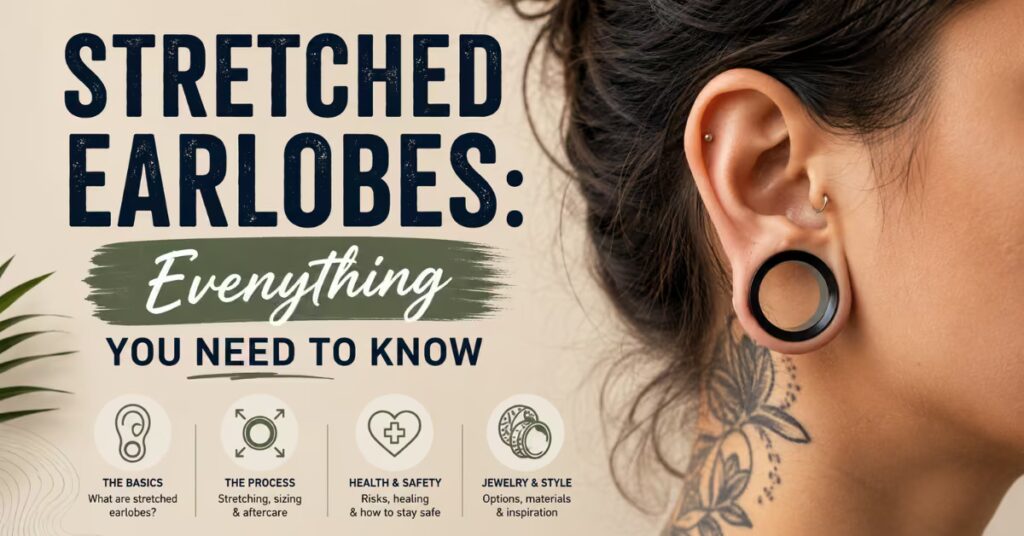
The first documented stretched ears date back to 3300 BC. Ötzi the Iceman, found in the Alps, had lobes stretched to between 7 and 11 millimeters. The practice still holds cultural meaning among the Maasai of Kenya, the Huaorani of the Amazon, and several Asian hill tribes.
Understanding Gauge Sizes
The American gauge system runs backward. A higher number means a smaller diameter.
A 20g plug is about 0.8mm. A 0g plug is 8mm. A 00g is roughly 10mm. Past 00g, sizes are measured in millimeters or fractions of an inch.
You cannot guess your current gauge by eye. Use a gauge wheel or digital calipers if you’re unsure where you’re starting from.
When You Can Start
Your existing piercing must be fully healed before the first stretch. Not just surface-healed.
A piercing feels normal after about 6–8 weeks, but the inner fistula takes longer to fully form. Most piercers recommend waiting six months from the initial piercing before stretching at all.
The fistula needs time for collagen to structure properly. Stretching before this point tears raw tissue instead of expanding mature skin.
What Size You’re Starting From
Your starting gauge depends entirely on how you were pierced.
Piercings done by gun are typically 20g, while professional needle piercings are usually 16g or 18g. A 20g ear stretches to 18g first. An 18g ear stretches to 16g first.
The jump from your starting size to the next gauge is the smallest stretch you’ll ever do. It often feels like nothing at all.
Tools You’ll Need
- Tapers. Cone-shaped tools that ease new sizes through the lobe. Stick to stainless steel, implant-grade titanium, or glass. Acrylic tapers grip and tear skin.
- Plugs or tunnels. Single-flare plugs are easiest for fresh stretches. Double-flare plugs are wider at both ends and should only be used in fully healed stretches.
- Lubricant. Jojoba oil, vitamin E oil, or stretching balm. Avoid Vaseline and Neosporin. Petroleum products trap bacteria and don’t absorb into the skin.
- O-rings. Small rubber rings that hold single-flare plugs in place.
How the Process Works
Wash your hands. Clean the lobe and the taper with sterile saline. Coat both with lubricant.
Insert the taper from the front, narrow end first. Push slowly. Stop if you feel sharp pain or strong resistance. Once the wide end sits flush with the lobe, follow it through with your plug.
The plug should slide in as the taper exits the back. Secure with the O-ring if needed. Clean off excess lubricant.
A correct stretch feels tight and warm. According to the Association of Professional Piercers, stretched earlobes should never bleed or appear torn, as these are signs of overstretching.
Wait Times Between Stretches
This is where most people cause permanent damage. They rush.
A safe schedule by size:
- 20g → 16g: 6–8 weeks per stretch
- 14g → 10g: 8–12 weeks per stretch
- 8g → 4g: 3 months minimum per stretch
- 2g and above: 4–6 months minimum per stretch
Professional piercers recommend waiting between 2 and 6 months between stretches. The wait is when new tissue actually forms.
Every stretch creates microtears. Healing those tears is what gives you elastic, stretchable tissue for the next size up.
Never Skip Sizes
Each gauge is about 25% larger in diameter than the one before. Skipping from 10g to 6g is not “one extra step.” It tears the fistula.
Some size jumps are also bigger than others. The 2g to 0g gap is larger than 6g to 4g. Half-sizes and the taping method help bridge these wider jumps safely.
Other Stretching Methods
- Taping. Wrap PTFE or bondage tape around your current plug, adding one layer every 1–2 weeks. Slower and gentler than tapers. Good for larger sizes.
- Dead stretching. Inserting slightly oversized jewelry without a taper and letting the lobe accommodate it. Only works for very small upgrades on elastic skin.
- Weights. Hangers and heavy plugs use gravity to elongate the lobe. Weights can cause uneven stretching between the two ears. Only suitable for fully healed, larger stretches.
- Scalpelling and dermal punching. A scalpel or a punch removes tissue, creating a larger hole in a single session. Done only by experienced body modification artists.
The Point of No Return
Your lobes are elastic, but elasticity has limits.
The threshold varies. The point of no return falls between 0g and 4g for most people. 0g (7mm) is the largest size where the lobe can still close on its own, with 00g (9mm) being the point at which a visible hole remains.
WebMD states that stretching beyond 2 gauge (6 millimeters) typically requires surgical help to restore the original earlobe shape.
Slow stretching improves your odds of natural shrink-back. Fast stretching destroys them.
Blowouts
A blowout is the most common stretching injury. It looks like a small ring or flap of skin pushed out behind the lobe.
It happens when the fistula gets forced out of the back of the piercing under pressure. The cause is almost always stretching too fast, skipping sizes, or forcing jewelry through.
To treat a fresh blowout:
- Remove the jewelry immediately.
- Downsize 2–3 gauges from your current size.
- Soak with sterile saline twice daily.
- Massage with jojoba or vitamin E oil.
- Wait several months before attempting to stretch again.
A blowout caught early often heals fully. A blowout left in place can become permanent scar tissue.
Other Risks and Complications
- Thinning lobes. The skin in front of or behind the plug becomes visibly thin. Downsize and consult a piercer. Severely thinned lobes can split.
- Tearing. Bleeding, sharp pain, or visible splits. Remove jewelry. See a piercer or doctor. Torn lobes often need surgical repair.
- Infection. Redness, swelling, heat, yellow or green discharge, and fever. Don’t remove the jewelry — it acts as a drain. See a doctor.
- Keloids. Earlobe stretching can trigger keloids or hypertrophic scars, which are raised, thickened tissue that may require medical intervention. People with a personal or family history of keloids should be cautious.
- Allergic reactions. Usually, nickel is used in cheap jewelry. Switch to implant-grade titanium or glass.
Jewelry Materials
For fresh stretches, only use non-porous materials. Non-porous materials such as steel, titanium, and glass are recommended to help prevent infection during the stretching process.
Safe for fresh stretches:
- Implant-grade titanium
- Surgical steel (316L or 316LVM)
- Borosilicate glass
Safe only for fully healed stretches:
- Wood
- Bone
- Horn
- Stone
- Silicone
- Amber
Avoid acrylic for daily long-term wear. It can leach chemicals and harbor bacteria.
Lobe Smell
Stretched lobes sometimes develop an odor. This is normal.
Dead skin cells accumulate in the fistula because they can’t slough off naturally while jewelry is in place. The smell is most noticeable with non-porous plugs like steel and glass.
Wash the lobes and plugs during showers with fragrance-free soap. Remove plugs occasionally to clean the channel. Persistent foul odor with discharge or pain is an infection, not normal lobe funk.
Daily Care for Stretched Lobes
- Clean lobes and jewelry during showers.
- Massage 5+ minutes per lobe, 2–3 times per week with jojoba or vitamin E oil.
- Switch to lightweight glass or silicone for sleep on larger sizes.
- Avoid sleeping directly on heavy plugs.
- For new stretches, do a 10-minute sterile saline soak daily for the first two weeks.
Reversing Stretched Lobes
Small stretches often close on their own. Large ones don’t.
If you’re at 2g or smaller and stretched slowly, downsize gradually. Wear smaller plugs for weeks, then go smaller again. Massage with oil daily. Expect a small scar or dimple even after closure.
Past 00g, surgery is usually required. A 2021 case series published in PMC reviewed two repair techniques — de-epithelialization with closure and excision with rotation — selected based on the size of the gauged defect. The procedure is outpatient, uses local anesthetic, and takes under an hour per ear.
You can re-pierce a repaired lobe after about three months. The new piercing should not go through the scar.
Common Mistakes That Cause Permanent Damage
- Stretching before the previous size has healed
- Using acrylic tapers
- Forcing a taper through that doesn’t slide easily
- Skipping a gauge size
- Using Vaseline or Neosporin as a lubricant
- Wearing heavy plugs 24/7 on a fresh stretch
- Ignoring the asymmetry between the two ears
FAQs
Does ear stretching hurt?
Done correctly, no. A new stretch feels tight and warm for a day or two. Sharp pain, bleeding, or throbbing means you stretched too fast — downsize and wait.
How long does it take to reach 00g?
Starting from 18g and following proper wait times, plan on 1.5 to 2 years to reach 00g safely.
Can I stretch a fresh piercing?
No. Wait at least 6 months from your initial piercing. The fistula needs to be fully formed.
Will my ears smell?
Mild odor is normal. A strong, persistent odor with discharge indicates an infection.
Can I get stretched ears at the piercer instead of doing it myself?
Yes. A professional can perform each stretch for you and check for problems. Cost varies by studio.
What’s the largest size that still closes on its own?
For most people, 0g to 4g is the upper limit for natural closure. Past 2g, full closure is unlikely without surgery.
Can I swim with newly stretched ears?
Avoid pools, hot tubs, lakes, and the ocean for 4–6 weeks after each stretch. Chlorine and bacteria irritate healing tissue.
Why does one ear stretch faster?
Skin elasticity isn’t symmetrical. Stretch each ear independently when it’s ready.
Can I use a piercing gun for the initial piercing if I plan to stretch?
No. The Association of Professional Piercers prohibits members from using ear piercing guns, requiring sterilized needles to be used once per person. Guns cause blunt-force trauma and create uneven tissue.
Do oils actually help?
For moisture and elasticity, yes. Jojoba and vitamin E soften skin and ease stretches. The evidence is weaker for breaking down existing scar tissue.
Can stretched ears affect my hearing?
No. The earlobe contains no structures involved in hearing.
Can I wear regular earrings in stretched lobes?
Yes, but they’ll dangle through the larger hole. Stud earrings can fit through smaller stretched lobes with the help of a smaller plug behind them.
Are heavy plugs bad for my lobes?
Long-term wear of heavy plugs can thin and elongate the lobe. Rotate between heavy and lightweight jewelry.
Can I stretch one ear and not the other?
Yes. Single-side stretches are common.
What happens if I leave my plugs out for a long time?
Smaller stretches shrink quickly — sometimes within hours. Larger stretches shrink slowly over weeks or months and may never fully close.