Cheek Piercing Quick Facts
| Detail | Info |
|---|---|
| Also Known As | Dimple piercing |
| Placement | High proximity to parotid duct and facial nerves |
| Needle Gauge | 12G–14G (10G recommended by some piercers for high-movement stability) |
| Standard Jewelry | Flat-back labret stud or straight barbell |
| Initial Jewelry Length | ~1 inch (24–25mm) to accommodate swelling |
| Pain Level | Moderate (4–6/10); lower than cartilage piercings |
| Healing Time | 6 months to 1+ year |
| Downsizes Required | 3 or more during healing |
| Average Cost | $50–$100 per piercing, excluding jewelry |
| Risk Level | High — proximity to parotid duct and facial nerves |
What Is a Cheek Piercing?
A cheek piercing passes a needle through the full thickness of the cheek, entering from the outside and exiting inside the mouth (or vice versa). It sits in the area where a natural dimple forms — typically level with the corners of the mouth.

Unlike most facial piercings, it penetrates a glandular, high-movement area of the face, placing it near critical anatomical structures, including the parotid duct and branches of the facial nerve.
Types of Cheek Piercings
Standard (Through-Cheek) Piercing
This is the classic cheek piercing. A needle passes entirely through the cheek tissue and into the oral cavity. A flat-back labret stud sits flush against the inside of the mouth, with the decorative end visible on the outside.
It produces the most convincing dimple effect — both while the jewelry is in and, often, after it’s removed. The tradeoff is a long, demanding healing process.
Dermal (Surface Anchor) Cheek Piercing
A microdermal anchor is implanted beneath the skin’s surface with no exit point inside the mouth. Healing is faster — roughly 2 months versus up to a year for through-cheek piercings.
The visual result is different. The jewelry sits flat against the skin rather than pulling inward, so it won’t replicate the look of a true dimple. It also carries a high risk of rejection, given the constant movement of the cheeks, and snagging on clothing or bedding can dislodge the anchor.
Anatomy Considerations: Why Piercer Selection Matters
The parotid duct — the channel that carries saliva from the parotid gland into the mouth — runs directly through the cheek. According to the Association of Professional Piercers, cheek piercings must not be placed further back than the first molars to avoid the parotid glands and ducts.
If the parotid duct is punctured, the damage is permanent. It cannot be surgically repaired. The result is chronic saliva leaking down the outside of the cheek. The only medical intervention available is cauterization of the tissue — a procedure that doesn’t fully restore normal function and leaves its own scarring.
The parotid duct runs along a line connecting the ear tragus to the midpoint of the upper lip, roughly along the middle third of that line. A skilled piercer uses a penlight or transillumination to identify blood vessels and nerves at the intended placement site before marking the piercing.
The buccal branch of the facial nerve also runs adjacent to the parotid duct. Nerve damage at this location can cause permanent numbness, loss of facial sensation, or difficulty moving facial muscles on the affected side.
Not everyone is anatomically suitable for this piercing. If a piercer assesses your anatomy and advises against it, that recommendation should be taken seriously.
Cheek Piercing Pain Level
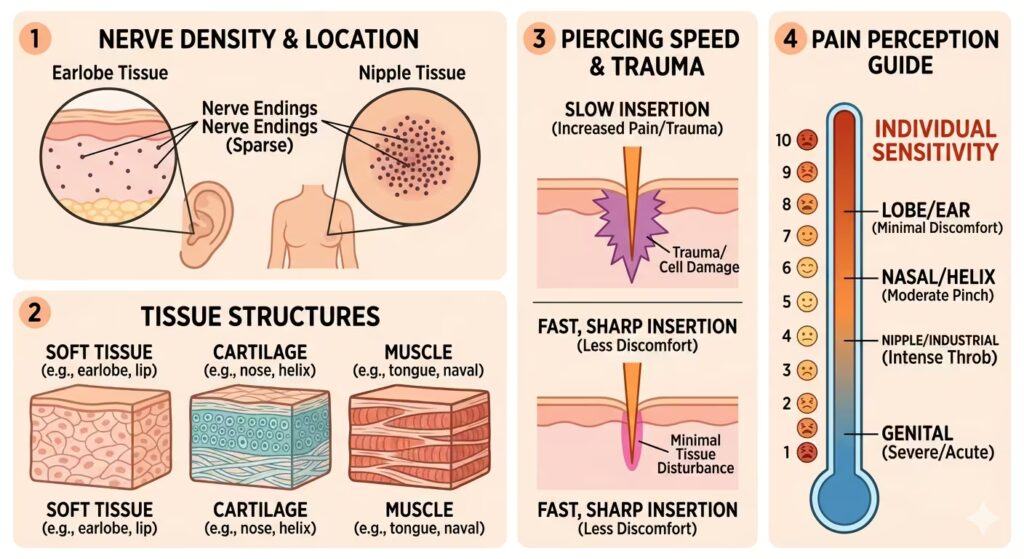
Cheek piercings register lower on the pain scale than most cartilage piercings. Many report a pain level of 4–6 out of 10.
The primary contributor to perceived pain is the dual-needle process — most people get both cheeks pierced in one sitting. Each side is a separate procedure. The cheek tissue itself is soft and pierces relatively easily, but significant swelling typically follows within minutes and can last for several months.
Cheek Piercing Healing Time & the Downsize Process
Full healing takes 6 months to over a year. This is not an estimate that varies much — it’s a consistent reality of this piercing’s location.
Swelling begins immediately after the procedure and can remain substantial for months. Initial jewelry is inserted long (around 1 inch) specifically to accommodate this swelling. Wearing a bar that is too short while the tissue is swollen can embed the jewelry into the cheek.
Unlike most oral piercings, which require a single downsize, cheek piercings typically require three or more. The size progression depends on how each individual’s tissue swells and settles. The first downsize generally happens between weeks 2 and 4. Returning to your piercer rather than attempting to change jewelry at home is important — the channel is fragile throughout the entire healing period.
Leaving a bar that is too long in a healed piercing increases the chance of biting down on it, which accelerates tooth damage.
Cheek Piercing Risks
Cheek piercings carry a more serious risk profile than most other piercings. The following are not rare edge cases — they are well-documented outcomes.
Parotid duct damage: Permanent, irreparable. Results in chronic saliva leakage and susceptibility to infection.
Dental damage: The flat-back disc inside the mouth presses against the teeth and gums during normal mouth movement. A 2020 study published in PMC (Covello et al.) found that 60.4% of oral piercing wearers were unaware their piercing could cause dental issues. Ongoing contact causes enamel chipping, gum recession, and bone loss over time.
Scarring: Cheek piercings nearly always leave visible marks after jewelry removal. The scarring may resemble dimples or may appear as hyperpigmented, irregular, or raised tissue. There is no reliable way to predict the outcome.
Facial nerve damage: A misplaced piercing can contact branches of the facial nerve, causing numbness, loss of taste, or partial facial muscle paralysis. Existing nerve damage does not reverse after jewelry removal.
Infection: The oral environment introduces a constant bacterial load into the channel. Because of the movement involved in chewing and speaking, cheek piercings are especially prone to infection during the healing period.
Rejection and migration: The body can identify the jewelry as a foreign object and push it toward the skin surface over time, distorting its placement and leaving a tract of scarring.
Hypertrophic scarring: Raised scar tissue around the piercing site is common, driven by the constant movement of the cheek during daily activity.
Blood vessel puncture: Major vascular structures run through the cheek. Even experienced piercers using a penlight cannot eliminate this risk entirely. If a blood vessel is hit, the piercing may need to be removed immediately, and significant bruising and swelling will follow.
Surgical closure: Fully healed cheek piercings sometimes fail to close on their own after jewelry removal, particularly when parotid leakage is present. Surgical closure may be required.
Who Should Not Get Cheek Piercing
- People with existing dental problems (gum disease, weak enamel, crown work, or braces)
- Anyone with a history of keloid scarring
- People with compromised immune function
- Those who cannot commit to 12+ months of strict aftercare
- First-time piercees — this is one of the most demanding piercings to heal
Cheek Piercing Jewelry
Best Materials
Implant-grade titanium is the top recommendation for initial jewelry. It is nickel-free, lightweight, hypoallergenic, and corrosion-resistant. It is especially appropriate for a piercing that passes into the oral cavity.
Implant-grade surgical steel (ASTM F138) is acceptable for most people without nickel sensitivity.
14K or 18K solid gold (not gold-plated) is suitable for fully healed piercings.
Avoid plated metals, acrylic, mystery alloys, and any externally threaded jewelry for initial wear.
Jewelry Style
Flat-back labret studs are the standard choice. The flat disc sits flush against the inside of the cheek, minimizing contact with gum tissue and teeth. The external end can be customized with gems, opals, or flat discs.
Straight barbells are used by some piercers as initial jewelry. The ball end inside the mouth should be as small as practical to reduce dental contact.
Curved barbells are not appropriate for cheek piercings.
Gauge
A 12G or 14G needle is standard. Some experienced piercers recommend a minimum of 10G or 12G for the cheeks due to the constant movement — thinner-gauge jewelry in a high-movement site increases the risk of irritation, bumps, and drainage problems. Piercings done at 14G or 16G are more likely to have persistent healing complications.
Cheek Piercing Aftercare
Cheek piercings require care on two fronts simultaneously: the external skin surface and the inside of the mouth.
Exterior cleaning:
- Rinse with sterile saline wound wash (0.9% sodium chloride) twice daily
- Do not use rubbing alcohol, hydrogen peroxide, or antiseptic ointments — these damage healing tissue
- Keep makeup, sunscreen, and skincare products away from the piercing site during healing
- Pat dry with clean gauze after rinsing; avoid cloth towels
Interior (oral) cleaning:
- Rinse the inside of your mouth with alcohol-free saline or an alcohol-free antimicrobial rinse after every meal and drink (other than water)
- Brush the inside of your jewelry gently with a clean soft-bristled toothbrush to prevent plaque buildup
- The Association of Professional Piercers advises against mixing your own sea salt solution — pre-mixed saline at the correct concentration (0.9%) is more reliable and won’t overdry the tissue
Diet during healing:
- Avoid spicy, acidic, and very hot foods and drinks for the first two weeks
- Take small bites and chew slowly — the long initial bar significantly increases the chance of biting it
- Cold foods and drinks can help reduce swelling in the first days
General:
- Do not touch the piercing with unwashed hands
- Do not rotate or twist the jewelry
- Avoid swimming in pools, oceans, or lakes until fully healed
- Keep cosmetics away from the external piercing site
- Sleep on your back or use a travel pillow to reduce pressure on the piercing site
- Avoid oral contact and open-mouth kissing during healing
When to see a doctor: Yellow or green discharge, fever, worsening swelling beyond the first week, or any suspected saliva leakage from the external site all require prompt medical attention.
The Dimple Effect: What to Expect
Cheek piercings do not create anatomically natural dimples. While the jewelry is in place, it physically depresses the cheek tissue, creating an indentation. After removal, the outcome varies significantly:
- Some people are left with indentations resembling natural dimples
- Others develop irregular, hyperpigmented, or raised scars
- Some see no indentation at all
- Outcomes are often asymmetrical even when both sides are pierced identically
This variation results from how individual tissue heals, how the piercing bisects the underlying muscle, and how much scar tissue the body produces. Anyone seeking guaranteed, symmetrical dimples should investigate cosmetic dimple-creation surgery (dimpleplasty) rather than relying on a piercing to produce a predictable result.
Cheek Piercing Cost
A single cheek piercing typically costs $50–$100, not including jewelry. Most people get both sides done, bringing the baseline to $100–$200.
Additional costs include:
- Initial jewelry ($20–$60 for implant-grade titanium labret studs)
- Multiple replacement posts during the downsize process (3+ changes are typical)
- Consultation fee at some studios
Studios in major cities and those with high demand for specialty piercings charge at the top of this range. Given the anatomical risks, choosing based on cost alone is a poor approach — look for a piercer with documented experience performing and healing cheek piercings specifically.
Cheek Piercing FAQs
Can I get just one cheek pierced?
Yes. Single-cheek piercings are less common but entirely possible. Placement still requires the same anatomical assessment to avoid the parotid duct on whichever side is pierced.
Will cheek piercings close after removal?
Sometimes. Fully healed cheek piercings can take a long time to close and may not close completely on their own. The longer a piercing has been worn and the larger the gauge, the less likely it is to close on its own.
Can cheek piercings damage my teeth?
Yes. The internal disc or ball rests against the teeth and gum tissue during all mouth movements. Over time, this causes enamel erosion, gum recession, and in some cases, tooth fracture. A dentist check after healing is recommended, and regular dental monitoring is advisable for long-term wearers.
What if my piercer refuses to do the piercing?
Refusal usually means your anatomy — specifically the position of your parotid duct — doesn’t allow for safe placement. The duct’s path varies between individuals. This is not reversible anatomy, and the refusal protects you from permanent salivary damage.
How do I know if my cheek piercing is infected versus healing normally?
Normal healing involves clear or white discharge that dries to a crust, mild tenderness, and swelling that gradually decreases. Infection produces yellow or green discharge with a foul odor, fever, heat around the site, and swelling that worsens rather than improves after the first week. If those signs appear, see a healthcare provider.
Can cheek piercings cause permanent nerve damage?
Yes. Improper placement that contacts branches of the facial nerve can cause permanent numbness, altered sensation, or partial loss of facial muscle function. If you notice numbness, tingling, or changes in facial movement after being pierced, see a doctor immediately.
Are cheek piercings worth it?
That depends entirely on individual priorities. The aesthetic is distinctive and difficult to achieve any other way. The risk profile — permanent parotid damage, guaranteed scarring on removal, dental wear, long healing — is also genuinely significant. People who are well-informed about the risks and committed to aftercare have successfully healed and worn cheek piercings long-term. People who underestimate the commitment often regret proceeding.