Labret Piercing Quick Facts
| Feature | Detail |
|---|---|
| Placement | Centered below the lower lip, above the chin crease |
| Pronunciation | Lay-BRET |
| Pain Level | 4 out of 10 |
| Healing Time | 6–8 weeks (external); up to 3–6 months (internal) |
| Starting Jewelry | Flat-back labret stud, 14G or 16G |
| Average Cost | $30–$80 (jewelry may be additional) |
| Risks | Gum recession, tooth damage, infection, scarring |
| Aftercare | Saline spray (external) + alcohol-free mouthwash (internal) |
What Is a Labret Piercing?
A labret piercing sits on the skin directly below the lower lip, centered between the lip line and the chin crease. Despite being grouped with lip piercings, it is technically a facial piercing — the needle goes through skin and soft tissue, not the lip itself.

The word labret derives from the Latin labrum, meaning lip. A labret stud consists of a flat disc that rests inside the mouth and a decorative end that sits on the outside.
Piercers center it not just on the lower lip but also at the midpoint of the entire face. This symmetry is critical to the final look.
Labret Piercing Variations
The standard center labret is the most recognizable version, but it has several distinct variations:
Side Labret — The same piercing shifted to the left or right of center. It gives an asymmetric look and is one of the most commonly requested lip piercing styles.
Vertical Labret — A curved barbell passes through the center of the lower lip vertically. Both ball ends remain visible — one below the lip, one on top. It does not enter the mouth at all, eliminating most dental risk.
Double Labret — Two side labret piercings, one on each side. They can sit symmetrically or be offset for a more irregular look.
Ashley Piercing (Inverse Vertical Labret) — The jewelry enters through the outer center of the lower lip and exits inside the mouth. Only one end is visible externally.
Labret Piercing Cultural and Historical Background
Labret piercings have one of the oldest documented histories among facial piercings. Evidence places the practice as far back as 3000 BCE in Mesoamerican cultures.
Among the Aztec and Maya, labret ornaments were carved from gold, jade, and obsidian. They were reserved for rulers, warriors, and high-ranking men — a marker of social power, not decoration.
On the Northwest Coast of North America, the Tlingit and Inuit peoples wore labrets made from walrus ivory, abalone shell, and carved bone. Among some Northwest Coast groups, the piercing was initiated when a girl reached the age of marriage, and the ornament was enlarged over time.
The Makololo of Malawi and the Mursi of Ethiopia practiced lip piercing as an expression of beauty and tribal identity, with the lip disc increasing in size to signal status and maturity.
In pre-Columbian South America, men of the Kayapo tribe wore labret plugs as symbols of warrior status.
The labret entered Western piercing culture in the 1980s and 1990s through the body modification and punk subcultures. It has since become one of the standard lip-piercing options in mainstream aesthetics.
Labret Piercing Pain Level
A labret piercing rates around 4 out of 10 on the pain scale. The area below the lower lip is dense with nerve endings, which makes it slightly more sensitive than ear or nose piercings.
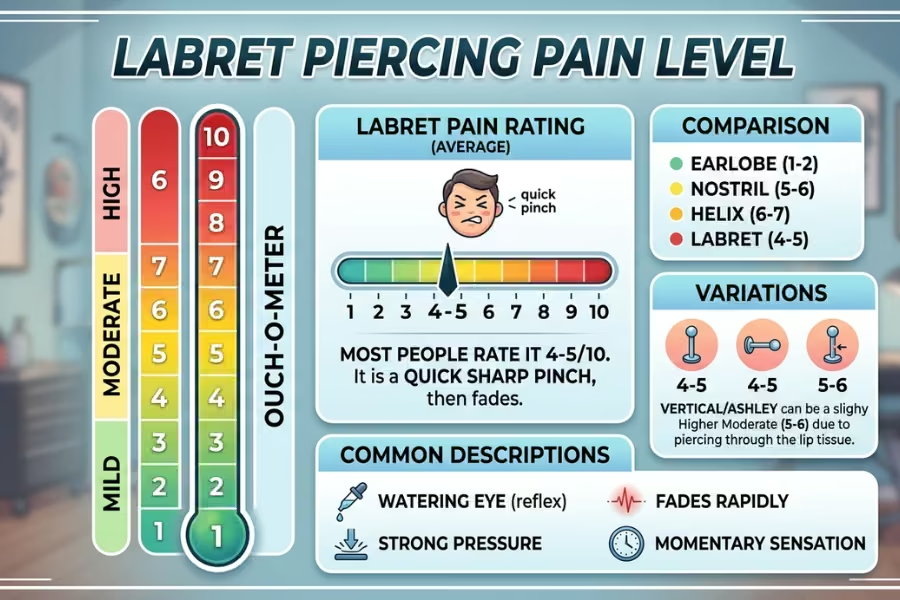
The sensation is a sharp pinch on the needle entry, followed by brief pressure as the jewelry is placed. Most people report the discomfort passes within seconds.
Swelling is the more noticeable side effect, not pain. Expect visible puffiness for 2–5 days after the piercing.
Labret Piercing Healing Time
The external skin heals in approximately 6–8 weeks. The internal channel, however, takes significantly longer — up to 3–6 months to fully stabilize.
A piercing that looks healed on the surface can still be fragile inside. Changing jewelry or stopping aftercare too early at 6–8 weeks is one of the most common causes of complications.
Most professional piercers recommend waiting a full 6 months before treating the piercing as completely healed.
Downsizing: Why It Matters
Your piercer will place a longer-than-necessary bar immediately after piercing to accommodate swelling. This longer post is not your permanent jewelry.
At roughly 3–4 weeks, once swelling subsides, you need to return to your piercer to have the bar downsized to a shorter post.
Skipping this step has direct consequences. A long bar that sits loose in the mouth rubs repeatedly against the gums and lower front teeth. Over time this accelerates gum recession and enamel wear — both of which are irreversible without dental treatment.
Do not attempt to downsize at home. The channel is still healing, and incorrect insertion risks tearing or irritating the tissue.
Labret Piercing Aftercare
Labret piercing aftercare is two-part — external and internal — because the jewelry crosses the boundary between the skin’s surface and the inside of the mouth.
- External (twice daily): Spray the piercing site with a sterile saline wound wash, such as NeilMed or H2Ocean. Gently pat dry with a clean paper towel. Do not use cotton balls — fibers catch on the jewelry and introduce bacteria.
- Internal (after every meal): Rinse with an alcohol-free, fragrance-free mouthwash. Alcohol-based mouthwash dries out healing tissue and slows recovery. Brush teeth twice daily with a soft-bristle toothbrush.
What to avoid:
- Touching the piercing with unwashed hands
- Kissing or oral contact during healing
- Smoking — chemicals delay healing and increase infection risk
- Alcohol consumption, which suppresses the immune response
- Spicy, acidic, or very hot food and beverages
- Swimming in pools, lakes, or the sea
- Applying makeup, sunscreen, or lip balm near the piercing site
Labret Piercing Jewelry: Types, Materials, and Gauge
Starting jewelry: A flat-back labret stud is the standard starting piece. The flat internal disc minimizes pressure on the inner lip tissue. Do not start with a hoop — a ring would need to be excessively large to clear swelling, and it shifts position while healing.
After healing: Once fully healed the labret, you can comfortably wear:
- Seamless rings — circular hoops with no clasp or seam
- Captive bead rings (CBRs) — a hoop held closed by a bead
- Circular barbells — horseshoe-shaped bars with removable ends
Gauge: The standard piercing gauge for labret piercings is 16G, though some piercers use 14G for more tissue support and lower migration risk.
Recommended materials:
- Implant-grade titanium — the top choice; lightweight, nickel-free, anodized in multiple colors, will not tarnish
- Implant-grade surgical steel (ASTM F136) — durable and smooth; contains trace nickel, so not ideal for those with metal sensitivities
- 14-karat or 18-karat solid gold — appropriate for healed piercings only; avoid gold-plated or gold-filled pieces
- Niobium — nickel-free alternative to titanium
Avoid acrylic, mystery alloys, and any jewelry labeled only as “surgical steel” without a material grade — these often contain reactive metals that cause irritation bumps, contact dermatitis, or embedding.
Dental and Gum Risks
The flat disc inside a labret stud sits against the inner lower gum line. This contact is the primary dental concern with standard labret piercings.
Research published in peer-reviewed dental literature confirms this risk is real. A systematic review found that gingival recession occurs in up to 50% of individuals with lip piercings. A University of Alberta study found that lip piercings can lead to alveolar bone loss, gum recession, and in severe cases, frontal tooth loss — with the majority of people surveyed unaware of these risks before piercing.
A case-control study comparing adults with and without oral-adjacent piercings found that those with piercings were more likely to present with uneven tooth wear and enamel damage.
Gum recession exposes tooth roots, which are more vulnerable to decay, temperature sensitivity, and periodontal disease. Once gum tissue recedes, it does not grow back without surgical intervention.
To minimize dental risk:
- Ensure your piercer measures and places the jewelry so it clears your gum line
- Downsize jewelry promptly — a long post that rubs freely does more damage than a fitted one
- Opt for a smaller, smoother flat disc
- Visit your dentist for check-ups every 6 months if you keep the piercing long-term
If the jewelry consistently contacts your teeth or gums, discuss removal with your piercer before permanent damage occurs.
Labret Piercing Infection: Signs and Response
Normal healing symptoms in the first few days include redness, swelling, clear or white discharge (lymph fluid), and mild tenderness.
Signs of infection differ from normal healing:
- Yellow or green discharge
- Skin is hot to the touch around the piercing
- Increasing pain rather than decreasing
- Fever
- Severe or spreading redness
A localized infection should be assessed by a piercer first. A systemic infection — indicated by fever or spreading redness — requires medical attention. Do not remove the jewelry if you suspect an infection; removal can trap bacteria inside the closing channel.
Hiding a Labret Piercing
A healed labret piercing is relatively easy to conceal. Clear or flesh-toned flat-back retainers are available in bioplast or acrylic specifically for this purpose.
During healing, retainers are not appropriate — only implant-grade jewelry should be worn in an unhealed piercing. Once healed, a retainer can be swapped in for work, school, or situations requiring a discreet appearance.
The hole itself closes quickly if jewelry is left out for even a few hours during the early healing period. In a fully healed piercing of several years, the channel often remains open long-term even without jewelry.
Scarring
A labret piercing can leave a small, faint indentation or scar if removed after years of wear. The external entry point is below the lip and visible in conversation.
Scarring is more pronounced if the piercing was rejected, infected, or if jewelry was repeatedly removed and reinserted during healing. Choosing a skilled piercer, using high-quality materials, and consistently following aftercare reduce the risk of scarring.
Keloids — raised, thick scar tissue — are uncommon and linked to genetic predisposition rather than aftercare mistakes.
Labret Piercing Frequently Asked Questions
How much does a labret piercing cost?
The piercing itself typically costs $30–$80. Quality implant-grade jewelry is usually priced separately, starting around $40. Budget $70–$120 total for a safe, properly equipped first piercing.
How long does swelling last after a labret piercing?
Initial swelling typically peaks in the first 24–48 hours and subsides within 2–5 days. Significant swelling lasting beyond a week warrants a check with your piercer.
Can I eat normally after getting a labret piercing?
You can eat, but adjust your approach for the first few weeks. Avoid spicy, acidic, salty, and very hot food. Take small bites and chew slowly on the side of your mouth away from the jewelry. Crunchy foods that could catch the bar — chips, hard bread — are worth skipping until the piercing stabilizes.
Can I change my labret jewelry myself?
Not during healing. Have your piercer handle the initial downsize at 3–4 weeks. Once the piercing is fully healed (typically after 6 months), self-changes are possible with clean hands and appropriate tools, though having a professional change it reduces the risk of irritation or accidental channel damage.
Does a labret piercing damage teeth?
It can, particularly through long-term gum friction from the internal disc. Research confirms gum recession is a documented risk. Proper placement, appropriate jewelry size, and regular dental check-ups considerably reduce this risk.
Will a labret piercing close if I take it out?
A new piercing closes within hours if jewelry is removed. A well-healed piercing that has been in place for several years tends to close slowly and may leave a small permanent indentation. The speed of closure varies by individual skin type and how long the piercing has been established.
What gauge is a labret piercing?
Most piercers use 16G (1.2mm) as the standard. Some use 14G (1.6mm), particularly for clients who want more durability or plan to wear heavier jewelry after healing.
Is a labret piercing the same as a lip piercing?
Not precisely. A standard labret pierces through the skin below the lower lip without touching the lip itself. Many piercings sold as “lip piercings” use the same jewelry style (labret studs), but the placement varies — Monroe, Medusa, and Ashley piercings are distinct placements that each use labret-style hardware.