Quick facts — Snake Bites Piercing
| Placement | Gum recession, Enamel wear, Inner disc contacts teeth and the gum line over time |
| Piercing type | Paired lip piercings (2 total) |
| Pain level | 3–5 / 10 Sharp pinch × 2; cumulative soreness common |
| Healing time | 6–12 weeks external up to 6 months full tissue |
| Starter jewelry | Labret studs (flat-back); 14 or 16 gauge, longer post to accommodate swelling |
| Standard gauge | 14g or 16g · ring diameter 8–10 mm once healed |
| Best materials | Implant-grade titaniumImplant-grade steel14k–18k goldBioplast |
| Aftercare | Sterile saline spray (outside) · alcohol-free saline rinse (inside) · twice daily |
| Cost | $60–$120 for both piercings · jewelry $30–$80 additional |
| Key risk | Gum recession, Enamel wear, Inner disc contacts teeth and gum line over time |
| Not suitable for | Active gum disease · braces · keloid history · jobs with no-facial-piercing policies |
| Variations | Two symmetrical piercings on either side of the lower lip, equidistant from the center |
What are Snake Bite Piercings?
Snake bite piercings are two symmetrical piercings placed on either side of the lower lip, equidistant from the center. The name comes from the visual — two puncture marks that mimic a snake’s fangs sinking into the lip.
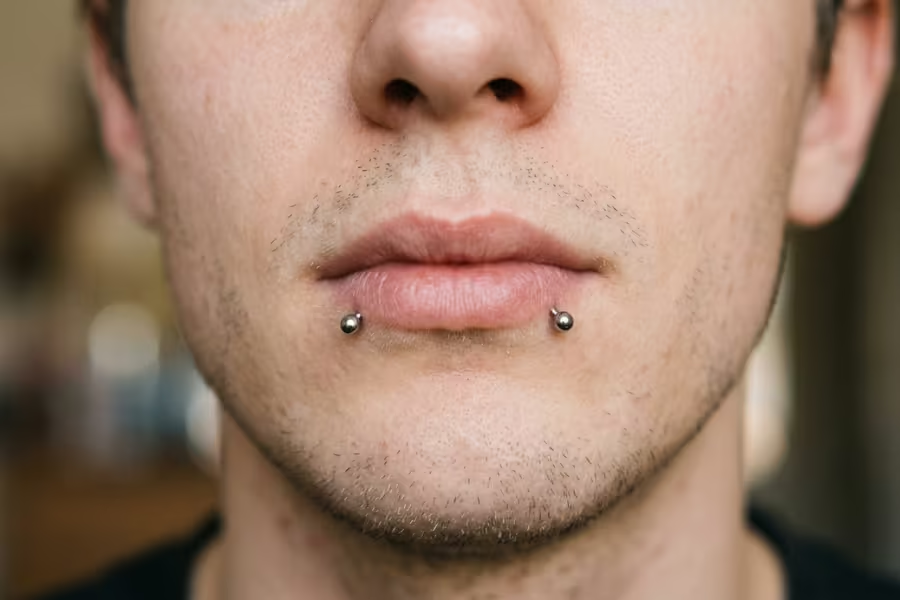
Because it’s two separate piercings, everything about it is doubled: the commitment to healing, the aftercare routine, and the potential for complications.
Types of Snake Bites Piercings
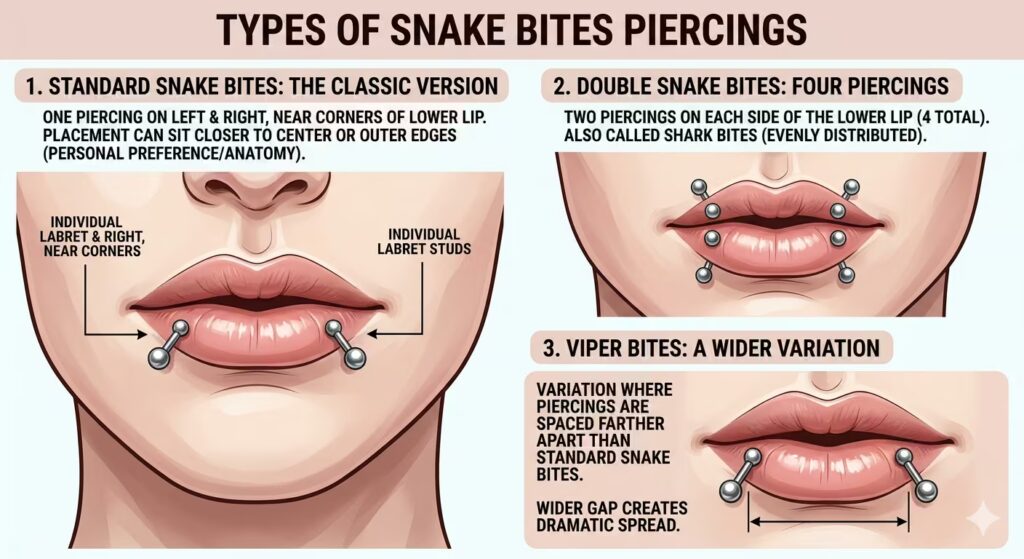
- Standard Snake Bites: The classic version: one piercing on the left, one on the right, placed close to the corners of the lower lip. Placement can sit closer to the center or more toward the outer edges, depending on personal preference and lip anatomy.
- Double Snake Bites: Two piercings on each side of the lower lip, for a total of four. Also called shark bites when the four piercings are evenly distributed across the lip.
- Viper Bites: A variation where the two piercings are spaced farther apart than standard snake bites. The wider gap creates a more dramatic spread across the lower lip.
Snake Bite Piercings Jewelry Types
- Labret Studs: The standard starting jewelry. A flat disc sits inside the mouth against the inner lip, and a decorative top faces outward. Studs minimize movement during healing and are easier to clean than rings.
- Captive Bead Rings (CBRs): A full hoop held closed by a single bead. Durable and secure once healed, but not recommended as starter jewelry since they move more during healing.
- Circular Barbells (Horseshoe Rings): U-shaped bars with a bead on each end. A popular choice after healing for a classic punk aesthetic.
- Seamless hoops: A continuous ring without a break. Sleek and minimal when healed, but harder to insert and adjust.
- Mixing Styles: Wearing one ring and one stud, or two different ring styles, is entirely acceptable once healed. Many people use mismatched jewelry intentionally as part of the look.
Snake Bite Piercings Jewelry Materials
Implant-grade titanium is the safest choice, especially for fresh piercings. It is completely nickel-free, lightweight, and the same material used in surgical implants. It’s the Association of Professional Piercers (APP) ‘s top recommendation for initial jewelry.
Implant-grade steel (316L or ASTM F138) is widely used and generally safe for healed piercings. It does contain trace nickel, so those with known nickel sensitivities should avoid it initially.
Solid 14k or 18k gold (nickel-free alloy) is appropriate for healed piercings. Gold-plated jewelry is not the same — the plating wears off, exposing base metals that can irritate tissue.
Bioplast, a flexible medical-grade plastic, is a useful option for oral piercings. It is fully metal-free and significantly gentler on teeth and gum tissue over the long term.
Nickel should be avoided entirely. The European Center for Allergy Research Foundation identifies nickel as one of the most common contact allergens worldwide. Any jewelry containing nickel as a primary component poses a real sensitization risk.
Gauge and Sizing
Most piercers use a 14 or 16-gauge needle and starter jewelry for snake bites. The starting posts are intentionally longer than the final jewelry to allow for swelling. Once swelling subsides — typically a few weeks in — your piercer can downsize the posts to a better-fitting length. Leaving the longer bar in too long increases the risk of the jewelry catching on food, teeth, or bedding.
The standard ring diameter for snake bites is typically 8mm to 10mm (5/16″ to 3/8″), though this varies by lip size and placement.
Snake Bite Piercings Pain Level
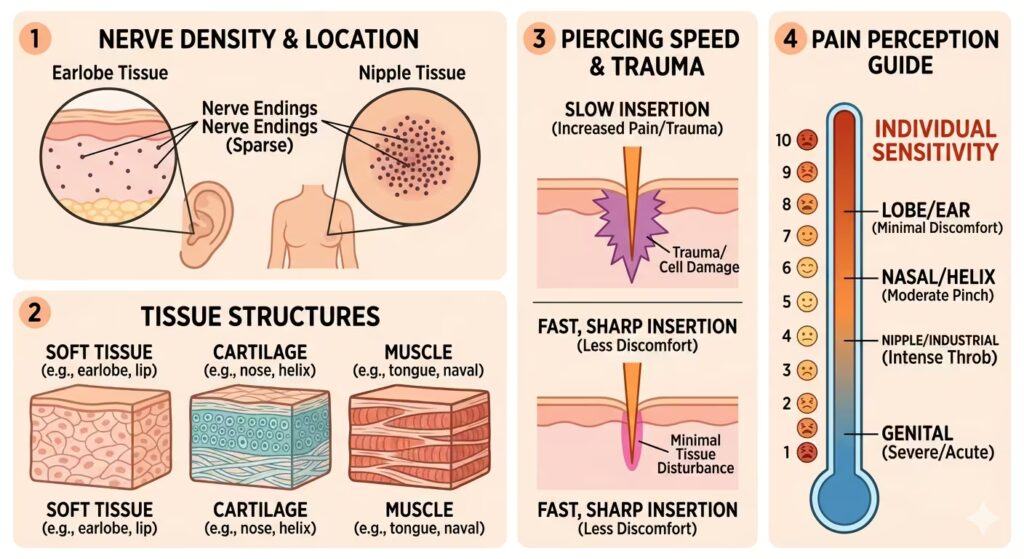
The skin below the lower lip has relatively few nerve endings compared to the lip surface itself. Individual piercings on each side tend to hurt less than Ashley piercings or vertical labrets, which pierce through the lip itself.
Most people describe it as a sharp pinch followed by pressure. Because you’re getting pierced twice, the second puncture comes when the first is already sore — so there is some cumulative discomfort. Tenderness and throbbing are common for the first few days, especially with eating and talking.
On a standard 1–10 pain scale, most recipients rate each individual piercing a 3–5.
Snake Bite Piercings Healing Time
Snake bites typically take 6 to 12 weeks to heal externally. Full internal tissue healing can take up to 6 months.
Because two wounds are healing simultaneously, complications in one can affect the other. Any trauma — snagging on food, sleeping on the piercing, or excessive movement — can restart the inflammatory phase and extend healing significantly.
Do not assume the piercing is fully healed because the exterior looks closed. Downsize jewelry and change pieces only after your piercer confirms healing.
Snake Bite Piercings Aftercare
- Outside the mouth: Clean both piercing sites twice daily with a sterile saline solution (0.9% sodium chloride). Spray directly onto the piercing or apply with a clean gauze pad. Do not use cotton balls — fibers can catch on the jewelry.
- Inside the mouth: Rinse with an alcohol-free saline mouthwash or a simple saltwater solution after eating, drinking anything other than water, and before bed. Avoid mouthwashes containing alcohol — they disrupt the oral microbiome and can delay healing.
What to avoid:
- Touching the piercing with unwashed hands
- Rotating or moving the jewelry — this is a myth that causes trauma, not healing
- Kissing or oral contact during the healing period
- Spicy, acidic, or very hot foods that inflame the tissue
- Alcohol and smoking, both of which restrict blood flow and slow healing
- Swimming in pools, lakes, or the ocean until fully healed
Whitish discharge (lymph fluid) crusting around the jewelry is normal. Yellow or green pus, increasing pain after the first week, or fever are not normal — these require prompt medical attention.
Swelling
Lip piercings swell more than most piercing sites. With snake bites, you have two swollen puncture wounds on the same lip simultaneously. Significant swelling is expected in the first 3–5 days. It can temporarily affect speech and make eating difficult.
Cold foods — ice water, cold fruit, popsicles — help manage swelling in the first 48 hours. Sleep with your head slightly elevated to reduce overnight fluid pooling.
Dental and Oral Health Risks
Snake bites carry real, documented oral health risks that should factor into the decision to get them.
A systematic review published in the European Archives of Paediatric Dentistry (2023) found that lip piercings are specifically associated with gingival (gum) recession. Research cited by multiple dental institutions shows that 44% of people with oral piercings experience gum recession, compared to just 7% of people without oral piercings.
A study published in the Journal of Oral Pathology & Medicine and covered by the University of Alberta found that 26.6% of oral piercing wearers showed measurable gum recession on clinical examination, and 14% had fractured teeth attributable to piercing jewelry contact.
A separate study of 387 individuals with oral piercings (Sapienza University of Rome) found that 42% showed signs of generalized gingivitis, and 22% had tooth fractures related to their piercings, and 46.8% had never been informed of these risks before getting pierced.
The mechanism is straightforward: the flat disc or bead on the inner labret stud rests against the gum line and inner surface of the lower front teeth. Repeated contact wears down enamel and can cause gum tissue to slowly recede, exposing tooth roots and increasing the risk of sensitivity and decay.
To reduce dental risk:
- Choose internally threaded or threadless flat-back labret studs with a low-profile disc. Larger beads create more contact surface.
- Opt for bioplast or PTFE inner discs once healed. Flexible, non-metal discs are dramatically less abrasive on gum tissue.
- See a dentist every 6 months and mention your piercings specifically so gum recession can be monitored.
- Avoid playing with or pressing the jewelry against your teeth — a habit that sharply accelerates enamel wear.
People with existing gum recession, a history of periodontal disease, or current orthodontic treatment should consult a dentist before getting snake bites.
Who Should Not Get Snake Bites
- Anyone with active gum disease or significant gum recession
- People currently wearing braces — jewelry will contact the brackets and interfere with treatment
- Those prone to keloid scarring — the face is a high-risk site
- People with a history of piercing rejection, particularly on the lip or face
- Those in workplaces that prohibit visible facial piercings — snake bites are not easily hidden and cannot be removed during healing
Snake Bite Piercings Cost
Snake bites cost more than single piercings because you are paying for two. Expect to pay $60–$120 for both piercings combined at a reputable studio, not including jewelry. High-quality starter jewelry — implant-grade titanium or solid gold — adds $30–$80 to that.
Pricing varies by studio reputation, piercer experience, and location. Tipping your piercer is standard — 15–20% is appropriate.
Do not choose a piercer based on price. Placement errors on symmetrical piercings are immediately visible and difficult to correct.
Snake Bites vs. Similar Piercings
Spider Bites: Two piercings clustered closely together on one side of the lower lip — not symmetrical. Often confused with snake bites, but the placement is entirely different.
Shark Bites: Four piercings across the lower lip — essentially double snake bites. Two on each side.
Angel Bites: Two piercings on the upper lip, mirroring the placement of snake bites on the lower lip.
Cyber Bites: One upper lip piercing (Medusa placement) combined with one lower lip center piercing (labret). Entirely different configuration.
Scarring
Removing snake bites may leave small marks at each puncture site. Whether scarring is noticeable depends on how long the piercings were worn, individual skin type, and how well aftercare was followed. Most people report small, barely visible indentations. Even minor marks can be visible on the face up close.
Keloids — raised, overgrown scar tissue — are a genetic condition, not a reaction to aftercare. If no one in your immediate family has keloids and you have never developed one, a piercing bump is almost certainly a hypertrophic scar (irritation bump), which resolves with proper care.
Snake Bite Piercings FAQs
Can I get only one side done first?
Yes. Getting one piercing at a time is a valid option, particularly if cost or discomfort is a concern. Just communicate this to your piercer so placement is marked with the other side in mind for future symmetry.
How long until I can kiss or have oral contact?
Wait until both piercings are fully healed — a minimum of 8–12 weeks, ideally confirmed by your piercer. Oral contact introduces bacteria and physical pressure to healing tissue.
Can I switch to rings right away?
No. Rings move significantly more than studs, which causes friction and delays healing. Most piercers recommend starting with labret studs and transitioning to rings only after full healing.
Will snake bites affect my speech?
Mild changes in speech are common during the first week while the tongue and lips adapt to new jewelry. This typically resolves as swelling decreases. Persistent speech changes after the first few weeks are not normal.
How do I clean the inside of the piercing?
Rinse with alcohol-free saline mouthwash or saltwater after eating and before bed. Do not use standard mouthwash with alcohol — it damages healing tissue and disrupts oral flora.
Do both piercings have to be done at the same time?
No, but doing them together ensures the piercer can mark and execute symmetrical placement in one session. Doing them separately introduces more room for alignment error.
Will I need to change my toothbrush?
Use a soft-bristled toothbrush during healing to minimize gum irritation near the inner disc. Brush gently around the piercing area and rinse afterward.
Can snake bites be hidden for work?
Clear or flesh-toned retainers can reduce visibility, but snake bites on the lower lip are difficult to fully conceal. Retainers should only be used once the piercing is fully healed — inserting retainers in a fresh piercing risks irritation and infection.