Frowny Piercing Quick Facts
| Info | Details |
|---|---|
| Also known as | Anti-smiley, lower lip frenulum piercing |
| Placement | Frenulum connecting the lower lip to the front gum |
| Pain level | 3–4 out of 10 |
| Healing time | 4–8 weeks (oral side); up to 12 weeks fully |
| Cost | $30–$80 |
| Jewelry gauge | 16G or 18G |
| Jewelry length | 5/16″ to 1/2″ |
| Starter jewelry | Small captive bead ring or curved barbell |
| Best materials | Implant-grade titanium (ASTM F-136), niobium, solid 14k/18k gold |
| Anatomy-dependent | Yes |
| Longevity | Often 1–2 years before migration |
| Main risks | Gum recession, tooth damage, rejection, migration, infection |
What Is a Frowny Piercing?
A frowny piercing passes through the lower lip frenulum. This is the thin band of tissue connecting the inside of your bottom lip to your front gum.
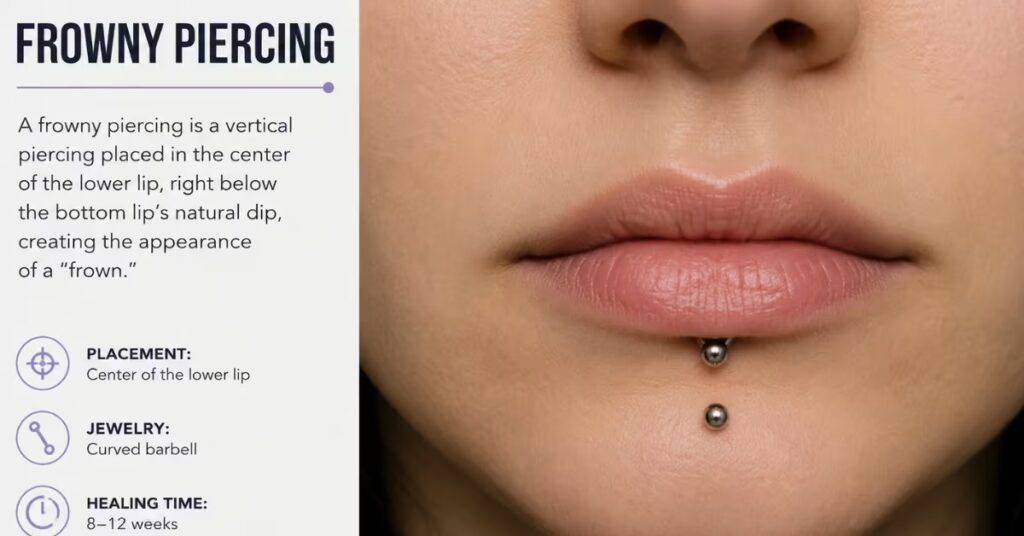
The jewelry sits low inside the mouth, just behind the lower front teeth. It stays hidden most of the time, only flashing briefly when the lower lip pulls down.
Placement and Anatomy
The piercing crosses the frenulum horizontally. The jewelry rests directly against the gum line of the lower incisors. This close contact with teeth and gums is what drives most of the long-term risks.
The lower frenulum is usually smaller and thinner than the upper one. Not everyone has enough tissue to support a piercing here. A piercer will pull your lower lip down and examine the webbing before agreeing to do it.
Frowny Piercing Pain Level
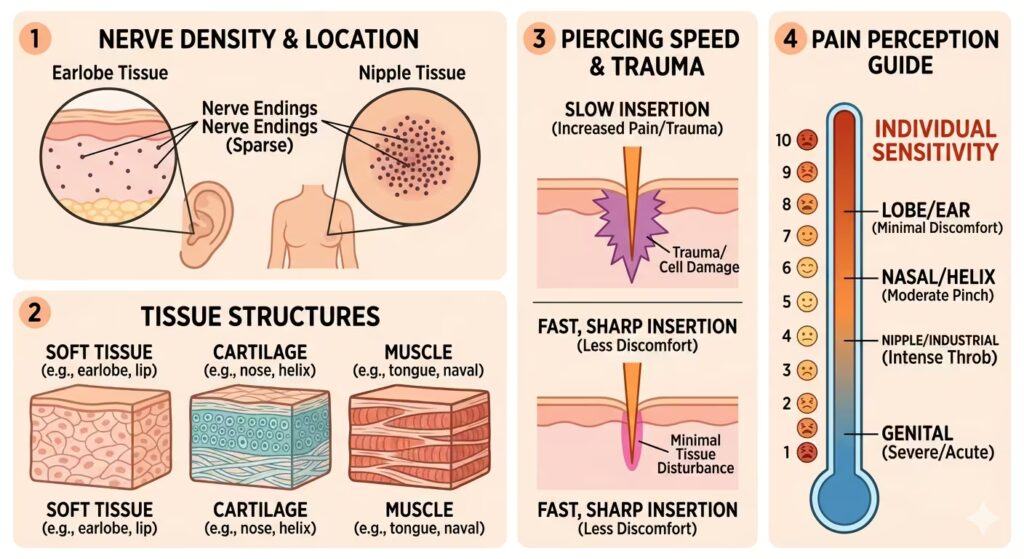
Most people rate the initial pinch a 3 or 4 out of 10. The frenulum is thin and contains few nerve endings, so the needle passes through quickly. Pressure from the piercer’s grip can feel more intense than the puncture itself.
Tenderness, light bleeding, and swelling follow for the first three to five days. The area stays sensitive to brushing, eating, and speaking during the first week.
Frowny Piercing Cost
A frowny piercing costs $30 to $80 in most studios. Price depends on location, the piercer’s experience, and the jewelry chosen. Implant-grade titanium and gold sit at the upper end. Tips are standard at 20% or more.
Frowny Piercing Healing Time
Surface healing takes 4 to 8 weeks. Full internal healing can run up to 12 weeks. Oral mucosa heals faster than skin because the mouth has strong blood supply and rapid cell turnover.
Swelling drops sharply after the first week. The starter jewelry should be downsized once swelling subsides, usually around week four. Leaving a long barbell in place after the swelling fades increases contact with teeth and gums.
Jewelry for a Frowny Piercing
Starter jewelry is usually a 16G or 18G captive bead ring or curved barbell. Length runs from 5/16″ to 1/2″ depending on the anatomy.
Healed jewelry options include:
- Curved barbells — sit closest to the frenulum and reduce gum contact
- Seamless rings — clean look, no bead to press against teeth
- Fixed bead rings — bead is welded in place
- Captive bead rings — common, but the bead shape raises dental risk
- Circular barbells (horseshoes) — popular for the visible accent
Materials to use: implant-grade titanium (ASTM F-136), niobium, solid 14k or 18k gold.
Materials to avoid: plated jewelry, sterling silver, nickel-containing steel, acrylic. <a href=”https://www.ncbi.nlm.nih.gov/pmc/articles/PMC10657282/”>A 2023 systematic review</a> found that metal ions from oral piercings leach into surrounding tissues and can cause hypersensitivity reactions and mucosal changes.
Frowny Piercing Risks
The frowny piercing has well-documented dental and tissue risks. Most research on lip piercings groups frownies with other lower-lip piercings, and the findings are not minor.
- Gum recession. A clinical study of 389 young adults found gingival recessions in 26.6% of pierced participants, mostly in the mandibular incisor area. Another study of 387 oral piercing wearers found that 20% had 3–4 mm recessions and 42% showed signs of generalized gingivitis. Recession does not grow back without surgical gum grafting.
- Tooth fracture and enamel wear. The same 389-patient study reported 15 fractured teeth in 11 pierced participants. The 387-patient study found 22% had tooth fractures linked to their piercing.
- Migration and rejection. The frenulum is thin connective tissue with low blood supply. Jewelry can slowly cut through and grow out. Frownies are rejected more often than smileys because the lower frenulum is typically smaller.
- Tearing. A snag from a toothbrush, fork, or finger can tear the frenulum.
- Infection. The mouth hosts hundreds of bacterial species. The American Dental Association notes oral piercings are particularly risky because of this bacterial load.
- Plaque and tartar buildup on the jewelry. Internal jewelry collects deposits faster than external piercings. This irritates the surrounding tissue.
- Metallic taste and mucosal changes. Linked to metal ion release in the systematic review cited above.
Who Should Skip This Piercing
Avoid the frowny if you have:
- A thin or small lower frenulum
- Existing gum recession or periodontal disease
- Braces, retainers, or active orthodontic work
- Veneers, sealants, or bonding on the lower front teeth
- A history of enamel erosion or sensitive teeth
- Bleeding disorders or an immunocompromising condition
- Pregnancy or breastfeeding
A piercer who agrees to the procedure without checking your anatomy is not the right piercer.
Frowny Piercing Aftercare
Twice daily:
- Rinse with sterile saline solution
- Brush with a fresh soft-bristle toothbrush
- Avoid toothpaste with peroxide or whitening agents
After every meal, snack, or drink other than water:
- Rinse with alcohol-free mouthwash
A homemade saline rinse: dissolve 1/4 teaspoon of non-iodized sea salt in 8 oz of warm distilled water.
Avoid during healing:
- Smoking and vaping
- Alcohol, including alcohol-based rinses
- Spicy, acidic, hot, hard, or crunchy foods
- Kissing and oral sex
- Sharing drinks, utensils, and lip products
- Chewing gum, pens, or fingernails
- Playing with the jewelry using fingers or tongue
- Pulling the lip down to show people
Signs of Trouble in Frowny Piercing
- Yellow or green pus
- Swelling that worsens after the first week
- Bleeding that won’t stop
- Fever
- The jewelry is sitting visibly closer to the lip edge
- Gum tissue pulling back from the lower front teeth
- A frenulum that looks thinned or stretched
Migration or recession is a signal to remove the jewelry. Do not yank it out yourself if it’s partially rejected. See your piercer.
Dental Check-Ups While Wearing a Frowny
The American Dental Association advises against oral piercings, but if you wear one, regular dental visits help catch damage early.
Schedule a check-up every six months and ask your dentist to look at:
- Recession on the lower front teeth
- Enamel wear on the back of the incisors
- Plaque buildup on the jewelry
- Soft tissue changes around the frenulum
How Long a Frowny Lasts
Most frownies are semi-permanent. Many last 1 to 2 years before migration or tearing ends them. Some last longer with careful jewelry choice and gentle handling. Removal leaves a small dot scar inside the lip that usually fades.
Frowny vs Smiley
A smiley pierces the upper lip frenulum. A frowny pierces the lower one. Smileys are visible when smiling. Frownies are mostly hidden and only peek out during exaggerated expressions.
Smileys are more common because the upper frenulum is usually thicker. Both carry the same dental risks since both involve metal sitting against the front teeth and gums.
Frowny Piercing FAQs
Does a frowny piercing actually look like a frown?
No. The name comes from it being the opposite of the smiley. The jewelry forms a small curve, not a frown shape.
Can people see a frowny piercing when your mouth is closed?
Almost never. It only shows when the mouth is wide open, laughing, or when the lower lip is pulled down.
How bad does a frowny piercing hurt?
The puncture is brief and rates around a 3 or 4 out of 10. Pressure from the clamp can feel more uncomfortable than the needle itself.
Can you get a frowny piercing with braces?
No. The jewelry can catch on brackets and wires, and the added metal-on-metal contact accelerates enamel damage.
Will a frowny piercing affect speech?
Slightly, for the first day or two. Most people adjust within 48 hours.
Can a frowny piercing close up?
Yes. Fresh frownies can close within hours. Healed ones may take days to weeks after the jewelry is removed.
Is gum recession from a frowny piercing reversible?
No. Lost gum tissue does not regrow without a surgical gum graft.
What is the rejection rate for a frowny piercing?
There is no exact published rate, but rejection and migration are common because of the thin frenulum and small surface area.
Can you use Listerine on a fresh frowny piercing?
No. Alcohol dries and irritates healing tissue. Use alcohol-free mouthwash only.
Can you drink coffee after a frowny piercing?
Wait at least 24 to 48 hours, then keep coffee lukewarm for the first week.
Will a frowny piercing damage my teeth?
It can. Research links lip piercings to enamel wear, gum recession, and tooth fracture, especially over time.
How old do you have to be to get a frowny piercing?
Most studios require 18 or 16 with parental consent. Local laws vary.
Can I eat right after getting a frowny piercing?
Yes, but stick to soft, cool foods like yogurt, mashed potatoes, or smoothies for the first 24 to 48 hours.
Does smoking affect frowny piercing healing?
Yes. Smoke and chemicals irritate the wound, slow healing, and increase the risk of infection.
Can the frowny piercing make my breath smell bad?
It can if plaque collects on the jewelry. Daily cleaning prevents it.
Will I have a scar after removing a frowny piercing?
A small dot scar may remain inside the lip. It’s hidden and usually fades over time.
Can a frowny piercing be done at home?
No. The placement is too small and too close to teeth and gums to be safe outside a sterile studio.
Is a frowny piercing safe for sensitive gums?
No. Existing gum issues will worsen quickly with metal pressing against the area.