Quick Snapshot
| Detail | What to Know |
|---|---|
| Placement | Crus of the helix — the innermost cartilage fold sitting just above the ear canal |
| Pain Level | 5–6 / 10 (moderate; sharp pressure rather than a quick pinch) |
| Healing Time | 6–12 months (cartilage heals slowly and from the outside in) |
| Average Cost | $30–$80 for the procedure + $20–$200+ for jewelry |
| Starting Gauge | 16G (1.2 mm) most common; some piercers use 14G (1.6 mm) |
| Starting Diameter | 8–10 mm hoop; 6–8 mm curved barbell |
| Best Initial Jewelry | Implant-grade titanium (ASTM F-136), niobium, or 14k+ solid gold |
| Migraine Relief? | Anecdotal only — not endorsed by the American Migraine Foundation or Cleveland Clinic |
What Is a Daith Piercing?
A daith piercing passes through the crus of the helix, the small horizontal fold of cartilage that sits directly above your ear canal opening. Because that fold tucks inward, a properly placed daith looks like the bottom of the ring is emerging straight out of the canal — that “hugging the ear” look is the entire visual signature of the piercing.
The name has an interesting origin. The piercing was developed in 1992 by piercer Erik Dakota and a client who was studying Hebrew at the time. She suggested the word da’at (דעת), meaning “knowledge,” because she felt the piercer had to be remarkably clever to figure out how to do it. The piercing first appeared publicly in Fakir Musafar’s Body Play magazine that same year, alongside the industrial and large-gauge conch.
It went mainstream around 2015–2016, when viral social media posts started claiming it could cure migraines — a claim we’ll examine carefully later, because the evidence is far more mixed than most articles admit.
What Does a Daith Piercing Look Like?
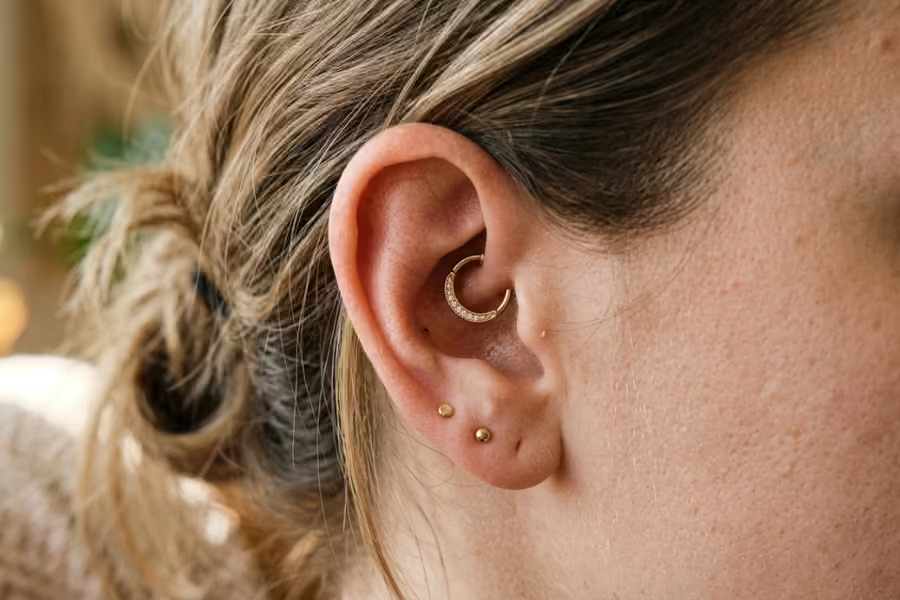
The daith is a single, unique placement — there’s no room for multiples in the same fold. But because the cartilage curves so dramatically, it’s one of the most photogenic piercings on the ear. Popular looks include:
- A simple, seamless hoop or captive bead ring that appears to come right out of the ear canal
- A heart-shaped ring (a Maria Tash signature look that drove much of the trend)
- A curved barbell with gemstone ends for a subtler finish
- Hinged clicker rings with paved CZs, opals, or diamonds for a high-jewelry effect
Because the placement is recessed, daith jewelry tends to be more visible from a front-facing angle than from the side, which is the opposite of how most ear piercings show off.
How a Daith Piercing Is Done (Step by Step)
A reputable studio will follow roughly this sequence. Knowing it ahead of time makes the appointment much less intimidating.
- Consultation and anatomy check. Not every ear has a daith fold deep or thick enough to safely take a piercing. A good piercer will examine your ear and tell you honestly if your anatomy isn’t suited — this is one of the most important things to look for in a studio.
- Sterilization. The area is cleaned with a medical-grade antiseptic (commonly chlorhexidine or a similar solution). The piercer washes their hands and wears fresh gloves.
- Marking. A sterile surgical pen marks the entry and exit points. You’ll typically be asked to confirm placement in a mirror before anything else happens.
- Piercing. A sterile, single-use hollow needle is used — never a piercing gun. Guns crush cartilage and can cause shattering, blunt-force trauma, and dramatically higher infection rates. Some piercers use a curved needle specifically for the daith; others use a straight one with a receiving tube. Most use 14G or 16G.
- Jewelry insertion. Your starter jewelry is inserted immediately. For initial healing, the piercer should use a slightly larger hoop or longer barbell than the final desired size to leave room for swelling.
- Cleanup and aftercare instructions. You’ll be sent home with written aftercare and usually a saline spray.
The whole procedure takes only a few seconds of actual piercing time, but plan on 20–45 minutes in the studio overall.
How Much Does a Daith Piercing Cost?
Pricing varies dramatically by city and studio, but here’s a realistic range based on current rates at Association of Professional Piercers (APP) member studios:
- United States: $30–$80 for the piercing; $30–$300+ for jewelry. At high-end studios like Maria Tash, the piercing fee starts at around $40, and the gold jewelry frequently runs into the triple- or even quadruple-digit range.
- United Kingdom: £20–£40 per ear; jewelry from £25 (titanium) up to several hundred pounds for solid gold pieces.
- Canada and Australia: Roughly CA$50–$100 / AU$60–$120, plus jewelry.
Why budget studios can cost more in the long run: Cheap piercings often come with low-quality jewelry that contains nickel or other irritants. Allergic reactions, migration, and infections are far more common with these, and the cost of replacement jewelry plus medical visits will eat any savings. Always ask the studio: Is your jewelry implant-grade ASTM F-136 titanium or solid 14k+ gold? If they can’t answer confidently, walk out.
How Painful Is a Daith Piercing?
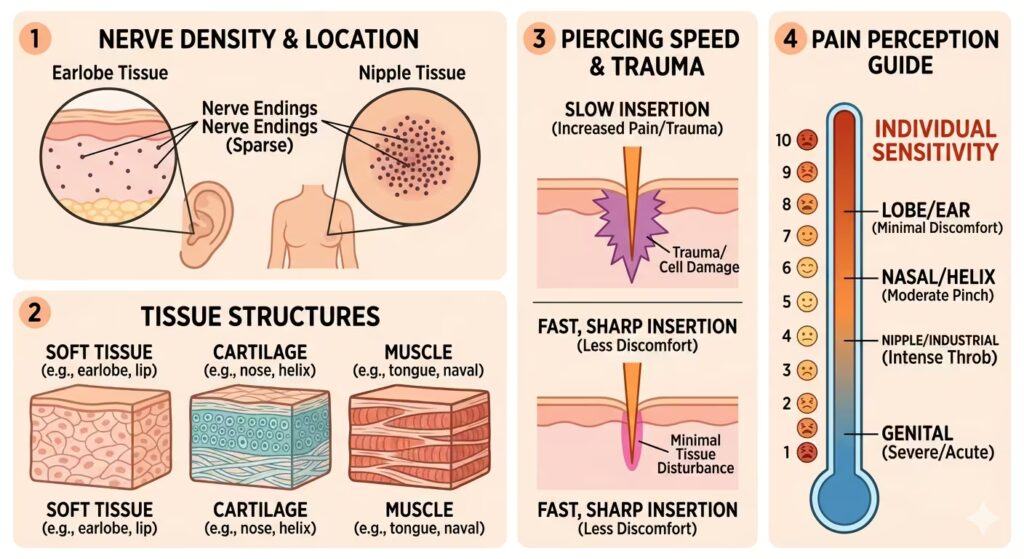
Honestly? It’s one of the moderately painful ear piercings — most clients rate it 5 or 6 out of 10. The sensation differs from that of a lobe or helix piercing. Instead of the quick, sharp pinch you get from thinner tissue, the daith feels like firm, sustained pressure as the needle pushes through the dense cartilage fold. Many people also report a distinct crunch sound, which can be more startling than the actual pain.
Pain after the piercing tends to settle into a dull, throbbing ache for the first three to five days, often radiating into the jaw and side of the head. If you’re particularly anxious about the pain, a lidocaine-based numbing cream (such as EMLA, available by prescription in many countries) applied 30–60 minutes before the appointment can take the edge off, though it won’t eliminate the sensation entirely. Tell your piercer beforehand if you plan to use one.
People report varied pain experiences. Cartilage density, your individual nerve sensitivity, where you are in your menstrual cycle (if applicable), and whether you’ve eaten and hydrated all influence how it feels.
Daith Piercing Healing Stages: What to Actually Expect Over 6–12 Months
Cartilage piercings heal slowly and unevenly because cartilage has a very limited blood supply — that’s the single most important fact to internalize. The skin around the piercing may look healed long before the actual cartilage channel is stable, which is why piercers warn against changing jewelry too early.
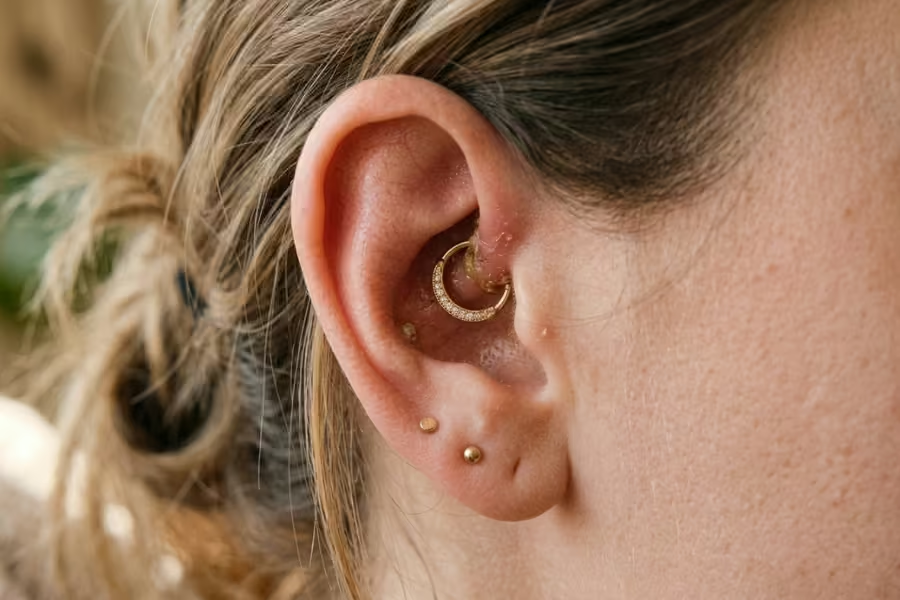
Here’s a realistic timeline:
- Weeks 1–2 (Initial Inflammatory Stage) Expect redness, swelling, warmth, and tenderness. Some bleeding in the first 24–48 hours is normal. A clear or slightly yellow lymph fluid will leak from the piercing and dry into crusts around the jewelry — this is healing tissue, not pus. Sleeping is the hardest part.
- Weeks 3–8 (Settling Stage) Visible swelling subsides. Crusting continues but becomes less frequent. The piercing may still feel sore if bumped, snagged on a hairbrush, or slept on. This is also when irritation bumps tend to appear if you’ve been touching, twisting, or sleeping on it.
- Months 2–6 (Internal Healing) The outside of the piercing looks healed. The inside is not. Tunnel formation inside the cartilage is still happening. This is when most people make their biggest mistake — changing jewelry too early — and trigger a fresh round of irritation, bumps, or even partial closure.
- Months 6–12 (Full Healing) The piercing channel becomes fully stable. You can change jewelry safely (ideally with a piercer’s help the first time). The Association of Professional Piercers and most studios recommend waiting at least 12 weeks before any cartilage jewelry change, and 6+ months for a comfortable swap on the daith specifically.
Daith Piercing Aftercare: Exactly What to Do (and What Not to Do)
The single most evidence-based aftercare protocol comes from the Association of Professional Piercers, and it’s refreshingly simple. The biggest aftercare mistake people make is doing too much, not too little.
Do this
- Clean twice daily with sterile saline solution (0.9% sodium chloride) — either spray it directly or soak a clean gauze pad and hold it against the piercing for 2–3 minutes. NeilMed Piercing Aftercare and similar sterile sprays are ideal.
- Always wash your hands before touching the piercing for any reason.
- Pat dry with disposable paper products. Cloth towels harbor bacteria and snag on jewelry.
- Sleep on your opposite side. A travel pillow with a hole cut out of the center (sometimes called a “piercing pillow”) works wonders for side sleepers.
- Eat well, sleep well, stay hydrated. Healing requires resources — vitamin C, zinc, and adequate protein all help wound healing.
- Leave the original jewelry in until fully healed.
Don’t do this
- Don’t use rubbing alcohol, hydrogen peroxide, tea tree oil, Bactine, antibacterial ointments like Neosporin, or “ear care solutions” sold at piercing kiosks. All of these damage healing tissue or trap moisture against the wound.
- Don’t twist or rotate the jewelry. This is an outdated myth — moving the jewelry tears the delicate healing tunnel and is a leading cause of irritation bumps.
- Don’t sleep on it. Pressure during sleep causes “pillow piercings” — angled, migrated, bumpy results.
- Don’t use earbuds or over-ear headphones for the first 6–8 weeks. They press on, irritate, and contaminate the piercing.
- Don’t submerge it. Skip pools, hot tubs, lakes, oceans, and long baths for at least the first month. Showers are fine.
- Don’t change the jewelry early. This is the most common cause of unnecessary complications.
The Migraine Question: What Does the Research Actually Say?
The theory: the daith fold is innervated by the auricular branch of the vagus nerve (sometimes called Arnold’s nerve), and the FDA has cleared transcutaneous vagus nerve stimulation devices for migraine relief. Continuous pressure on that area, the argument goes, mimics that stimulation and could ease chronic migraine.
It’s a plausible mechanism. But plausibility isn’t evidence.
What the actual studies show:
- A 2017 case report published in Frontiers in Neurology described a single 54-year-old man with refractory chronic migraine who experienced significant improvement after a bilateral daith piercing. The authors specifically wrote that “daith piercing cannot be recommended as migraine treatment” and that vagal modulation was speculative. (Cascio Rizzo et al., 2017)
- A 2021 review published in Cureus titled “Daith Piercing: Wonder Treatment or Untested Fad?” concluded that “the evidence is currently lacking” and noted the German national migraine treatment guidelines recommend against daith piercing due to insufficient evidence. (Bhandari et al., 2021)
- A London Migraine Clinic survey found 75% of respondents reported significant migraine improvement after daith piercing — but the same researchers acknowledged this could not be distinguished from a placebo effect in an uncontrolled survey.
- Multiple reviews report that even when patients experience initial relief, symptoms typically return within weeks to months.
What major medical organizations say:
- The American Migraine Foundation does not recommend daith piercing as a migraine treatment, citing risks of infection and pain that outweigh unproven benefits.
- The Cleveland Clinic states there is no evidence to support the claim.
- WebMD’s medical reviewers note that more than one-third of people who get daith piercings experience complications such as infection.
An additional point that’s almost never mentioned: Acupuncturist Dr. Will Foster (cited by the American Migraine Foundation) and other practitioners note that the actual digestive-system pressure point believed to be involved sits roughly 1 cm away from where most daith piercings are placed. Even if the pressure-point theory were correct, most daith piercings don’t hit it.
The honest summary: If you want a daith piercing because it’s beautiful, get one. If you’re considering it specifically as a migraine treatment, know that you’re betting on anecdote against the position of every major neurology body, and that even if it works, results may be temporary or due to a placebo. Talk to a neurologist first, and consider FDA-cleared vagus nerve stimulation devices, which have clinical trial evidence to support them.
Daith Piercing for Anxiety: Same Story
The same vagus nerve theory underlies claims that the daith helps with anxiety. The vagus nerve is genuinely involved in parasympathetic (“rest and digest”) activation, and vagal stimulation has been studied as an anxiety treatment. But there is no controlled clinical trial evidence specifically supporting daith piercings for anxiety relief, and any benefit is currently considered anecdotal or placebo-mediated.
If you’re getting it for the look and the slim chance of secondary benefit, that’s a reasonable choice. If you’re getting it because you’re hoping to replace evidence-based anxiety treatment, please talk to a healthcare provider first.
Risks and Side Effects (The Numbers People Don’t Tell You)
- A large 2025 cohort study published in The Laryngoscope found that cartilage ear piercings have 2.2 times higher odds of complications than lobe piercings, with a 40.2% complication rate in cartilage piercings versus 25.4% in lobe piercings.
- An older but frequently cited study in cartilage piercing complications among nurses (Tweeten and Rickman) found a 32% complication rate, with infection accounting for 77% of those cases.
- Among women aged 18–28, infection after ear cartilage piercing was significantly more common than after earlobe piercing (41.4% vs 29.6%, p = 0.0004).
The most common and serious risks for the daith specifically are:
- Bacterial infection. Cartilage has a poor blood supply, which makes infections both more likely and harder to clear once they take hold. Symptoms include increasing redness spreading outward, severe swelling, warmth, throbbing pain that worsens rather than improves, and yellow-green, foul-smelling discharge (distinct from the normal clear/white lymph fluid).
- Perichondritis — infection of the lining of the cartilage. This is a medical emergency that can cause permanent ear deformity (“cauliflower ear”) if untreated. Pseudomonas aeruginosa is a common culprit and requires specific antibiotics.
- Irritation bumps (granulomas). Small, fluid-filled reddish bumps next to the piercing site. Usually caused by trauma, low-quality jewelry, or sleeping on the piercing. Not the same thing as a keloid. Most resolve with improved aftercare.
- Keloids. True keloids are raised scars that grow beyond the original wound boundary. They are genetic — you’re at risk only if you have a personal or family history. Cartilage piercings are an established risk factor; one study found 100% of cartilage piercings in keloid-prone patients developed infection during healing.
- Migration and rejection. The body slowly pushes the jewelry toward the surface. Less common in the daith than in surface piercings, but possible — especially with poor-quality jewelry.
- Allergic reactions. Most often to nickel. Symptoms include itching, redness, and weeping that don’t resolve with cleaning. Switch to implant-grade titanium or solid gold.
- Rare but serious systemic complications. Toxic shock syndrome, sepsis, bloodborne diseases (hepatitis B, hepatitis C, HIV) from contaminated equipment, and tetanus have all been documented from improper piercing procedures. These are rare in licensed studios but are a real reason to avoid friend-with-a-needle scenarios.
Choosing Daith Piercing Jewelry: What to Buy and What to Avoid
For a fresh daith piercing, the metal matters enormously. The Association of Professional Piercers recommends these materials for initial piercings:
- Implant-grade titanium (ASTM F-136 or ISO 5832-3). The gold standard. Lightweight, hypoallergenic, MRI-compatible, and won’t react with anything.
- Implant-grade steel (ASTM F-138). Slightly heavier than titanium and contains a small amount of nickel — fine for most people but avoid if you have any nickel sensitivity.
- Solid 14k or 18k gold (nickel-free). Beautiful but expensive. Never gold-plated, gold-filled, or vermeil for a fresh piercing — the plating wears off into the wound.
- Niobium. Hypoallergenic and inert. Less common but excellent.
Avoid for fresh piercings: “Surgical steel” without an ASTM rating, sterling silver (tarnishes and reacts with body fluids), gold-plated or gold-filled anything, and especially the cheap mystery-metal jewelry sold at mall kiosks and on Amazon for $5.
Sizing for the daith
| Spec | Recommended |
|---|---|
| Gauge | 16G (1.2 mm) most common; 14G (1.6 mm) for thicker anatomy |
| Hoop inner diameter | 8–10 mm initial; 6–8 mm after healing for snug fit |
| Curved barbell length | 6–8 mm |
Your piercer should measure your specific anatomy — these are guidelines, not guarantees.
Style options
- Captive bead rings (CBRs) — classic, simple, edgy
- Seamless or segment hoops — clean and minimalist
- Hinged clicker rings — easy to insert, popular for paved gemstone designs
- Curved barbells — discreet, lower-profile look
- Heart-shaped rings — the Maria Tash signature look
Who Should Not Get a Daith Piercing?
Skip or postpone the daith if you:
- Take blood thinners (warfarin, apixaban, daily aspirin therapy)
- Have a bleeding disorder like hemophilia or severe thrombocytopenia
- Have a personal or family history of keloids
- Have eczema, psoriasis, or active dermatitis on or near the ear
- Have a history of poor wound healing (uncontrolled diabetes, immunocompromise)
- Are currently undergoing chemotherapy or radiation
- Are pregnant (most studios decline to pierce during pregnancy due to infection risk)
- Have ear anatomy without a sufficient daith fold (your piercer will check)
- Need an MRI in the near future and don’t want to remove the jewelry (note: implant-grade titanium is MRI-safe; surgical steel may not be)
How to Tell If Your Daith Piercing Is Infected (vs. Just Healing)
The hardest part of healing a daith is distinguishing normal symptoms from real infection. Here’s the difference:
| Normal Healing | Possible Infection |
|---|---|
| Mild localized redness | Spreading or worsening redness |
| Some swelling in week 1 | Severe or increasing swelling after week 1 |
| Clear or pale yellow lymph fluid that crusts | Thick yellow, green, or brown discolored pus |
| Mild tenderness | Throbbing pain that worsens, especially at rest |
| No smell | Foul or distinct odor |
| No body symptoms | Fever, chills, body aches |
| Improves week over week | Plateaus or worsens |
Critical: If you suspect an infection, do not remove the jewelry. Removing it can trap the infection inside the cartilage, leading to a serious abscess. See a doctor or your piercer first; oral antibiotics will usually clear an early infection while the jewelry stays in place.
Daith Piercing Frequently Asked Questions
Does a daith piercing actually help with migraines?
There is no high-quality clinical evidence that it does. A handful of case reports describe relief, but the American Migraine Foundation, Cleveland Clinic, and German migraine treatment guidelines all decline to recommend it. Any benefit may be due to placebo effect, and reported relief tends to fade within weeks to months. If migraines are your primary motivation, consider an FDA-cleared transcutaneous vagus nerve stimulation device (such as gammaCore) instead, which has real clinical trial evidence.
Which side should I get pierced for migraines?
Anecdotal advice — and there’s only anecdotal advice here — suggests piercing the ear on the side where your migraine pain is most severe. Some people get both sides done. If you’re piercing for aesthetics rather than therapy, the side doesn’t matter; pick whichever ear photographs better for you.
Can I get my daith pierced if I have an MRI scheduled?
Yes, but the metal matters. Implant-grade titanium (ASTM F-136) is MRI-safe at standard field strengths, while surgical steel jewelry may heat up and isn’t compatible with all MRI machines. Tell your piercer if MRIs are likely in your future and request titanium specifically. For an MRI, your radiologist will tell you whether the jewelry needs to come out.
How long until I can sleep on my daith piercing?
Most people can sleep on it comfortably between 3 and 6 months, but some take a full year. Don’t rush it — sleeping on a healing cartilage piercing is one of the leading causes of irritation bumps, migration, and crooked healing.
Can I wear earbuds with a daith piercing?
Avoid earbuds and over-ear headphones for at least 6–8 weeks, and ideally for the first 3 months. Earbuds press directly on the piercing, introduce bacteria, and irritate the healing channel. Over-ear headphones are slightly safer if their cups don’t compress the daith. Once fully healed, earbuds are fine — clean them regularly.
Why is my daith piercing not healing?
The most common reasons cartilage piercings stall:
- Sleeping on it — biggest cause of bumps and slow healing
- Touching, twisting, or rotating the jewelry — a completely outdated practice
- Low-quality jewelry — mystery metals trigger ongoing irritation
- Over-cleaning or harsh products — alcohol, peroxide, tea tree oil all damage healing tissue
- Earbuds, phones, and masks rubbing against it
- A hidden infection that needs medical attention
If you’ve been healing for over 12 months with persistent issues, see your piercer for an in-person assessment.
Can my body reject a daith piercing?
Rejection in the daith is uncommon because it sits in a deep tissue fold rather than near the surface. It’s possible — especially with low-quality jewelry — but rare. Migration (the jewelry slowly shifting position) is more likely than full rejection.
Is the daith piercing the most painful ear piercing?
No. Most piercers and clients rate it 5–6 out of 10. The snug (anti-helix) is widely considered the most painful ear piercing, often rated 9/10. The rook also tends to hurt more than the daith. Helix piercings are typically less painful than the daith.
Can I get a daith piercing while pregnant?
Most reputable studios will decline to pierce you during pregnancy. Pregnancy alters the immune response and increases the risk of infection, and any infection or required medication during pregnancy carries additional considerations. Wait until after pregnancy and breastfeeding.
How long do I have to keep the original jewelry in?
The standard recommendation is 12 weeks before any cartilage jewelry change. For the daith specifically, most piercers recommend a minimum of 6 months, and your first change should be done at the studio so a professional can assess healing and downsize correctly.
What’s the difference between a daith and a tragus piercing?
The tragus is the small, thick flap of cartilage that partially covers your ear canal entrance. The daith is the inner cartilage fold sitting just above the ear canal opening. Both are claimed to stimulate the vagus nerve; the tragus tends to heal slightly faster and is generally rated less painful.
Will a daith piercing close up if I take the jewelry out?
Possibly. A fully healed daith piercing held open for many years may stay open for a few hours to a day. Newer piercings (under a year old) can begin to close within minutes to hours. If you remove it for an MRI or surgery, get jewelry back in as quickly as possible — within 24 hours at most for a young piercing.
Can children get daith piercings?
Most reputable studios don’t pierce daiths on minors under 16, and many wait until 18. The procedure requires sustained patience during a long, demanding healing process, and ear anatomy continues to develop during adolescence.
How do I know if my piercer is reputable?
Look for: APP (Association of Professional Piercers) membership, single-use sterile needles (never a piercing gun), implant-grade jewelry options, a separate clean piercing room, an autoclave on the premises, and a piercer willing to talk you out of it if your anatomy isn’t suited. Walk out of any studio that uses a gun, can’t tell you their jewelry’s grade, or pressures you to decide quickly.
The Bottom Line
The daith is one of the most striking ear piercings you can get, and for the right person — someone who loves the look, has suitable anatomy, and is patient enough to nurse a long-healing cartilage piercing through 6–12 months of careful aftercare — it’s a worthwhile addition. The migraine claim, however, is far weaker than viral social media posts suggest, and you shouldn’t get one expecting it to replace medical migraine treatment.
Pick a reputable piercer, demand implant-grade titanium, follow the simple saline-only aftercare protocol, leave it alone, and you’ll dramatically tilt the odds in your favor. Cartilage doesn’t forgive shortcuts, but it also rewards patience.
Sources
- Cascio Rizzo A, Paolucci M, Altavilla R, et al. Daith Piercing in a Case of Chronic Migraine: A Possible Vagal Modulation. Frontiers in Neurology. 2017;8:624.
- Bhandari P, Ranjit E, Sapra A, et al. Daith Piercing: Wonder Treatment or Untested Fad? Cureus. 2021;13(2).
- Ziegler A, et al. Ear Piercing Complications: Comparing Cartilage and Soft Tissue Piercings in a Large Survey Cohort. The Laryngoscope. 2025.
- Tweeten SS, Rickman LS. Comparison between cartilage and soft tissue ear piercing complications. American Journal of Otolaryngology. 1998;19(5).
- Henssen DJHA, et al. Vagus nerve stimulation for primary headache disorders: an anatomical review. Cephalalgia. 2019;39(9).
- American Migraine Foundation. Daith Piercings as Migraine Treatment.
- Cleveland Clinic. Can a Daith Piercing Prevent Chronic Migraines?
- Association of Professional Piercers. Suggested Aftercare for Body Piercings. safepiercing.org/aftercare/
- Meltzer DI. Complications of Body Piercing. American Family Physician. 2005;72(10).
- Macgregor DM. Ear-piercing complications in children and adolescents. Canadian Family Physician.
- WebMD. Daith Piercings as Migraine Treatment. Reviewed by Zilpah Sheikh, MD.
- Healthline. Daith Piercing for Anxiety. Reviewed by Timothy J. Legg, PhD.