Nasallang Piercing Quick Facts
| Detail | Info |
|---|---|
| Also Known As | Tri-nasal piercing |
| Placement | Horizontally through both nostrils and the septum |
| Pain Level | 8/10 — one of the most intense nose piercings |
| Healing Time | 6–12 months |
| Average Cost | $50–$100 (jewelry sold separately) |
| Jewelry Type | Straight barbell |
| Gauge | 16g (1.2mm) or 18g (1.0mm) |
| Best Materials | Implant-grade titanium (ASTM F136), 14K/18K gold, implant-grade steel |
| Piercing Experience Required | Yes — not recommended as a first or early piercing |
| Piercer Skill Required | Advanced |
What Is a Nasallang Piercing?
A nasallang piercing passes a single straight barbell through the right nostril, the septum, and the left nostril in one continuous line. From the outside, it looks like two separate nostril piercings — but a single piece of jewelry connects them underneath. It’s classified as a single piercing, not three.
It’s sometimes compared to an industrial piercing, but on the nose instead of the ear. The bar must exit at a perfect 180-degree angle, which is what makes it technically demanding.
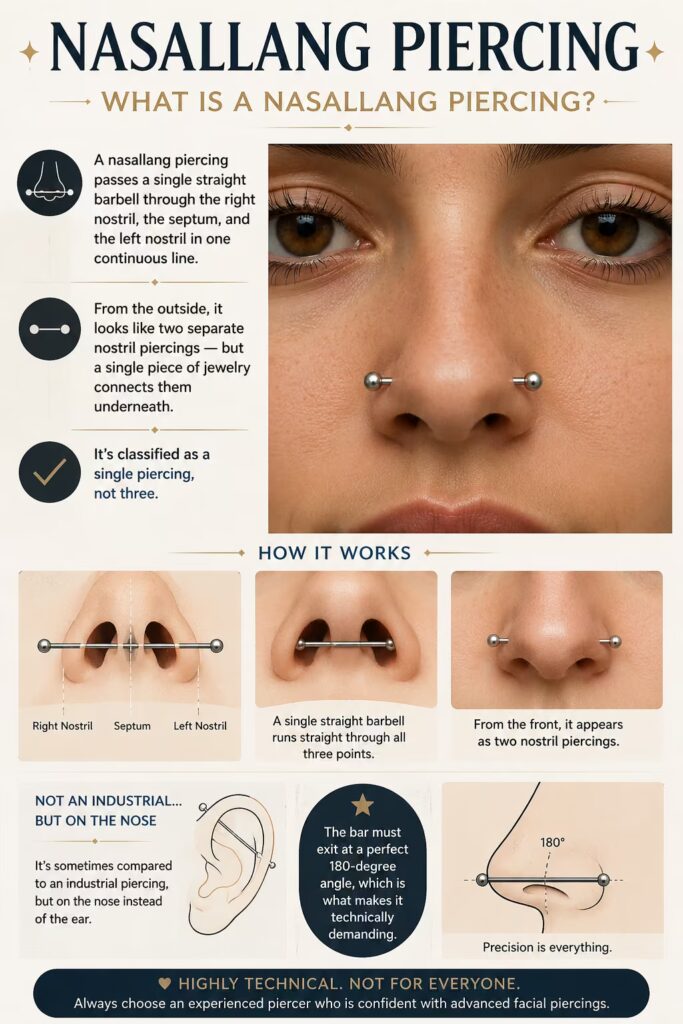
California piercer Cliff Cadaver pioneered the nasallang in the 1990s. The name itself is a reference to an analogous piercing done elsewhere on the body — a connection most people in the nose-piercing community are happy to skip over.
Anatomy Considerations
Not every nose is built for a nasallang piercing. Before agreeing to do one, a skilled piercer will assess:
- Nostril shape and width — the bar must pass through both nostrils at a symmetrical height.
- Septum position and thickness — a deviated septum or unusually thick cartilage can complicate placement or rule it out entirely.
- Nasal cartilage density — unlike a standard septum piercing, which passes through the softer “sweet spot” of tissue, a nasallang goes directly through cartilage on both sides.
If you already have separate nostril piercings and a septum piercing, they almost certainly cannot be connected into a nasallang later. The angles rarely align correctly.
Nasallang Piercing Pain Level
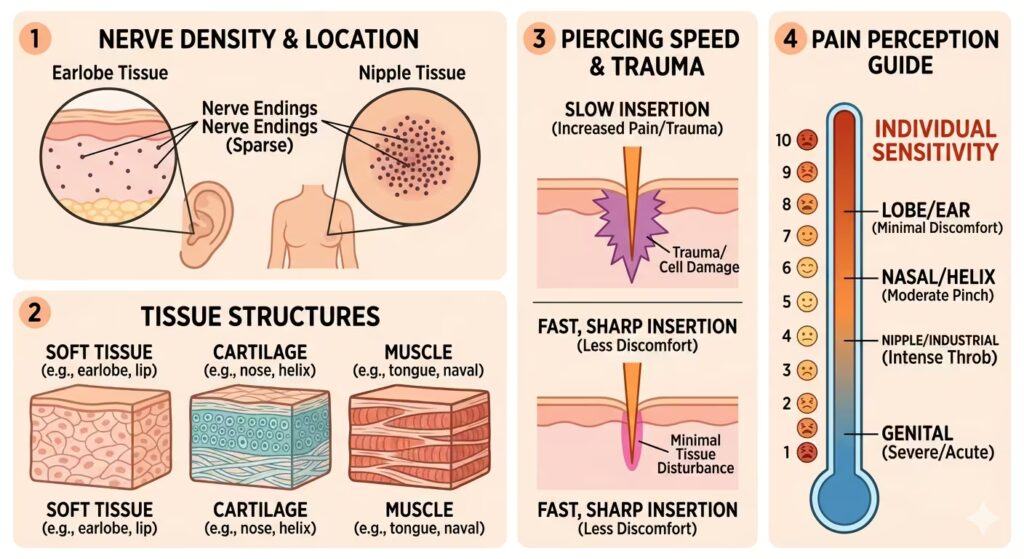
The nasallang piercing is consistently rated around 8 out of 10 on the pain scale by people who have multiple piercings. Several factors compound the intensity:
- The needle passes through three distinct tissue zones — cartilage on both sides and the nasal septum — in a single pass.
- The nasal septum portion does not go through the soft “sweet spot” the way a standalone septum piercing does.
- The larger gauge required (typically 16g) means a wider needle than most nose piercings use.
The pain is sharp and brief during the actual piercing. Soreness, tenderness, and swelling follow for days to weeks afterward. Most piercers recommend working up to this one rather than making it an early piercing.
Nasallang Piercing Healing Time
Expect 6 to 12 months for full healing. Some people settle closer to the lower end; others take longer, depending on anatomy, consistency of aftercare, and overall health.
Three cartilage points healing simultaneously is why recovery is extended compared to a standard nostril (2–4 months) or even a septum piercing (6–8 weeks). According to WebMD, cartilage piercings heal significantly more slowly than soft-tissue piercings because cartilage has a reduced blood supply, which slows cellular repair.
Swelling can be pronounced in the first 2–4 weeks. The initial jewelry will be sized longer to accommodate this — do not switch to a shorter bar until a piercer confirms the piercing is fully healed.
Nasallang Piercing Aftercare
Clean the piercing twice daily with sterile saline solution (0.9% sodium chloride). Spray directly onto both entry points and the septum area. Pat dry with a clean, disposable paper towel.
Avoid:
- Harsh cleansers, including rubbing alcohol, hydrogen peroxide, Hibiclens, and any alpha or beta hydroxy acids. Dermatologist Dr. Hadley King notes these kill the new cells migrating to heal the wound, extending the risk window for infection.
- Submerging the piercing in pools, lakes, or hot tubs during healing.
- Touching, twisting, or rotating the jewelry — this disrupts the healing tissue and can create irritation bumps.
- Sleeping directly on the piercing. Because a nasallang exists on both sides, any lateral pressure can cause migration or prolonged soreness.
- Changing jewelry before the piercing is fully healed.
Change pillowcases and face towels at least once weekly throughout the healing process. The nose is in constant contact with surfaces and airborne bacteria, so hygiene habits matter more here than with most piercings.
Nasallang Piercing Risks and Complications
Common risks:
- Infection — signs include increasing pain after the first week, fever, significant swelling, unusual discharge with an odor, and redness spreading beyond the piercing site. A localized infection may respond to an antibiotic ointment prescribed by a doctor; a more serious infection requires oral antibiotics.
- Irritation bumps — these form from physical trauma (bumping, snagging, sleeping pressure) and are not infections. They typically resolve with improved aftercare and reduced jewelry movement.
- Keloid scarring — thickened fibrous scar tissue that can form at the wound site. People with darker skin tones are at higher risk. A dermatologist can treat keloids if they develop.
- Rejection and migration — the body may push the barbell outward over time, particularly if the piercing was placed too shallow or the jewelry gauge is too thin.
- Prolonged swelling — extreme swelling can temporarily narrow the nasal passage. A warm compress or saline soak helps reduce this. If swelling is accompanied by fever or increasing pain, see a doctor.
Rare but serious:
- Necrosis (tissue death from disrupted circulation) and irreversible nerve damage are rare complications associated with improper placement. Choosing an experienced piercer dramatically reduces this risk.
- Swallowing dislodged jewelry can partially obstruct the airway if the jewelry components are small enough. Properly fitted, internally threaded or threadless jewelry with secured ends significantly reduces this risk.
Choosing a Piercer
The nasallang requires a piercer with documented experience performing it specifically. Asking to see a portfolio of completed, healed nasallangs — not just fresh ones — is reasonable and important.
Look for piercers certified by the Association of Professional Piercers (APP). APP members are required to follow standardized sterilization protocols and use implant-grade materials. An inexperienced piercer attempting a nasallang risks misalignment, uneven placement, or tissue damage that leads to complications during healing.
You may need to travel to access the right professional. That inconvenience is worth it for a piercing at this level of difficulty.
Nasallang Piercing Jewelry: Materials, Gauge, and Style
Starting jewelry is always a straight barbell sized longer than your anatomy requires, to account for initial swelling. Once healing is complete, return to your piercer for a shorter, better-fitted bar.
Recommended gauge: 16g (1.2mm) or 18g (1.0mm). Most piercers start with 16g to improve stability through cartilage. Going thinner than 18g increases the risk of rejection.
Material standards:
- Implant-grade titanium (ASTM F136) — the gold standard for initial piercings. Nickel-free, non-corrosive, hypoallergenic, and lightweight. It can be anodized to various colors without adding coatings that could irritate healing tissue.
- Implant-grade surgical steel (ASTM F138) — acceptable for most people, though it contains trace nickel. Not recommended for those with known nickel sensitivity.
- 14K or 18K solid gold — suitable for healed piercings or initial use if confirmed implant-grade. Avoid gold-plated or gold-filled options, as the plating degrades inside a piercing.
- Avoid acrylic, mystery metals, or any jewelry described only as “hypoallergenic” without a materials certification.
After full healing, some people switch to a nasallang chain — a decorative chain that runs across the nose between the two visible end points. These are an aesthetic option only for fully healed piercings, as chain movement can irritate unhealed tissue.
Nasallang vs. Double Nostril Piercing
The visual result of a nasallang piercing closely resembles bilateral nostril piercings. The differences are significant:
| Nasallang | Double Nostril | |
|---|---|---|
| Jewelry pieces | 1 | 2 |
| Passes through septum | Yes | No |
| Healing time | 6–12 months | 4–6 months |
| Pain level | 8/10 | 4–5/10 |
| Piercer skill required | Advanced | Standard |
| Can be separated later | No | N/A |
If the look appeals but the commitment doesn’t, bilateral nostril piercings are a legitimate and far less demanding alternative.
Nasallang Piercing FAQs
Does a nasallang piercing go through cartilage?
Yes. Both nostril entry points pass through the nasal cartilage. The septum portion also passes through tissue, but not the softer sweet spot used in standard septum piercings. This is the primary reason pain and healing time exceed those of other nose piercings.
Can I get a nasallang piercing if I already have a septum and nostril piercings?
Almost never. The existing piercings were likely made at angles that don’t align with the horizontal path a nasallang requires. Connecting them is not a viable option in most cases.
How long does the actual piercing take?
The needle passes through all three points in a single pass, which takes seconds. Setup, marking, and jewelry insertion add more time to the appointment, but the piercing moment itself is brief.
What gauge is used for a nasallang piercing?
Most piercers use 16g (1.2mm) for the initial piercing. Some use 18g (1.0mm). The correct gauge for your anatomy is best determined in-person by your piercer.
Can I blow my nose during healing?
Gently, yes. Forceful blowing puts pressure on healing tissue and can cause irritation or micro-tears at the entry points. Blot rather than blow when possible in the early weeks.
Is the nasallang piercing permanent?
No. If you remove the jewelry, the piercings will close over time. Fully healed piercings may leave small scars at the nostril entry points.
Why is it called a nasallang piercing?
The name references a similar piercing done elsewhere on the body — specifically, a type of transverse penile piercing. The nasal version was named by analogy when Cliff Cadaver introduced it in the 1990s.
How much does a nasallang cost?
Expect to pay $50–$100 for the piercing, with jewelry as a separate cost. Highly experienced piercers in major cities may charge more. Prioritizing skill over price is especially important for this piercing.